


🏛️Official — FIA
Loading OpenSourceSports…
Active aerodynamics: driver-operable wing-flap actuators (front + rear) — Z-mode for cornering downforce, X-mode for straight-line drag reduction; Ground-effect Venturi underfloor retained from 2022-onward regulations; DRS (Drag Reduction System) replaced by the active rear-wing element
Why people argue about this
People often assume that having driver-operable wing-flap actuators means they can be physically manipulated by the driver mid-race for on-the-fly adjustments, but in reality, these devices are pre-programmed to optimize aerodynamics based on the car's speed and position, so drivers cannot alter their settings during a race.
Composite chassis must pass FIA crash tests (front impact, side intrusion, rear impact, rollover); Power unit elements limited per season (penalties for exceeding allocation — covered in Sporting Regulations)
Why people argue about this
People often assume that composite chassis in F1 cars are just made of carbon fiber, which they believe is inherently strong and doesn't need crash tests. But actually, these materials can be tricky to predict their strength under impact, leading to debates about how thorough the crash testing must be for safety compliance.
1.6 L V6 turbocharged ICE retained; MGU-H removed; MGU-K output tripled; 50/50 ICE-to-electric split (target ~750 kW combined peak power); Energy deployment limits: 4 MJ per lap from MGU-K (up from 2 MJ)
Why people argue about this
People often assume that the tripled MGU-K output means a significant increase in top speed for F1 cars, which they mistakenly believe will lead to more overtaking opportunities. However, the actual impact of this rule is on managing energy recovery systems rather than raw performance, so it won't necessarily translate into faster lap times or easier passes.
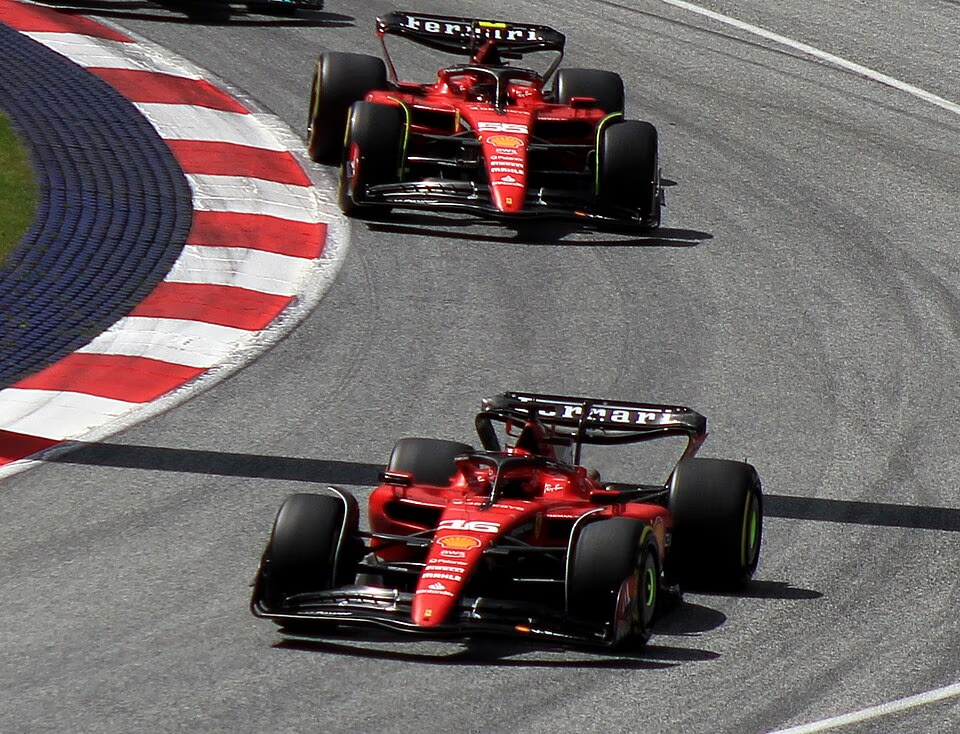
Chassis: single-seat open-cockpit monocoque with halo cockpit protection device; Minimum weight (car + driver, no fuel): 768 kg for 2026 (down from 798 kg); Maximum dimensions: 1900 mm wide (down from 2000 mm), 3400 mm wheelbase (down from 3600 mm), 950 mm overall height
Why people argue about this
People often assume that reducing chassis weight from 798 kg to 768 kg in F1 for 2026 will solely increase car speed, but actually, it's about optimizing aerodynamics and fuel efficiency within new sustainability mandates, leading to a more balanced approach to performance.
FIA Grade 1 circuits only (homologation required); 23+ circuits on the 2026 calendar; Pit lane speed limit: 80 km/h (race), enforced by car-side limiter; Track-edge kerbs, sausage kerbs, and run-off areas defined per circuit homologation
Why people argue about this
People often assume that the pit lane speed limit of 80 km/h applies universally across all circuits, forgetting that it's only enforced at Grade 1 circuits where Section 3 requires homologation for the playing area. They overlook the distinction between Grade 1 and other circuit types, leading to misunderstandings about which rules apply where.
10 constructor teams × 2 cars = 20 drivers on the 2026 grid; Each car: 1 driver, plus reserve driver entitlement per team; FIA officials enforce Technical Regulations: Technical Delegate, scrutineers, technical commissioners
Why people argue about this
People often assume that having a maximum of two drivers means teams can only use one car for races, which is incorrect. The real meaning here is that each team must have at least one driver in their grid, and they're allowed to designate up to two as the ones who start the race. Confusion arises because it's easy to misinterpret this as a limit on the number of cars per team rather than drivers.
1.6 L V6 turbocharged ICE retained; MGU-H removed; MGU-K output tripled; 50/50 ICE-to-electric split (target ~750 kW combined peak power); Energy deployment limits: 4 MJ per lap from MGU-K (up from 2 MJ)
Why people argue about this
People often assume that the new energy deployment limits in 2026 will solely dictate how much power a car can generate from its engine, but actually, they're more about setting specific boundaries on where and when energy recovery systems like MGUs can be used to maximize efficiency without compromising safety or fairness.
The Technical Regulations do not govern race scoring (handled by the Sporting Regulations: 25-18-15-12-10-8-6-4-2-1 for P1–P10, plus 1 bonus point for fastest lap in top 10). Technical scrutineering produces a binary pass/fail outcome — non-compliant cars are excluded from the session results.
Why people argue about this
People often assume that technical compliance is directly tied to race scoring in Formula 1, thinking that non-compliant cars are automatically disqualified from all results. However, the Technical Regulations only dictate which vehicles can participate in a session based on scrutineering outcomes; they don't affect how points are awarded or calculated once a car has passed inspection.
Failed scrutineering: car may be excluded from session/race results (e.g., underweight, plank wear excess, fuel sample non-conformance); Power unit allocation exceeded: grid penalties (10 places per additional element); Parc fermé violation: pit-lane start required
Why people argue about this
People often assume that a car failing scrutineering means it's automatically banned from the race outright, forgetting that its results might only be disqualified for that session if found non-compliant after inspection. They overlook the fact that cars can still compete in future sessions or races as long as they meet all technical regulations thereafter.
Mandatory halo cockpit protection (since 2018) — must pass 116 kN static load test. Carbon-fibre monocoque survival cell with anti-intrusion panels and impact-absorbing nose.
Why people argue about this
People often assume that the mandatory halo cockpit protection is solely for driver safety, forgetting that it's also designed to prevent debris from hitting them during high-speed crashes, thus reducing the risk of serious head injuries. They overlook the fact that this rule mandates a specific design and testing protocol to ensure its effectiveness in real-world scenarios.