


🏛️Official — FIBA
Loading OpenSourceSports…
Honor the check-in: give the defender a fair moment before attacking
After every made basket or dead ball, the offensive team must bring the ball to the arc and wait for a defender to physically touch it before attacking. Receiving the check and immediately launching a shot — technically legal — before the defender can contest is considered a serious breach of etiquette rooted in 3x3's pickup-ball origins.
Don't flop — flopping is antithetical to 3x3's identity
Exaggerated falls or theatrical reactions to minimal contact to draw foul calls are especially scorned in 3x3. Given the sport's streetball origins and its cultural emphasis on toughness and authenticity, flopping is viewed as a fundamental betrayal of the game's values — far more so than in 5-on-5 organized basketball.
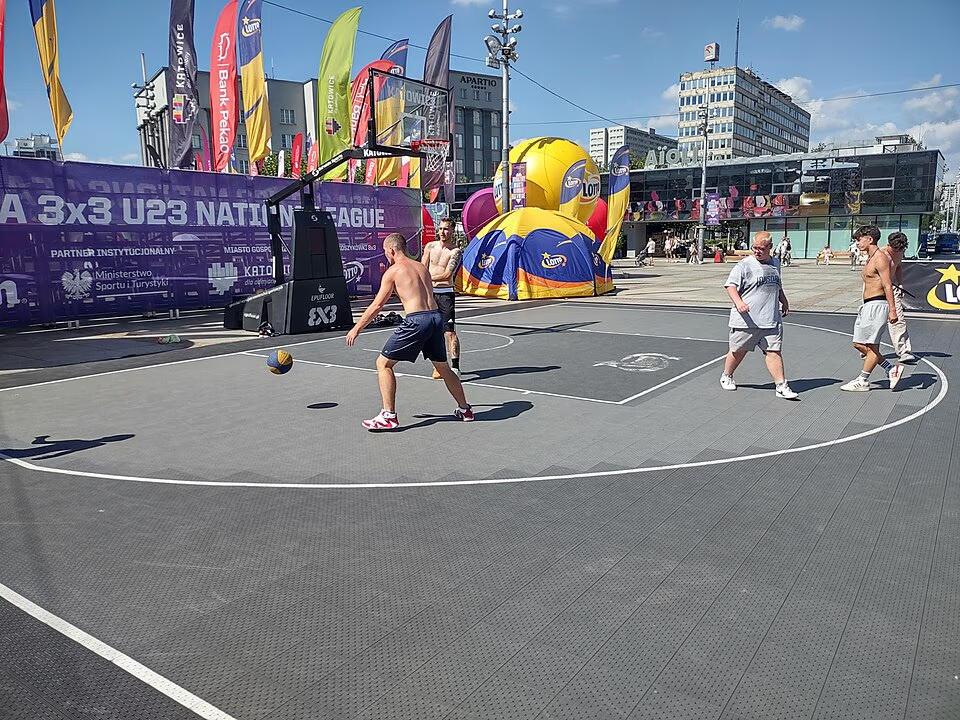
Single basket positioned at the end of the half-court; Standard basketball hoop: 18-inch (45.7 cm) diameter, 10 feet (3.05 m) high; Standard backboard: 6 feet wide × 3.5 feet high (1.83 m × 1.07 m)
Why people argue about this
People often assume that the grooved grip pattern on the 3x3 basketball ball is there purely for aesthetic reasons, but actually it's designed to make the ball more durable and easier to hold in players' hands during quick dribbling movements, which is crucial in such a fast-paced game.
The check-ball restart area is the top of the arc at the half-court line opposite the basket. After a made basket and on out-of-bounds restarts in specific scenarios, the offensive team takes the ball at the check-ball spot and passes it to a defe...
Why people argue about this
People often assume that the check-ball area is at half-court, which leads them to misplace their feet when taking a shot from there. In reality, it's actually located right above the half-court line, opposite the basket, where players must be careful not to step on or over the line for a legal pass and restart.
At the start of the game and after dead balls in specific scenarios, the offensive team starts at the check-ball area at the top of the arc. The ball is passed from offense to defense, then back from defense to offense ("checked"), and play resumes.
Why people argue about this
People often assume that players have to pass the ball directly from offense to defense before it can be checked back to offense, but actually, they can check the ball at any point during the sequence, as long as both teams are involved in the passing exchange. This rule's flexibility leads to misunderstandings about when and how checking occurs.
If the offensive team (after a defensive rebound or steal) attempts a shot or scores without first clearing the ball outside the 3-point arc, the basket does not count and the defensive team gains possession at the check-ball area.
Why people argue about this
People think that if they score without clearing outside the 3-point arc, it's just a missed shot, but in reality, it’s considered a clear violation where the other team gets possession right away at the check-ball area, which can be a significant difference in momentum and scoring opportunities.
3x3 is unique among FIBA disciplines in that coaches are not permitted on the bench during play in standard FIBA 3x3 competition — the players themselves manage strategy, substitutions, and timeout...
Why people argue about this
People often assume that coaches are allowed on the bench in 3x3 basketball simply because they're accustomed to seeing them in other formats like full-court 5-on-5 games. The confusion arises because FIBA's standard for 3x3 specifically prohibits coaches from being present during play, focusing instead on player management and strategy as dictated by the players themselves.
FIBA follows the IOC consensus on concussion in sport: any player with a suspected concussion is removed from play and is subject to a graduated return-to-play assessment before being cleared for subsequent competition. Match-day diagnosis is the ...
Why people argue about this
People often assume that the concussion protocol in 3x3 basketball is only about diagnosing concussions on the spot during a match, but actually it's about ensuring players are cleared for subsequent games through a comprehensive return-to-play process after any suspected head injury, regardless of when during play it occurs.
Single half-court, 15 m wide × 11 m long (approximately 49 ft × 36 ft); One basket at the end opposite the check-ball restart area; 3-point arc at 6.75 m from the basket (matches FIBA 5-on-5)
Why people argue about this
People often think that the check-ball spot is just a random point near half-court, but actually it's precisely at the top of the arc opposite the basket, which can lead to confusion about where exactly it is located and how far players need to pass from there.
Outdoor surfaces: synthetic 3x3 court tiles, asphalt, or concrete; Indoor surfaces: hardwood or synthetic sport floor; FIBA-approved 3x3 World Tour events typically use pop-up synthetic flooring on a flat outdoor surface in city-center venues
Why people argue about this
People often assume that the check-ball spot is just a random point anywhere on half-court line, but in reality, it's specifically at the top of the arc where you'd draw a free throw line - this precise location ensures fair play and minimizes confusion about which area to use for restarts.
1 point for a field goal made from inside the 6.75 m arc (a "deuce" worth 1 in 3x3, distinct from the 2-point deuce in 5-on-5); 2 points for a field goal made from beyond the 6.75 m arc (a "trey" worth 2 in 3x3, distinct from the 3-point trey in 5-on-5); The 1/2 scoring scale is the most distinct...
Why people argue about this
People often assume that free throws in 3x3 basketball are worth 2 points instead of 1, which stems from their familiarity with standard 5-on-5 basketball where each free throw counts as 2 points. But FIBA's official rule for 3x3 is to make it simple and consistent with the rest of the game by awarding 1 point per successful free throw.
Each successful free throw is worth 1 point.
Why people argue about this
People often assume that free throws in 3x3 basketball are worth more than just one point, thinking they might be worth two like in traditional basketball, but actually, each successful free throw is always worth exactly one point. The confusion arises because the scoring system seems simple at first glance, yet its consistency can lead to misunderstandings when watching games.
Personal fouls in the act of shooting: free throws are awarded as in 5-on-5 basketball; Free throw outside the arc: 2 free throws; Free throw inside the arc: 1 free throw
Why people argue about this
People often assume that free throws in 3x3 Basketball are like regular free throws where they stop the clock regardless of outcome, but actually, it's until a team scores or fouls occur - meaning if no score is made and no foul happens during those attempts, the clock doesn't stop.
10-minute game clock from the first check-ball start; the clock runs continuously and stops only on referee-signaled stoppages; The clock stops on free throws, fouls being administered, timeouts, and stoppages for injury; If neither team has reached 21 points when the clock expires, the team with...
Why people argue about this
People often think that if it goes into overtime in a 3x3 basketball game tied at 20-20, every single play will be played out until someone scores two points to break the tie. But actually, there's no overtime clock; once overtime starts, teams can take their time between shots and even rest, making each point potentially more valuable as it comes from a longer sequence of events.
The game starts with a coin toss to determine which team gets first possession (no jump ball). The team winning the toss may choose to start with the ball or to start on defense.
Why people argue about this
People often assume that choosing first possession means they get to shoot from the free-throw line on their very first shot, which isn't true in 3x3 basketball as per FIBA rules; instead, it's about deciding whether to start with the ball or defense, and who gets to jump for the tip-off.
WBGT-based heat thresholds for play modifications and postponement in outdoor events; Lightning detection halts outdoor activity; play resumes only after the all-clear interval has elapsed; High wind affecting ball trajectory may delay play in outdoor competitions; the decision is at the discreti...
Why people argue about this
People think they can ignore surface temperature checks if it's just a bit hot outside, but actually, the rule requires thorough inspections before play begins to ensure safety from heat absorption risks like melted rubber or asphalt that could cause injuries.
The team that reaches 21 points first wins, regardless of remaining time; If neither team reaches 21 before the 10-minute clock expires, the team with more points at the end of regulation wins; If the game is tied at the end of regulation, untimed overtime is played to "first team to score 2 points"
Why people argue about this
People often assume that in FIBA 3x3 World Tour events, if a match ends in a tie after regulation time, they automatically go straight into overtime without any tiebreaker system, which leads to confusion about how exactly ties are resolved during pool play stages. Actually, the rule specifies a clear process for tiebreakers during these initial group stage matches.
FIBA 3x3 World Tour and World Cup events have on-site medical staff including physicians and EMTs; Emergency action plans cover on-field cardiac, head/neck, orthopedic, and heat-related emergencies; Defibrillators (AEDs) are positioned at every FIBA-sanctioned 3x3 venue
Why people argue about this
People often assume that since medical coverage isn't explicitly detailed in FIBA's 3x3 Basketball rules, it must be non-existent or handled differently from other sports. But actually, it means there are no specific protocols or requirements outlined for how injuries should be managed on the court, leaving teams and officials to decide their own procedures without official guidance.
One or two on-court referees; Scorer/timekeeper at the table; Shot-clock operator
Why people argue about this
People often assume that coaches are banned from the bench purely for safety reasons due to FIBA 3x3's smaller court size, but actually, it's designed to encourage more player involvement in strategy and decision-making, which is seen as a key aspect of the game’s fast-paced nature.
Whistle for each referee; 12-second shot clock display visible to players; 10-minute game clock
Why people argue about this
People often assume that using FIBA-approved 3x3 balls is just a preference for aesthetics, when in fact it's crucial for maintaining consistent gameplay conditions across all competitions, ensuring fair play by having standardized ball properties like bounce and weight.
Traveling: same standard as 5-on-5 basketball; loss of possession; Double dribble: same standard as 5-on-5; loss of possession; Out of bounds: ball awarded to opposing team at check-ball area
Why people argue about this
People often assume that if a team commits an Other Violation within 12 seconds after a defensive Clearing violation, possession is always awarded back to them, which leads to confusion because it actually varies based on whether they shoot or not; if they do, it goes to the other team, but if they don't have time to shoot and instead check-ball at the area, possession remains with their team.
3x3 is often contested outdoors on asphalt, concrete, or synthetic tiles; surface inspection prior to play is the responsibility of the event organizer; Heat absorption by dark surfaces in summer competition requires hydration management and, in extreme conditions, surface-temperature monitoring;...
Why people argue about this
People often assume that the removal of a player with a suspected concussion in 3x3 basketball is solely based on match-day diagnosis by the referees, but actually, it's part of a broader graduated return-to-play protocol overseen by medical professionals to ensure safety and prevent long-term effects from concussions.
If the game is tied at the end of regulation (neither team reached 21 before time expired and both have equal points), untimed overtime is played: the first team to score 2 points in overtime wins. There is no overtime clock; play continues from t...
Why people argue about this
People often assume that if it goes into untimed overtime and neither team scores in a set of 2-point attempts, they would have to continue trying until one does score. But actually, once no points are scored after two attempts, the game is won by the other team instantly, as per FIBA's rule for this specific scenario in 3x3 basketball.
3x3 is a high-intensity, short-duration game — a typical 10-minute game can deliver a higher heart-rate load than a 5-on-5 game. Players are responsible for warming up adequately, managing hydratio...
Why people argue about this
People often assume that if a player is removed for suspected concussion during a 3x3 basketball game, they are automatically out of that match. Actually, players who are removed due to a suspected concussion must undergo a graduated return-to-play assessment and can only be cleared by medical professionals before returning to competition, whether it's the same or another match in the tournament.
Personal fouls in 3x3 are tracked at the team level (not per-player); Up to 6 team fouls per game are non-bonus fouls; Starting with the team's 7th, 8th, and 9th team foul, the opposing team shoots 2 free throws
Why people argue about this
People often assume that failing to shoot within 12 seconds means an automatic turnover, which they see as too harsh a penalty for missed opportunities. In reality, it's designed to keep the game moving by penalizing teams that don't capitalize on their scoring chances quickly enough, avoiding prolonged possessions and potential delays.
Team uniform with each player wearing the same color top; Numbered jerseys (numbers 1-99); numbering must be distinct within the team; Shorts
Why people argue about this
People often assume that the material requirement for player apparel is solely about durability against ball contact, forgetting that it must also be suitable for all outdoor surfaces like asphalt and concrete. They overlook how the fabric could affect traction or slip resistance on these hard surfaces, leading to misunderstandings about what exactly constitutes "suitable.
After a made basket, the defending team becomes the offensive team and takes the ball at the check-ball area; no inbound pass required — the new offensive team can immediately begin the offensive sequence after the ball is taken behind the arc; After a defensive rebound, the rebounding team must ...
Why people argue about this
People often assume that possession is immediately transferred from defense to offense after a dead ball simply by passing the ball, forgetting about the "checked" part of the process. This confusion arises because they overlook the entire "check-ball" sequence required before play can resume.
Size 6 (28.5 inches / 72.4 cm circumference) — sized between a women's 5-on-5 ball and a men's 5-on-5 ball; Weight equivalent to a men's 5-on-5 basketball (approximately 580-620 g); FIBA-approved 3x3 ball with grooved grip pattern designed for outdoor use
Why people argue about this
People often assume that any basketball can be used in 3x3 games, forgetting about FIBA's strict approval for the smaller, lighter balls designed specifically for 3x3. The confusion arises because they don't realize that only officially approved balls meet the exact specifications for this fast-paced format and ensure fair play.
The check-ball restart area is the top of the arc at the half-court line opposite the basket. After a made basket and on out-of-bounds restarts in specific scenarios, the offensive team takes the ball at the check-ball spot and passes it to a defe...
Why people argue about this
People often assume that the check-ball spot is just a few feet away from where they made their basket, which leads them to rush over too quickly and potentially foul or get called for interference. Actually, it's positioned at the top of the half-court line directly opposite the basket, requiring players to take their time approaching this area with caution.
3x3 is unique among FIBA disciplines in that coaches are not permitted on the bench during play in standard FIBA 3x3 competition — the players themselves manage strategy, substitutions, and timeout...
Why people argue about this
People often assume that coaches are allowed on the bench in 3x3 basketball simply because they're common in other FIBA disciplines like full-court 5-on-5. The confusion arises specifically because of this rule's uniqueness, making it harder for some to grasp why coaches aren't permitted on the sidelines during play.
If the game is tied at the end of regulation (neither team reached 21 before time expired and both have equal points), untimed overtime is played: the first team to score 2 points in overtime wins. There is no overtime clock; play continues from t...
Why people argue about this
People often assume that in 1-on-1 overtime, the first team to score any point wins, which leads to misunderstandings about how quickly a game can end. Actually, they overlook the requirement of scoring at least 2 points for a win, keeping them from realizing it could take multiple possessions before determining a winner.
Each successful free throw is worth 1 point.
Why people argue about this
People often assume that free throws in 3x3 basketball are worth two points instead of one, misunderstanding a key part of scoring rules that FIBA clearly states each successful free throw is worth just 1 point. This confusion stems from the simplicity and prevalence of two-point free throws in other forms of basketball, leading to misinterpretation when seeing them as one-pointers.
If the offensive team fails to attempt a rim-contacting shot within 12 seconds, the defensive team gains possession at the check-ball area.
Why people argue about this
People often assume that if they don't shoot within 12 seconds, their opponents automatically get a free throw instead of possession. But actually, it's about gaining possession at the check-ball area, which is different and more strategic - like being able to start a new play from halfway court rather than having to jump out of bounds.
FIBA follows the IOC consensus on concussion in sport: any player with a suspected concussion is removed from play and is subject to a graduated return-to-play assessment before being cleared for subsequent competition. Match-day diagnosis is the ...
Why people argue about this
People often assume that a player removed for suspected concussion is simply pulled from the game until they're cleared by coaches on the sidelines, but actually, FIBA requires a more thorough medical assessment involving doctors outside of the match to ensure no lingering effects before returning them to play safely.
12-second shot clock — the offensive team must attempt a shot within 12 seconds of gaining possession; A shot must hit the rim to satisfy the shot clock; an air ball that misses the rim entirely is a shot clock violation; The shot clock resets on a change of possession and on offensive rebounds
Why people argue about this
People often assume that checking the ball means dribbling it back after a pass, which leads to misunderstandings about how quickly play can resume. The actual process involves passing from offense to defense, then having the defensive team check by passing or bouncing the ball back to the offensive team without dribbling, allowing for quicker transitions and game flow.
If the offensive team fails to attempt a rim-contacting shot within 12 seconds, the defensive team gains possession at the check-ball area.
Why people argue about this
People often assume that missing a shot automatically gives possession to the other team, which isn't quite correct. They misunderstand that it only applies if they fail to shoot within 12 seconds after gaining control of the ball; otherwise, it's just a violation without changing possession.
Each team has a roster of 4 players total; 3 players on the court at any time; 1 substitute available throughout the game
Why people argue about this
People often assume that coaches are banned from the bench in 3x3 basketball solely due to time constraints, thinking it's a way to save on coaching staff costs. However, the real reason is rooted in ensuring fair play: allowing coaches access could lead to strategic advantages not available to all teams, undermining the game’s competitive integrity and spirit.
Technical foul: 1 free throw + possession to the offended team. A player charged with two technical fouls is disqualified from the game; Unsporting foul: 2 free throws + possession. A second unsporting foul is a disqualifying foul; Disqualifying foul: 2 free throws + possession + disqualification...
Why people argue about this
People think that in 3x3 basketball, players get disqualified for accumulating too many personal fouls like they do in traditional 5-on-5 games, but actually, only team-level infractions apply with free throws instead of disqualification to keep the game moving quickly and avoid long stoppages.
Size 6 (28.5 inches / 72.4 cm circumference) — sized between a women's 5-on-5 ball and a men's 5-on-5 ball; Weight equivalent to a men's 5-on-5 basketball (approximately 580-620 g); FIBA-approved 3x3 ball with grooved grip pattern designed for outdoor use
Why people argue about this
People often assume that the ball's circumference is exactly 28.5 inches based on FIBA's official description, but they overlook the fact that it can vary within a range of just half an inch—between 28 and 29 inches. This precision issue leads to misunderstandings about how much larger or smaller the ball might be in practice compared to what’s stated.
Each team has one 30-second timeout per game; Timeouts are called by the players on the court (since coaches are not permitted to direct from the bench); The clock stops during the timeout
Why people argue about this
People often assume that timeouts in 3x3 Basketball are shorter than they actually are, thinking a maximum of 30 seconds means exactly 30 seconds every single time, when in fact, it's a guideline and can vary based on game flow and the referee’s discretion to ensure fair play.
FIBA 3x3 World Tour and World Cup events use bracket-format tournaments with pool play / group stages followed by single-elimination knock-out rounds. Tiebreakers in pool play (when multiple teams ...
Why people argue about this
People often assume that in FIBA 3x3 tournaments, tiebreakers are only used for deciding which teams advance from pool play, but actually, they can be employed throughout all stages to resolve score ties and ensure fair competition, leading to confusion about their application across different rounds.