


🏛️Official — NCAA
Loading OpenSourceSports…
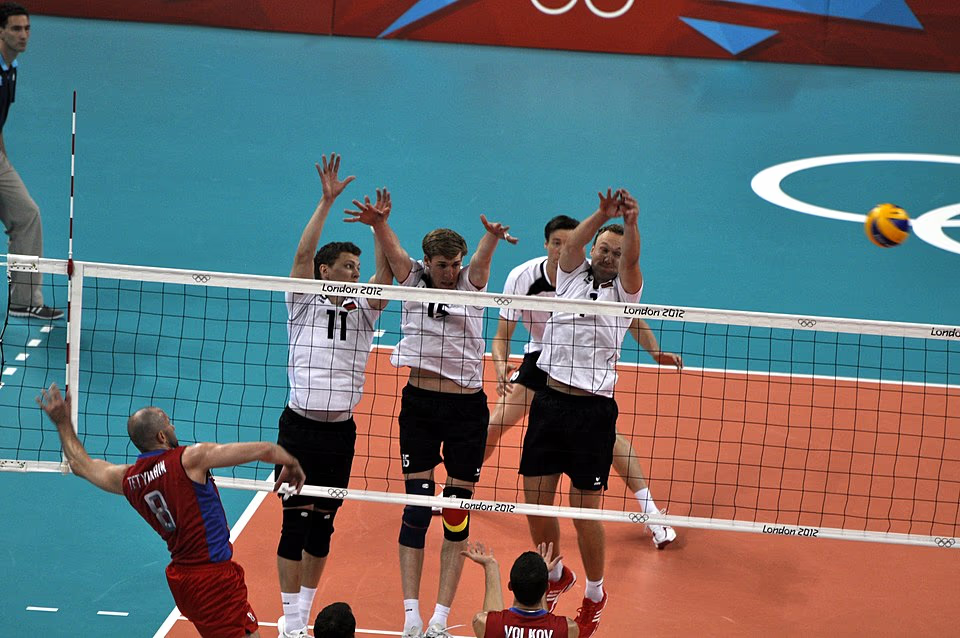
Ball: spherical, leather/synthetic, 65-67 cm circumference, 260-280 g, FIVB/Molten approved; Net: 2.43 m height (men's standard, vs 2.24 m women's), 1m × 9.5-10 m; Antennas marking the legal crossing zone
Why people argue about this
People often assume that all volleyball balls are exactly 65-67 cm in circumference, forgetting that there's a slight tolerance allowed by FIVB. This leads to arguments about whether a ball is officially legal or not, despite the rule clearly stating it must be within those dimensions.
Court: 18 m × 9 m, divided by center line into 9 m × 9 m halves; Attack line: 3 m from center line on each side; Service zone: behind end line, full court width
Why people argue about this
People often assume that the center line in NCAA Men's volleyball divides the court into four equal quadrants, which leads to arguments about where players can be positioned or how much of the court each team controls. Actually, the center line only separates the court into two halves, and teams are free to occupy as much space within their respective halves as they see fit during play.
6 players on court per team; roster 12-18 D1; one or two designated liberos; Libero: defensive specialist, contrasting jersey, plays only back row, may replace any back-row player without counting against substitution limit; Substitutions: up to 15 per set (NCAA framework); substituted players ma...
Why people argue about this
People often assume that libero status is solely determined by jersey color, forgetting that it must be designated as such in official records, leading to mix-ups during games where players switch jerseys or teams have different contrasting colors for their liberos.
Best of 5 sets; Sets 1-4: rally scoring to 25 points, must win by 2 (no upper cap); Set 5 (decider): rally scoring to 15 points, must win by 2
Why people argue about this
People often assume that in NCAA Men's Volleyball, a set can end as quickly as 15-10 if one team reaches 15 points first, leading to confusion about when the rally scoring system actually kicks in and why it applies differently for sets 1 through 4 versus set 5.
Rally scoring: point on every rally regardless of who served; Sets 1-4 to 25 (win by 2); set 5 to 15 (win by 2); match won by first to 3 sets; Per-quarter team-foul reset framework matches NCAA Women's Volleyball
Why people argue about this
People often assume that winning by just 2 points is too easy for a team to achieve, so they argue it's unfair. Actually, the key fact emphasizes the importance of controlling the game flow rather than the margin of victory, making it clear that outlasting opponents in terms of sets won is what truly matters here.
Faults causing loss of rally: ball out, four contacts, double contact (controlled), catch/throw, hand-setting violation, net touch, antenna contact, foot fault on serve, illegal server (out of rotation); Center-line fault (updated): completely crossing the center line with a foot or feet is a fau...
Why people argue about this
People often argue that a ball hitting the net is always considered a fault, forgetting that it's only a fault if it goes out of bounds or touches an opponent. They overlook the fact that faults like four contacts and ball out are clearly defined under Section 7, while misconduct penalties are more ambiguous, leading to misinterpretation and debate.
Concussion protocol: removal + graduated return-to-play assessment. Court surface and post padding inspected pre-match.
Why people argue about this
People often assume that just inspecting court surfaces and padding before a match is enough to prevent concussions in volleyball, which leads them to misunderstand the true intent of the rule. However, Y actually means this inspection is part of a broader concussion protocol designed for safety during play, not solely as a pre-match check.