



Section 1: Introduction
Thoroughbred racing in the United States is governed at the national level by the Horseracing Integrity and Safety Authority (HISA), a private, independent, self-regulatory organization created by the federal Horseracing Integrity and Safety Act of 2020. HISA develops and enforces a uniform set of rules for Thoroughbred racing, replacing the patchwork of separate rules previously maintained by each state's racing commission. HISA's rulemaking is overseen and approved by the Federal Trade Commission (FTC), which gives the rules the force of federal regulation.
HISA's authority is exercised through two national programs. The Racetrack Safety Program took effect on July 1, 2022, and covers training and racing safety standards, surface maintenance, veterinary oversight, and injury reporting. The Anti-Doping and Medication Control (ADMC) Program took effect on May 22, 2023, and establishes uniform medication rules, testing, and enforcement. ADMC results management and adjudication are administered by the Horseracing Integrity and Welfare Unit (HIWU), an independent agency that conducts sample collection, laboratory testing, investigations, and the prosecution of violations.
HISA rules apply to all Thoroughbred "covered horses," "covered persons" (owners, trainers, jockeys, veterinarians, and others licensed to participate), and "covered races" run at registered racetracks in the United States. Individual state racing commissions retain a role in licensing and in setting "conditions of racing" specific to each meet, but state rules may not conflict with HISA's national standards. Each racetrack also publishes its own house rules and a "condition book" describing the races offered during a meet.
The sport's calendar is anchored by the spring Classics for three-year-olds, collectively known as the Triple Crown: the Kentucky Derby at Churchill Downs (first Saturday in May), the Preakness Stakes at Pimlico (two weeks later), and the Belmont Stakes (three weeks after the Preakness). A horse that wins all three in a single season is a Triple Crown champion — a feat achieved only thirteen times in history. Thoroughbred racing also includes year-round programs of claiming, allowance, handicap, and stakes races at tracks across the country, culminating in the Breeders' Cup championships each autumn.
Section 2: Equipment
Jockey Safety Equipment
Under the HISA Racetrack Safety Program, every rider — in races and during training — must wear approved protective equipment that meets recognized safety standards:
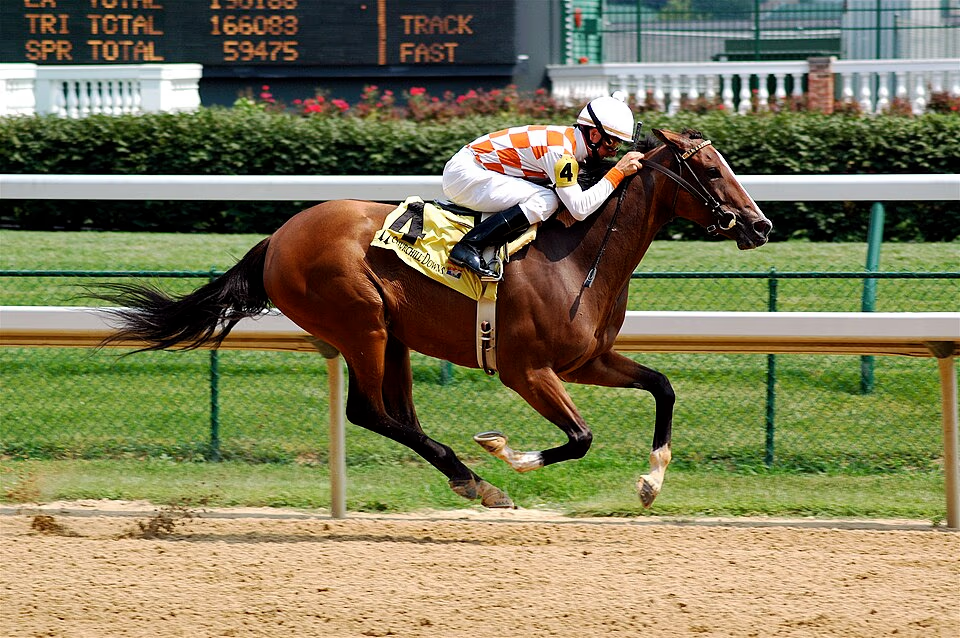
- Safety helmet: A securely fastened helmet meeting an approved equestrian standard (such as ASTM F1163 or an equivalent international standard) is mandatory at all times when mounted. Helmets that have sustained a significant impact must be removed from service.
- Safety vest (body protector): An approved safety vest meeting a recognized standard must be worn during racing and training. The vest is designed to absorb impact and protect the torso in a fall.
- Boots and attire: Riding boots, breeches, and racing silks. Silks identify the horse's ownership and are registered with the racing office.
- Goggles: Multiple stacked goggles are worn so that a rider can pull down a soiled lens and continue with a clean one during a race run over dirt.
The Riding Crop
HISA enforces a uniform national riding-crop rule that limits both the design of the crop and how it may be used:
- Approved design: Only a HISA-compliant crop may be carried. The crop must be padded (shock-absorbing), within prescribed length and weight limits, and free of any feature that could injure the horse.
- Permitted use: The crop may be used a limited number of times in a race. HISA's standard limits a rider to no more than six strikes during a race, with no more than two strikes in succession before giving the horse a chance to respond.
- Manner of use: The crop may only be used in the backhand or forehand position for encouragement and correction, never on the head, and never when the horse is clearly out of the race, has obtained its maximum placing, is showing no response, or is past the finish.
Tack and Saddlery
- Racing saddle: An extremely lightweight saddle (often under 2 lb) is used so that the combined weight of rider and equipment can be brought up to the assigned weight with lead pads carried in the saddle's weight cloth.
- Bridle, bit, and reins: Standard racing bridle with an approved bit. Equipment changes such as blinkers, tongue ties, shadow rolls, and nasal strips must be reported to the racing office and are recorded in the program.
- Girth and overgirth: A girth plus a secondary overgirth secure the saddle for the demands of racing speed.
- Horseshoes: HISA's Racetrack Safety rules regulate shoeing. Traction devices such as toe grabs above a specified height, bends, jar caulks, and stickers are prohibited on the front shoes of horses racing or training on dirt surfaces, because they are associated with increased injury risk.
- Bandages and boots: Leg bandages and protective boots are permitted within HISA limits and, where they may affect identification or soundness assessment, are subject to inspection.
Horse Identification
- Foal registration: Every Thoroughbred is registered at birth with The Jockey Club, which maintains the breed registry and assigns the horse's registered name and pedigree.
- Microchip: Horses are implanted with a microchip that is scanned to confirm identity in the paddock and at sample collection. The microchip number is recorded in the horse's records.
- Registration with HISA: Covered horses, and the covered persons responsible for them, must be registered in the HISA portal before they are eligible to race or train at a registered track.
- Lip tattoo / digital identification: Older horses may carry a lip tattoo; identification is increasingly handled by microchip and digital records that link to the horse's registration papers.
Section 3: Playing Area
The Racetrack
Thoroughbred races are run on an oval racing surface. Most North American tracks have a main dirt oval with one or more turf (grass) courses inside it; some tracks use a synthetic all-weather surface. Track ovals commonly measure one mile or less around, although configurations vary by venue.
- Surfaces: Dirt, turf, and synthetic surfaces each ride differently and are maintained to HISA Racetrack Safety standards for composition, depth, moisture, and consistency.
- The rail: The inside rail defines the inner boundary of the course. Temporary turf rails are moved between race days to vary the wear and present fresh ground.
- The homestretch: The straight section from the final turn to the finish line, where most races are decided.
- Chutes: Straight extensions off the oval that allow certain distances to begin with a longer run before the first turn.
Distances and Markings
- Furlongs: Race distances are measured in furlongs; one furlong equals one-eighth of a mile (220 yards / about 201 meters). Sprints are typically 4½ to 7 furlongs; routes are a mile or longer.
- Distance poles: Colored poles around the track mark the distance remaining to the finish (for example, the quarter pole marks two furlongs out, the eighth pole one furlong out).
- The finish line (wire): The finish is marked by the "wire." A horse's nose at the wire determines the order of finish.
The Starting Gate
- Races begin from a mechanical starting gate with numbered, padded stalls. All stalls open simultaneously when the starter presses the release.
- Each horse is loaded with assistance from the gate crew. Horses must be approved by the starter — demonstrating they will load and break safely — before they are eligible to race.
- The gate is positioned at the start of the listed distance so that the race is run over an exact, measured course to the wire.
Track Facilities
- Paddock: The enclosure where horses are saddled and paraded before each race under the supervision of the paddock judge.
- Winner's circle: The area where the winning connections are photographed after the race is declared official.
- Backstretch / stable area: The training and stabling complex, access to which is controlled and licensed.
- Test barn: The secure facility where horses are taken for post-race sample collection under HIWU and racetrack supervision.
Section 4: Players/Officials
Covered Persons
HISA rules govern every licensed participant connected to a covered horse. The principal participants are:
- Jockey: The licensed rider. Jockeys ride at an assigned weight, must be licensed by the relevant state commission and registered with HISA, and are subject to HISA's riding, crop, and safety rules. An apprentice ("bug") jockey receives a weight allowance for a defined period or number of wins while gaining experience.
- Trainer: The licensed person responsible for the horse's conditioning, entries, and care. The trainer is the "absolute insurer" of the horse's condition under longstanding racing principles, and bears primary responsibility for medication and treatment records.
- Owner: The person or entity that owns the horse and races under registered silks. Owners must be licensed and, as covered persons, are bound by HISA rules.
- Veterinarian: Treating veterinarians must be registered, may only administer permitted treatments within HISA timing rules, and must maintain treatment records. Regulatory veterinarians employed by the racetrack or commission examine horses independently.
Racing Officials
- Stewards: A panel of (typically three) stewards is the on-track judicial authority for a race meet. Stewards supervise the running of races, review inquiries and objections, rule on disqualifications, issue rulings and penalties for on-track infractions, and approve the official order of finish.
- Starter: Responsible for a fair start. The starter approves horses to use the gate, loads the field, and releases the gate.
- Clerk of scales: Verifies that each jockey weighs out before the race and weighs in afterward at the assigned weight, ensuring weight rules are met.
- Paddock judge: Supervises saddling, equipment changes, and the timely movement of horses from paddock to post.
- Placing judges: Determine the order of finish, assisted by the photo-finish camera.
- Patrol judges / video review: Observe the race from multiple vantage points and provide film to the stewards for review of interference.
- Racing veterinarian: Conducts pre-race examinations, maintains the veterinarians' list, and may scratch a horse deemed unfit to race.
- Outriders: Mounted officials who escort horses to the post, catch loose horses, and maintain safety on the track.
- Valets: Assist jockeys with equipment and ensure the correct weight is carried.
Regulatory Bodies
- HISA: Writes and enforces the national Racetrack Safety and ADMC rules, subject to FTC approval.
- HIWU (Horseracing Integrity and Welfare Unit): Administers the ADMC Program — education, sample collection, laboratory testing, investigations, results management, and prosecution of medication violations.
- State racing commissions: License participants and set meet-specific conditions of racing that do not conflict with HISA rules.
- The Jockey Club: Maintains the Thoroughbred breed registry (foal registration, naming, and pedigree records).
Section 5: Rules of Play
Race Conditions and the Condition Book
Each racetrack publishes a condition book describing the races offered during a meet. Every race has "conditions" that define eligibility — distance, surface, age, sex, and class restrictions, plus the weights to be carried and any allowances. Common race types include:
- Maiden races: For horses that have never won a race.
- Claiming races: Every horse is entered for a stated claiming price and may be purchased ("claimed") by an eligible licensed party before the race; this class system keeps fields competitive.
- Allowance races: Non-claiming races whose conditions grant weight allowances based on a horse's recent record.
- Handicap races: The racing secretary assigns weights intended to equalize the field's chances.
- Stakes races: The highest class, with graded stakes (Grade 1, 2, 3) representing the most prestigious events. The Kentucky Derby, Preakness, and Belmont are Grade 1 stakes.
Entries, Scratches, and the Draw
- Entries: Trainers enter eligible horses by the entry deadline. If a race draws more entries than the field limit, an "also-eligible" list is created.
- Post-position draw: Post positions are drawn at random in the presence of officials, fixing each horse's starting stall.
- Scratches: A horse may be withdrawn ("scratched") before the race for soundness, eligibility, or other reasons; the racing veterinarian may scratch a horse found unfit on examination.
- Workout requirements: Horses returning from a layoff, or those new to the gate, must record published official workouts and meet HISA requirements before they are eligible to race.
Weights and Allowances
- Each horse is assigned a weight to carry (rider plus equipment plus lead). Weight is the central handicapping lever in racing.
- Weight allowances reduce the assigned weight — for example, an apprentice-jockey allowance, or a sex allowance for fillies and mares running against males.
- The clerk of scales confirms the correct weight at weigh-out and weigh-in. Carrying materially more or less than the assigned weight can result in disqualification.
Running of the Race
- The start: When the starter is satisfied the field is loaded and standing fair, the gate is released and timing begins.
- Right of way and lanes: A horse in front may not be ridden across the path of, or interfere with, a horse it has not cleared. A jockey must maintain a straight course in the stretch unless clear, and may not cause a horse to "shift in" or "shift out" so as to impede a rival.
- Holding the line: Jockeys must make every reasonable effort to give their horse a full opportunity to win or finish as well as possible — "honest effort" is a core requirement.
- The finish: The first horse whose nose reaches the wire is the winner. Close finishes are decided by the photo-finish camera.
The Triple Crown and Major Events
The North American Triple Crown is a series of three Grade 1 stakes for three-year-old Thoroughbreds, run within roughly five weeks in the spring:
- Kentucky Derby — Churchill Downs, Louisville, Kentucky, run at 1¼ miles on the first Saturday in May. Entry is governed by a published points system that qualifies the field through designated prep races, with the field capped at 20 starters.
- Preakness Stakes — Pimlico Race Course, Baltimore, Maryland, run at 1⅜ miles, two weeks after the Derby.
- Belmont Stakes — traditionally run at 1½ miles, three weeks after the Preakness; the "Test of the Champion." When Belmont Park is unavailable the race has been hosted at alternate venues and distances.
Each Triple Crown race is run under HISA's national rules together with the host state's conditions of racing and the track's own published conditions for the event. The autumn Breeders' Cup championships and year-round graded stakes complete the sport's championship calendar.
Section 6: Scoring
Determining the Order of Finish
A Thoroughbred race has no points — the result is simply the order in which the horses' noses reach the finish wire. The placing judges, assisted by the photo-finish camera, record the order of finish from first through last.
The Photo Finish
- A high-speed strip camera images the finish line continuously, producing a single composite photo used to separate horses in a close finish.
- The margin of victory is described in lengths (and fractions: nose, head, neck) and is published with the official chart.
Dead Heats
When two or more horses cannot be separated at the wire, the race is declared a dead heat and the tied horses share the placing. Purse money and any applicable awards for the tied positions are combined and divided equally among the dead-heated horses.
Inquiries, Objections, and the Official Result
- Stewards' inquiry: The stewards may, on their own initiative, review the running of a race for possible interference before declaring it official.
- Jockey's objection: A rider (or owner/trainer) may lodge an objection alleging interference; the stewards review the patrol films and testimony.
- Disqualification and placing: If the stewards find that interference cost a horse a better placing, the offending horse is disqualified and placed behind the horse it interfered with.
- "Official": Once the stewards confirm the order of finish and rule on any inquiry or objection, the result is posted as official. Pari-mutuel payouts are then released.
Purses and Pari-Mutuel Wagering
- Purse distribution: The advertised purse is split among the top finishers on a published scale, with the largest share to the winner. The winning owner's connections — trainer and jockey — receive customary percentages of the owner's share.
- Pari-mutuel pools: Wagers are pooled by bet type (win, place, show, and exotic wagers); after the track's statutory takeout, the pool is divided among the winning tickets. Odds are therefore set by the betting public, not by the house.
- A change to the official result (for example, a disqualification) changes the pari-mutuel payouts accordingly.
Section 7: Violations/Penalties
Riding Infractions
- Interference / foul riding: Causing a horse to bump, impede, intimidate, or cross the path of another. Penalties range from disqualification of the offending horse to fines and riding suspensions ("days") for the jockey.
- Careless or reckless riding: Failing to maintain a straight course or take reasonable measures to avoid contact. Reckless riding draws heavier penalties than careless riding.
- Failure to ride a horse out / lack of honest effort: A jockey who does not give the horse a full opportunity may be penalized.
- Crop violations: Exceeding the permitted number or manner of crop strikes, or using a non-compliant crop, results in fines and, for repeat or serious offenses, suspension.
Medication and Anti-Doping Violations (ADMC)
The HISA Anti-Doping and Medication Control Program, administered by HIWU, classifies substances and sets the rules of liability:
- Banned substances: Substances with no legitimate therapeutic use in racehorses (and certain methods). A banned-substance finding carries the most serious consequences, including extended suspensions for the responsible covered person and disqualification of the horse's result.
- Controlled medications: Therapeutic medications that are permitted in training but regulated by screening limits and withdrawal times so they are not present at impermissible levels on race day.
- Trainer responsibility: Consistent with the "absolute insurer" principle, the trainer is presumptively responsible for the condition of the horse, though HIWU investigates the facts of each case.
- Adjudication: HIWU issues charges; covered persons may accept the consequences or contest the case before an independent arbitral tribunal. Provisional suspensions may apply pending adjudication for the most serious findings.
- Consequences: Sanctions include disqualification of results and loss of purse, fines, and periods of ineligibility. Atypical findings and "B sample" confirmation procedures are part of results management.
Racetrack Safety and Eligibility Violations
- Safety-rule violations: Breaches of shoeing rules, equipment rules, treatment-record rules, or training-and-racing safety protocols are penalized under the Racetrack Safety Program.
- Registration and licensing violations: Racing or training an unregistered covered horse, or participating without proper licensing and HISA registration, makes the participant ineligible and subject to penalty.
- Weight violations: Carrying materially more or less than the assigned weight, or failure to weigh out/in correctly, can void a placing or result in disqualification.
- Conduct violations: Misconduct toward officials, fraudulent practices, or actions that compromise the integrity of racing draw fines, suspension, or revocation of license.
Penalty Framework
HISA and HIWU apply published penalty schedules so that comparable violations draw comparable sanctions nationwide. Aggravating factors (intent, repeat offenses, harm to a horse) increase penalties; mitigating factors may reduce them. Rulings are published, and covered persons have defined appeal and arbitration rights.
Section 8: Safety Considerations
The HISA Racetrack Safety Program
The Racetrack Safety Program is built around reducing equine injuries and fatalities through uniform national standards for training and racing. Its core elements include pre-race veterinary oversight, surface standards, shoeing and equipment rules, void-claim protections, and mandatory injury and fatality reporting.
Veterinary Oversight
- Pre-race examinations: A regulatory veterinarian examines every horse on race day. A horse showing lameness or any condition that makes racing unsafe is scratched.
- The veterinarians' list: Horses that are unsound, ill, or otherwise unfit are placed on the veterinarians' list and may not race until they are removed by passing the required examination (and, where applicable, a workout).
- Treatment records and timing rules: Treating veterinarians must keep records, and certain treatments and procedures are prohibited within defined windows before a race or workout.
Surface and Environmental Safety
- Surface maintenance: Racing surfaces are maintained and monitored for composition, depth, moisture, and consistency under HISA standards; tracks document their maintenance practices.
- Weather: Stewards and track management may delay, postpone, or cancel racing for lightning, extreme heat, or unsafe footing.
- Continuous monitoring: The track is inspected before and during the racing day, and outriders maintain order on the course.
Injury Reporting and Data
- Mandatory reporting: Racetracks must report racing and training injuries and fatalities to HISA.
- Necropsy program: Fatalities are subject to necropsy examination so that contributing factors can be studied.
- Equine Injury Database: Aggregated injury data is used to track trends and target safety interventions; reducing the rate of equine fatalities is a stated objective of HISA.
Void Claim and Horse-Welfare Protections
- Void claims: A claim is voided if the claimed horse is determined to have died, been euthanized, suffered an injury, or been placed on the veterinarians' list during or shortly after the race — protecting buyers and discouraging the running of unsound horses.
- Whip/crop limits: The national crop rule limits strikes and prescribes a padded crop, balancing encouragement with horse welfare.
- Anti-doping: The ADMC Program protects both the integrity of competition and the welfare of horses by preventing the masking of pain or injury.
Jockey Safety
- Mandatory approved helmets and safety vests in racing and training, with damaged equipment removed from service.
- On-site medical staff and ambulance coverage are required during racing.
- Gate-approval requirements ensure horses break safely, and outriders are positioned to catch loose horses and prevent collisions.