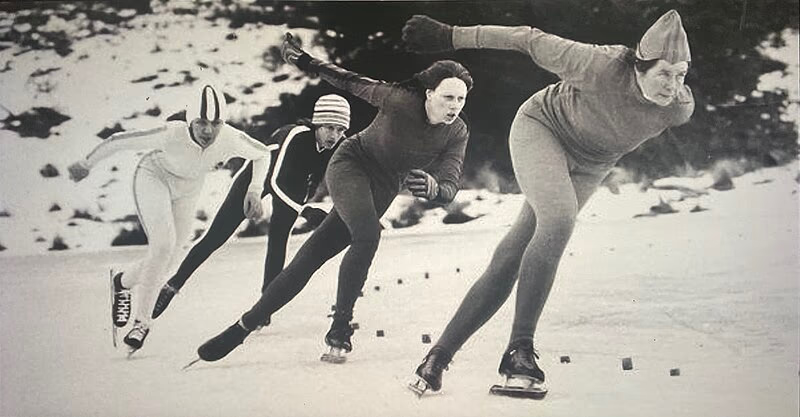
Section 1: Introduction
1.1 Overview and Governing Body
Long track speed skating has been an Olympic discipline since the inaugural 1924 Chamonix Winter Games (men's events) and since 1960 Squaw Valley (women's events). The sport is governed by the International Skating Union (ISU) under the ISU Sports Rules Speed Skating, read together with the ISU Constitution and Competition and Event Regulations (CER). Rule 200 (International and team competitions) sets out the standard distances and race formats that International Competitions may include; results are determined by time except in Mass Start and Team Pursuit, which use points or elimination formats.
1.2 Olympic Events
Per Rule 202 (Distances and races at Olympic Winter Games):
- Individual distances (Men): 500 m, 1000 m, 1500 m, 5000 m, 10 000 m, and a Mass Start race over 16 laps.
- Individual distances (Women): 500 m, 1000 m, 1500 m, 3000 m, 5000 m, and a Mass Start race over 16 laps.
- Team Pursuit: Men race 8 laps (3200 m), Women race 6 laps (2400 m) (Rule 202, paragraph 1.c-d).
Beyond the OWG program, ISU Championships (Rule 201) also carry Team Sprint and Mixed Relay events, and International Competitions may add distances as short as 100 m or as long as a Marathon (over 10 000 m) under Rule 258.
1.3 Historical Context
Speed skating originated in the Netherlands and Scandinavia, where frozen canals served as natural competition surfaces. The introduction of indoor ovals beginning in the 1980s dramatically improved times by eliminating wind and temperature variability. The clap skate revolution of 1996–1998, where the blade hinges at the toe to extend push-off power, resulted in world records being broken across every distance; Rule 224, paragraph 2.a now codifies the clap-skate mechanism as an allowable "passive mechanical extension of the leg." The Netherlands, Norway, South Korea, Japan, and Canada are the traditionally dominant nations.
Section 2: Equipment
2.1 Skates
Rule 224, paragraph 2.a defines a skate as "a passive mechanical extension of the leg, meant to facilitate the gliding technique," consisting of a blade and a shoe connected by a construction that may allow translation and rotation of the shoe relative to the blade (the clap-skate mechanism). The rule expressly prohibits any element that would let energy, matter, or heat reach the blade from an external source: "it is not permitted to heat the blades of the skates from any external source or by means of any artificial mechanisms." All energy propelling the skate must originate from the skater's own metabolic work during the race.
2.2 Racing Suit
Rule 224, paragraph 1.a requires that "racing suits shall conform to the natural shape of the body of the Skater," and bars insertion or attachment of forms or devices that create a different shape. The only permitted attachments are permanently fixed stripes, capped at a maximum height of 0.5 cm and a maximum width of 2.5 cm. Competitors may additionally be equipped with shin guards and padded knee protection worn inside the racing suit for injury protection, but these are optional, not mandatory.
Rule 224, paragraph 1.b requires that skaters of the same national team (i.e., entered by the same ISU Member) wear racing uniforms of identical design displaying the country name or its official ISU abbreviation, in characters no smaller than 7 cm high on the external part of both lower legs, at ISU Championships and ISU Events. Rule 224, paragraph 1.c extends the same country-identification requirement to warm-up suits.
2.3 Protective Equipment
Rule 224, paragraph 1.a states that competitors "may wear a helmet, neck protection, gloves or mitts (predominantly white) outside the racing suit" — these items are permitted, not mandated, for individual and team races. For ISU Events, any helmet that is worn must be one approved by the ISU approval commission and meeting the technical safety specifications in the latest ISU Communication.
Mass Start races are the exception: Rule 257, paragraph 5 requires that "Skaters must wear special safety equipment (see also Rule 224 and 279), helmet covers, armbands or bibs, as well as devices to support the timekeeping." A competitor who does not comply is disqualified or denied the start. Because a helmet cover can only be worn over a helmet, this provision makes helmet-wearing effectively required in Mass Start competition.
Rule 224, paragraph 3 disqualifies any competitor who does not comply with the suit, skate, or equipment rules above.
Section 3: Playing Area
3.1 Track Dimensions
Rule 203, paragraph 1 defines a Standard Speed Skating Track as a two-lane competition track of maximum 400 m, minimum 333⅓ m, with two 180° curved ends whose inner-curve radius "should not measure less than 25 m and not more than 26 m." Rule 203, paragraph 3 sets the inner competition lane at exactly 4 m wide and requires the outer lane to be at least 4 m wide. Rule 203, paragraph 2 defines the crossing area as the full length of the straight measured from the end of the curve — this is the lane-change zone used on every lap (see Section 5.1).
Rule 226 (Demarcation of the competition track) requires fully painted lines 5 cm wide in both straights and curves. Indoor tracks must additionally use movable rubber or synthetic blocks (maximum height 5 cm) along the curves — spaced 50 cm apart for the first 15 m of the curve and 2 m apart thereafter — with closed-top cones (recommended 10 cm, maximum 20 cm) marking the entrance to each curve.
3.2 Ice Conditions
Ice preparation at ISU Events, the Olympic Winter Games, and the Winter Youth Olympic Games is governed by an ISU Ice Commission consisting of the Referee(s) and the ISU Speed Skating Technical Committee Representative or Technical Delegate (Rule 229, paragraph 1). The Commission sets the ice preparation schedule in consultation with the venue's ice technical expert, who must supply historical data on ice preparation under varying climatic conditions, water quality used in resurfacing, and (on indoor tracks) airflow/ventilation data, "with the aim to give the participants equal conditions" (Rule 229, paragraph 2).
Indoor venues are effectively required for World Cup and Olympic competition: Rule 205 and Rule 206 both mandate that the track "must be enclosed within a heated building to be protected from wind and weather," with the infield accessible without crossing the ice surface.
3.3 Start and Finish
Rule 227, paragraph 2 places the pre-start line 2 m before the starting line, with starting and finishing lines denoted by colored lines no more than 5 cm wide at right angles to the straight. On a standard 400 m track, the 1000 m finish line sits at the middle of the finishing straight, and Team Pursuit/Team Sprint start and finish there as well; other distances finish toward the end of the straight (Rule 227, paragraph 2).
A photo-finish system is mandatory at ISU Championships, ISU World Cup Competitions, and the Speed Skating events of the OWG and YOWG (Rule 251, paragraph 2.d). Where a photo-finish system is in use, its recorded times and order of finish govern the official result even if a separate optical or transponder system displays different "live" times (Rule 251, paragraph 2.c). Times are recorded to the hundredth of a second, or the thousandth where a photo-finish system with that resolution is used to break ties (Rule 251, paragraph 3).
Section 4: Players & Officials
4.1 Competitors
Individual races are skated in pairs, one skater in the inner lane and one in the outer lane, changing lanes each lap (Rule 254, paragraphs 2 and 5). Team Pursuit races may be entered with either 3 or 4 skaters per team; regardless of team size, the team's finishing time is fixed as the time of the third skater to cross the line, and a team finishing with fewer than 3 skaters is disqualified as not having completed the race (Rule 256, paragraph 1.1). Mass Start races may carry up to 24 entered competitors (Rule 208, paragraph 2.1.1), lining up in rows of maximum 6 skaters for a simultaneous start (Rule 257, paragraph 3).
4.2 Officials
Rule 210, paragraph 1 sets the minimum roster of officials for a competition: one Referee, one Assistant Referee, one Starter with an assistant, one Finishing line judge, a Chief Timekeeper plus at least four manual timekeepers, Lap Scorers, and Track Judges (two Corner Judges, a Crossing Straight Judge, and a Finishing Straight Judge); ISU Events additionally require an Ice Technical Expert and a Competition Coordinator.
The Referee's powers under Rule 216 include disqualification decisions for breaches of the Sports Rules (paragraph 1.e), approving ice and safety conditions before racing (paragraph 2.a), stopping a race in progress for a fallen or injured competitor (paragraph 2.i), and issuing a Referee warning or a Yellow Card for unsportsmanlike conduct (paragraph 2.e-f). The Starter separately controls all disputes arising during the starting procedure itself, from the moment competitors go to their lane until a valid start is completed (Rule 217, paragraph 2).
4.3 Pairing and Draw
Team Leaders confirm final entries and withdrawals at a Team Leaders' meeting before the opening draw (Rule 239, paragraph 1). For World Championships single-distance and individual races, competitors are grouped by seasonal best time in groups of 6, with the fastest group's pairs skating last (Rule 240, paragraph 5.b). In the 500 m and other single-race sprint formats, lane assignment carries particular tactical weight because the inner lane requires fewer crossover steps on the opening curve.
Section 5: Rules of Play
5.1 Lane Change Rules
Rule 254, paragraph 5.a requires the inner-lane skater to move to the outer lane on the crossing straight — the straight between the end of the curve (marked by movable blocks) and the beginning of the next curve (marked by a cone) — and the outer-lane skater to move to the inner lane, every lap. The exception is the first straight of the 1000 m and 1500 m on a standard 400 m track, where no lane change occurs (Rule 254, paragraph 5.b). At the crossing point, the skater moving from the outer to the inner lane must not be hindered by the skater moving from the inner to the outer lane; the skater leaving the inner lane bears responsibility for any such obstruction unless the other skater acts obstructively (Rule 254, paragraph 6). Cutting the inner line of the lane in, through, or exiting a curve is separately forbidden under Rule 254, paragraph 7.
5.2 Individual Distance Races
Rule 200, paragraph 1 lists the standard International Competition distances as 100, 500, 1000, 1500, 3000, 5000, and 10 000 m. World Championship single-distance titles (Rule 201, paragraph 1.2) cover 500 m, 1000 m, 1500 m, 5000 m, and 10 000 m for men, and 500 m, 1000 m, 1500 m, and 3000 m plus 5000 m for women, alongside Mass Start for both. The 500 m is contested as a pure sprint with reaction time critical at the start; the 1000 m and 1500 m each require one lane change; the longer distances (3000 m/5000 m/10 000 m) reward pacing and negative splits.
5.3 Team Pursuit
Rule 256, paragraph 1.1 permits Team Pursuit teams of either 3 or 4 skaters; in both cases "the finishing time of the Team will be determined as the finishing time of the third Skater in the Team." The two teams start simultaneously at each side of the track, at the middle of the straights (paragraph 1.2), skating single file with the lead rotating to share the aerodynamic burden. Where the competition is run as elimination heats, a team that overtakes the other — defined as its third-positioned skater passing the other team's third-positioned skater — is declared the winner of that heat immediately, before the full distance is skated (paragraph 1.5). Each skater on a team wears distinct identification: No. 1 white armbands, No. 2 red, No. 3 yellow, and (for 4-skater teams) No. 4 blue (paragraph 1.6).
5.4 Mass Start
The Mass Start track is laid out without separate racing lanes, and the race distance is specified as a number of laps, with the countdown starting the first time skaters cross the finishing line (Rule 257, paragraph 1.1). During the first lap, accelerating before a distinct sound signal is forbidden and is a disqualifying offense (Rule 257, paragraph 4.1). Competitors who are lapped by the leading skater (or by a defined number of leaders) must move to the coaches' area and abandon the race within one full lap, without skating through the finish line; failing to do so results in disqualification (Rule 257, paragraph 4.4).
Where the race format includes intermediate sprints, Rule 265, paragraph 6.3 governs scoring at the OWG, World and European Championships, and ISU World Cups: three intermediate sprints are contested at the finishing line after laps 4, 8, and 12, in addition to the final sprint. Intermediate-sprint points are awarded 3–2–1 to the first three finishers of each sprint, and the final sprint awards points to the first six finishers on a 60–40–20–10–6–3 scale (Rule 265, paragraph 6.3.b). At the Olympic Winter Games, the Mass Start is additionally run through a semi-final elimination stage: competitors are seeded by ranking into two semi-finals (no more than one skater per ISU Member in each), and the 8 best-ranked finishers from each semi-final advance to the Final (Rule 241, paragraph 5).
5.5 Start Procedure
On the Starter's command "Go to the start," competitors take a stable position between the pre-start line and the starting line (2 m apart); on "Ready," they hold their starting position, with all skate blades entirely behind the starting line, until the shot fires (Rule 253, paragraph 3.2.a). A distinct interval of 1 to 1.5 seconds must separate the "Ready" position from the firing of the shot (paragraph 3.2.b). A false start is declared if a competitor is deliberately slow to set (paragraph 4.1.a), breaks early and pulls the other competitor with them (paragraph 4.1.b), or leaves position after "Ready" but before the shot (paragraph 4.1.c). The Starter warns the competitor responsible for the first false start in a pair or heat; any competitor committing a further false start in that same pair or heat is disqualified from the race (Rule 253, paragraph 4.3).
Section 6: Scoring
6.1 Individual Distances
Rule 265, paragraph 1 determines the result of a single-distance race by comparing all competing skaters' times; skaters tied on time (per the manual or automatic timekeeping procedure) are each considered a winner of the distance. Where a photo-finish system with thousandth-of-a-second resolution is in use, those finer times settle the order of finish and any ties in the official protocol. For competitions where a distance is contested as two counting races (e.g., 500 m skated twice), the total time across both races determines the final classification.
6.2 Team Pursuit Scoring
Where Team Pursuit is skated with elimination phases, teams that progress to the next phase are ranked ahead of eliminated teams in the results even if their subsequent race result is invalid (DNS/DNF/DQ); the winner is the team that wins the final-phase race (Rule 265, paragraph 5.a). As set out in Section 5.3, the team's official time in any given heat is the finishing time of its third skater, and a team finishing with fewer than 3 skaters does not complete the race (Rule 256, paragraph 1.1).
6.3 Mass Start Scoring
Where the race includes intermediate sprints, Rule 265, paragraph 6.1 ranks competitors by total sprint points gained, with any tie broken by order of finish at the final sprint; skaters who do not finish are ranked by laps completed. At the OWG, World and European Championships, and ISU World Cups, Rule 265, paragraph 6.3.b sets the point schedule at 3–2–1 for the top three finishers of each intermediate sprint and 60–40–20–10–6–3 for the top six finishers of the final sprint. Skaters lapped and removed from the race are ranked behind all skaters who complete the full distance (Rule 257, paragraph 4.4; Rule 265, paragraph 6.1).
6.4 World Records
Rule 222, paragraph 2 sets the conditions for World Record recognition: the track must be a Standard 400 m Speed Skating Track (paragraph 2.c); automatic timekeeping with photo-finish equipment as the primary system must be in use (paragraph 2.e); the Referee must belong to the ISU or International Referees list for that season (paragraph 2.d); and the ISU World Record application, with supporting documents, must reach the ISU Director General by May 1 of the season concerned (paragraph 2.f). For an individual-distance record, the skater must have been selected for doping control on race day and returned a negative test (paragraph 2.h); for a Team Pursuit or Team Sprint record, at least 2 skaters per team must be tested negative, and for a Mixed Relay record, at least 1 skater per team (paragraph 2.i).
Section 7: Violations & Penalties
7.1 Lane and Crossing Violations
- Failure to change lanes: Disqualification for breach of the mandatory lane-change on the crossing straight (Rule 254, paragraph 5.a).
- Interfering with a skater in their own lane: The offending skater is disqualified if they interfere with a competitor who is skating entirely within their designated lane (Rule 254, paragraph 3).
- Crossing the lane line with a full skate: May result in disqualification even absent interference with another competitor; confirmed repeated crossings during the race lead to disqualification (Rule 254, paragraph 4).
- Cutting the inner curve line: Disqualification (Rule 254, paragraph 7).
- Exceptions: A skater who briefly crosses a lane line while exiting a curve and returns immediately, or who leaves the lane due to a fall and returns directly, is not disqualified (Rule 254, paragraph 8).
7.2 Start Violations
- First false start: A warning to the responsible competitor(s); the pair or heat restarts (Rule 253, paragraph 4.3).
- Second false start in the same pair or heat: Disqualification of the offending competitor (Rule 253, paragraph 4.3).
- Touching or crossing the starting line before the shot: A breach of the required starting position (Rule 253, paragraph 3.2.a).
7.3 Mass Start Violations
- Accelerating before the first-lap sound signal: Disqualification (Rule 257, paragraph 4.1).
- Failing to abandon the race after being lapped: A skater who does not clear the race within one full lap of being overtaken by the leader(s) is disqualified (Rule 257, paragraph 4.4).
- Unsportsmanlike conduct: Serious obstruction, deliberate blocking, charging, or pushing another skater with any part of the body may lead to disqualification of the offender (Rule 257, paragraph 4.5).
7.4 Equipment Violations
- Non-compliant racing suit, skate, or safety equipment: Disqualification (Rule 224, paragraph 3).
- Improper armband, bib, or missing timekeeping device: Disqualification (Rule 279, paragraph 5).
- Wearing communication or music-playback devices while racing: Disqualification (Rule 279, paragraphs 1-2, 5).
Section 8: Safety Considerations
8.1 Track Safety Infrastructure
Rule 228, paragraph 2 sets minimum protection standards for all competitions: protection mats must be at least 80 cm high and at least 30 cm thick, with an anti-abrasive, water-resistant surface, used in the curves and extending at least 20 m onto the straight after each curve exit, and secured so a collision "will not in itself create a significant risk for injuries." Fixed, heavy objects within 3 m of the track edge must be padded. At ISU Championships, other ISU Events, and the OWG, Rule 228, paragraph 3 requires enhanced protection: mats at least 80 cm thick at the bottom tapering to 40 cm at the top in the curves (and 20 m beyond), and at least 60 cm thick at the bottom tapering to 20 cm at the top on the straights, with an overall height of 100 cm, covering the full length of straights and curves.
8.2 Ice Maintenance
As described in Section 3.2, ice preparation at ISU Events, the OWG, and the YOWG is directed by the ISU Ice Commission (Referee(s) plus the ISU Speed Skating Technical Committee Representative or Technical Delegate), which sets and may revise the ice preparation schedule in consultation with the venue's ice technical expert, with Team Leaders briefed on the procedure before the opening draw (Rule 229, paragraphs 1-2).
8.3 Medical Protocols
The Referee is empowered to stop a race in progress on safety grounds in the case of a fallen or injured competitor (Rule 216, paragraph 2.i). For ISU Championships and ISU Events, including World Cup Competitions, "the Referee should recognize an air temperature limit of -20° C (-4° F) as a reason to postpone races until later in the day or the following day," taking into account that wind lowers the effective temperature and increases hypothermia risk (Rule 216, paragraph 3.d). The Referee may also suspend competition if public interference disrupts orderly conduct (Rule 216, paragraph 2.j) or cancel/postpone the event for extremely cold weather (Rule 216, paragraph 2.k).