


🏛️Official — FIS
Loading OpenSourceSports…
Don't celebrate or show elation when a jumping competitor crashes
In the ski jumping phase of Nordic Combined, it is a strict taboo to visibly celebrate, smirk, or appear pleased when a rival falls or crashes on landing. A crash can cause serious injury, and any display of satisfaction is considered deeply disrespectful to the athlete and the sport. Athletes are expected to show concern or neutral composure.
Respect a competitor's mental preparation before their jump
Ski jumping demands total focus in the moments before an athlete leaves the start gate. Deliberately attempting to distract, crowd, or unsettle a competitor during their preparation—through noise, unnecessary movement, or conversation—is a serious breach of etiquette shared across Nordic Combined and ski jumping. Athletes wait their turn in silence.
Jumping skis: Maximum length 145% of body height, adjusted by BMI (lower BMI = shorter maximum ski length, per FIS BMI-to-ski-length table). Minimum ski width 95 mm at the binding. Maximum weight per ski not to exceed half the ski length in grams (e.g., max 1350 g for a 270 cm ski).; Jumping suit...
Why people argue about this
People often argue that the rule's width requirement is too strict, thinking it limits their ability to maneuver during jumps when they believe wider skis would be more stable and easier to control in the air. Actually, the rule aims to balance aerodynamics with safety, ensuring skiers don't have overly wide boards that could cause instability or injury upon landing.
Skating skis: Free technique is standard for the cross-country phase. Minimum length = athlete’s height minus 10 cm. Skis must comply with all FIS cross-country equipment rules.; Skating poles: Maximum length 100% of body height. Pole baskets maximum 100 cm².; Skating boots: High-cuff design with...
Why people argue about this
People often argue that this rule is too restrictive, thinking it limits them from using their most aerodynamic skis for maximum speed, but actually, the key intent is to ensure safety by keeping lengths manageable within a controlled range to prevent accidents on narrow Nordic Combined courses.
Athletes carry or transport two complete sets of equipment: jumping gear and cross-country gear; Equipment is pre-positioned in the transition area before the jumping phase begins; Rapid transition between jumping and skiing equipment is essential; teams practice transition to minimize time
Why people argue about this
People often assume that the helmet requirement is only for safety during the ski jumping portion of the race, forgetting about its necessity in the cross-country skiing part as well. But actually, the FIS-approved helmet rule applies to both phases, ensuring athletes have adequate head protection throughout their entire competition journey.
Normal Hill: Hill Size (HS) 98–109 m. K-point (construction point) approximately 90–100 m. In-run length, takeoff table angle, and landing slope profile must meet FIS homologation standards.; Large Hill: HS 127–145 m. K-point approximately 120–130 m. Full FIS homologation certificate required.; W...
Why people argue about this
People often assume that all ski jumping hills are homologated at birth, without realizing they need a full homologation certificate for each size range—Normal Hill from 98-109 meters to Large Hills above 109 meters, which requires an additional certification process. This oversight leads to confusion about when and how the hill sizes get officially recognized in competitions.
10 km course: 2.5 km or 5 km laps; total climb 250–420 m. Course terrain one-third uphill, one-third downhill, one-third flat.; 5 km course (team relay / women): 2.5 km laps; total climb 125–210 m; Minimum course width 6 m for free technique (skating)
Why people argue about this
People often assume that the 10 km cross-country course in Nordic Combined must be a straight, flat run with no elevation changes, which they mistakenly believe is what "total climb 250-420 m" means. In reality, this refers to the total vertical ascent of the entire course, not just the distance covered on flat ground within those 10 km laps.
Transition area between jumping hill and cross-country start: athletes change from jumping to skiing equipment. Minimum size to accommodate all competitors simultaneously.; Stadium area includes: cross-country start zone (staggered start positions), finish straight (minimum 100 m), exchange zone ...
Why people argue about this
People often assume that the transition area only needs to meet cross-country standards since Nordic Combined involves both disciplines. But they misunderstand that the stadium area must adhere to FIS homologation standards for ski jumping as well, ensuring safety and consistency across all aspects of the event.
Athletes must hold a valid FIS license and be registered by their national federation; Olympic quotas: maximum 5 athletes per nation for individual events; 1 team per nation for the team event; Athletes must meet minimum FIS points requirements in both ski jumping and cross-country to qualify
Why people argue about this
People often assume that just having a valid FIS license is enough for participation in Nordic Combined events, forgetting about the requirement to be registered by their national federation. This oversight leads to confusion because registration isn't automatically granted based on individual licenses alone.
Individual events: Each athlete competes alone in both phases; Team event: 4 athletes per team; all 4 jump in the jumping phase, then race a 4×5 km relay in the cross-country phase; Team jumping order and relay leg order are declared by the team coach before competition
Why people argue about this
People often assume that in Nordic Combined team events, each athlete must compete individually first before joining up for the relay race, which leads to misunderstanding of how the 4-athlete limit applies. Actually, all four athletes participate together in both the ski jumping and cross-country segments as part of a single unit, just with different roles during those parts of the event.
Competition jury: FIS Technical Delegate, Chief of Competition, Assistant TD; oversees both phases; Jumping officials: 5 style judges, distance measurers, equipment controllers, wind/gate compensation committee; Cross-country officials: Timekeepers, technique controllers (not typically needed as ...
Why people argue about this
People often assume that just because an athlete meets FIS requirements in terms of age and qualifications for Nordic Combined doesn't mean they're automatically eligible if they haven't participated in both ski jumping and cross-country skiing events before. They mistakenly believe eligibility is based solely on meeting the criteria, not also having experience in both disciplines.
All Nordic combined events follow the same fundamental sequence: ski jumping first, then cross-country skiing. The jumping phase determines the start time gaps for the cross-country phase using the Gundersen method.
Why people argue about this
People often assume that shorter distances in Nordic Combined events are solely for increasing spectator appeal, forgetting that these changes can also affect athletes' performance strategies and potentially alter competition dynamics, leading to confusion about how these adjustments impact their training and game plans.
Jumping results (total points from distance + style + wind/gate compensation) are converted into time differences relative to the leader; Conversion factor (Individual): Each point difference = 4 seconds in cross-country start time gap (e.g., an athlete 10 points behind the jumping leader starts ...
Why people argue about this
People often assume that the Gundersen Method is a mandatory part of Nordic Combined competition, forgetting that it's actually an optional technique used for scoring purposes in certain World Cup events. They misunderstand that its introduction into Compact Individual format doesn't mean it becomes compulsory for all competitions, leading to confusion about its applicability and importance.
Typically one competition round (one jump per athlete); a provisional/trial round may precede it; Scored identically to standalone ski jumping: distance points + 5 style judges (highest and lowest dropped, 3 remaining scores summed) + wind/gate compensation; Athletes jump in reverse order of FIS ...
Why people argue about this
People often assume that shorter cross-country distances in Compact formats mean reduced jumping phases, which they mistakenly believe leads to less excitement for spectators. Actually, FIS adjusts the jumping distance within these compact formats while keeping the overall competition structure intact, so athletes still have plenty of opportunities to showcase their jumping skills.
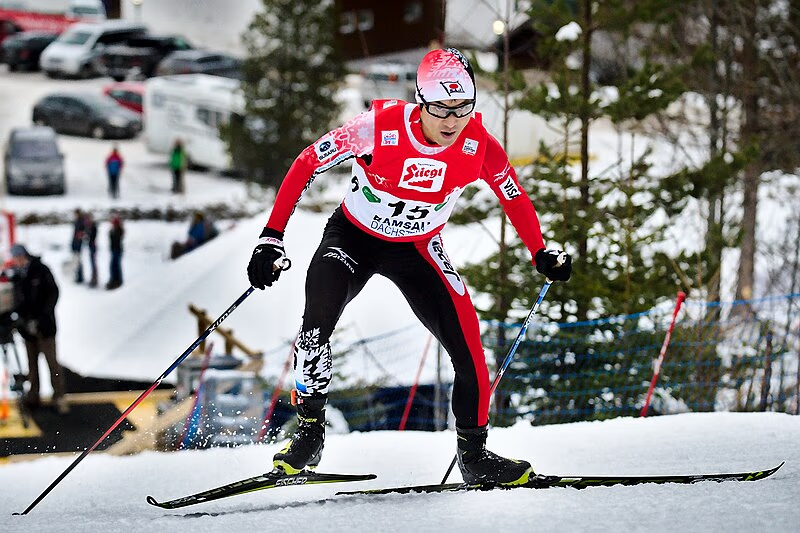
Free technique (skating) used exclusively in Nordic combined cross-country; Individual: 10 km race (2.5 or 5 km laps through the stadium); Team relay: 4×5 km with body-contact exchange in the 30 m exchange zone
Why people argue about this
People often assume that shorter cross-country distances in Compact formats mean less challenging races for athletes, which they mistakenly believe would make the events less exciting. In reality, these formats are designed to balance athlete performance with viewer engagement by tweaking race lengths without necessarily reducing overall difficulty or competitiveness.
FIS has introduced compact formats for World Cup events to increase spectator appeal. , 7.5 km) with a tighter point-to-time conversion, compressing the field for closer finishes.
Why people argue about this
People often argue that the shorter cross-country distance in the Compact Individual format somehow diminishes the overall challenge of Nordic Combined compared to traditional formats, but actually, it's designed to make events more appealing with a quicker viewing time for spectators without sacrificing too much of the technical and endurance aspects that define the sport.
Distance points: Each meter beyond or short of the K-point = a fixed number of points (1.8 points/m on Normal Hill, 1.2 points/m on Large Hill). Landing at the K-point = 60 points.; Style points: 5 judges each award 0–20 points based on flight form, body position, landing technique, and outrun. H...
Why people argue about this
People often assume that style points are purely subjective and therefore open to interpretation, forgetting that they're calculated based on a fixed set of criteria like takeoff angle and body position, adjusted for camera angles. They also overlook how wind speed and gate conditions can significantly affect the distance score, leading to misunderstandings about its accuracy and fairness.
Final ranking is determined by cross-country finish order, not by total points; The first athlete to cross the finish line wins, regardless of their jumping score; Jumping scores serve solely to determine the cross-country start time gaps via the Gundersen method
Why people argue about this
People often assume that the jury adjusts gates solely for aesthetic reasons, when in fact they do it for safety purposes before calculating final results, leading to misunderstandings about why certain gate scores are adjusted.
World Cup points awarded for top 30 finishers: 100-80-60-50-45-40-36-32-29-26-24-22-20-18-16-15-14-13-12-11, then 10 through 1 for places 21–30; Overall World Cup standings determine the season champion; separate standings for individual and team events; Nations Cup standings determine team quota...
Why people argue about this
People often assume that jumping scores are solely based on distance alone, forgetting about style points entirely. However, they overlook the jury's role in deciding gate adjustments due to wind and safety conditions, which significantly impacts overall scores and can lead to disputes over final rankings.
Equipment non-compliance: Suit thickness, air permeability, ski length, or boot height outside FIS limits — DSQ from the entire competition (both phases); BMI manipulation: If an athlete’s BMI is found to be artificially altered (e.g., wearing weights), DSQ and potential FIS disciplinary action; ...
Why people argue about this
People often assume that jumping phase violations are solely about equipment malfunctions, forgetting that BMI manipulation is also a violation. This oversight stems from the fact that the rules don't explicitly mention BMI in relation to jumping phases, leading many athletes and coaches to overlook this aspect entirely.
Obstruction: Deliberate blocking of an overtaking athlete — time penalty or DSQ depending on severity and whether it influenced the final result; Unauthorized assistance: Receiving pushing, pacing, or physical aid from team personnel or spectators — DSQ; Course cutting: Deviating from the marked ...
Why people argue about this
People often assume that if they just brush past another skier without knocking them down, it's okay—thinking there’s no penalty for mere contact. But actually, the rule is about deliberate blocking to cause a time penalty or disqualification, not just brushing by. They miss the nuance of what constitutes "obstruction.
Unsportsmanlike conduct in either phase: warning, time penalty, or DSQ at the jury’s discretion; Missing mandatory equipment control checks: athlete may not start the respective phase; Late arrival at the start: in jumping, the athlete forfeits their jump; in cross-country, the athlete starts at ...
Why people argue about this
People often assume that a fall in Nordic Combined automatically disqualifies an athlete, which isn't true according to Section 7.3. However, they mistakenly believe improper landing alone results in style deductions only, failing to grasp that falls can lead to safety holds and potential disqualification if severe enough.
FIS-approved helmet mandatory for all jumps; chin strap must be fastened; Competition jury monitors wind conditions continuously; jumping halted if crosswind exceeds safe thresholds (typically >3 m/s sustained crosswind); In-run gate adjusted by the jury based on wind, snow, and athlete safety; a...
Why people argue about this
People often assume that only helmets are required for safety in Nordic Combined jumps, overlooking the necessity of fastened chin straps on approved helmets. However, the real confusion arises because they overlook the continuous monitoring aspect; if crosswinds exceed safe thresholds, immediate action is taken by officials, not just a requirement to wear a helmet with a strap.
Temperature limits apply: competition cancelled or shortened if ambient temperature drops below -20 °C (-4 °F) or wind chill below -25 °C (-13 °F); Course controllers stationed every 500 m with radio communication to race control; Emergency snowmobile access to all course sections within 3 minutes
Why people argue about this
People often assume that the temperature limit in Nordic Combined is solely about safety for the athletes' equipment, thinking it's just a precautionary measure against metal freezing or breaking. But actually, the real concern is ensuring the snow remains firm and safe for skiing, which could be compromised by extremely high temperatures melting the snowpack.
Transition area must be fenced and controlled to prevent unauthorized access; Non-slip surfaces or mats at the equipment change area to prevent falls; Team support personnel limited to designated areas; no more than 2 team staff per athlete in the transition zone
Why people argue about this
People often assume that just wearing a helmet is enough under the Transition Area Safety rule, but they misunderstand that it must be an FIS-approved model with a chin strap fastened for full compliance. The confusion arises because the rule specifies using "FIS-approved helmets" rather than just any kind of helmet.
Competition may be cancelled, postponed, or shortened at any time if conditions become unsafe for either discipline; If the jumping phase is completed but the cross-country cannot be held (e.g., extreme weather), the competition may be rescheduled or the jumping results may stand as provisional (...
Why people argue about this
People often assume that wearing a helmet is optional for safety in Nordic Combined, which leads to misunderstandings about its necessity. However, the official stance is clear: FIS-approved helmets are mandatory for all jumps to ensure head protection and prevent injuries, thus people mistakenly believe it's an extra layer rather than a core requirement.
Jumping skis: Maximum length 145% of body height, adjusted by BMI (lower BMI = shorter maximum ski length, per FIS BMI-to-ski-length table). Minimum ski width 95 mm at the binding. Maximum weight per ski not to exceed half the ski length in grams (e.g., max 1350 g for a 270 cm ski).; Jumping suit...
Why people argue about this
People often assume that the 145% body height measurement is based solely on an athlete's actual height, ignoring their BMI, leading to misunderstandings about how much longer they can make their skis compared to others with similar heights but different BMIs.
Normal Hill: Hill Size (HS) 98–109 m. K-point (construction point) approximately 90–100 m. In-run length, takeoff table angle, and landing slope profile must meet FIS homologation standards.; Large Hill: HS 127–145 m. K-point approximately 120–130 m. Full FIS homologation certificate required.; W...
Why people argue about this
People often assume that the 10 km to 5 km cross-country course distances in Nordic Combined are for the entire race, including both ski jumping and cross-country segments, rather than just the distance skied after taking off from the ski jump ramp. The confusion arises because they overlook Section 3's clear distinction between these two distinct parts of the event.
Athletes must hold a valid FIS license and be registered by their national federation; Olympic quotas: maximum 5 athletes per nation for individual events; 1 team per nation for the team event; Athletes must meet minimum FIS points requirements in both ski jumping and cross-country to qualify
Why people argue about this
People often assume that athletes can switch between ski jumping and cross-country phases whenever they want during a competition, thinking substitutions are allowed like in other sports. However, the official verdict clarifies that Nordic Combined players must compete in both phases without being able to substitute between them, which leads to confusion about how matches are structured.
FIS has introduced compact formats for World Cup events to increase spectator appeal. , 7.5 km) with a tighter point-to-time conversion, compressing the field for closer finishes.
Why people argue about this
People often assume that shorter cross-country distances in the Compact Individual format are solely for increasing spectator appeal, forgetting that these changes also affect athletes' performance metrics and strategy planning, leading to confusion about how their training should adapt.
Distance points: Each meter beyond or short of the K-point = a fixed number of points (1.8 points/m on Normal Hill, 1.2 points/m on Large Hill). Landing at the K-point = 60 points.; Style points: 5 judges each award 0–20 points based on flight form, body position, landing technique, and outrun. H...
Why people argue about this
People often assume that only three judges' scores are considered for scoring in Nordic Combined, which leads them to miss out on how the fixed distance-based score is incorporated alongside those adjusted style points from five judges—something they mistakenly believe doesn't factor into their total.
Equipment non-compliance: Suit thickness, air permeability, ski length, or boot height outside FIS limits — DSQ from the entire competition (both phases); BMI manipulation: If an athlete’s BMI is found to be artificially altered (e.g., wearing weights), DSQ and potential FIS disciplinary action; ...
Why people argue about this
People often assume that equipment non-compliance in just the jumping phase means only that skier gets disqualified for that event, not their entire competition. But under Section 7's "Key Fact," it actually results in a disqualification from the whole combined event due to failing to meet technical standards throughout.
FIS-approved helmet mandatory for all jumps; chin strap must be fastened; Competition jury monitors wind conditions continuously; jumping halted if crosswind exceeds safe thresholds (typically >3 m/s sustained crosswind); In-run gate adjusted by the jury based on wind, snow, and athlete safety; a...
Why people argue about this
People often assume that wearing a helmet is optional for safety in Nordic Combined, misunderstanding that FIS mandates them for all jumps as per their safety guidelines. The confusion arises because they overlook the specific requirement of helmets across all competition elements and only focus on one aspect—jumps—and ignore the comprehensive safety measures outlined by FIS.