


🏛️Official — FIS
Loading OpenSourceSports…
Winter Sports
1 players
outdoor
ski, pole, helmet
10 essential rules
Nordic combined has been part of the Olympic program since the inaugural Winter Games at Chamonix in 1924, making it one of the oldest winter Olympic disciplines. Governed by FIS under ICR Book VII (Nordic Combined), the sport uniquely demands that athletes excel in two fundamentally different ph...
Jumping skis: Maximum length 145% of body height, adjusted by BMI (lower BMI = shorter maximum ski length, per FIS BMI-to-ski-length table). Minimum ski width 95 mm at the binding. Maximum weight per ski not to exceed half the ski length in grams (e.g., max 1350 g for a 270 cm ski).; Jumping suit...
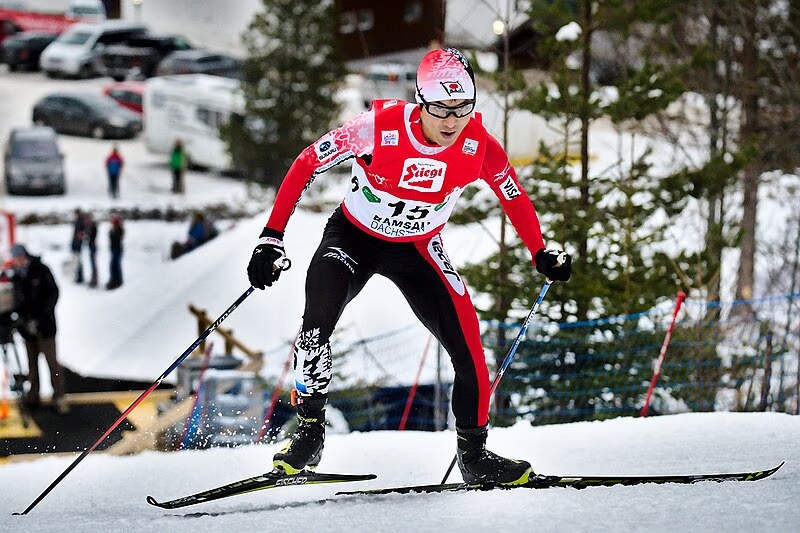
Skating skis: Free technique is standard for the cross-country phase. Minimum length = athlete’s height minus 10 cm. Skis must comply with all FIS cross-country equipment rules.; Skating poles: Maximum length 100% of body height. Pole baskets maximum 100 cm².; Skating boots: High-cuff design with...
Athletes carry or transport two complete sets of equipment: jumping gear and cross-country gear; Equipment is pre-positioned in the transition area before the jumping phase begins; Rapid transition between jumping and skiing equipment is essential; teams practice transition to minimize time
Normal Hill: Hill Size (HS) 85–109 m, with the construction-point distance (w) 75–99 m (ICR 511.1). In-run length, takeoff table angle, and landing slope profile must meet FIS homologation standards.; Large Hill: HS 110–149 m (ICR 511.1). Full FIS homologation certificate required.; Wind screens:...
Individual Gundersen course: 5 to 15 km raced on 2.0 or 2.5 km laps (ICR 512.1). Course terrain one-third uphill, one-third undulating rolling terrain, one-third varied downhills (ICR 512.4).; 5 km course (team relay / women): 2.5 km laps; total climb 150–210 m (ICR 512.1, 512.5.3); Course must b...
Transition area between jumping hill and cross-country start: athletes change from jumping to skiing equipment. Minimum size to accommodate all competitors simultaneously.; Stadium area includes: cross-country start zone (staggered start positions), finish area, exchange zone (a rectangle 30 m lo...
Athletes must hold a valid FIS license and be registered by their national federation; Athletes must meet minimum FIS points requirements in both ski jumping and cross-country to qualify; Minimum age: at OWG, World Ski Championships, World Cup and Continental Cup, competitors must reach their 16t...
Individual events: Each athlete competes alone in both phases; Team event: 4 athletes per team who must participate in and complete both disciplines: all 4 jump, then race a 4×5 km relay (ICR 543.1, 512.1); Team jumping order and relay leg order are declared by the team coach before competition
Competition jury: FIS Technical Delegate, Chief of Competition, Assistant TD; oversees both phases; Jumping officials: 5 style judges, distance measurers, equipment controllers, wind/gate compensation committee; Cross-country officials: Timekeepers, technique controllers (not typically needed as ...
All Nordic combined events follow the same fundamental sequence: ski jumping first, then cross-country skiing. The jumping phase determines the start time gaps for the cross-country phase using the Gundersen method.
Don't celebrate or show elation when a jumping competitor crashes
In the ski jumping phase of Nordic Combined, it is a strict taboo to visibly celebrate, smirk, or appear pleased when a rival falls or crashes on landing. A crash can cause serious injury, and any display of satisfaction is considered deeply disrespectful to the athlete and the sport. Athletes are expected to show concern or neutral composure.
Respect a competitor's mental preparation before their jump
Ski jumping demands total focus in the moments before an athlete leaves the start gate. Deliberately attempting to distract, crowd, or unsettle a competitor during their preparation—through noise, unnecessary movement, or conversation—is a serious breach of etiquette shared across Nordic Combined and ski jumping. Athletes wait their turn in silence.
Ready to dive deeper?