


🏛️Official — IHFIn Season
Loading OpenSourceSports…
Return possession after an injury stoppage
When play is halted for an injured player and the referee awards a free throw to the interrupting team, it is expected that the team with the ball voluntarily returns it to the side that held possession before the stoppage. Failing to do so draws strong disapproval from opponents, crowd, and often teammates.
Give a genuine handshake after the final whistle
The post-match handshake line is treated as a solemn obligation in handball culture. Offering a limp hand, refusing eye contact, skipping the line, or using the moment to taunt is considered a serious breach of respect. Teams that lose composure in the handshake are remembered negatively long after the result is forgotten.
Avoid exaggerating contact — diving is disrespected
Despite handball being a highly physical sport where contact is legal and expected, deliberately exaggerating a foul or falling theatrically to draw a suspension card is culturally condemned. Players who flop habitually are labelled negatively by peers and opposing teams and lose credibility with referees over time.
The handball is spherical, made of leather or synthetic leather, with a non-shiny, non-slippery surface. Three official sizes exist: Size 3 (Men): Circumference 58–60 cm (22.8–23.6 in), weight 425–475 g (15–16.8 oz); Size 2 (Women): Circumference 54–56 cm (21.3–22 in), weight 325–375 g (11.5–13.2...
— Rule 3
Why people argue about this
People often assume that the ball's surface is meant to be shiny so it can roll more smoothly during play, which they mistakenly believe contradicts the official requirement for a non-shiny surface. However, the non-shiny specification isn't about smoothness but rather to prevent players from using their hands as rollers or manipulating the ball’s direction with reflective surfaces.
Goals have internal dimensions of 3 m wide x 2 m high (9.84 ft x 6.56 ft). Goal posts and crossbar are 8 cm (3.1 in) square in cross-section, painted in alternating two-colour bands (typically black and white or red and white) visible from both sides.
— Rule 1
Why people argue about this
People often assume that the 3m width refers to the goalposts themselves, leading them to argue about how wide their own sticks can be relative to these posts. However, the official verdict clarifies that it's actually the internal dimensions of the goal area itself, not including the goalposts, which is why stick widths are irrelevant here.
Footwear: Non-marking indoor court shoes are mandatory. Outdoor soles and studded shoes are prohibited (IHF Rule 4).; Jerseys: Numbered 1–99. Field players wear matching jerseys of a uniform colour distinct from the opposing team. Goalkeepers wear a jersey colour distinct from both their own fiel...
— Rule 4
Why people argue about this
People often assume that the size and weight of the ball are uniform for all players, which leads to misunderstandings since these specifications vary based on a player's position in the game—goalie needs a smaller, heavier ball than other positions do. The confusion arises because they don't realize the specific requirements tailored to each role within the team.
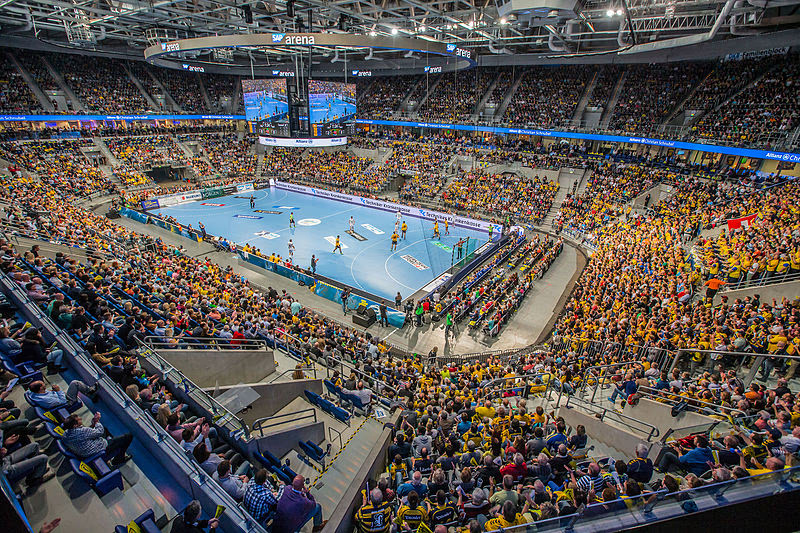
The playing court measures 40 m x 20 m (131 ft x 66 ft), with a safety zone of at least 1 m along the sidelines and 2 m behind each goal line. The court surface is typically hardwood, synthetic, or rubberised flooring and must be flat and non-slip (IHF Rule 1).
— Rule 1
Why people argue about this
People often assume that the court dimensions are fixed at 40m x 20m without considering the safety zone additions, leading them to believe it's even smaller than what they're actually playing on. The confusion arises because they overlook the additional width and length required for safety zones along the sidelines and behind each goal line.
Goal area line (6 m arc): A quarter-circle arc drawn 6 m (19.7 ft) from each goal post, connected by a straight line 3 m from the goal line parallel to it. Only the goalkeeper may occupy this zone during active play (IHF Rule 1).; Free-throw line (9 m arc): A dashed arc 9 m (29.5 ft) from the goa...
— Rule 1
Why people argue about this
People often assume that the officials' table is placed at a random sideline, thinking it's just another bench area like those for players. Actually, they misunderstand that its central location is crucial for visibility and communication during games, not just to be near the substitution spots.
Each team's bench area is positioned along the same sideline as the substitution area. The officials' table (timekeeper and scorekeeper) is at the centre of the sideline.
— Rule 4
Why people argue about this
People often assume that the officials' table is placed randomly anywhere along one sideline, which leads them to believe it can be on either side of the substitution area. However, the actual placement is at the exact center of one sideline, ensuring clear communication and minimizing confusion for all players and spectators.
Amended effective 1 July 2025, the coaching zone (IHF Rule 1:11) was extended and now begins 3.5 m from the centre line and ends 8 m from the respective outer goal line, including, as far as possib...
— Rule 1
Why people argue about this
People often think that extending the coaching zone means coaches can now stand closer to their players, which they see as an advantage. However, the actual change is about giving coaches more space to work effectively with their teams without encroaching on the playing field too much, thus not necessarily giving them a strategic edge.
Each team consists of up to 16 players; no more than 7 may be on the court at once. A player identified as a goalkeeper may become a court player at any time, and a court player may become a goalkeeper, so there is no fixed split between the two.
— Rule 4
Why people argue about this
People often assume that goalkeepers can play anywhere on the court, which is incorrect under IHF rules; they must stay in their designated goal area at all times. The confusion arises because goalkeepers are allowed to leave their goal area only if they're passing the ball to a field player or taking a shot on goal.
Goalkeeper (GK): Defends the goal within the 6 m area. May use any body part (including feet) to stop the ball. May leave the goal area but then becomes a regular court player subject to field-player rules.; Centre back (CB): The primary playmaker. Organises the attack from the centre of the 9 m ...
Why people argue about this
People often assume that flying substitutions are only about speed; they mistakenly believe it allows for quicker changes of players than other sports. However, the real purpose is to ensure no stoppage in play due to substitution, which keeps the flow of the game seamless and competitive.
Substitutions are unlimited and occur as "flying substitutions" — the outgoing player must leave the court before the incoming player enters, both through the substitution zone. No stoppage of play is required.
— Rule 4
Why people argue about this
People often assume that flying substitutions mean players can run onto the court at full speed like in football, which is incorrect. Actually, it's about timing - the outgoing player must clear the court before the incoming one enters, ensuring no stoppage of play due to a substitution. They just need to do so quickly and seamlessly.
Two court referees: Hold equal authority and may independently call any infraction. They position themselves at court and goal-line positions and swap roles throughout play (IHF Rule 17).; Timekeeper: Controls the official game clock, signals timeouts, and manages 2-minute suspensions (IHF Rule 1...
— Rule 17
Why people argue about this
People often assume that goalkeepers can only use their hands (arms) to stop the ball within the 6m area, forgetting they can also use their feet if necessary. The confusion arises because this flexibility in body parts used by goalkeepers is not widely known or emphasized in casual discussions about handball rules.
A distinctive feature of modern handball is the option to replace the goalkeeper with a seventh court player (sometimes called a "specialist" or wearing a goalkeeper jersey over a court player uniform). This creates a 7-vs-6 numerical advantage on attack but leaves the goal completely undefended.
— Rule 4
Why people argue about this
People often assume that using a seventh player means the goal is always left completely undefended, which they mistakenly believe is an intentional strategy by teams. However, actually, it's more about tactical flexibility where coaches might choose to leave the goal open for strategic purposes like exploiting defensive weaknesses or creating space in other areas of the court.
Effective 1 July 2025, each team may register up to 5 team officials per match, increased from the previous limit of 4 (IHF Rule 4:2). Team officials occupy the team bench and the coaching zone described in Section 3.4, and are subject to the same...
— Rule 4, Section 3.4
Why people argue about this
People often assume that increasing from 4 to 5 team officials means each team can now have one more official on the bench, but in reality, it allows teams to bring a fifth official onto the field of play during matches if needed, which could be crucial for managing substitutions or enforcing rules effectively.
A standard match consists of two halves of 30 minutes each with a 10-minute halftime break (15 minutes at major tournaments). The clock is a running clock that only stops on referee signal (team timeouts, injuries, disciplinary actions).
— Rule 2
Why people argue about this
People often assume that a 10-minute halftime break means exactly ten minutes of actual rest for players, forgetting about the time spent by coaches during timeouts or substitutions, leading to misunderstandings about how much actual play resumes after halftime.
3-second rule: A player holding the ball stationary may do so for a maximum of 3 seconds before passing, shooting, or dribbling (IHF Rule 7).; 3-step rule: A player may take a maximum of 3 steps while holding the ball. After dribbling (bouncing the ball with one hand), the player may take another...
— Rule 7
Why people argue about this
People often assume that all players can jump into the goal area for a shot, thinking it's just about timing. But they misunderstand that only the goalkeeper is allowed in there at all times, while other players are permitted to enter only when releasing the ball mid-air, which is called an "in-flight" or "diving" shot.
Only the goalkeeper may stand in or enter the 6 m goal area. A court player may jump into the goal area to shoot, provided the ball is released before the player lands inside the area (known as an "in-flight" or "diving" shot).
— Rule 6
Why people argue about this
People often assume that any player can dive into the goal area for a shot as long as they release the ball before hitting the ground, but actually, only the goalkeeper is allowed in or enter the 6-meter zone at all times, regardless of when the ball leaves their hand. The rule specifically excludes other players from this restricted area.
Throw-off: Taken from the centre of the court to start each half and after every goal. The throwing team's players must be in their own half; the opposing team must be at least 3 m away (IHF Rule 10).; Throw-in: Awarded when the ball crosses the sideline. Taken from the point where the ball left ...
— Rule 10
Why people argue about this
People often assume that if their team isn't actively trying to score, they shouldn't throw in the ball at all, which leads to misunderstandings about what constitutes a "recognisable attempt to attack." The confusion arises because under this rule, teams are allowed some passive play for control and strategy, but when the referees judge it as stalling, that's when a warning is given.
Teams must demonstrate a recognisable attempt to attack and score. If the referees judge a team is stalling, a passive play warning is signalled (forearm raised).
— Rule 7
Why people argue about this
People often assume that a passive play warning is given when a team simply isn't moving around enough, thinking it's about physical activity levels. Actually, it signals when the team has no recognizable attempts to score or attack, regardless of their movement. They're looking for something more dynamic and goal-oriented from the attacking side.
The fast break (or counter-attack) is one of the most effective scoring methods in handball. After gaining possession — from a goalkeeper save, interception, or turnover — teams attempt to advance the ball quickly before the opposing defence can organise.
Why people argue about this
People often assume that a team can only start a fast break after gaining possession from a save by their goalkeeper, which is incorrect. The actual rule allows teams to initiate a fast break if they intercept an opposing player's pass or recover a turnover before the other team even has a chance to set up defensively, not just after a direct goalkeeping intervention.
Teams typically operate from one of several standard offensive formations against a set defence: 6-0 defence / standard attack: The most common setup where 3 backcourt players (left back, centre back, right back) attack from outside the 9 m line while 2 wings and 1 pivot work along the 6 m line.;...
Why people argue about this
People often assume that a team can only request one timeout per possession of the ball, leading to arguments about when exactly they're allowed their third timeout in a half. But actually, the three timeouts are cumulative and can be used whenever the requesting team has possession, not limited to just one per possession as some mistakenly believe.
Each team is allowed three 1-minute team timeouts per match (maximum two per half). A team official places a green card on the officials' table to request a timeout, which is granted at the next interruption when that team has possession (IHF Rule 2).
— Rule 2
Why people argue about this
People often assume that a team can only use one timeout per possession of the ball, which leads them to think they need to save their timeouts for when they have the ball at critical moments. However, the actual rule allows teams to request a timeout whenever they want, regardless of possession status, as long as it's within the limit of three per match and two per half.
A goal is scored when the entire ball crosses the goal line between the posts and beneath the crossbar. , stepping into the goal area, offensive foul).
— Rule 9
Why people argue about this
People often assume that a goal is only valid if no defender touches the ball before it crosses the line, which isn't entirely true according to the official verdict. The confusion arises because they overlook the key phrase "no violation by the attacking team preceded the throw," meaning even defenders can touch the ball as long as the attacker didn’t commit an infraction first.
Goals can be scored from a variety of positions, each requiring distinct technique: Back-court shot (9–10 m): Powerful overarm throws from the left back, centre back, or right back positions. These shots must beat both the defence wall and the goalkeeper, typically aimed at the corners.; Wing sho...
Why people argue about this
People often assume that if a game ends in a draw during group stages, one team must be declared the winner based on their goal difference throughout all matches played. But actually, the official verdict states that a draw is perfectly valid and acceptable under these conditions, meaning no team needs to win outright; they simply share the points for that round.
The team with the most goals at the end of regulation time wins. In group-stage formats, a draw is a valid result.
— Rule 2, Section 5.1
Why people argue about this
People often assume that if a match ends in a 0-0 draw, it automatically goes into extra time for a winner, which is incorrect. Actually, under IHF rules, a draw is considered a valid result and no further play-by-play is required; the teams simply share points as per their league standings.
Elite matches typically produce combined scores of 50–65 goals. Goals can be scored from long-range shots (backcourt players at 9–10 m), diving shots into the goal area (wings and line players), fa...
Why people argue about this
People often assume that in case of a tie at full time, a shootout is automatically triggered, which isn't explicitly stated here. The confusion arises because the official verdict doesn’t mention playoffs or shootouts for ties; it only specifies that a draw is valid when there’s no clear winner by goals.
The IHF uses a progressive punishment system for personal fouls and unsportsmanlike conduct: Warning (yellow card): Given for the first minor foul or unsportsmanlike act. Each team may receive a maximum of 3 warnings collectively; after 3, further infractions result directly in 2-minute suspensio...
— Rule 16
Why people argue about this
People often assume that a penalty is only called if an attacker deliberately trips their opponent to stop them from scoring, which isn't always the case. The rule also allows for confusion because it can be applied in various scenarios where play is disrupted illegally, not just by tripping, making it harder to predict when and why it might occur.
Body contact fouls: Holding, pushing, tripping, hitting, or charging an opponent: free throw plus possible progressive punishment (IHF Rule 8).; Destroying a clear chance: Grabbing a player's throwing arm, tackling from behind, or otherwise fouling a player with a clear path to goal: 7 m throw pl...
— Rule 8
Why people argue about this
People often think that if a defender interferes with an attacker's shot from beyond the 7-meter line, it won't be called as a defensive foul unless the attacker is actually shooting at the goal when they interfere. But in fact, this rule applies whenever there’s a clear scoring opportunity disrupted by a defender anywhere on the court, regardless of where the shooter was aiming initially.
Awarded when a clear scoring opportunity is illegally destroyed anywhere on the court. The thrower stands behind the 7 m line and may shoot using any technique.
— Rule 14
Why people argue about this
People often assume that the 7-Metre Throw is only for when a defender deliberately trips an attacker near the goal line, but actually, it can be called anywhere on the court if a clear scoring opportunity is destroyed illegally by a defender, not just at the very edge of the goal area.
Amended IHF Rules 8:8d and 8:8e, effective 1 July 2025, standardised the sanction for shots that strike the goalkeeper's head. Previously, hitting the goalkeeper's head with the ball on a 7 m throw or on a free throw taken after the final signal w...
— Rule 8
Why people argue about this
People often assume that hitting a goalkeeper's head in handball is just as penalized as it would be in football (soccer), thinking severe penalties like red cards are automatically applied. However, under IHF rules 8:8d and 8:8e, the penalty for such an act is not a direct expulsion but rather a suspension of one match, which can lead to confusion about its severity compared to more common fouls.
The court surface must be non-slip and uniformly flat. Goals must be anchored securely to prevent tipping.
— Rule 1
Why people argue about this
People often assume that bleeding is only a safety concern for spectators, not players, so they argue that it's unnecessary for players to leave the game if they're bleeding as long as their team wins. The confusion arises because this rule emphasizes immediate player safety over competition results in handball matches.
Jewellery, watches, and hard accessories are prohibited to prevent lacerations and injuries during contact (IHF Rule 8).; Fingernails must be kept short (IHF Rule 8).; Glasses must be secured with a sports strap or replaced with sport-specific eyewear (IHF Rule 8).
— Rule 8
Why people argue about this
People often assume that if a player is bleeding during a match, they can just stop play for a moment while medical attention is sought, but actually, the rule mandates that the player must leave the court immediately to ensure their safety and prevent further injury until covered and no longer bleeding.
A qualified medical team must be present at all sanctioned matches. A player who is bleeding must leave the court immediately and may only return once the bleeding has stopped and the wound is securely covered.
— Rule 4
Why people argue about this
People often assume that bleeding is only a safety concern for the player's own health, forgetting that it could also be an infection risk to other players on the court. The confusion arises because they overlook how quickly blood can spread and contaminate surfaces if not cleaned up promptly, potentially affecting multiple teammates' hygiene and causing unnecessary delays in play.
Where resin is permitted, venues must provide cleaning materials and designate areas for resin application. The floor around the substitution area and officials' table must be cleaned regularly to prevent slip hazards from resin residue.
— Rule 4
Why people argue about this
People often assume that resin application is only allowed during breaks in play for substitutions, which leads them to believe they can freely apply it anywhere on the court without cleaning requirements. Actually, the rule specifies clean-up must occur around designated areas like the substitution zone and officials' table, not just where resin was applied.
Goalkeepers face particular injury risks due to close-range shots at speeds exceeding 100 km/h (62 mph). While no special protective equipment is mandated beyond the standard jersey, goalkeepers may wear a soft groin protector, long-sleeved jersey, and padded shorts.
— Rule 4, Rule 8, Section 7.4
Why people argue about this
People often assume that goalkeepers in handball need special protective gear like pads or helmets for their legs and head due to high-speed shots, but actually, the focus is on groin protection and long-sleeved jerseys/padded shorts as a safety measure tailored to prevent injuries from collisions rather than direct hits.
IHF-sanctioned competitions require a minimum ceiling height of 7 m (23 ft) above the playing surface. Lighting must provide a minimum of 1,500 lux uniformly across the court for televised events and 500 lux for lower-tier competitions.
— Rule 1
Why people argue about this
People often assume that the height requirement is solely for safety reasons, forgetting that it's also crucial for camera angles in televised matches where players need enough space above their heads without feeling cramped or disoriented by the ceiling. The confusion arises because this aspect of venue requirements isn't always top-of-mind when discussing handball rules.
The handball is spherical, made of leather or synthetic leather, with a non-shiny, non-slippery surface. Three official sizes exist: Size 3 (Men): Circumference 58–60 cm (22.8–23.6 in), weight 425–475 g (15–16.8 oz); Size 2 (Women): Circumference 54–56 cm (21.3–22 in), weight 325–375 g (11.5–13.2...
— Rule 3, Rule 1, Rule 4
Why people argue about this
People often assume that the surface of the ball must be matte black like in soccer, when in fact it can be shiny as long as it doesn't have a slippery texture. They overlook the crucial detail about the non-shiny and non-slippery requirement, which is what makes the official verdict so specific.
The playing court measures 40 m x 20 m (131 ft x 66 ft), with a safety zone of at least 1 m along the sidelines and 2 m behind each goal line. The court surface is typically hardwood, synthetic, or rubberised flooring and must be flat and non-slip (IHF Rule 1).
— Rule 1, Rule 4
Why people argue about this
People often assume that the safety zone is only along one side of the court, thinking it's just 1 meter on each side, but actually, it extends 1 meter out from both sidelines and an additional 2 meters behind each goal line, creating a much larger protected area than they initially realize.
Each team consists of up to 16 players; no more than 7 may be on the court at once. A player identified as a goalkeeper may become a court player at any time, and a court player may become a goalkeeper, so there is no fixed split between the two.
— Rule 4, Rule 17, Section 3.4
Why people argue about this
People often assume that only 6 players are allowed on the court at once, which leads to arguments when they see more than six active in a game. The confusion arises because the official rule specifies seven players per team must be on the court simultaneously, including one goalkeeper, but this doesn't mean just six field players plus the goalie, as some mistakenly interpret it.
A standard match consists of two halves of 30 minutes each with a 10-minute halftime break (15 minutes at major tournaments). The clock is a running clock that only stops on referee signal (team timeouts, injuries, disciplinary actions).
— Rule 2, Rule 7, Rule 6, Rule 10
Why people argue about this
People often assume that the halftime break is 15 minutes based solely on the clock notation in their records, but actually, it's a standard 10-minute break as per Section 5 of the Handball (IHF) rules, which can lead to confusion when watching matches at major tournaments.
A goal is scored when the entire ball crosses the goal line between the posts and beneath the crossbar. , stepping into the goal area, offensive foul).
— Rule 9, Rule 2, Section 5.1
Why people argue about this
People often assume that a goal counts only if no violation by the defending team occurred before it was scored, which is incorrect according to the official verdict. The confusion arises because they misinterpret "no violation by the attacking team" as applying to both teams rather than just their own actions.
The IHF uses a progressive punishment system for personal fouls and unsportsmanlike conduct: Warning (yellow card): Given for the first minor foul or unsportsmanlike act. Each team may receive a maximum of 3 warnings collectively; after 3, further infractions result directly in 2-minute suspensio...
— Rule 16, Rule 8, Rule 14
Why people argue about this
People often assume that a penalty is only called for deliberate obstruction, forgetting that it can also be for illegal interference like pushing or holding during an opponent's shot attempt from behind the 7-meter line, which isn't always intentional but still violates the spirit of fair play and scoring opportunities.
A qualified medical team must be present at all sanctioned matches. A player who is bleeding must leave the court immediately and may only return once the bleeding has stopped and the wound is securely covered.
— Rule 1, Rule 8, Rule 4, Section 7.4
Why people argue about this
People often assume that bleeding is only a safety concern for spectators, not players, so they argue why a player needs to leave if they're just bleeding on the court rather than seriously injured. The confusion arises because this rule aims to prevent serious injuries by ensuring all wounds are properly treated before play resumes, regardless of severity.