


🏛️Official — FIA
Loading OpenSourceSports…
Never deliberately crash into a rival to win the championship
The most serious taboo in F1: intentionally colliding with a championship rival to secure the title is universally condemned. Ayrton Senna's deliberate take-out of Alain Prost in Japan 1990, Michael Schumacher's moves against Damon Hill (1994) and Jacques Villeneuve (1997) are the definitive case studies—each still debated decades later as stains on the sport's integrity.
Defend with one move, not repeated weaving
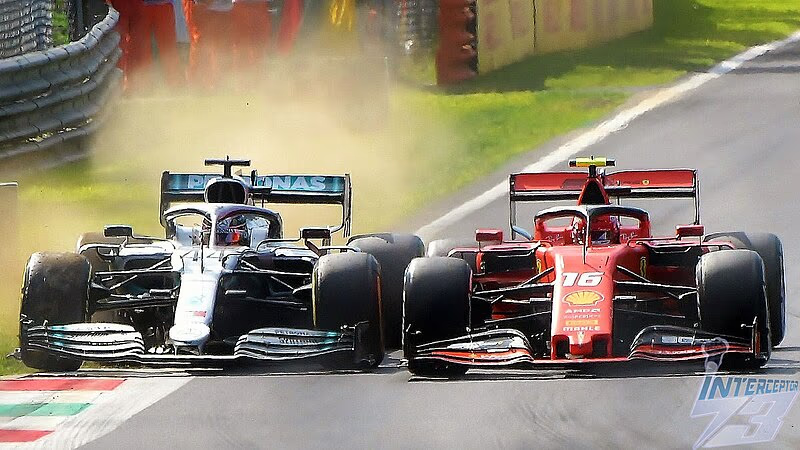
Drivers are expected to make one decisive move to defend their line, then hold it. Repeatedly weaving across the track to block a pursuing car is considered dangerous and unsporting—'chopping' a rival multiple times violates the spirit of wheel-to-wheel combat regardless of whether the stewards intervene. This cultural norm predated its eventual partial codification in the sporting regulations.
Don't move under braking when defending
Changing your defensive line mid-braking zone—when a following car has already committed—is considered one of the most dangerous and dishonorable moves in racing. It removes the pursuer's ability to react. The cultural expectation that defenders choose their line before braking points is strong, even though stewards have only partially codified it.
Don't impede a rival on a flying lap in qualifying
Blocking another driver's timed lap in qualifying—by being too slow on the racing line in their path—is a serious breach of etiquette that can cost them a grid position. Drivers are expected to check their mirrors, let faster cars through clearly, and plan their out-laps to avoid being in the way. Penalties and reputational damage follow persistent offenders.
Car specifications are governed by Section C: Technical Regulations of the FIA Formula 1 Regulations. All dimensions and specifications cited below are drawn from that document unless otherwise noted.
— Section C
Why people argue about this
People often assume that car specifications in F1 are based solely on the current year's regulations without considering past versions, leading to misunderstandings about how certain design elements have evolved over time rather than being dictated by a single document like the 2026 Technical Regulations.
The following dimensional limits apply to all cars competing in the 2026 World Championship: Maximum overall width: 1,900 mm (reduced from 2,000 mm in 2025); Maximum overall height: 950 mm (measured from the reference plane); Maximum wheelbase: 3,600 mm
— Article 4.2
Why people argue about this
People often assume that adding ballast means simply loading extra weight onto their car without considering where it goes or how secure it is. However, they misunderstand that the key point here is securing the ballast so thoroughly that tools are needed to remove it, and declaring its exact position before each race, ensuring fairness for all competitors.
The 2026 season introduces a new Power Unit specification replacing the 2014–2025 hybrid formula. The key elements of the 2026 Power Unit (PU) are: Internal Combustion Engine (ICE): 1.6-litre V6 turbocharged engine, maximum 10,500 rpm, with a single turbocharger; Electrical deployment target: App...
— Article 5.1.4, Article 19, Article 5.2
Why people argue about this
People often assume that eliminating MGU-H will significantly reduce performance, thinking it's a major power unit component. However, they overlook how other parts of the Power Unit can compensate for its absence, leading to confusion about overall impact on car speed and efficiency.
A major 2026 innovation is the introduction of driver-controlled active aerodynamic devices: Front Wing Active Element (FWAE): A moveable flap on the front wing, adjustable by the driver between two pre-defined positions. Permitted at any time, unlike previous DRS systems.; Rear Wing Active Eleme...
— Article 3.9
Why people argue about this
People often assume that driver-controlled active aerodynamic devices in Formula 1 will be purely for aesthetic purposes, like adjustable wings on a race car, but actually, these systems are designed to enhance performance by dynamically adjusting airflow and reducing drag, potentially giving certain teams an unfair advantage if not regulated properly.
Tyres are supplied exclusively by the single designated FIA tyre supplier (Pirelli SpA as of 2026 under the existing supply agreement). No car may be driven using tyres that have not been supplied by the appointed tyre supplier.
— Article 24.4
Why people argue about this
People often assume that F1 teams can still find ways to use illegal tyres by sourcing them from outside suppliers, which they believe circumvents the official supplier agreement. However, the rule explicitly states no car may be driven using non-supplied tyres, so there's no room for interpretation or loophole in this regard.
The following safety components are mandatory on all cars per the Technical Regulations: Halo device (Article 15.4): A titanium or homologated composite structure mounted at the cockpit opening, providing overhead driver protection. Mandatory since 2018; structural requirements are defined in App...
— Article 15.4, Article 14.3, Article 14.1, Article 14.1.2, Article 8.5, Article 15.2
Why people argue about this
People often assume that all safety equipment listed in Rule 2.6 is strictly optional for teams to install, thinking it's merely a recommendation rather than an enforceable requirement. However, the official verdict clearly states these components are mandatory on all cars per the Technical Regulations, meaning teams must adhere to them or face penalties.
HANS device: A Head and Neck Support (HANS) device, or other FIA-approved Frontal Head Restraint (FHR), conforming to FIA 8858-2010 or 8858-2002 is mandatory (ISC Appendix L, Article 4; Sporting Regulations, Article B1.8.2).; Race suit: Must conform to FIA Standard 8856-2018, providing a minimum ...
— Article 4.1, Article 4
Why people argue about this
People often assume that just because a driver is wearing a standard racing suit, they're automatically in compliance with the minimum weight requirement. But actually, what matters most under Rule 2.7 is the total combined mass of the car and its driver must meet or exceed 768 kg, not the specific type of clothing worn by the driver.
All circuits hosting a round of the FIA Formula One World Championship must hold a valid FIA Grade 1 circuit licence, issued in accordance with the FIA Circuit Licence Standards — Grade 1 (latest edition). The homologation is granted for a defined maximum car speed and is reviewed periodically.
Why people argue about this
People often assume that simply having a valid FIA Grade 1 circuit license automatically makes a track eligible for hosting Formula 1 races, but actually, it's about the defined maximum car speed set by the FIA and reviewed periodically to ensure safety standards are met — not just the existence of the license itself.
While no single universal minimum track width applies across all Grade 1 circuits (layout is historically fixed at most venues), the FIA Circuit Licence Standards specify:
Why people argue about this
People often assume that all Formula 1 tracks must have a uniform minimum width across different circuits, which they see as a fixed historical standard at most venues. However, the FIA Circuit Licence Standards actually specify individual track dimensions and surface conditions rather than enforcing a universal minimum width, leading to this misconception about uniformity.
Under Article B1.8.6, drivers must make every reasonable effort to use the track at all times and may not leave the track without a justifiable reason. A driver is judged to have left the track if no part of the F1 Car remains in contact with it; ...
Why people argue about this
People often assume that leaving the track means simply driving off-road, which is why they argue; however, the rule specifically states that a driver is only considered to have left the track if no part of their car remains in contact with it on the circuit, not necessarily straying onto dirt or gravel.
The pit lane is divided into a fast lane and the working lane (pit boxes). Pursuant to Article B1.6 of the Sporting Regulations: Pit entry and exit: Drivers must follow the designated pit entry and pit exit lines where marked. Crossing a solid white line at pit entry or exit may be penalised.; No...
— Article 28.6
Why people argue about this
People often assume that only one lane exists in pit lane for all activities, leading to misunderstandings about which cars can use which parts of it based on their status (like whether they're stopped or working). The confusion arises because this rule specifies two distinct lanes: a fast lane for those actively driving and a separate working lane for maintenance crews.
The start/finish line is a fixed line painted across the full width of the track. Grid positions are marked by painted lines or boards indicating P1 through the total number of grid positions available — for the 2026 Championship, the grid procedu...
Why people argue about this
People often assume that grid positions are just numbered lines painted along the side of the track, forgetting that they're also marked by boards at each starting position, which can lead to confusion about where exactly drivers should be positioned for their race start.
Circuits are divided into marshalling sectors, each served by a marshal post. ) and light panels at each post is coordinated by the Clerk of the Course.
Why people argue about this
People often assume that the different colored flags used in marshalling sectors are interchangeable for signaling different issues on the track, which they're not. Actually, each color has a specific meaning related to safety protocols like caution or emergency stops, and misinterpreting them can lead to confusion and potentially dangerous situations.
A "Competitor" in Formula 1 is the Constructor: the organisation that designs and builds the car.
— Article 8.2, Article 8.3
Why people argue about this
People often think that a competitor in Formula 1 refers solely to the driver who's behind the wheel, forgetting about the entire team effort from design to maintenance of the car. But actually, under this rule, the "Competitor" encompasses the whole constructor, which includes all the engineers, mechanics, and support staff involved in building and maintaining the racing car.
All drivers competing in a World Championship event must hold a valid FIA Super Licence, the highest class of racing licence issued by the FIA.
Why people argue about this
People often assume that only top-tier racers need a Super Licence, leading them to overlook that even non-championship drivers must hold one for World Championship events, which can cause confusion about who needs what license and where compliance is mandatory.
All team personnel present in the pit lane, garages, or on the grid during sessions must hold appropriate FIA or ASN accreditation.
Why people argue about this
People often assume that the Race Director is appointed by each individual team rather than by FIA, leading to misunderstandings about their role in overseeing the entire race event. The confusion arises because they are clearly stated to be appointed by the FIA, not individually by teams as some might initially think.
The Race Director is appointed by the FIA and, per Article B1.3.3, has overriding authority (subject to the Clerk of the Course acting only with their express agreement) over the control of free practice, qualifying, sprint qualifying, sprint, and...
Why people argue about this
People often assume that the Race Director's authority is absolute in free practice, qualifying, and sprint events, but they misunderstand Article B1.3 which stipulates their power "subject to the Clerk of the Course acting only with their express agreement." This oversight can lead to confusion about who ultimately makes final decisions during these crucial race preparation phases.
A panel of a minimum of three and a maximum of four stewards (one appointed chair), all holders of an FIA Super Licence, is nominated for each event by the FIA and the relevant ASN (Article B1.3.1–B1.3.2).
Why people argue about this
People often assume that only FIA officials can be stewards in Formula 1 races, which is a misconception. Actually, while stewards must hold an FIA Super Licence, they don't have to be directly affiliated with the FIA; stewards are appointed by the FIA and the relevant national authority (ASN), allowing for a broader pool of qualified individuals who can serve as stewards.
The FIA Technical Delegate nominated by the FIA is responsible for scrutineering and may carry out, or have carried out by scrutineers, any checks to verify the compliance of the F1 Cars entered in the Competition at any time until the end of the ...
Why people argue about this
People often assume that FIA Scrutineers only inspect cars before an event starts, forgetting about post-qualifying and post-race inspections. However, the official verdict clarifies these are all part of their responsibilities under rule 4.6.
The standard 2026 Formula One race weekend consists of three days (Friday, Saturday, Sunday) with the following session structure: Friday: Practice 1 (FP1) — 60 minutes; Practice 2 (FP2) — 60 minutes; Saturday: Practice 3 (FP3) — 60 minutes; Qualifying (Q1/Q2/Q3); Sunday: Race
Why people argue about this
People often assume that all three practice sessions are mandatory just like qualifying, which leads to arguments about whether teams can skip one of them if they choose. Actually, these practices are part of the official race weekend format and are scheduled in a specific order for a reason, not optional extras.
The race distance is the least number of complete laps that exceeds 305 km, except at Monaco, where it is the least number of complete laps that exceeds 260 km (Article B2.5.2). The base race duration is two (2) hours from the start signal; should...
Why people argue about this
People often argue over why the race distance isn't always exactly 305 km or 260 km at Monaco, thinking it's due to some arbitrary rounding issue. In reality, the confusion arises because of different track layouts and varying circuit lengths that necessitate adjusting the exact distance to ensure fairness across all circuits while adhering to the spirit of safety and racing integrity.
Qualifying determines the grid order for the race using a three-segment knock-out format.
— Article 24.6
Why people argue about this
People often think that qualifying in Formula 1 is a straightforward race where drivers compete against each other like they do in the main event, but actually, it's structured as a knock-out format to determine grid positions for the actual race, which adds complexity and can lead to confusion about who competes and how.
Parc fermé conditions apply from the start of Qualifying until the start of the race. Under parc fermé, no work may be carried out on the car except that which is specifically permitted, including work required for safety reasons approved by the F...
Why people argue about this
People often assume that only safety-related work is allowed during parc fermé, which they believe means anything related to race preparation like changing tires or adjusting settings. However, the actual rule states that only specifically permitted work can be done, including safety-approved tasks, so it's not as broad as what people commonly think.
The pre-race procedure follows a defined sequence: A notification board is shown to indicate the number of minutes to the formation lap. Pit lane opens at this time.; One minute before the formation lap, the pit lane exit closes. Cars must leave the grid for the formation lap no later than this s...
Why people argue about this
People often assume that if they're ready to go when the pit lane closes one minute before the formation lap begins, they'll be fine. However, the confusion arises because the cars must leave the grid for the formation lap no later than this time, not simply being prepared; they need to actually be on track and in motion by then.
There is no mandatory pit stop requirement under most race conditions; however, the tyre regulations require that a driver who starts the race on dry-weather tyres uses at least two different dry-weather tyre specifications during the race, effect...
— Article 24.6, Article 28.11
Why people argue about this
People often assume that there are strict mandatory pit stop rules in F1 based on the number of stops a driver makes, but actually, it's about using different tyre specifications during the race as per the regulations, which can lead to confusion with how many times they need to change their tyres rather than just focus on pit stops.
A driver may use any part of the track (within the defined track limits) during the race. Key conduct rules include: At no time may an F1 Car be driven unnecessarily slowly, erratically, or in a manner that could be deemed potentially dangerous to other drivers or any other person (Article B1.8.5...
Why people argue about this
People often argue that if a car can use all of the track, then it should be able to drive at whatever speed is fastest for its strategy or comfort. But actually, the rule states drivers must avoid driving slowly in a way that could endanger others, which means they're allowed to maintain their optimal pace but not go so slow as to cause risk to other racers.
The Safety Car (SC) is deployed when conditions are not suitable for racing but do not warrant a race suspension. Upon SC deployment: SC boards or lights are shown at all marshal posts and on the Marshalling System panels in cockpits.; All cars must reduce speed and form a queue behind the SC. No...
Why people argue about this
People often assume that once a Safety Car is deployed, all cars must immediately stop completely and form a single-file line behind it, which can lead to misunderstandings about their speed restrictions or positioning. However, the actual rule states that cars must reduce speed and form a queue, not necessarily come to a complete halt, allowing for some flexibility in how they maintain formation.
The Virtual Safety Car (VSC) procedure allows neutralisation of a session for short periods without deploying the physical Safety Car. When the VSC is deployed, the message "VSC DEPLOYED" is sent to all Competitors and all FIA light panels display...
Why people argue about this
People often assume that deploying a Virtual Safety Car in F1 means all cars have to stop immediately like with a physical car, but actually, it's just a warning system where drivers slow down and maintain their current pace until further notice, as indicated by messages from the race stewards.
The Race Director may suspend the race (red flag) if the track is blocked or conditions are dangerous. Red flags are shown at the start/finish line and at all marshal posts, and the message "RED FLAG - RACE SUSPENDED" is sent to all Competitors.
Why people argue about this
People often assume that a red flag means all cars must immediately stop at their pit boxes, which leads to arguments about who stopped first and second. However, the actual rule states only that drivers show the red flag signal as instructed by the Race Director, allowing them to continue on if conditions permit without stopping, thus avoiding unnecessary grid penalties or disputes over timing.
Points are awarded to the classified finishers of each World Championship race as follows:
Why people argue about this
People often assume that if a driver finishes in 1st place, they automatically get all the points for the race, but actually, the distribution is based on how many cars are classified (finish) at the end of the race, not just who's first. So, even if one car crashes out and doesn't finish, it can still affect how points are awarded to those that do make it across the line.
One additional point is awarded to the driver who sets the fastest lap of the race, provided that driver is classified within the top 10 finishers. If the driver who sets the fastest lap finishes outside the top 10, no bonus point is awarded (this rule applies since 2019).
Why people argue about this
People often assume that if a driver sets the fastest lap in any race, they automatically get a bonus point, regardless of their final finishing position. However, the actual rule is that only drivers who finish within the top 10 are eligible for this bonus point, which has led to much debate and confusion among fans and teams alike.
No fastest lap bonus point is awarded for Sprint sessions. Sprint points count towards both the Drivers' and Constructors' championships.
Why people argue about this
People often assume that a fastest lap in Sprint races earns bonus points, which can affect their championship standings. But the official FIA verdict clarifies that no such point is awarded for these sessions, leading to confusion about how exactly those laps contribute to overall rankings.
If a race is stopped and cannot be restarted, or is declared finished before 75% of the scheduled race distance has been completed: If fewer than two laps have been completed: no points are awarded; If between two laps and 25% (rounded down) of the scheduled race distance: half points are awarded...
Why people argue about this
People often assume that if a race is stopped early due to safety concerns and no laps are completed, they automatically get zero points. However, under 6.4 of Formula 1's rules, it’s actually only half-points that apply when fewer than two full laps have been completed—despite the race being effectively canceled for safety reasons.
The Drivers' World Championship is awarded to the driver who has accumulated the most points across all rounds of the championship. In the case of equal points at the end of the season, the driver with the most race wins is declared champion; if s...
— Article 59.5
Why people argue about this
People often assume that if two drivers finish with identical points at the end of a season in Formula 1, they would be declared tied for the championship. However, according to the official rules, it's actually determined by who had more race wins; thus, this rule introduces an additional layer of competition beyond just points.
The Constructors' World Championship is awarded to the Constructor which has accumulated the most points. Both cars' points from every event count towards the Constructors' championship.
— Article 60.4
Why people argue about this
People often assume that only one car's points count towards the Constructors' World Championship in F1, when in fact both cars' points from every race add up together. This leads to misunderstandings about which team is actually leading the championship at any given moment.
A driver is classified as a finisher (and thus eligible for championship points) if they have completed at least 90% of the number of laps covered by the winner, rounded down to the nearest whole lap.
Why people argue about this
People often assume that if a driver finishes more than 90% of the race distance, they automatically get championship points, but actually, it's about completing whole laps—so finishing just over 90%, say by half a lap, doesn't count unless you've completed an extra full lap. It’s all about those pesky fractions and rounding down to the nearest whole number!
Penalties in Formula 1 are imposed by the stewards under Article B1.9 of the Sporting Regulations ("Incidents, Infringements & Penalties"), or administratively by the Race Director for defined infringements. Under Article B1.9.3, unless it is clea...
Why people argue about this
People often assume that penalties in Formula 1 are automatically handed down by stewards without Race Director intervention, which is incorrect according to Article B1.9.3 of the Sporting Regulations. The confusion arises because they overlook the Race Director's role for certain infringements and instead mistakenly believe all decisions fall solely under steward jurisdiction.
In the event of an Incident during a Total Time Classified Session (i.e. a Sprint or the Race), the stewards may impose any one of the following penalties:
Why people argue about this
People often assume that race penalties in Formula 1 are solely about driver performance issues like speeding or dangerous driving. However, they overlook the fact that these penalties can also be imposed for incidents during practice sessions, which is a common misconception since Article B1.9.5 specifically refers to "Total Time Classified Sessions," including Sprints and the actual race itself.
Collision causing a retirement: Typically investigated and may result in a time penalty or grid drop, depending on fault determination by the stewards.; Forcing a driver off track / making contact: Investigated as an Incident under Article B1.9; penalties range from a time penalty to a grid drop....
Why people argue about this
People often assume that if a driver intentionally forces another car off track, they'll get away with it as long as no contact is made, but actually, forcing a competitor out of the race can be just as serious under Article B1.9, leading to penalties ranging from time penalties up to grid drops, regardless of whether there was physical contact or not.
Car below minimum weight: Disqualification from the relevant session or race results, per Technical Regulations Article 4.2.; Illegal fuel / fuel composition: Disqualification from the race results.; Exceeding fuel flow rate: Disqualification from the race results (Technical Regulations, Article ...
— Article 4.2, Article 5.1.4
Why people argue about this
People often assume that the Power Unit component allocation rules are strictly about engine parts, but in reality, they cover a broader spectrum of components like compressors, turbines, intercoolers, etc., which can lead to confusion over what exactly constitutes an infringement and how it affects performance across different teams.
For the 2026 Championship, the Power Unit component allocation is defined as follows per driver, per Championship (Article B8.2.2), unless the driver drives for more than one Competitor:
Why people argue about this
People often assume that if a driver switches teams mid-season for the 2026 Championship, they can simply carry over their Power Unit components from their previous team without restrictions. However, the actual rule states that each driver must adhere to separate allocations per driver, per Championship, regardless of team changes, ensuring fair competition across all competitors.
Under the FIA International Sporting Code, the FIA World Motor Sport Council has authority to impose penalties on Competitors or drivers beyond the stewards' immediate powers, including exclusion f...
Why people argue about this
People often assume that they can protest a decision at any time after it's made, without needing to follow the 30-minute deadline. Actually, the rule clearly states you must lodge your protest within 30 minutes of session or race results being published, and includes details about the deposit needed for the process.
A Competitor wishing to protest a decision must lodge a formal protest with the Clerk of the Course no later than 30 minutes after the session or race results are published. A protest deposit (as specified in the national ASN or FIA schedule of fees) must be lodged with the protest.
Why people argue about this
People often assume that they can protest anything at any time after a race without adhering to strict deadlines, which leads them to misunderstand the necessity of lodging a formal protest within 30 minutes post-results publication and ensuring they've paid the required deposit as specified by their national association or FIA schedule.
The safety of drivers, team personnel, officials, and spectators is the primary consideration in the administration of the FIA Formula One World Championship. The FIA's Medical and Safety Commission oversees continuous development of safety standa...
Why people argue about this
People often assume that the FIA Safety Mandate is solely about crash barriers and track safety measures, forgetting its broader scope which includes driver health and welfare, as well as medical protocols for race events. The mandate isn't just about physical infrastructure but also encompasses the safety of drivers' mental and emotional states during races.
Mandatory since the start of the 2018 season, the Halo is a titanium structure fitted above the driver's cockpit designed to deflect debris and reduce the risk of fatal head impacts.
— Article 15.4.3
Why people argue about this
People often assume that the Halo is only there for safety reasons, thinking it's a purely protective device against head injuries during crashes. However, the truth is more complex; the FIA mandated its use to improve aerodynamics and reduce drag on cars, which indirectly contributes to safer driving conditions by enhancing overall vehicle stability at high speeds.
The Safety Car (SC) is an FIA-designated vehicle that leads the field at reduced pace during dangerous conditions. Its deployment eliminates the speed differential between cars while incidents are cleared, reducing risk to marshals and recovery vehicles.
Why people argue about this
People often assume that the Safety Car only comes out when there's a crash on track, which is why they argue it doesn't appear for slower cars drafting off faster ones or in heavy rain. Actually, the rule states it can be deployed at the discretion of the race stewards to maintain safety and order, regardless of specific incidents like crashes.
When red flags are shown, overtaking is forbidden, the Pit Lane exit is closed, and all cars must proceed slowly into the Pit Lane (Article B5.14.2). If the session cannot be resumed, results are taken at the end of the penultimate lap before the lap during which the suspension signal was given.
Why people argue about this
People often assume that red flag shows mean overtaking is forbidden everywhere, including on track, which isn't entirely accurate. The official rule states it's only in the Pit Lane where overtaking is strictly prohibited and cars must proceed slowly, not throughout the entire circuit. This can lead to confusion about how far beyond the Pit Lane this slow-moving requirement extends.
A fully equipped FIA Medical Car staffed by the FIA Medical Delegate (or a deputy) must be present on track throughout all sessions.
Why people argue about this
People often assume that having a FIA Medical Car with an FIA Medical Delegate is just about showing up on track for practice sessions, but actually, they must be present throughout all sessions, including qualifying and race weekends, which can lead to scheduling conflicts and logistical issues.
Official instructions are given to drivers by means of the signals laid out in the ISC; Competitors may not use flags or lights similar to these.
— Article 2.5.5
Why people argue about this
People often assume that using flags or lights similar to those used by officials during race broadcasts is allowed as a way to communicate with other drivers in real-time, but actually, the official verdict clearly states that competitors are strictly prohibited from doing so, emphasizing the importance of adhering to the specific signals outlined in ISC Appendix H for safety and fairness.
All Super Licence holders must undergo a medical examination by an FIA-approved doctor prior to each season. Medical examination requirements include vision tests, cardiovascular assessment, and neurological screening.
Why people argue about this
People often assume that the FIA fuel rig specifications apply only during races, forgetting that they must adhere to these standards in the pit lane at all times, leading to confusion about when exactly these regulations take effect and how strictly they need to be followed.
For FIA Grade 1 homologation, all circuits must provide: Barrier systems: ARMCO (steel) barrier, SAFER barrier (steel and foam energy reduction), or TecPro barrier in designated impact zones per the FIA Circuit Safety Technical Guidelines; Run-off areas: Asphalt or gravel run-off designed to dece...
Why people argue about this
People often argue that fuel rigs in the pit lane should only be about safety and don't realize they're also subject to strict specifications set by FIA, thinking these specs are just for aesthetic or convenience reasons rather than critical performance criteria.
Fuel and fuel rigs in the pit lane must comply with FIA fuel rig specifications. Fuelling equipment must include FIA-approved dry-break coupling systems.
Why people argue about this
People often assume that just because fuel rigs are in the pit lane, they can be made of anything as long as they hold fuel. But actually, the rule requires them to meet FIA specifications for safety and use approved dry-break coupling systems to prevent leaks and fires. Confusion arises because some might not realize the critical fire safety aspect of this regulation.
Car specifications are governed by Section C: Technical Regulations of the FIA Formula 1 Regulations. All dimensions and specifications cited below are drawn from that document unless otherwise noted.
— Article 3, Article 4.2, Article 5.1.4, Article 19, Article 5.2, Article 3.9, Article 24.4, Article 15.4, Article 14.3, Article 14.1, Article 14.1.2, Article 8.5, Article 15.2, Article 4.1, Article 4, Section C
Why people argue about this
People often assume that all car dimensions are explicitly stated in black and white within the FIA Technical Regulations for 2026, but actually, there's a lot of room for interpretation and extrapolation from various sections, leading to debates over whether certain features like wheelbase or engine displacement fall under specific measurements.
All circuits hosting a round of the FIA Formula One World Championship must hold a valid FIA Grade 1 circuit licence, issued in accordance with the FIA Circuit Licence Standards — Grade 1 (latest edition). The homologation is granted for a defined maximum car speed and is reviewed periodically.
— Article 28.6
Why people argue about this
People often assume that just having a valid FIA Grade 1 circuit licence means the track is automatically safe for Formula 1 races, which leads to misunderstanding about what exactly the license entails—specifically, it's more about meeting speed and safety standards rather than guaranteeing the entire circuit itself is grade 1.
A "Competitor" in Formula 1 is the Constructor: the organisation that designs and builds the car.
— Article 8.2, Article 8.3
Why people argue about this
People often think that a "Competitor" in Formula 1 refers to the driver themselves, rather than the team (Constructor) behind them. But actually, according to Section 4 of FIA's rules, a Competitor is defined as the entire team, including all drivers and their equipment, not just one individual racer.
The standard 2026 Formula One race weekend consists of three days (Friday, Saturday, Sunday) with the following session structure: Friday: Practice 1 (FP1) — 60 minutes; Practice 2 (FP2) — 60 minutes; Saturday: Practice 3 (FP3) — 60 minutes; Qualifying (Q1/Q2/Q3); Sunday: Race
— Article 24.6, Article 28.11
Why people argue about this
People often assume that the Sprint Race is just a shorter version of the regular Grand Prix race, forgetting that it's essentially an entirely different format with its own qualifying process (Sprint Shootout) and time limits, leading to misunderstandings about how points are awarded or how strategy plays out compared to traditional Grands Prix.
Points are awarded to the classified finishers of each World Championship race as follows: If fewer than two laps have been completed: no points are awarded; If between two laps and 25% (rounded down) of the scheduled race distance: half points are awarded to the top 5 classified positions; If be...
— Article 59.5, Article 60.4
Why people argue about this
People often assume that Article 57 of the FIA Formula One Sporting Regulations 2026 is where you find out about scoring points for finishing positions, but actually it's Section 6 that outlines how those points are distributed across races and seasons, leading to a lot of debate over which section contains the actual rules.
Penalties in Formula 1 are imposed by the stewards under Article B1.9 of the Sporting Regulations ("Incidents, Infringements & Penalties"), or administratively by the Race Director for defined infringements. Under Article B1.9.3, unless it is clea...
— Article 4.2, Article 5.1.4
Why people argue about this
People often assume that penalties in Formula 1 are solely imposed by the Race Director for administrative issues, forgetting that Stewards can also impose them under Article 54 of the Sporting Regulations for infractions like illegal tire changes or driver behavior. This leads to confusion about who has the authority to penalize and what exactly constitutes a penalty.
The safety of drivers, team personnel, officials, and spectators is the primary consideration in the administration of the FIA Formula One World Championship. The FIA's Medical and Safety Commission oversees continuous development of safety standa...
— Article 15.4, Article 15.4.3, Article 2.5.5, Article 4
Why people argue about this
People often assume that safety measures in Formula 1 are solely about crash barriers and fireproof cars, forgetting that it also includes advanced medical protocols for drivers post-race, like continuous monitoring by FIA's Medical and Safety Commission to ensure their long-term health isn't compromised despite the high-stress racing environment.