

🏛️Official — FIA
Loading OpenSourceSports…
Motor Sports
1–20 players
both
car, helmet, race suit
10 essential rules
Formula One World Championship racing is governed by the Fédération Internationale de l'Automobile (FIA) under the authority of the FIA International Sporting Code (ISC) and its appendices. As of the 2026 Championship, the FIA Formula 1 Regulations are published in three parts: Section A — Genera...
Car specifications are governed by Section C: Technical Regulations of the FIA Formula 1 Regulations. All dimensions and specifications cited below are drawn from that document unless otherwise noted.
The following dimensional limits apply to all cars competing in the 2026 World Championship: Maximum overall width: 1,900 mm (reduced from 2,000 mm in 2025); Maximum overall height: 950 mm (measured from the reference plane); Maximum wheelbase: 3,600 mm
The 2026 season introduces a new Power Unit specification replacing the 2014–2025 hybrid formula. The key elements of the 2026 Power Unit (PU) are: Internal Combustion Engine (ICE): 1.6-litre V6 turbocharged engine, maximum 10,500 rpm, with a single turbocharger; Electrical deployment target: App...
A major 2026 innovation is the introduction of driver-controlled active aerodynamic devices: Front Wing Active Element (FWAE): A moveable flap on the front wing, adjustable by the driver between two pre-defined positions. Permitted at any time, unlike previous DRS systems.; Rear Wing Active Eleme...
Tyres are supplied exclusively by the single designated FIA tyre supplier (Pirelli SpA as of 2026 under the existing supply agreement). No car may be driven using tyres that have not been supplied by the appointed tyre supplier.
The following safety components are mandatory on all cars per the Technical Regulations: Halo device (Article 15.4): A titanium or homologated composite structure mounted at the cockpit opening, providing overhead driver protection. Mandatory since 2018; structural requirements are defined in App...
HANS device: A Head and Neck Support (HANS) device, or other FIA-approved Frontal Head Restraint (FHR), conforming to FIA 8858-2010 or 8858-2002 is mandatory (ISC Appendix L, Article 4; Sporting Regulations, Article B1.8.2).; Race suit: Must conform to FIA Standard 8856-2018, providing a minimum ...
All circuits hosting a round of the FIA Formula One World Championship must hold a valid FIA Grade 1 circuit licence, issued in accordance with the FIA Circuit Licence Standards — Grade 1 (latest edition). The homologation is granted for a defined maximum car speed and is reviewed periodically.
While no single universal minimum track width applies across all Grade 1 circuits (layout is historically fixed at most venues), the FIA Circuit Licence Standards specify:
Under Article B1.8.6, drivers must make every reasonable effort to use the track at all times and may not leave the track without a justifiable reason. A driver is judged to have left the track if no part of the F1 Car remains in contact with it; ...
Never deliberately crash into a rival to win the championship
The most serious taboo in F1: intentionally colliding with a championship rival to secure the title is universally condemned. Ayrton Senna's deliberate take-out of Alain Prost in Japan 1990, Michael Schumacher's moves against Damon Hill (1994) and Jacques Villeneuve (1997) are the definitive case studies—each still debated decades later as stains on the sport's integrity.
Violations are career-defining controversies. Schumacher was stripped of his 1997 championship points for the Villeneuve incident.
Defend with one move, not repeated weaving
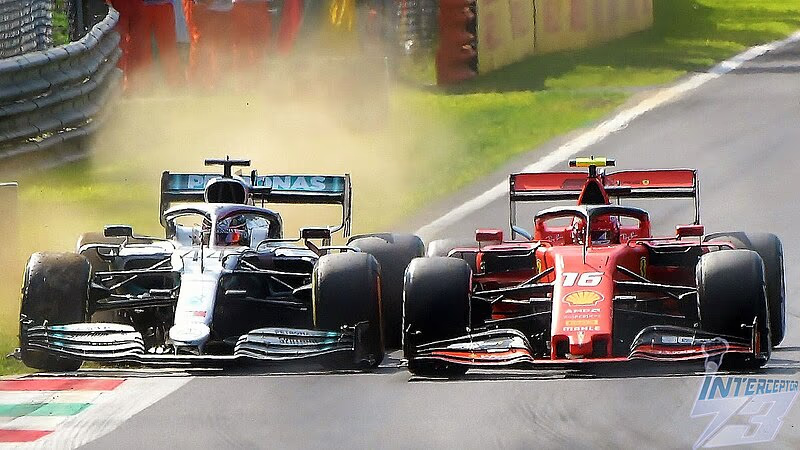
Drivers are expected to make one decisive move to defend their line, then hold it. Repeatedly weaving across the track to block a pursuing car is considered dangerous and unsporting—'chopping' a rival multiple times violates the spirit of wheel-to-wheel combat regardless of whether the stewards intervene. This cultural norm predated its eventual partial codification in the sporting regulations.
The distinction between 'one move to defend' and 'blocking' has generated intense stewards debates throughout the DRS era.
Don't move under braking when defending
Changing your defensive line mid-braking zone—when a following car has already committed—is considered one of the most dangerous and dishonorable moves in racing. It removes the pursuer's ability to react. The cultural expectation that defenders choose their line before braking points is strong, even though stewards have only partially codified it.
Incidents involving Schumacher and Barrichello at Hungary 2010, and multiple Verstappen/Hamilton moments, reignited debate about where racing starts and foul play begins.
Don't impede a rival on a flying lap in qualifying
Blocking another driver's timed lap in qualifying—by being too slow on the racing line in their path—is a serious breach of etiquette that can cost them a grid position. Drivers are expected to check their mirrors, let faster cars through clearly, and plan their out-laps to avoid being in the way. Penalties and reputational damage follow persistent offenders.
The problem worsened with Q3 traffic in the hybrid era. Teams also bear responsibility for poor timing of their driver's laps.
Ready to dive deeper?