

🏛️Official — NFHS
Loading OpenSourceSports…
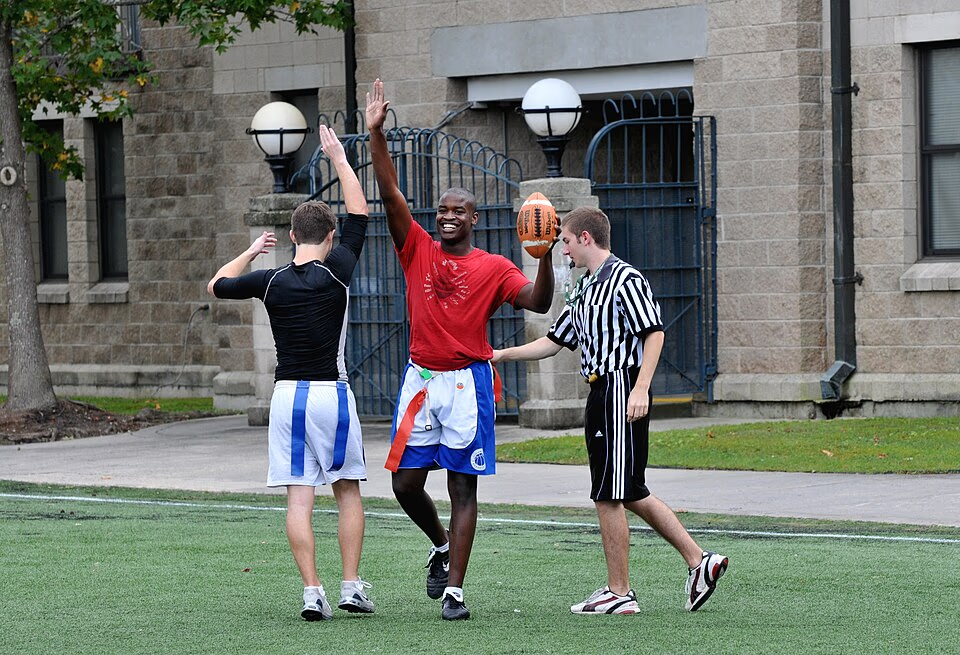
Player is "down" when defender removes either hip flag (or back flag if used); No tackling, blocking, or contact — incidental contact penalty-free; intentional contact = flag
Why people argue about this
People often think that a player is only downed if they drop their hands completely off the ball, but in reality, a defender just needs to remove either hand from the ball for it to count as "Down a Player," regardless of how much or little contact there is with the ball itself. The confusion arises because this rule isn't explicitly clear about what constitutes removing one's hand from the ball.
Two 20-minute halves (running clock except in final 2 minutes — clock stops on incomplete pass, out-of-bounds, score, change of possession); 1-minute half-time; OT periods if tied (alternating from 10-yard line); Each team is allowed three charged timeouts per half (increased from two, per the Ru...
— Rule 3
Why people argue about this
People often assume that the running clock applies throughout both halves, forgetting about the final two minutes where officials can stop play for various reasons, leading to unexpected end times that catch coaches off guard.
QB starts behind line of scrimmage; one direct hike; Once ball is hiked: QB has 7-second pass clock or must release/lateral; Forward pass allowed only behind line of scrimmage
Why people argue about this
People often assume that a possession resets every time there's a turnover, forgetting that in NFHS Flag Football, each possession begins anew at the offense’s own 5-yard line regardless of what happened on previous plays, leading to confusion about when a new possession starts and how it affects scoring opportunities.
Each possession starts at offense's own 5-yard line; Offense has 4 downs to advance past midfield → fresh 4 downs to score; No first downs prior to midfield
Why people argue about this
People often assume possession means starting from midfield right away, which would be 50 yards downfield for a team at their own 5, but actually, it starts at your own 5-yard line and each team gets four downs to move past that initial 5-yard mark, not necessarily reaching midfield.
Ball: youth/junior/intermediate football (size adjusted by gender + level); Flag belt: three-flag belt (two hip + one back) per player; pop-style detachable flags 14-16" long; No pads or helmets required (no tackling)
Why people argue about this
People often assume that only offensive players need mouthguards in flag football, leading to a misunderstanding of who must wear them. However, the official verdict clarifies that mouthguards are required for all players at most NFHS levels, not just those on offense. This rule is meant to protect all participants from potential oral injuries during tackles and collisions.
Field: Per Rule 1, state associations designate one of four official field sizes for competition: 300 ft. × 120 ft., 360 ft. × 120 ft., 360 ft. × 160 ft., or the newly added 300 ft. × 160 ft. (adopted for 2026-27) — each configuration includes two 30-foot end zones.; 5-yard line markings; cones m...
— Rule 1
Why people argue about this
People often assume that all Flag Football fields are exactly 80 yards long, forgetting that different states have varying regulations for field dimensions. The confusion arises because these state-specific rules aren't always clearly communicated or enforced uniformly across leagues and schools.
5 players per side on the field (some states 7-on-7); Roster size typically 12-15 players per team; Substitutions: unlimited between plays
Why people argue about this
People often assume that in NFHS Flag Football, each team must always have exactly 5 players on the field at all times during a play, which leads to arguments about substitutions or changes in formation. However, the actual rule allows for unlimited substitutions between plays, so teams can adjust their formations and numbers as needed without violating any rules.
Two 20-minute halves (running clock except in final 2 minutes — clock stops on incomplete pass, out-of-bounds, score, change of possession); 1-minute half-time; OT periods if tied (alternating from 10-yard line); Each team is allowed three charged timeouts per half (increased from two, per the Ru...
— Rule 3
Why people argue about this
People often assume that advancing past midfield automatically wins them the possession instead of just giving it back to the other team, which is a common misunderstanding since they're under 4 downs when crossing midfield. The confusion arises because the rule essentially gives teams another chance at gaining those crucial 10 yards if they can't manage within their remaining downs.
Touchdown: 6 points; Extra point (PAT): 1 point from 5-yard line, 2 points from 10-yard line; Trailing-team possession option (new exception to Rule 8-3-9, effective 2026-27): instead of attempting a try, a team trailing on the scoreboard may elect to retain possession, taking over on fourth down...
— Rule 8
Why people argue about this
People often assume that a safety automatically gives their team 2 points, forgetting that it's actually awarded to the defense for recovering a fumble in their end zone. This oversight leads to much debate over whether a safety should be considered an offensive or defensive play in terms of scoring.
Offensive flag-guarding: 5-yard penalty + loss of down (using hands/arms to block defender's reach for flag); Illegal contact / blocking: 10-yard penalty; Defensive holding / illegal flag pull: 5-yard penalty + automatic first down
— Rule 9
Why people argue about this
People often assume that defensive players can't be penalized for flag-guarding, thinking it's only offensive players who get flagged in NFHS Flag Football. This misunderstanding stems from a lack of understanding about which team is responsible for maintaining possession and avoiding penalties when handling the ball.
Flag Football is intentionally non-contact, which substantially reduces injury risk relative to tackle football. NFHS still requires: mandatory mouthguards (at most state-association levels), pre-participation physical examination, certified athle...
— Rule 9
Why people argue about this
People often assume that since flag football is described as "intentionally non-contact," players don't wear helmets or pads. But actually, while it's true there are no helmet-to-helmet hits in flag, mandatory mouthguards and pre-participation physicals still apply to ensure player safety regardless of the contact level.