


🏛️Official — FEI
Loading OpenSourceSports…
Red ribbon on the tail marks a horse that kicks
A horse known to kick must wear a red ribbon braided or tied visibly into its tail in any shared warm-up or collecting ring. This signals all other riders to keep their distance behind it. Failing to ribbon a known kicker is one of the gravest breaches of barn and competition etiquette across every equestrian discipline worldwide.
Never publicly lose your temper with your horse
Visibly venting frustration on a horse — aggressive use of spurs, excessive whip, or harsh rein contact — in front of judges, officials, or spectators is a deep cultural taboo at the FEI level, entirely separate from written welfare rules. Elite riders are expected to maintain composure regardless of how badly a round has gone. The horse must not bear the cost of the rider's emotions in public.
Riders tracking left have right of way in shared arenas
When two riders meet going in opposite directions in a warm-up or schooling arena, the rider tracking left (counterclockwise) has conventional right of way. The rider tracking right moves off the centre line or wall to yield. This convention is taught from the first lessons in FEI-affiliated programmes and remains the default in international warm-ups.
Only one horse approaches the practice fence at a time
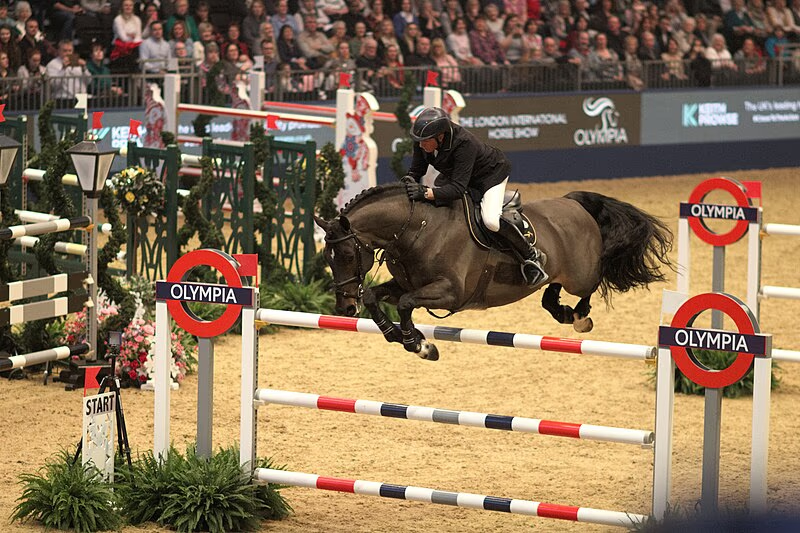
In a show jumping warm-up, riders queue informally at the practice fence. Only one horse is on the approach or landing side at a time. Riders wait clear of the line until the previous horse has jumped and moved away before turning in. Cutting the queue, cross-approaching, or failing to wait is a serious breach that risks dangerous collisions.
Any breed of horse is eligible for Olympic equestrian competition. Horses must meet the following requirements: Age: Minimum 9 years old for all three Olympic disciplines; FEI Passport: Each horse must be registered with the FEI and carry a valid FEI identification document (passport) recording i...
Why people argue about this
People often assume that only certain horse breeds are allowed in Olympic equestrian competitions based on their personal preferences or limited knowledge of equine varieties. However, the official ruling clarifies that any breed of horse is eligible as long as it meets the necessary performance standards and health criteria, which can lead to misunderstandings about specific types being banned.
Dressage saddle: Deep-seated with long, straight flaps to facilitate a long leg position. No weight restrictions.; Jumping saddle: Forward-cut seat with shorter flaps to accommodate the rider's shorter stirrup length over fences. Used in Show Jumping and the SJ phase of Eventing.; Cross-country s...
Why people argue about this
People often argue that a horse must be at least 9 years old just from reading the rule without context, forgetting it's part of a broader set of regulations including registration and passport requirements. The confusion arises because they overlook the necessity for all these components to participate in FEI competitions, not just the age stipulation alone.
Helmet: ASTM/SEI F1163, PAS 015, EN 1384 (or successor standard) certified riding helmet mandatory at all times when mounted. Chin strap must be fastened. No modifications to the helmet shell.; Dressage attire: Shadbelly (tailcoat) or short jacket, white or light-colored breeches, tall black boot...
Why people argue about this
People often assume that the "Rider Equipment and Attire" section in the FEI equestrian rulebook must cover all sorts of gear from saddles to spurs, when in fact it explicitly states this area is not addressed within their guidelines. The confusion arises because they interpret the title literally as a comprehensive list, overlooking the explicit disclaimer about its scope.
Dimensions: 60 m × 20 m (197 ft × 66 ft) for Grand Prix and Olympic competition. A smaller 40 m × 20 m arena is used for lower levels but not at the Olympics.; Letters: Marker letters placed around the perimeter define where movements must be performed. Perimeter letters: A (entrance), K, E, H, C...
Why people argue about this
People often assume that the perimeter markers are there for purely aesthetic reasons, when in fact they delineate the exact 60m x 20m area required by the competition rules for Grand Prix and Olympic Dressage events. The confusion arises because these markers ensure every horse and rider start and end precisely within the designated space, maintaining the integrity of the scoring system.
Minimum area: 2,500 m² (26,910 ft²) for Olympic competition, though larger arenas (up to 5,000 m²) are preferred for Grand Prix courses; Obstacles: 10–16 obstacles with 12–15 jumping efforts (including combinations of 2 or 3 elements). Fences include verticals (poles stacked vertically), oxers (s...
Why people argue about this
People often assume that 60m x 20m is a fixed size for all show jumping arenas worldwide, but in reality, it's just the standard dimensions used for Grand Prix and Olympic competitions, allowing flexibility elsewhere to fit different venues' needs.
Course length: 5,700–6,270 m (3.5–3.9 miles) for Olympic-level (CCI5*-equivalent) competition; Jumping efforts: 25–40 jumping efforts, including combinations; Fence dimensions: Maximum height 1.20 m (3 ft 11 in), maximum spread 1.80 m (5 ft 11 in) at the highest point, maximum spread at base 2.40...
Why people argue about this
People often assume that the depth of footing material only needs to be 8-12 cm for eventing cross-country courses, but they overlook the crucial aspect that it must be a consistent non-slip surface across the entire course. The misconception arises because they focus solely on the depth measurement without considering the uniformity and stability requirement.
Individual events: Each athlete competes as an individual horse-rider combination; Team events: Teams of 3 riders per nation. All 3 scores count (no drop score since the team size was reduced from 4 to 3 in recent Olympic formats). Team and individual medals may be decided from the same competiti...
Why people argue about this
People often assume that the maximum of 3 riders per nation applies only to individual competitors in equestrian events, forgetting that it also includes teams of three. This leads to misunderstandings because they overlook the fact that this rule covers all types of competitors—individuals and teams alike—in any discipline, not just team settings.
Ground Jury: 5 or 7 judges positioned at designated locations around the arena. Standard Olympic positions: C (at the short end behind the arena), H, M (long sides near C), B, E (center of long sides).; Each judge scores independently: Judges do not communicate during the test. Each sees differen...
Why people argue about this
People often assume that the standard positions for a ground jury in dressage competitions are only C, H, M, B, E, but actually, there can be variations based on the specific competition format or venue layout. They might not realize that organizers have flexibility to adjust these positions as long as they maintain fair and consistent scoring across all sections of the test.
Course Designer: Creates the course, sets fence heights and distances, and determines the time allowed based on course length and prescribed speed (typically 375 m/min for Grand Prix); Fence Judges: Positioned at each obstacle to observe and record faults (knockdowns, refusals); Timekeepers: Elec...
Why people argue about this
People often assume that drop scores are allowed in team show jumping events, so they argue why a score can't be dropped when one of their riders has an off day. Actually, the rule states all scores count for the team total, no matter how poor or good individual performances were, leading to more controversy than understanding.
Cross-country course designer: Designs and builds the course over a period of months or years. Course must be approved by the FEI Technical Delegate.; Fence judges: Positioned at every obstacle on the cross-country course. Each judge records refusals, run-outs, falls, and penalties. Multiple judg...
Why people argue about this
People often assume that the ground jury's role is solely about enforcing penalties for infractions during eventing phases, forgetting that they also have a crucial job of assessing the horses' performance in terms of manners and obedience throughout all three phases, which can significantly impact scores. This oversight leads to misunderstandings about their comprehensive responsibilities.
The rider performs a prescribed test of movements in the 60 m × 20 m arena. At the Olympic level, the tests performed are: Grand Prix test: The standard test used for team and individual qualification. Approximately 6 minutes long. Includes all FEI movements: collected/extended walk, trot, and ca...
Why people argue about this
People often assume that a judge's score of 5 for a particular movement means the horse performed it just averagely, when in fact, scores are meant to reflect how closely the horse matched the exact movements and qualities as described in the test, with each element graded from 0 to 10 based on precision and quality.
Horse and rider navigate a course of 10–16 colored, knockable fences within a time allowed; Faults: 4 penalty points per knocked rail (any part of the fence falls). 4 penalty points per refusal (horse stops or runs out at a fence). 1 penalty point per second over the time allowed.; Elimination: S...
Why people argue about this
People often assume that in show jumping competitions scored cumulatively across all phases, each phase is judged independently with separate scores, leading to a total at the end. But actually, they misunderstand that judges score each competitor's performance as a whole throughout all three phases combined, not individually adding up scores from each segment.
A three-phase competition scored cumulatively across all phases. Lowest total penalty score wins: Phase 1 — Dressage: Performed on a standard 60 m × 20 m arena. The percentage score is converted to penalty points (lower is better): penalty points = (100 − percentage score). A dressage score of 75...
Why people argue about this
People often assume that in eventing, each phase is scored separately rather than cumulatively across all phases, leading to debates about how scores are calculated and who wins based on which phase they perform best in.
The FEI Code of Conduct for the Welfare of the Horse underpins all competition rules: Blood rule: If blood is observed on a horse's flank (from spur use), mouth, or body, the horse must be inspected by the veterinarian. The Ground Jury may issue a warning, require the athlete to halt until cleare...
Why people argue about this
People often assume that the FEI's horse welfare rules are only about preventing cruelty during competitions, thinking it means horses can't be ridden at all if they're uncomfortable. But in reality, these rules cover a much broader spectrum of issues like proper diet, adequate rest and recovery periods, and ensuring horses aren’t overworked or exposed to extreme conditions that could harm them.
Each movement scored 0–10 (half marks permitted) by each judge independently; Marks are summed, coefficient movements doubled, and collective marks added; Total marks divided by maximum possible marks × 100 = percentage score
Why people argue about this
People often assume that doubling a judge's score for coefficient movements means multiplying it by two directly instead of adding twice its value to the total, leading to miscalculations and disputes over scores. The confusion arises because they misinterpret how coefficients are applied in the scoring system.
Knockdown: 4 faults per rail (only the top element of each fence is counted); Refusal/run-out: 4 faults (first instance). Elimination on second refusal (cumulative across the course).; Time faults: 1 fault per second over the time allowed (calculated from course length ÷ prescribed speed)
Why people argue about this
People often assume that knockdowns only count as 4 faults if they occur on the very last element of a fence, forgetting that each rail of every fence is scored independently, leading to confusion about when and where these penalties apply.
Cumulative penalty system across all three phases; Dressage penalties: (100 − percentage) = penalty score; Cross-country penalties: Time faults (0.4/sec) + refusal penalties (20/40) + fall penalties
Why people argue about this
People often assume that doubling the scores from dressage and show jumping means they are essentially quadrupled, leading to inflated final scores, which can cause arguments about fairness when comparing different eventing competitions. The confusion arises because judges must multiply by two but not double-doubly each score before dividing by total possible marks.
Dressage: Collective marks compared. If still tied, the judge at C's score breaks the tie.; Show Jumping: Jump-off round. If still tied after jump-off, shared ranking.; Eventing: Best cross-country score (closest to optimum time with fewest jumping penalties) breaks the tie. If still tied, best s...
Why people argue about this
People often assume that each judge's individual percentage is the final deciding factor in tiebreaking, forgetting that their scores are averaged across a panel before determining the winner. This oversight leads to misunderstandings about how judges' contributions are actually combined into one overall score.
Error of course: Performing the wrong movement or at the wrong letter. First error: 0.5 percentage point deduction. Second error: 1.0 percentage point deduction. Third error: elimination.; Lameness: If the Ground Jury President determines the horse is unlevel during the test, the test is stopped ...
Why people argue about this
People often think that they can get away with minor mistakes in form or timing as long as their overall score is still high enough for them to advance, but actually, the FEI's "7.1 Dressage Violations" rule requires every movement and letter to be perfect, resulting in deductions even if other scores are strong, leading to elimination if three errors occur.
Knockdown: 4 faults per element knocked from its cups; First refusal: 4 faults. Horse must re-approach and jump the fence.; Second refusal (cumulative): Elimination
Why people argue about this
People often argue that knocking down a fence should only result in one fault per element knocked, thinking it's too harsh given how many fences there are, but actually, the rule aims to penalize riders for careless or reckless behavior by imposing four faults each time an obstacle is knocked over, reflecting the severity of such infractions.
First refusal at a fence: 20 penalty points; Second refusal at the same fence: 40 penalty points (rider may take the alternative route if available); Third refusal (cumulative across the course): Elimination
Why people argue about this
People often assume that lameness is only about a horse being unable to move forward normally, but they misunderstand that if one hoof leaves the ground during a jump, it's considered all hooves leaving, leading to elimination regardless of whether the other hooves are still on the arena or not.
Blood on horse: Inspection required. May result in a warning, compulsory halt, or elimination depending on severity and cause.; Excessive whip use: Stewards may issue a yellow card (warning) or report to the Ground Jury for further sanction. FEI guidelines specify a maximum of 3 uses of the whip ...
Why people argue about this
People often assume that a knockdown in Equestrian only results in 4 faults per element, forgetting that resistance can lead to a zero score on an affected movement, which they mistakenly believe is limited to just knocking the horse down. They overlook how serious and penalizing even one resistance issue can be under this rule.
Helmet: Certified riding helmet (ASTM/SEI, PAS 015, or equivalent) mandatory at all times when mounted, including warm-up, competition, and prize-giving mounted lap of honor; Body protector (Eventing XC): BETA Level 3 body protector mandatory for the cross-country phase. Must fit snugly and be in...
Why people argue about this
People often assume that just wearing a helmet is enough for rider safety at cross-country in equestrian, forgetting about the importance of an inflatable air vest as strongly recommended by the official rules. The misconception arises because they prioritize helmets over other protective gear like vests, which are designed to offer additional support and protection in high-impact scenarios.
Veterinary inspections: All horses are examined before each phase of competition. The trot-up inspection checks for soundness. Horses failing the trot-up are not permitted to compete.; Holding boxes (Eventing XC): Compulsory halts on the cross-country course where veterinarians check heart rate, ...
Why people argue about this
People often assume that mandatory helmets are only for riders, not horses, leading to arguments about who should wear them. The confusion arises because in equestrian sports like cross-country jumping, where there's significant risk of injury from landing impacts and jumps, ensuring both horse safety and rider protection is crucially important.
Medical team (human and equine) on-site throughout competition; Ambulance (human) and horse ambulance (specially equipped vehicle) available at all times during cross-country; Screens available at cross-country fences to shield the public and other competitors from viewing any serious incident
Why people argue about this
People often assume that air vests are mandatory for safety in equestrian events under Venue Safety Rule 8.3, but they're actually just recommended—this leads to confusion about what equipment is truly required and expected by officials.
Any breed of horse is eligible for Olympic equestrian competition. Horses must meet the following requirements: Age: Minimum 9 years old for all three Olympic disciplines; FEI Passport: Each horse must be registered with the FEI and carry a valid FEI identification document (passport) recording i...
Why people argue about this
People often assume that only certain breeds of horses are allowed in Olympic equestrian competitions based on their personal preferences for particular looks or temperaments, but the official ruling clarifies that any breed can compete as long as it meets all other eligibility criteria set by the FEI.
Dimensions: 60 m × 20 m (197 ft × 66 ft) for Grand Prix and Olympic competition. A smaller 40 m × 20 m arena is used for lower levels but not at the Olympics.; Letters: Marker letters placed around the perimeter define where movements must be performed. Perimeter letters: A (entrance), K, E, H, C...
Why people argue about this
People often assume that the exact 60m x 20m dimensions apply to all levels of competition, including cross-country jumping events where such arenas are rarely used. Actually, these specific measurements pertain exclusively to Grand Prix and Olympic Dressage competitions, leading to misunderstandings when applied elsewhere.
Individual events: Each athlete competes as an individual horse-rider combination; Team events: Teams of 3 riders per nation. All 3 scores count (no drop score since the team size was reduced from 4 to 3 in recent Olympic formats). Team and individual medals may be decided from the same competiti...
Why people argue about this
People often assume that only one rider's score counts for their team in individual competitions, thinking it’s a uniform rule across all disciplines. But they misunderstand that this particular FEI Section 4 applies specifically to team events where scores from all three riders contribute towards the nation's total, regardless of whether the competition format changes within a discipline.
The rider performs a prescribed test of movements in the 60 m × 20 m arena. At the Olympic level, the tests performed are: Grand Prix test: The standard test used for team and individual qualification. Approximately 6 minutes long. Includes all FEI movements: collected/extended walk, trot, and ca...
Why people argue about this
People often assume that a score of 0 means the horse completely failed at executing the movement perfectly, which is why they argue; in reality, a score of 0 indicates no attempt or an incorrect execution by the rider, not necessarily a total failure as some mistakenly believe.
Each movement scored 0–10 (half marks permitted) by each judge independently; Marks are summed, coefficient movements doubled, and collective marks added; Total marks divided by maximum possible marks × 100 = percentage score
Why people argue about this
People often assume that each judge's score in dressage is averaged directly for the final score, thinking it’s a simple sum of all judges' percentages. However, the official scoring system actually averages these percentages to ensure fairness and consistency across different juries, which can lead to unexpected results if they interpret the rule as a straightforward addition.
Error of course: Performing the wrong movement or at the wrong letter. First error: 0.5 percentage point deduction. Second error: 1.0 percentage point deduction. Third error: elimination.; Lameness: If the Ground Jury President determines the horse is unlevel during the test, the test is stopped ...
Why people argue about this
People often assume that leaving the arena automatically results in elimination without fully understanding the context of their score; they mistakenly believe it happens at any point during their test, when in fact, it's specifically noted as a failure to complete the course and is part of the final deductions.
Helmet: Certified riding helmet (ASTM/SEI, PAS 015, or equivalent) mandatory at all times when mounted, including warm-up, competition, and prize-giving mounted lap of honor; Body protector (Eventing XC): BETA Level 3 body protector mandatory for the cross-country phase. Must fit snugly and be in...
Why people argue about this
People think that helmets and body protectors are only necessary during cross-country phases, which leads them to forget about wearing these safety items in other parts of equestrian events like dressage or show jumping. The confusion arises because they misinterpret Section 8's requirement for all times in the sport, not just specific phases.