


🏛️Official — FEI
Loading OpenSourceSports…
Equestrian
1 players
both
horse, saddle, bridle
10 essential rules
Equestrian sports have been part of the Olympic programme since 1900 (polo) and in their modern form since the 1912 Stockholm Games. The Fédération Equestre Internationale (FEI), founded in 1921, governs all international equestrian competition under the FEI General Regulations and discipline-spe...
Any breed of horse is eligible for Olympic equestrian competition. Horses must meet the following requirements: Age: Minimum 9 years old for all three Olympic disciplines; FEI Passport: Each horse must be registered with the FEI and carry a valid FEI identification document (passport) recording i...
Dressage saddle: Deep-seated with long, straight flaps to facilitate a long leg position. No weight restrictions.; Jumping saddle: Forward-cut seat with shorter flaps to accommodate the rider's shorter stirrup length over fences. Used in Show Jumping and the SJ phase of Eventing.; Cross-country s...
Helmet: ASTM/SEI F1163, PAS 015, EN 1384 (or successor standard) certified riding helmet mandatory at all times when mounted. Chin strap must be fastened. No modifications to the helmet shell.; Dressage attire: Shadbelly (tailcoat) or short jacket, white or light-colored breeches, tall black boot...
Dimensions: 60 m × 20 m (197 ft × 66 ft) for Grand Prix and Olympic competition. A smaller 40 m × 20 m arena is used for lower levels but not at the Olympics.; Letters: Marker letters placed around the perimeter define where movements must be performed. Perimeter letters: A (entrance), K, E, H, C...
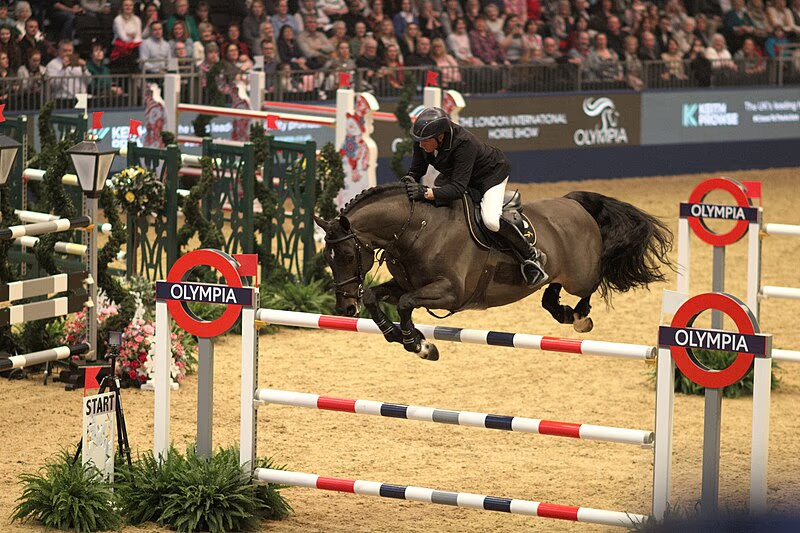
Minimum area: 2,500 m² (26,910 ft²) for Olympic competition, though larger arenas (up to 5,000 m²) are preferred for Grand Prix courses; Obstacles: 10–16 obstacles with 12–15 jumping efforts (including combinations of 2 or 3 elements). Fences include verticals (poles stacked vertically), oxers (s...
Course length: 5,700–6,270 m (3.5–3.9 miles) for Olympic-level (CCI5*-equivalent) competition; Jumping efforts: 25–40 jumping efforts, including combinations; Fence dimensions: Maximum height 1.20 m (3 ft 11 in), maximum spread 1.80 m (5 ft 11 in) at the highest point, maximum spread at base 2.40...
Individual events: Each athlete competes as an individual horse-rider combination; Team events: Teams of 3 riders per nation. All 3 scores count (no drop score since the team size was reduced from 4 to 3 in recent Olympic formats). Team and individual medals may be decided from the same competiti...
Ground Jury: 5 or 7 judges positioned at designated locations around the arena. Standard Olympic positions: C (at the short end behind the arena), H, M (long sides near C), B, E (center of long sides).; Each judge scores independently: Judges do not communicate during the test. Each sees differen...
Course Designer: Creates the course, sets fence heights and distances, and determines the time allowed based on course length and prescribed speed (typically 375 m/min for Grand Prix); Fence Judges: Positioned at each obstacle to observe and record faults (knockdowns, refusals); Timekeepers: Elec...
Cross-country course designer: Designs and builds the course over a period of months or years. Course must be approved by the FEI Technical Delegate.; Fence judges: Positioned at every obstacle on the cross-country course. Each judge records refusals, run-outs, falls, and penalties. Multiple judg...
Red ribbon on the tail marks a horse that kicks
A horse known to kick must wear a red ribbon braided or tied visibly into its tail in any shared warm-up or collecting ring. This signals all other riders to keep their distance behind it. Failing to ribbon a known kicker is one of the gravest breaches of barn and competition etiquette across every equestrian discipline worldwide.
Universally observed across show jumping, dressage, eventing, and endurance at every level from club shows to FEI championships.
Never publicly lose your temper with your horse
Visibly venting frustration on a horse — aggressive use of spurs, excessive whip, or harsh rein contact — in front of judges, officials, or spectators is a deep cultural taboo at the FEI level, entirely separate from written welfare rules. Elite riders are expected to maintain composure regardless of how badly a round has gone. The horse must not bear the cost of the rider's emotions in public.
Has become more sharply scrutinised in the social-media era; high-profile incidents at FEI level have ended or damaged careers.
Riders tracking left have right of way in shared arenas
When two riders meet going in opposite directions in a warm-up or schooling arena, the rider tracking left (counterclockwise) has conventional right of way. The rider tracking right moves off the centre line or wall to yield. This convention is taught from the first lessons in FEI-affiliated programmes and remains the default in international warm-ups.
Ready to dive deeper?
Only one horse approaches the practice fence at a time
In a show jumping warm-up, riders queue informally at the practice fence. Only one horse is on the approach or landing side at a time. Riders wait clear of the line until the previous horse has jumped and moved away before turning in. Cutting the queue, cross-approaching, or failing to wait is a serious breach that risks dangerous collisions.
The FEI warm-up steward controls fence height and direction but turn-taking is entirely self-policed by competitors.