

Dodgeball·Playground Games
Dodgeball
🌱Community
Loading OpenSourceSports…
Playground Games
2–10 players
both
ball
10 essential rules
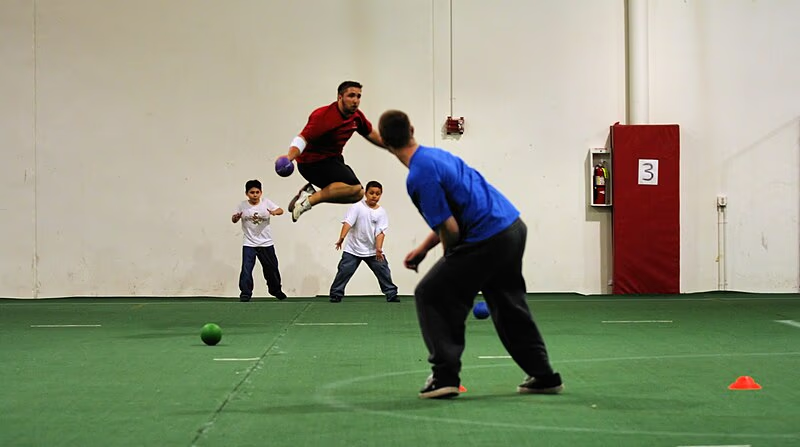
Dodgeball is a fast-paced team sport in which players attempt to eliminate opponents by hitting them with thrown balls while simultaneously avoiding being hit themselves. The game is widely played in schools, recreation leagues, and organized competitions around the world. Its combination of athl...
Young children (under 8): Use softer, lighter balls and smaller courts. Emphasize fun over competition. Consider allowing unlimited catches without elimination; Elementary school (8-12): Standard foam balls with slightly reduced court size. Focus on fair play and inclusion; Teens and adults: Stan...
At the start of each game, all 6 balls are placed evenly along the center line; Typically, 3 balls are placed on the right side and 3 on the left side of the center line; Teams line up on their respective end lines before the opening rush
Players may hold a maximum of one ball at a time (some rulesets allow holding two); A player may not hold a ball for longer than 10 seconds; after 10 seconds they must throw it or roll it to the opposing side; If a team holds all available balls and does not throw within 5 seconds, the balls are ...
Use only approved foam or rubber-coated balls. Hard rubber, leather, or weighted balls are prohibited; Inspect balls before each game for damage, deflation, or excessive wear; Replace balls that have become too firm, cracked, or irregularly shaped
Standard balls: 6 foam or rubber balls per game (the most common setup); Size: Approximately 7 inches (18 cm) in diameter for standard play; smaller balls (5-6 inches) may be used for younger players; Material: Soft foam, rubber-coated foam, or cloth-covered foam. Hard rubber balls are discourage...
A clean catch (ball does not touch the ground or any other surface) eliminates the thrower; Upon a successful catch, one previously eliminated teammate from the catching team re-enters the game, returning in the order they were eliminated (first out, first back in); If a player attempts a catch a...
Crossing the center line: Stepping onto or beyond the center line during play. The offending player is immediately eliminated; Out of bounds: Stepping outside the court boundaries. The offending player is immediately eliminated; Stalling: Holding a ball for longer than the allowed time (typically...
Standard court: Rectangular, approximately 60 feet (18 m) long by 30 feet (9 m) wide; Center line: Divides the court into two equal halves; players may not cross this line during play; Attack line: Located approximately 10 feet (3 m) from the center line on each side; some rulesets require player...
Ensure the playing surface is clean, dry, and free of debris or obstructions; Maintain adequate clearance around the court boundaries to prevent collisions with walls, bleachers, or equipment; In outdoor settings, check the surface for holes, rocks, or uneven terrain before play
A ball is considered "dead" and cannot eliminate a player when: It has touched the ground, a wall, the ceiling, or any other surface; It has already hit a player (the ball is dead after the first contact); It was kicked rather than thrown
Ready to dive deeper?