


🏛️Official — ICC
Loading OpenSourceSports…
Team Sports
2–10 players
outdoor
cricket ball, bat, wicket
10 essential rules
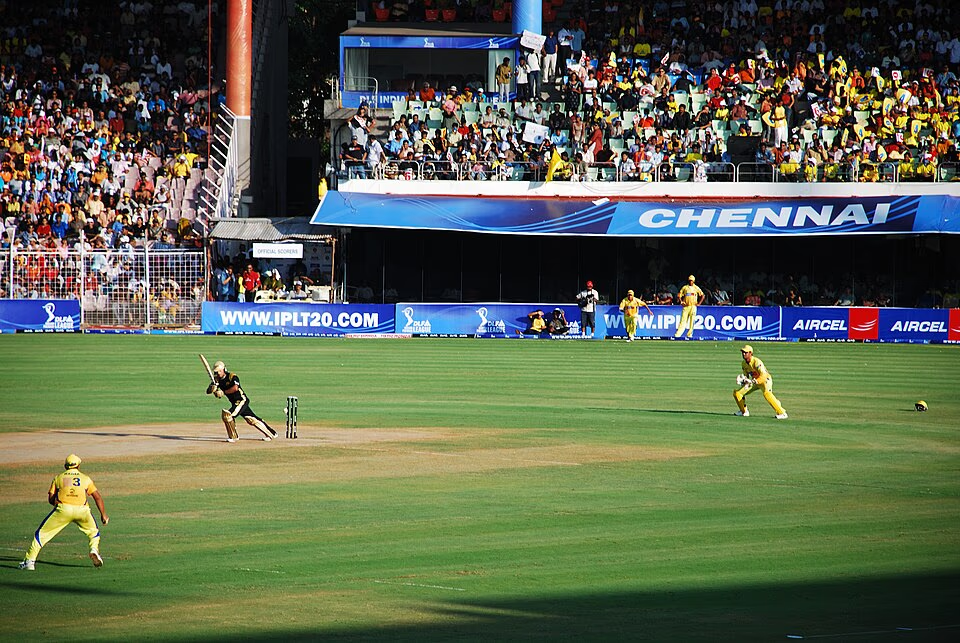
Twenty20 (T20) is the shortest format of international cricket, with each side batting for 20 overs. Introduced as an international format in 2005 and as a World Cup in 2007, T20 is the format selected for cricket's return to the Olympic program at the 2028 Los Angeles Games — cricket's first Oly...
Batter dismissed by: bowled, caught, LBW, run out, stumped, hit wicket, obstructing field, timed out, retired; Free hit ball: batter cannot be dismissed except run out; When a batter is dismissed Caught, the incoming batter takes strike at the end where the striker was standing at the moment of t...
Max 4 overs per bowler; No-ball: bowler oversteps front popping crease → free hit (next ball cannot dismiss batter except run-out); Wide ball: outside off-stump (per umpire judgment) → extra run + re-bowled
Power-play (overs 1-6): only 2 fielders allowed outside the 30-yard circle; After power-play (overs 7-20): maximum 5 fielders outside the 30-yard circle; At most 4 fielders on leg side at any time
Two innings — each side bats once for 20 overs (or until all-out); Each over = 6 legal deliveries; each bowler max 4 overs per innings; Match target ~75-90 minutes per innings; total ~3-3.5 hours
Ball: white leather ball (4-piece construction) at international level; weight 5.5-5.75 oz (155.9-163 g); Bat: max 38" length × 4.25" width; willow blade; max thickness 67 mm edge, 60 mm depth; Pads: batting pads, thigh pads, arm guards, helmet with grille, abdominal guard, gloves
Field: oval; boundary diameter typically 130-170 yards (120-155 m); Pitch: central 22 yards (20.12 m) strip of compacted earth/grass; Crease markings: bowling crease, popping crease (4 ft from stumps), return creases
11 players per side; Captain, wicket-keeper, batters, bowlers, all-rounders, fielders; Officials: 2 on-field umpires, 1 TV (third) umpire, 1 reserve umpire, 1 match referee
Two innings — each side bats once for 20 overs (or until all-out); Each over = 6 legal deliveries; each bowler max 4 overs per innings; Match target ~75-90 minutes per innings; total ~3-3.5 hours
Runs scored by: running between wickets (1, 2, 3 runs per ball typical) or boundaries (4 along the ground, 6 over the boundary on the fly); Extras: byes, leg-byes, wides, no-balls, penalty runs; Team total: sum of runs across innings (vs. wickets lost)
Slow over-rate: fielding side penalized 5 runs to opponent per missed over; captain banned if persistent; Ball tampering: 5-run penalty to opponent + match-suspension fine for offender; Dissent / unsportsmanlike: match referee may issue suspension or match-fee deduction
Do Not Claim a Bump Ball as a Catch
If a fielder takes a catch after the ball has bounced off the ground ('bump ball'), they must not claim it as a fair catch. The expectation is that the fielder immediately signals to the umpire that the ball grounded, even before an appeal. Claiming a catch you know to be false is considered one of cricket's most serious integrity breaches.
DRS and third-umpire review have reduced the number of uncontested bump-ball incidents, but the fielder honesty norm predates and underpins the review systems.
Withdraw a Knowingly Dishonest Appeal
If a fielder appeals for a dismissal knowing it is not out — pressing a bump-ball catch appeal, an LBW where the ball clearly hit the bat first, or similar — the fielder or fielding captain is expected to actively signal to the umpire that the appeal should be withdrawn. Pursuing a dishonest appeal for competitive gain is a clear Spirit of Cricket violation.
Distinct from a mistaken appeal: dishonest withdrawal concerns cases where the fielder has clear knowledge the dismissal is invalid.
Sledging Has Limits: No Personal or Discriminatory Abuse
Verbal gamesmanship ('sledging') is a tolerated part of cricket's competitive culture — psychological pressure and competitive banter are broadly accepted. The unwritten line is crossed when language targets a player's race, religion, ethnicity, family, or becomes degrading on a personal level. That line is enforced primarily by player culture rather than formal rules.
Ready to dive deeper?
T20 cricket's compressed timeframe, stump microphones, and broadcast proximity have raised scrutiny of on-field language considerably.
Walking: Self-Dismiss When You Know You Are Out
A batsman who knows they have edged a catch to the keeper or slips is expected by tradition to 'walk' — to depart before the umpire raises their finger. Once considered the defining mark of cricket honour, this practice is now extremely rare at the professional T20 level, where players almost universally await the umpire's decision or invoke DRS.
Far more prevalent in amateur cricket and pre-DRS eras. Adam Gilchrist's decision to walk in the 2003 World Cup semi-final was treated as a remarkable exception even then.
No Mankad Without Prior Warning
Running out the non-striker who backs up too far before ball delivery — the 'Mankad' dismissal — was long held to require a prior verbal warning to the batsman as a matter of sportsmanship. The ICC removed the warning requirement in 2022 and reclassified it as a standard run-out, but many players and commentators still view using it unannounced as contrary to cricket's code.
Named after Indian bowler Vinoo Mankad (1947). Remains one of cricket's most-debated etiquette questions precisely because the Laws changed but the culture has not fully followed.
Do Not Show Excessive Dissent to Umpires
Cricket has a foundational tradition of accepting umpires' decisions without visible argument. Gesturing, audibly disputing, prolonged staring, or aggressively reacting to an umpiring decision is considered a serious breach of conduct. DRS provides the legitimate channel to challenge decisions; anything beyond invoking DRS is culturally impermissible.
ICC Code of Conduct formally penalises dissent as a Level 1 or Level 2 offence, but the cultural norm precedes and exceeds the formal rule.
Do Not Celebrate Aggressively in a Dismissed Batsman's Face
When a wicket falls, bowlers and fielders may celebrate among themselves but are not to direct aggressive gestures, verbal taunts, or prolonged physical proximity at the departing batsman. Running down the pitch at the batter or staring them down as they leave draws both official ICC sanction and strong cultural criticism.
T20 cricket has a more expressive celebration culture than Test cricket, but targeted aggression directed personally at the dismissed batter remains clearly out of bounds.