


🏛️Official — ICF
Loading OpenSourceSports…
Rescue the swimmer — all other runs stop
In whitewater disciplines (slalom, wildwater), when a paddler capsizes and cannot roll, every nearby paddler abandons their own run to assist. No training rep or race preparation outweighs swimmer safety. Considered the most sacred obligation in whitewater paddling culture across all skill levels.
Offer your bow to a swimmer
When a paddler is swimming, the nearest paddler paddles over and presents their bow for the swimmer to grab, enabling a tow to the bank. Paddling past a swimmer without offering a bow rescue is a serious breach. The technique is taught at beginner level and expected instinctively at all higher levels.
Downstream paddlers have right of way
On moving water, paddlers committed to a downstream line have right of way over those ferrying across current or moving upstream. Anyone eddy-hopping or crossing must yield and time their move around downstream traffic. Universally observed on rivers to prevent collisions.
Wait for the all-clear signal before dropping in
In a group, no paddler enters a rapid until the paddler ahead has completed the run and given a visible all-clear — typically a raised paddle. Running on top of another athlete risks collision with a swimmer or pinned boat below. This norm is embedded in every whitewater skills curriculum.
Scout unfamiliar or serious water before committing — especially when leading
Paddling blind into an unseen or potentially dangerous rapid, particularly when others are following your lead, is considered reckless and a failure of leadership. Experienced paddlers are expected to set the norm by scouting when conditions warrant it, regardless of perceived skill advantage.
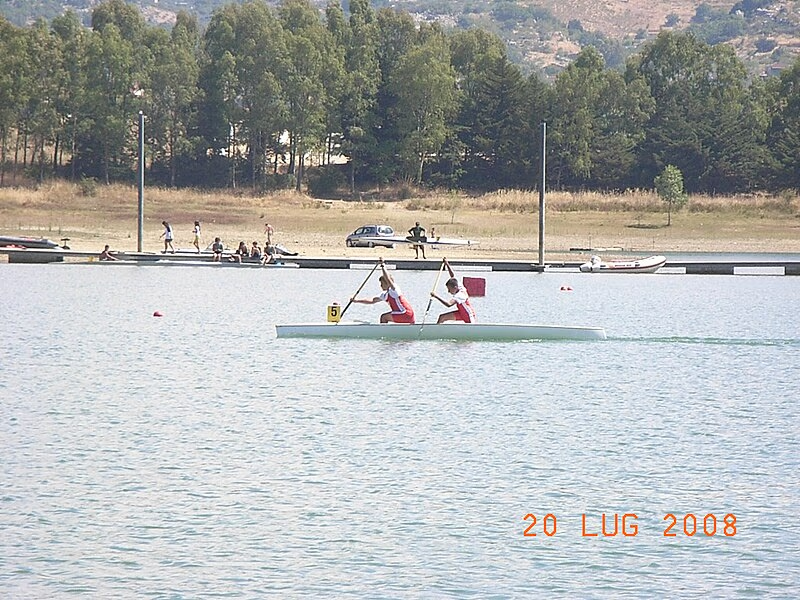
Sprint boats are long, narrow, and designed for maximum speed on flat water. ICF regulations specify maximum length and minimum weight: K1 (single kayak): Maximum length 520 cm (17 ft 1 in), minimum weight 8 kg (17.6 lb); K2 (double kayak): Maximum length 650 cm (21 ft 4 in), minimum weight 12 kg...
Why people argue about this
People often assume that "sprint boats are long and narrow for aesthetic reasons," but actually, it's designed to maximize speed on flat water surfaces by reducing drag and increasing stability. The misconception stems from thinking only about appearance rather than performance benefits.
Slalom boats are shorter and more maneuverable to navigate whitewater and gates: K1 Slalom: Maximum length 350 cm (11 ft 6 in), minimum weight 9 kg (19.8 lb), minimum width 60 cm (23.6 in); C1 Slalom: Maximum length 350 cm (11 ft 6 in), minimum weight 8 kg (17.6 lb), minimum width 60 cm (23.6 in)...
Why people argue about this
People often assume that the shorter length of slalom boats in canoeing is solely for aesthetic reasons, but the actual intention behind this design is to enhance maneuverability through rapid whitewater and tight gate turns, which requires a boat that can be quickly turned and steered with precision.
Kayak paddle: Double-bladed. No restrictions on length, blade size, or material. Typically 210–220 cm for sprint, 196–200 cm for slalom. Carbon fiber shaft and blade standard at elite level. Blades may be offset (feathered) at various angles.; Canoe paddle: Single-bladed. No restrictions on lengt...
Why people argue about this
People often assume that ICF regulates paddles in canoeing, which they do not; instead, ICF focuses on boat specifications like length, weight, steering devices, and material composition. The confusion arises because paddles are typically considered a personal piece of equipment by athletes, leading them to believe the governing body would have some say over their design or materials.
Helmet (Slalom/Kayak Cross): Mandatory. Must meet ICF safety standards. Full-cut design covering temples and back of head. Ear protection required in Kayak Cross.; Buoyancy aid/PFD (Slalom/Kayak Cross): Mandatory. Minimum buoyancy 6 kg (13.2 lb). Must be worn at all times on the water. Cannot res...
Why people argue about this
People often assume that the safety equipment rules in canoeing are about personal gear like helmets, but they misunderstand that ICF regulations specifically mandate minimum weights for boats themselves to ensure structural integrity and safety during races. The confusion arises because boat weight is not typically discussed in discussions of safety equipment or performance enhancements.
Competition bib or number vest worn over the buoyancy aid (slalom) or directly (sprint); National federation uniform required at Olympic events; No restrictions on footwear (many slalom paddlers wear neoprene booties)
Why people argue about this
People often assume that Section 2.5 in ICF Canoeing mandates strict uniformity of attire for all paddlers, thinking it's akin to other sports where uniforms are mandatory. However, this isn't the case; the rule simply states there’s no specific regulation on what canoes and paddles look like, leaving each team or individual free to choose their gear as they see fit.
A purpose-built regatta course on calm, flat water. Specifications: Distances: 200 m (sprint), 500 m, and 1000 m. The 200 m course uses the final 200 m of the 1000 m course, with a separate start area.; Lanes: 9 racing lanes, each 9 m (29.5 ft) wide. Lane markers (buoys) spaced at 10 m intervals ...
Why people argue about this
People often assume that the "purpose-built regatta course on calm, flat water" means the race must be held in a man-made lake or reservoir, but actually, it refers to any natural body of water where conditions are sufficiently stable and smooth for fair racing, whether it's a river, canal, or even part of an ocean.
Length: 200–400 m (656–1,312 ft) of whitewater channel; Water: Artificial (pump-recirculated) or natural river. Artificial channels allow consistent, repeatable water conditions for fair competition. Water flow rate typically 10–15 m³/s.; Gates: 18–25 gates suspended from overhead wires by adjust...
Why people argue about this
People often assume that the minimum 3m depth requirement means the water must be at least 3 meters deep in every lane throughout the entire course, leading to misunderstandings about where they should or shouldn't race due to shallow spots. Actually, it only mandates a minimum depth across the width of each lane, not for the length of the course.
Length: Approximately 250–350 m modified slalom course; Start ramp: Elevated platform where 4 athletes launch simultaneously on the start signal, sliding down a ramp into the water; Eskimo roll gate: A mandatory section where athletes must capsize and perform an Eskimo roll (self-righting maneuve...
Why people argue about this
People often assume that the mechanical alignment system in the kayak cross course is there just for show, thinking it's an unnecessary fancy feature when in reality, its precise perpendicular placement of start and photo finish cameras ensures ultra-accurate timing across all competitors' splits, which can be crucial in such competitive events.
Boat classes: K1 (1 paddler), K2 (2), K4 (4), C1 (1), C2 (2). Olympic events cover a subset of these per programme cycle.; Competition format: Heats → Quarterfinals (if needed) → Semifinals → Finals (A final for medals, B final for places 9–17). The fastest qualifiers from each round advance.; Se...
Why people argue about this
People often assume that the seeding system is purely random, thinking it's meant to eliminate bias in judging performance directly. In reality, the rule aims to minimize wave interference for top athletes by strategically placing them in center lanes where reflected waves are less disruptive, thus ensuring fairness and maintaining competitive integrity despite their high rankings.
Boat classes: K1 (men/women), C1 (men/women), K1X Kayak Cross (men/women); Format (K1/C1): Qualification (2 runs, best counts) → Semifinal (1 run) → Final (1 run). Each run is a timed individual descent through all gates.; Start interval: Athletes start individually at intervals of approximately ...
Why people argue about this
People often assume that in the semifinal round of Canoeing Slalom, athletes compete against each other head-to-head with one run each, just like in the finals. But actually, they only race one competitor from their qualification rounds to determine who advances, which can lead to confusion about how many runs are involved and who exactly is racing whom.
Starter: Gives the start commands ("Ready... Set..." + electronic tone or gun). Monitors for false starts via the alignment system.; Aligner: Ensures all boats are properly positioned in the alignment system before the start signal; Umpires: Travel alongside the race in motorboats, observing for ...
Why people argue about this
People often assume that the lane assignments are purely based on world rankings, thinking it's a simple system of assigning lanes by athlete skill level. However, they misunderstand that wave conditions can also influence which athletes start in certain lanes to mitigate starting line turbulence, thus complicating the straightforward interpretation of ranking-based lane allocation.
Gate judges: Positioned at each gate (or group of gates) to observe whether the paddler correctly negotiates the gate and whether any touches occur. Each gate has 2 judges who must agree; disagreements are reviewed by the section chief.; Section chiefs: Supervise groups of gate judges and resolve...
— section c, Section c
Why people argue about this
People often assume that in a Slalom event governed by ICF, each competitor only gets one chance to qualify through their best run from two attempts. But actually, they get two runs per qualification round, and it's their best result out of those two that counts towards the final selection for the semifinal. This oversight can lead to debates about fairness in qualifying rounds.
Start: All boats held in the alignment system. On the start signal (electronic tone after "Ready... Set..."), boats are released simultaneously. Standing start (no rolling start).; Lane discipline: Each boat must remain within its 9 m lane for the entire race. Crossing into another lane results i...
Why people argue about this
People often assume that crossing lanes in Sprint Racing is only a penalty if it causes an accident or disrupts the race flow significantly, but actually, the rule strictly disqualifies boats regardless of impact, as long as they cross into another lane during the start phase.
A false start occurs when a boat moves before the start signal while in the alignment system; First false start: Warning issued to the offending crew. All boats return to the alignment system for a restart.; Second false start (by any crew): The crew that committed the second false start is exclu...
Why people argue about this
People often assume that a false start in canoeing is just a warning and no penalty, forgetting that all boats are disqualified if it happens, which can be seen as harsh compared to other sports where only one boat might face disqualification for such an infraction.
Gate negotiation: The paddler's head must pass between the two poles of the gate in the correct direction (downstream for green gates, upstream for red gates). The entire head must cross the gate line.; Gate sequence: Gates must be negotiated in numerical order. Skipping a gate or negotiating out...
Why people argue about this
People often assume that crossing lanes is only a big deal if it causes another boat to collide, forgetting that even slight interference can lead to disqualification under ICF's rules. The confusion arises because they overlook the rule stating boats must remain within their designated 9m lane at all times, which includes any form of non-interfering overlap as well.
Start: 4 athletes launch simultaneously from a start ramp into the water on the signal. Lane selection is based on seeding (fastest time trial gets first lane choice).; Contact: Incidental boat-to-boat contact is permitted and expected. Deliberate blocking, holding, or grabbing another athlete's ...
Why people argue about this
People think that they can safely drift out of their lane a bit without penalty, but actually the rule is very strict - boats must remain within their 9 m lane for the entire duration of the race to avoid disqualification, and any deviation from this exact positioning will result in immediate disqualification.
Result determination: First boat across the finish line wins. Photo finish cameras and transponder timing record results to 1/1000th of a second (0.001 s).; Qualification advancement: In heats and semifinals, the top finishers advance directly (e.g., top 2 from each heat go to the semifinal). Add...
Why people argue about this
People often assume that in case of a dead heat, only one crew gets disqualified for crossing the line simultaneously, which isn't true according to YAC (Youth America Cup) rules; instead, both crews are awarded the same ranking, and photo finishes determine their exact order within those tied positions.
Total time = course time + penalty seconds; Course time: Measured from the start signal to the paddler's bow crossing the finish line, recorded to 1/100th of a second; Gate touch penalty: +2 seconds per gate touched (maximum one penalty per gate, even for multiple touches at the same gate)
Why people argue about this
People often assume that penalty seconds are added directly to their overall course time, leading them to believe they can simply add up all their errors for a final score. However, the confusion arises because these penalty seconds are subtracted from your total time, not added on top of it, meaning you need to calculate your actual race time minus those penalties to get your final score.
Placement-based: No times recorded for ranking. Finishing position (1st, 2nd, 3rd, 4th) in each heat determines advancement.; Time trial: An initial time trial run (similar to slalom) seeds athletes into the head-to-head bracket; Bracket: Top 2 from each heat advance. Rounds continue through quar...
Why people argue about this
People often assume that if two kayaks cross at exactly the same time in a kayak cross event, they'll be declared co-winners based on photo finish or GPS data alone. However, the actual rule is that even with simultaneous crossings, both boats still get equal ranking, and no shared placements occur unless there's an official dead heat determined by these methods.
False start: Warning on first offense. Exclusion on second offense (by any crew after the general warning).; Lane violation: Boat enters another crew's lane. If interference occurred, the offending crew is disqualified. If no interference, a warning is issued.; Interference: Creating wake or phys...
Why people argue about this
People often assume that a false start in canoeing only results in an immediate exclusion from the race, forgetting about the warning system laid out in Rule 7.1. The confusion arises because they overlook how the rule allows for a first offense to be addressed with just a warning before escalating to an exclusion if another false start occurs after a general reminder.
Gate touch: +2 seconds. Assessed when the body, boat, or paddle contacts one or both gate poles while negotiating the gate. Only one penalty per gate.; Missed gate: +50 seconds. Gate not negotiated (paddler does not pass head between poles in correct direction). This is typically a run-ending pen...
Why people argue about this
People often assume that touching a gate in Canoe Slalom only results in a +2 second penalty, but they overlook the fact that if you touch more than one or miss an entire gate, penalties can stack up, leading to significantly higher times and causing disputes over how many gates were actually touched.
Deliberate obstruction: Intentionally blocking, holding, or impeding another athlete's forward progress. Penalty: disqualification from the heat.; Grabbing: Grabbing another athlete's boat, paddle, body, or equipment. Penalty: disqualification.; Missing the roll gate: Failure to perform the manda...
Why people argue about this
People often assume that a kayak cross violation only results in disqualification if there was actual interference between boats, which isn't necessarily true according to the ICF's guidelines. The confusion arises because the rule states no interference warrants a warning, but some argue this means no penalty at all, ignoring the possibility of lane violations even without contact.
Sprint protests must be filed within 15 minutes of the official results being posted; Slalom protests must be filed within 5 minutes of the run being completed, accompanied by a protest fee; Video review is the primary tool for resolving gate judgment disputes in slalom
Why people argue about this
People often assume that if a crew causes another to be disqualified through interference, they themselves would only receive a warning instead of disqualification, but actually, under ICF rules, interfering in such a way results in both crews being penalized equally with disqualifications.
Buoyancy aid/PFD: Mandatory for all slalom and Kayak Cross competitors whenever on the water (practice and competition). Minimum buoyancy 6 kg. Must allow full range of paddling motion.; Helmet: Mandatory for slalom and Kayak Cross. Must cover temples, forehead, and back of head. Chin strap must ...
Why people argue about this
People often assume that just because the rule mentions buoyancy aids and helmets for slalom and Kayak Cross, they're only required during races, forgetting about their importance in training and safety on water. The confusion arises because this rule emphasizes personal safety year-round, not just during competition events.
Slalom safety kayakers: Positioned at key points throughout the whitewater course (below each major rapid or technical section). Trained in swiftwater rescue techniques. Carry throw bags and rescue equipment.; Sprint rescue boats: Motorized safety boats positioned along the course. Crew trained i...
Why people argue about this
People often assume that the 'key points' mentioned in the rule refer exclusively to fixed locations like starting gates or finish lines, but actually, they encompass various strategic spots along the course where safety personnel can be strategically placed for immediate response and monitoring of competitors at any critical moment during their race.
Water quality: Must meet local health authority standards for recreational water. Water is tested for bacterial contamination, pH levels, and temperature before competition.; Water temperature: If water temperature drops below 12°C (54°F), organizers must provide additional thermal protection gui...
Why people argue about this
People often assume that a buoyancy aid is optional for safety reasons, thinking it's just extra weight they don't want to carry. But in reality, the official verdict emphasizes its mandatory use due to water and environmental safety concerns, ensuring paddlers are secure in unpredictable conditions.
All slalom boats must have adequate flotation (built-in or foam blocks) to prevent sinking in the event of capsizing; Bow and stern of slalom boats must have rubber or foam bumpers to protect against collisions; Grab handles or loops at bow and stern are mandatory for rescue personnel to grip dur...
Why people argue about this
People often assume that the buoyancy aid is solely for safety in case of capsizing, but they overlook its importance during normal paddling where it helps maintain proper body positioning and range of motion, which can significantly impact performance and efficiency on the water.
Sprint boats are long, narrow, and designed for maximum speed on flat water. ICF regulations specify maximum length and minimum weight: K1 (single kayak): Maximum length 520 cm (17 ft 1 in), minimum weight 8 kg (17.6 lb); K2 (double kayak): Maximum length 650 cm (21 ft 4 in), minimum weight 12 kg...
Why people argue about this
People often argue that sprint boats are only designed for flat water when in fact, the official verdict clarifies they're built for maximum speed across various conditions, including some rough waters, just with adjustments to their design and setup. The confusion arises because many assume all canoe designs are rigidly tailored to specific water types.
A purpose-built regatta course on calm, flat water. Specifications: Distances: 200 m (sprint), 500 m, and 1000 m. The 200 m course uses the final 200 m of the 1000 m course, with a separate start area.; Lanes: 9 racing lanes, each 9 m (29.5 ft) wide. Lane markers (buoys) spaced at 10 m intervals ...
Why people argue about this
People often assume that the official verdict means there are no waves allowed anywhere on the course during a race, which is incorrect. The rule actually specifies calm, flat water for the entire playing area, but doesn't prohibit waves elsewhere in the river or lake where paddlers might be training or racing under different conditions.
Boat classes: K1 (1 paddler), K2 (2), K4 (4), C1 (1), C2 (2). Olympic events cover a subset of these per programme cycle.; Competition format: Heats → Quarterfinals (if needed) → Semifinals → Finals (A final for medals, B final for places 9–17). The fastest qualifiers from each round advance.; Se...
— section c, Section c
Why people argue about this
People often assume that seedings are purely random, without considering rankings, so they argue why sprint competitors aren't seeded based on their world rankings alone, when in fact, it's a compromise to balance fairness with scheduling efficiency.
Start: All boats held in the alignment system. On the start signal (electronic tone after "Ready... Set..."), boats are released simultaneously. Standing start (no rolling start).; Lane discipline: Each boat must remain within its 9 m lane for the entire race. Crossing into another lane results i...
Why people argue about this
People often assume that lane width is only about keeping boats from touching each other, but they overlook the fact that ICF's rule specifically requires boats to stay within their 9-meter lane for the entire duration of the race to maintain fair play and competitive integrity.
Result determination: First boat across the finish line wins. Photo finish cameras and transponder timing record results to 1/1000th of a second (0.001 s).; Qualification advancement: In heats and semifinals, the top finishers advance directly (e.g., top 2 from each heat go to the semifinal). Add...
Why people argue about this
People often assume that in case of a photo finish tie, all tied boats get equal points, which isn't correct according to ICF rules. Actually, dead heats result in shared rankings for those specific races, meaning no boat gets extra points over another; it's just a tie at the finish line.
False start: Warning on first offense. Exclusion on second offense (by any crew after the general warning).; Lane violation: Boat enters another crew's lane. If interference occurred, the offending crew is disqualified. If no interference, a warning is issued.; Interference: Creating wake or phys...
Why people argue about this
People often assume that false starts only result in a warning, forgetting that it escalates to disqualification if committed twice. They also misunderstand lane violations, thinking they're merely warnings unless they cause interference, which isn't always clear from the rule text alone.
Buoyancy aid/PFD: Mandatory for all slalom and Kayak Cross competitors whenever on the water (practice and competition). Minimum buoyancy 6 kg. Must allow full range of paddling motion.; Helmet: Mandatory for slalom and Kayak Cross. Must cover temples, forehead, and back of head. Chin strap must ...
Why people argue about this
People often assume that swimming 50 meters in open water is a safety requirement for all canoeists, which can lead to misunderstandings since canoeing itself doesn't inherently necessitate such a skill. The confusion arises because they overlook how this rule serves as a safeguard against unexpected situations where a competitor might need to exit their boat quickly and safely.