


🏛️Official — NCAA
Loading OpenSourceSports…
Ball: yellow with grip pattern; men's circumference 68-71 cm / weight 400-450 g; women's circumference 65-67 cm / weight 400-450 g (NCAA spec); Caps: numbered, white for one team / dark for the other; goalkeepers wear red caps with the same number; Cap ear protectors required (NCAA mandate)
Why people argue about this
People often assume that mouthguards are only for protection against teeth damage in water polo, but they're also recommended by NCAA rules as a way to prevent concussions and other oral injuries sustained from collisions with teammates or opponents. The rule's emphasis on "recommended" can lead to misunderstandings about its necessity and importance among players.
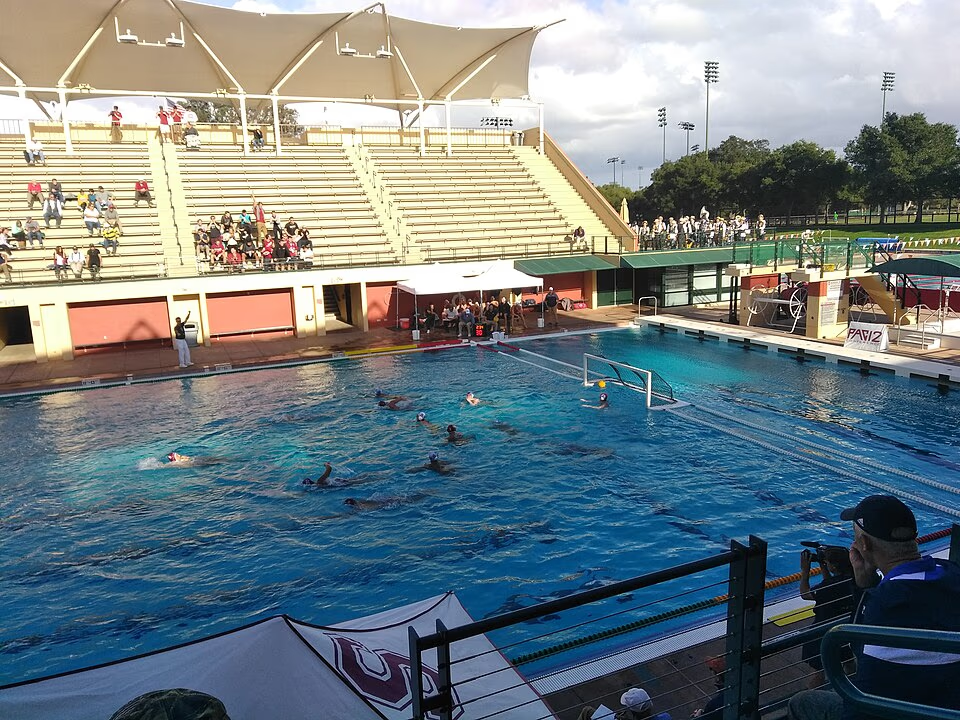
Field of play: 30 m long × 20 m wide for men / 25 m × 20 m for women (NCAA-spec; matches World Aquatics); Water depth: minimum 1.8 m (NCAA championship: minimum 2.0 m for safety); 2-meter line: directly in front of the goal — offensive players may not be inside without the ball
Why people argue about this
People often assume that water depth is only a concern during championship games, forgetting that NCAA matches require at least 1.8 meters of water depth for safety reasons, which can lead to misunderstandings about compliance in regular season play. The confusion arises because this rule ensures player safety and the integrity of gameplay across all levels, not just championships.
7 players per team in the water at any time (6 field players + 1 goalkeeper). Per the 2026-27 rules book, after the start of play a team may elect to play with seven field players and no goalkeeper; when a team plays without a player wearing the goalkeeper's cap, none of its players in the water ...
Why people argue about this
People often assume that only 6 players are active in the water at once during play, which leads them to overlook the goalkeeper. However, the NCAA's Section 4 clearly states each team has 7 players in the water (6 field players + 1 goalie) at all times, and this can be confusing because it doesn't match their initial perception of a typical game setup.
Game structure: 4 quarters of 8 minutes each (NCAA spec; FIVB international is 4 × 8 also for adult competition); 2-minute breaks between Q1/Q2 and Q3/Q4; 5-minute halftime; Tied at end of regulation: NCAA tournament — 3-minute golden-goal overtime periods; if needed, penalty shootout
— Section 4
Why people argue about this
People often assume that water polo games in NCAA use 8-minute quarters like basketball, forgetting about the key detail of having 4 quarters instead. They also misunderstand how overtime works; they think it's a sudden-death format where the first team to score wins, but actually, teams get 3 minutes each to try and break the tie before a coin toss decides who gets the ball first.
Goal scored when the entire ball passes the goal line between the posts and below the crossbar; 1 goal = 1 point; Most goals at end of regulation/overtime/shootout wins
— Section 4
Why people argue about this
People often assume that a goal is scored when just part of the ball passes over the crossbar, thinking it's about the whole ball passing through entirely. But actually, they misunderstand the key fact: it’s all about the entire ball crossing below the bar and between the posts. This subtle difference can lead to confusion in scoring during fast-paced water polo games.
Ordinary foul: free throw to the offended team; minor infraction (e.g., taking the ball under, two-handed touch, holding without ball); Exclusion foul: 20-second exclusion to the penalty area; team plays short until the time expires, the opposing team scores, or possession changes hands per the r...
Why people argue about this
People often think that if a player gets three personal fouls in Water Polo, they're just ejected for the rest of the game. But actually, what the rule means is that they get ejected from their current play and must be replaced by a teammate, meaning they can still participate later on in the match but not during their foul period.
Water polo is a high-contact aquatic sport with significant injury risk from elbow/knee strikes, head impacts, and over-extension. Mandatory ear-protector caps reduce ear injury.
Why people argue about this
People often argue that wearing ear-protector caps is unnecessary in water polo since players are already protected by goggles, but the real issue is that the rule doesn't address other safety concerns like elbow strikes or knee bumps, leading to misunderstandings about what exactly it aims to prevent.