


🏛️Official — FIVB
Loading OpenSourceSports…
Self-call own violations in non-officiated play
In games without referees, players are culturally expected to call their own net touches, double contacts, lifts, and carries immediately. Failing to call an obvious personal violation is treated as cheating and severely damages trust within the playing community.
Beach volleyball: self-call block touches honestly
In beach volleyball, the blocker is culturally and practically expected to immediately acknowledge when they touched a ball during a block attempt, because that contact counts as the team's first of three and changes the tactical situation. Deliberately concealing a felt touch is considered dishonest and violates the sport's strong self-officiating culture.
Restrained celebration after opponent unforced errors
When an opponent commits an unforced error—service fault, ball hit out of bounds without a defensive play—excessive directed celebration is taboo. Quiet acknowledgment of the point is expected; pointing, taunting gestures, or directed dancing toward the opponent violates the code at all competitive levels including FIVB.
Honest out-of-bounds line calls benefit the doubt to opponent
In self-officiated matches, players call balls in or out honestly. The longstanding convention—borrowed from tennis and observed in recreational volleyball worldwide—is that a ball that genuinely could go either way is called in favor of the opponent.
Post-match handshake line at the net
After the final point of a match, both teams immediately line up and pass through the net handshaking or slapping hands with every opponent. Refusing to participate, dragging feet, or walking away before the line completes is considered a serious sign of disrespect toward the opponent.
All balls used in a match must have the same characteristics regarding circumference, weight, pressure, type, and color (Rule 3.3). In FIVB World and Official Competitions, three balls are used.
— Rule 3.1, Rule 3.3, Rule 3.4
Why people argue about this
People often assume that all balls used in a match need to be identical only in terms of color, forgetting about circumference, weight, and pressure. This leads to arguments because they overlook the technical specifications outlined by the rule, which are crucial for maintaining consistent gameplay conditions across different matches.
The net is placed vertically over the centre line. Its dimensions and specifications are as follows (Rule 2.1): Length: 9.50–10.00 m (31.2–32.8 ft); Width: 1.00 m (3.28 ft); Mesh: 10 cm × 10 cm (3.94 × 3.94 in) square mesh
— Rule 2.1, Rule 2.2, Rule 2.3, Rule 2.4
Why people argue about this
People often assume that the net placement is purely arbitrary, thinking it can be placed anywhere over the centre line without consequence. However, the official verdict clarifies that the net must indeed be positioned vertically over the center line for proper gameplay and safety standards, thus avoiding misunderstandings about its exact positioning.
The net height is measured from the centre of the playing court (Rule 2.1): Men: 2.43 m (7 ft 11⅝ in); Women: 2.24 m (7 ft 4⅛ in); Mixed (men and women together): 2.43 m
— Rule 2.1, Rule 2.5
Why people argue about this
People often assume that the net height is measured from the top of the net itself rather than from the centerline of the playing court, which leads to misunderstandings about how high they need to jump or how tall their spikes can be. The confusion arises because the official rule specifies it's measured from the center of the court, not the edge where players typically stand and hit the ball.
Shoes must be flexible and lightweight with rubber or leather soles, without heels (Rule 4.3.3). Players are not permitted to wear objects that may cause injury or give artificial advantage; smooth and/or protective braces may be worn (Rule 4.3.5).
— Rule 4.3, Rule 4.3.4, Rule 4.3.3, Rule 4.3.5
Why people argue about this
People often assume that the shoe sole material (rubber or leather) is a strict requirement for all matches, forgetting that it's just one of several conditions listed in Rule 4.3. The confusion arises because they overlook other allowable materials like synthetic rubber and focus only on the sole type when selecting their footwear.
The playing court is a rectangle measuring 18 m × 9 m (59.06 ft × 29.53 ft), surrounded by a free zone which is a minimum of 3 m (9.84 ft) wide on all sides. The free playing space is the space above the playing area which is free from any obstruction.
Why people argue about this
People often assume that the dimensions are given in feet rather than meters, leading them to argue about needing a conversion tool or calculator just to understand the court size. The confusion arises because the official rules explicitly state measurements in metric units (meters), which can be confusing for those accustomed to imperial measurements used in other sports.
The playing surface must be flat, horizontal, and uniform. Indoor surfaces must be of wood or synthetic material.
Why people argue about this
People often assume that only wood surfaces are allowed for indoor volleyball courts, misunderstanding that synthetic materials are also permitted under FIVB guidelines. The rule's specificity about uniformity can lead to confusion over what exactly constitutes a "flat" surface, especially if it's not perfectly smooth like wood might be.
All lines are 5 cm (1.97 in) wide. Lines must be a light color, different from the color of the floor and from any other lines.
Why people argue about this
People often assume that a 5 cm line is too narrow for visibility in bright sunlight, leading them to argue it should be wider. However, the FIVB's official stance is based on ensuring consistent measurement across different courts and conditions without compromising safety or clarity of lines.
In each court, an attack line is drawn 3 m (9.84 ft) from the axis of the centre line to delimit the front zone. The attack line is extended beyond the sideline by 5 short lines, each 15 cm (5.91 in) long, 5 cm wide, and spaced 20 cm (7.87 in) apa...
Why people argue about this
People often assume that the attack line is just a visual aid for referees, when in fact it's an important boundary that players must adhere to during their approach to the ball, ensuring they don't step over this line before contacting the ball, which would be considered out-of-bounds and penalized.
Front Zone: Bounded by the axis of the centre line and the edge of the attack line nearest to the net (Rule 1.4.1).; Back Zone: Bounded by the back edge of the attack line and the inside edge of the end line (Rule 1.4.2).; Service Zone: 9 m (29.53 ft) wide area behind each end line. The server mu...
— Rule 1.4.1, Rule 1.4.2, Rule 1.4.3, Rule 1.4.4, Rule 1.4.5, Rule 1.5
Why people argue about this
People often assume that the temperature and lighting conditions are just guidelines rather than strict rules, leading to misunderstandings about their enforcement in official volleyball competitions. The confusion arises because these parameters are explicitly stated as minimums and maximums for FIVB events, yet some teams or officials might overlook them during games.
For FIVB World and Official Competitions, the minimum temperature is 16°C (61°F) and the maximum is 25°C (77°F). The illumination level on the playing surface must be 1,000–1,500 lux (Rule 1.2 notes).
— Rule 1.2
Why people argue about this
People often assume that the temperature and lighting conditions are set by the players themselves, forgetting that these factors are strictly regulated by the FIVB for fair play in all competitions, leading to arguments over what they perceive as unfair adjustments outside of their control.
A team consists of a maximum of 14 players: 12 players and 2 Liberos (Rule 4.1.1). In FIVB World and Official Competitions, teams may register up to 14 players; 12 regular players and 2 Liberos.
— Rule 4.1.1, Rule 4.1.2, Rule 4.1.3
Why people argue about this
People often assume that all 14 players must be active in every set of a match, which leads to misunderstandings about how substitutions work. However, the actual rule allows for up to 12 active players plus 2 Liberos who can come on as substitutes without changing the team composition, unlike regular players whose positions are fixed throughout the game.
The Libero is a defensive specialist. Key rules governing the Libero include: Teams may designate up to 2 Liberos from the registered roster (Rule 8.1).; The Libero wears a jersey (or jacket/bib for the Libero, in FIVB competitions) of a contrasting color from all other team members (Rule 8.1).; ...
— Rule 8.1, Rule 8.4.1, Rule 8.4.2, Rule 8.4.3, Rule 8.3, Rule 8.3.2, Rule 8.5
Why people argue about this
People often assume that the Libero player can play any position they choose during a match, which is incorrect. Actually, the Libero is restricted to only playing as a setter or libero (defensive specialist), and must wear a different colored jersey than the rest of the team to ensure clear identification throughout the game.
At the moment of service, all players must be within their respective courts and in the rotational order recorded on the line-up sheet (Rule 7.1). Players are numbered in a rotational order 1–6, starting from the right back position and moving counterclockwise.
— Rule 7.1, Rule 7.3.1, Rule 7.4.1, Rule 7.4.2, Rule 7.4.3
Why people argue about this
People often assume that as long as players are in their designated positions, they can move around freely once the ball is served. However, the actual rule states that all players must remain within their respective courts and maintain their rotational order from the line-up sheet at the moment of service, which can lead to confusion if not strictly adhered to.
Substitution is the act of a player replacing another player on the court. In each set, each team is allowed a maximum of 6 substitutions (Rule 15.2).
— Rule 15.2, Rule 15.3
Why people argue about this
People often think that you can only make 6 substitutions in a game overall, regardless of how many sets are played, but actually, each team is allowed a maximum of 6 substitutions per set, no matter how many sets they play. This oversight leads to confusion because it's easy to forget the per-set limit when focusing on the total number of subs for an entire match.
The officiating team for FIVB World and Official Competitions consists of: First Referee (R1): Directs the match from start to end; has authority over all members of both teams and officiating team; his/her decisions are final (Rule 23.1).; Second Referee (R2): Assists the first referee; controls...
— Rule 23.1, Rule 23.2, Rule 23.3, Rule 23.4, Rule 23.5
Why people argue about this
People often assume that the 4.5 match officials' composition is a fixed list of roles without room for interpretation, but in reality, it's designed to allow flexibility based on the specific needs of different competitions and venues, which can lead to confusion about how exactly these positions are filled or adapted.
A rally is the sequence of playing actions from the moment of the service hit by the server up to the moment the ball is out of play (Rule 11.1). If the serving team wins a rally, it scores a point and continues to serve.
— Rule 11.1, Rule 11.2, Rule 11.3.1, Rule 11.3.2
Why people argue about this
People often assume that a rally starts as soon as the server hits the ball, but in volleyball, it's only when the ball is out of play or touches the net and can't be returned by either team that we consider the rally over. They forget about the back-and-forth passing and bumping actions happening before the initial hit, which are crucial parts of what constitutes a rally under FIVB rules.
Each team is entitled to a maximum of 3 contacts with the ball to return it to the opponent's side (Rule 12.1). If more contacts are made, a fault of "Four Hits" is called.
— Rule 12.1, Rule 12.2, Rule 12.3, Rule 12.4
Why people argue about this
People often assume that hitting the ball with their hands is allowed as long as they don't touch it more than three times, which leads them to overlook the fact that only arms and legs are permitted in volleyball, making hand-hitting illegal. The confusion arises because they misinterpret "contacts" to mean any kind of body part used, not just the hands.
Service is the act of putting the ball into play by the right back-row player, who hits the ball with one hand or any part of the arm from the service zone (Rule 13.1). The server must hit the ball within 8 seconds after the first referee's whistle for service (Rule 13.2.1).
— Rule 13.1, Rule 13.2.1, Rule 13.2.2, Rule 13.2.3
Why people argue about this
People often assume that a player can hit the ball with their whole arm from anywhere in the back row as long as it's on the first serve, but actually, they must use just one hand or part of an arm and be within the designated service zone for it to count as valid service under Rule 13.
An attack hit is any action directing the ball toward the opponent except a service or block (Rule 14.1).
— Rule 14.1, Rule 14.2, Rule 14.3, Rule 14.4
Why people argue about this
People often assume that just hitting the ball over the net is an attack hit, forgetting that a block counts as such too. The confusion arises because they overlook the official definition which explicitly states it includes service or block hits as well.
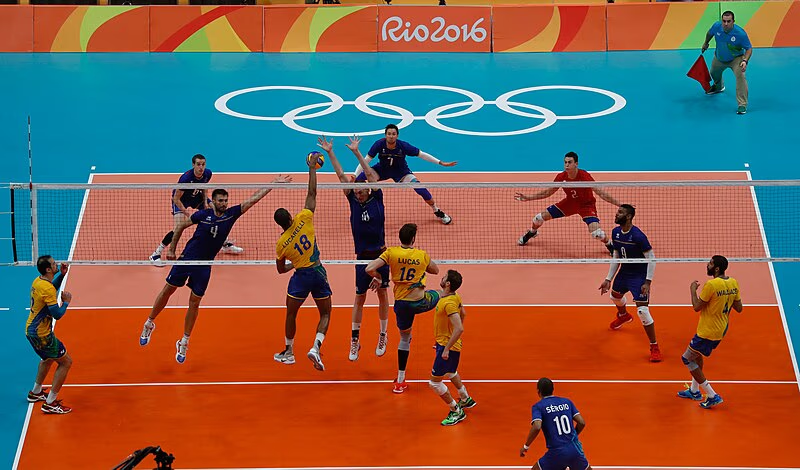
Blocking is the action of players close to the net to intercept the ball coming from the opponent by reaching higher than the top of the net (Rule 15.1.1). Only front-row players are permitted to complete a block; a back-row player or Libero who completes a block commits a fault (Rule 15.1.3).
— Rule 15.1.1, Rule 15.1.3, Rule 15.1.2, Rule 15.4, Rule 15.4.1, Rule 15.4.2, Rule 15.4.3
Why people argue about this
People often assume that blocking only involves players touching the ball with their hands, when in fact it's about reaching higher than the top of the net with any part of their body, including arms and legs, to intercept an opponent’s serve or spike, leading to confusion on what exactly constitutes a block.
Each team is entitled to a maximum of 2 timeouts per set (Rule 18.1), each lasting 30 seconds (Rule 18.2). In FIVB World and Official Competitions, in addition to the 2 regular timeouts, two Technical Timeouts of 60 seconds each are applied automa...
— Rule 18.1, Rule 18.2, Rule 19.1
Why people argue about this
People often assume that each timeout is 30 seconds in volleyball, forgetting that these are individual timeouts per team, so they might think it's a total of 60 seconds for both teams combined, leading to misunderstandings about how much time they actually have. The confusion arises because the rule specifies "each lasting 30 seconds," but doesn't clarify that this is per team, not collectively.
Intervals between sets last 3 minutes (Rule 20.1). During this time, teams change courts.
— Rule 20.1, Rule 20.2
Why people argue about this
People often assume that the 3-minute interval between sets is only for players to rest and prepare mentally, forgetting that it also includes time for officials to change the court markers and switch sides. This oversight leads to misunderstandings about how much actual playing time there is during these intervals.
Volleyball uses the rally point system: a point is scored on every rally regardless of which team served. The team that wins a rally scores a point (Rule 6.1.1).
— Rule 6.1.1, Rule 6.2
Why people argue about this
People often assume that a team only scores a point if they win the serve directly, forgetting that points are awarded on every rally regardless of who won the previous serve. The confusion arises because in other sports like tennis, scoring is tied strictly to serving order, making this rule seem counterintuitive at first glance.
A match is played in the best of five sets (Rule 5.1). A team wins the match by winning three sets.
— Rule 5.1, Rule 6.3, Rule 6.4, Rule 6.5
Why people argue about this
People often assume that a volleyball match is always played in five sets regardless of the score, which leads them to misunderstand the structure. However, the official verdict clarifies that a match can indeed end after three or four sets if one team reaches the predetermined win threshold (Rule 5.1), not necessarily five as they might think.
A point is awarded when (Rule 6.1): The ball is grounded on the opponent's playing court.; The opponent commits a fault.; The opponent receives a penalty.
— Rule 6.1, Rule 6
Why people argue about this
People often assume that a point is awarded for every successful serve, which leads to arguments about when points are given in volleyball matches. Actually, points are awarded based on who serves first at each set changeover and whether they manage to score before the other team does, not just because of a successful serve itself.
The first team to win 3 sets wins the match. If both teams have won 2 sets, the deciding (fifth) set is played to 15 points with a 2-point lead.
— Rule 20.2
Why people argue about this
People often assume that a 3-2 victory means only one set was decisive, forgetting about the crucial part where they must win two sets in a row to claim the match, which can lead them to overlook how close and potentially controversial these matches can be when the score is tied at 2-2.
A fault is a playing action that is contrary to the rules. The referees judge faults and determine the consequences according to the rules.
— Rule 6.1.2
Why people argue about this
People often think that a fault in volleyball is simply about making mistakes during play, like hitting the ball out of bounds. But actually, it's much more nuanced - faults are defined as actions that violate specific rules, such as hitting the ball twice before it touches the ground or stepping on the line while serving, and these violations lead to points being awarded to the opposing team.
Foot fault (Rule 13.2.2): Server contacts the end line or court, or steps outside the service zone, at the moment of service contact. Consequence: point and service to opponent.; Four Hits (Rule 12.1): A team contacts the ball more than 3 times before returning it over the net. Consequence: point...
— Rule 13.2.2, Rule 12.1, Rule 12.4, Rule 11.2, Rule 16.2, Rule 11.3.3, Rule 16.3, Rule 11.3, Rule 14.2, Rule 15.3, Rule 13.3, Rule 7.4
Why people argue about this
People often assume that only intentional foul plays like hitting the ball out of bounds count as misconduct under 7.2 Playing Faults in volleyball. However, the confusion arises because it also includes unintentional fouls such as playing the ball with a part of the body other than the hands or arms, which is mistakenly thought to be limited to deliberate aggression and rudeness.
Misconduct includes rude behavior, offensive behavior, and aggression. Sanctions are applied progressively (Rule 21.1): Warning (yellow card): No point or service lost; recorded in the score sheet. Issued for minor unsportsmanlike conduct.; Penalty (red card): Opponent awarded a point and service...
— Rule 21.1, Rule 21.2
Why people argue about this
People often assume that just being aggressive is enough for a conduct penalty in volleyball, forgetting that it must be coupled with rude or offensive behavior; thus, they might overlook situations where aggression alone without rudeness could still warrant a penalty under this rule.
An illegal substitution (Rule 15.6) results in a point for the opponent and the team returns to its correct lineup. If the illegal substitution is discovered after play has resumed, the illegally substituted player must leave; any points won durin...
— Rule 15.6, Rule 15.6.2, Rule 7.5
Why people argue about this
People often assume that an illegal substitution only leads to a point if it happens during a serve, which is incorrect. The real issue here is that they overlook the fact that an illegal substitution can occur at any time in a match, not just when serving, and results in a direct point for the opposing team without needing to correct the lineup immediately.
The FIVB Official Volleyball Rules 2025–2028 and FIVB Medical Regulations outline player safety requirements for official competitions. The playing surface must be flat, horizontal, and free from any object that could cause injury.
— Rule 1.2
Why people argue about this
People often assume that just because a volleyball court is flat doesn't mean it's safe for players. They misunderstand that safety extends beyond mere flatness to ensuring there are no objects like sharp edges or protrusions on the floor that could cause injury, even if everything appears smooth at first glance.
In FIVB World and Official Competitions, a certified medical professional or trainer must be present at all matches. Each team is entitled to one medical timeout per set (distinct from regular timeouts) of up to 3 minutes in the event of injury, a...
— Rule 18.4, Rule 15.7, Article 5
Why people argue about this
People often assume that only one medical timeout is allowed per match, not per set. But in reality, each team gets one medical timeout per set, which can lead to misunderstandings about how many timeouts are available throughout a game.
Teams are allocated official warm-up time before each match and each set. In FIVB World and Official Competitions, teams receive shared warm-up time at the net (typically 6 minutes with the net, 3 minutes off the net) as specified in match regulations.
— Rule 1.5
Why people argue about this
People often think that the 6-minute warm-up time at the net is exclusively for their team's players, leading them to argue about how many minutes they should use or if teammates from both sides can share this time together. However, the rule actually states it's shared between teams, not just one side, which causes misunderstandings and disputes.
Physical aggression — defined as actual physical contact with an opponent, official, or spectator in an aggressive manner — results in immediate disqualification of the offending player or coach (Rule 21.1, Misconduct Sanctions). The FIVB Code of ...
— Rule 21.1
Why people argue about this
People often assume that "aggression" in volleyball is just about yelling at the referees, when in fact it's strictly defined as physical contact—like pushing or hitting—that can lead to immediate disqualification under Rule 8.4. The rule glosses over the subtlety of what constitutes aggression, leading many to overlook its broad definition that includes more than verbal confrontations.
For indoor FIVB World and Official Competitions, the court illumination must be 1,000–1,500 lux measured at the playing surface. Temperature must be maintained between 16°C (61°F) and 25°C (77°F).
— Rule 23.1
Why people argue about this
People often assume that the anti-doping rules apply only during competitions when in fact they cover both competition times and out-of-competition periods for all FIVB athletes, regardless of venue or event type. The confusion arises because this rule is not explicitly stated as applying to all FIVB events but rather is part of a broader WADA code that applies universally across all sports.
All FIVB competitions are subject to the FIVB Anti-Doping Rules, which are harmonized with the World Anti-Doping Agency (WADA) Code and the World Anti-Doping Code. Players are subject to in-competition and out-of-competition testing.
— Article 2
Why people argue about this
People often assume that anti-doping rules only apply to athletes during competitions when in fact they extend to out-of-competition testing as well, leading to misunderstandings about when players need to be vigilant against prohibited substances.
All balls used in a match must have the same characteristics regarding circumference, weight, pressure, type, and color (Rule 3.3). In FIVB World and Official Competitions, three balls are used.
— Rule 3, Rule 3.1, Rule 3.3, Rule 3.4, Rule 2, Rule 2.1, Rule 2.2, Rule 2.3, Rule 2.4, Rule 2.5, Rule 4.3, Rule 4.3.4, Rule 4.3.3, Rule 4.3.5
Why people argue about this
People often argue that all balls need to be exactly identical in every way, which can lead to disputes over minor differences like slight variations in pressure or color. The confusion arises because volleyball players and officials sometimes overlook how subtle changes in these characteristics can affect gameplay, such as the bounce or feel of the ball during play.
The playing court is a rectangle measuring 18 m × 9 m (59.06 ft × 29.53 ft), surrounded by a free zone which is a minimum of 3 m (9.84 ft) wide on all sides. The free playing space is the space above the playing area which is free from any obstruction.
— Rule 1.1, Rule 1.2, Rule 1.3, Rule 1.3.3, Rule 1.4.1, Rule 1.4.2, Rule 1.4.3, Rule 1.4.4, Rule 1.4.5, Rule 1.5
Why people argue about this
People often argue that the dimensions of 18m by 9m seem too small for volleyball, thinking it would make the game less exciting or more difficult. However, the actual confusion arises because these measurements are designed to ensure fair play and prevent players from having an unfair advantage in terms of space and reach on the court.
A team consists of a maximum of 14 players: 12 players and 2 Liberos (Rule 4.1.1). In FIVB World and Official Competitions, teams may register up to 14 players; 12 regular players and 2 Liberos.
— Rule 4.1, Rule 4.1.1, Rule 4.1.2, Rule 4.1.3, Rule 8, Rule 8.1, Rule 8.4.1, Rule 8.4.2, Rule 8.4.3, Rule 8.3, Rule 8.3.2, Rule 8.5, Rule 7, Rule 7.1, Rule 7.3.1, Rule 7.4.1, Rule 7.4.2, Rule 7.4.3, Rule 15, Rule 15.2
Why people argue about this
People often argue that a team can only have 12 active players on the court at once, forgetting about the two Liberos who are technically part of the roster but don't count as regular hitters until they touch the ball in play. This oversight leads to misunderstandings about how many total players are allowed per side under FIVB rules.
A rally is the sequence of playing actions from the moment of the service hit by the server up to the moment the ball is out of play (Rule 11.1). If the serving team wins a rally, it scores a point and continues to serve.
— Rule 11, Rule 11.1, Rule 11.2, Rule 11.3.1, Rule 11.3.2, Rule 12, Rule 12.1, Rule 12.2, Rule 12.3, Rule 12.4, Rule 13, Rule 13.1, Rule 13.2.1, Rule 13.2.2, Rule 13.2.3, Rule 14, Rule 14.1, Rule 14.2, Rule 14.3, Rule 14.4
Why people argue about this
People often assume that a rally starts as soon as the ball is hit by the server, which can lead to misunderstandings when it comes to timing of points. The confusion arises because they sometimes overlook the fact that a point doesn't officially start until the ball hits the ground out of bounds or touches an opponent's body, not just when the ball leaves the server’s hands.
Volleyball uses the rally point system: a point is scored on every rally regardless of which team served. The team that wins a rally scores a point (Rule 6.1.1).
— Rule 6, Rule 6.1.1, Rule 6.2, Rule 5.1, Rule 6.3, Rule 6.4, Rule 6.5, Rule 6.1, Rule 20.2
Why people argue about this
People often think that a point is scored only when their team serves first in a rally, which leads them to miss out on scoring points they could have won by winning rallies where they weren't serving. The confusion arises because under the rally point system, every rally determines its own winner and scores a point for whichever side wins that particular rally, regardless of who served initially.
A fault is a playing action that is contrary to the rules. The referees judge faults and determine the consequences according to the rules.
— Rule 6.1, Rule 6.1.2, Rule 13.2.2, Rule 12.1, Rule 12.4, Rule 11.2, Rule 16.2, Rule 11.3.3, Rule 16.3, Rule 11.3, Rule 14.2, Rule 15.3, Rule 13.3, Rule 7.4, Rule 21, Rule 21.1, Rule 21.2, Rule 15.6, Rule 15.6.2, Rule 7.5
Why people argue about this
People often assume that a fault in volleyball is simply about making mistakes during gameplay, forgetting that faults are more specifically defined as illegal actions like double hitting or blocking underhand - misunderstandings can lead to disputes over whether an action was truly a fault.
The FIVB Official Volleyball Rules 2025–2028 and FIVB Medical Regulations outline player safety requirements for official competitions. The playing surface must be flat, horizontal, and free from any object that could cause injury.
— Rule 1.2, Rule 18.4, Rule 15.7, Rule 1.5, Rule 21.1, Rule 23.1, Article 5, Article 2
Why people argue about this
People often assume that just because a surface is flat doesn't mean it's safe for playing volleyball. They overlook the fact that safety considerations also encompass smoothness, non-slippery qualities, and adequate drainage to prevent players from slipping or tripping, which can be overlooked in their interpretation of "flat.