
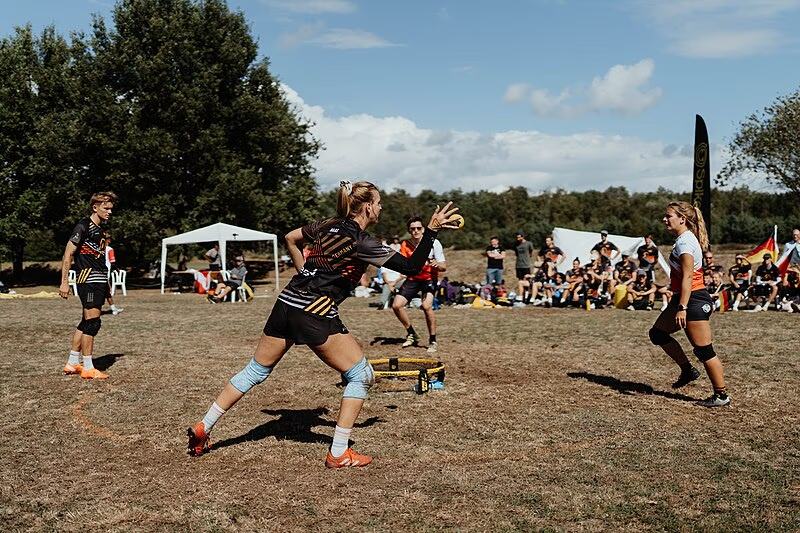

Spikeball (Roundnet)·Playground Games
Spikeball (Roundnet)
🌱Community
Loading OpenSourceSports…
Purpose: The legs elevate the net to ankle height and provide stability on uneven surfaces; Adjustment: Some sets feature adjustable-length legs to accommodate different surfaces (grass, sand, indoor floors); Stability: Legs should be firmly seated and locked before play begins. On soft surfaces ...
Why people argue about this
People often assume that Adjustable Legs refer to a feature allowing players to adjust their height like basketball hoops, when in fact they're simply retractable supports made of plastic or metal designed for stability and easy setup, folding out from a central hub as described. The confusion arises because the term "adjustable" can be misleading if not explained properly.
Casual Play: Slightly softer inflation makes the ball easier to control and rallies longer, ideal for beginners; Competitive Play: Firmer inflation produces faster play and sharper angles; tournament balls are typically at maximum inflation; Testing: Squeeze the ball between thumb and forefinger....
Why people argue about this
People often assume that the 12-inch bounce standard is a hard-and-fast requirement for every spikeball game, forgetting that it's meant as a guideline for consistent play in competitive settings. They overlook the fact that this rule allows for some flexibility to account for variations like ball age and environmental factors, not treating it as an exact measurement.
The serving team begins by serving the ball onto the net toward the receiving team; The receiving team has up to three touches among its two players to control the ball and spike it back onto the net; Teams continue alternating net hits until a team fails to return the ball legally
Why people argue about this
People often assume that once a serve is returned, it's immediately time for the next serve, forgetting that the basic flow of play only starts after one complete rally cycle where both teams have had their turns hitting and returning the ball back and forth. They miss understanding that each team gets to hit the ball twice in a rally before switching sides.
Legal contact: The ball may be played with any part of the body, including hands, fists, arms, head, chest, legs, and feet; Unintentional contact: If the ball strikes a player unintentionally (e.g., a deflection off the body), it counts as a touch for that player's team; Below the net: If a playe...
Why people argue about this
People often assume that a body shot in spikeball is when you intentionally hit your opponent with your arm, which isn't true at all. The real issue is that if a player touches their net or hits it with part of their body during play, they incur a fault and lose the rally, leading to confusion about what exactly constitutes a "body shot.
Definition: A carry occurs when the ball visibly rests in a player's hand or on their body rather than being struck cleanly. The ball must be hit with a single, distinct contact; Ruling: The opposing team is awarded the point; Judgment: Carries can be subjective. In tournament play, the referee m...
Why people argue about this
People often think that carrying means catching a ball with their hands like in volleyball, which is incorrect for spikeball. The confusion arises because in spikeball, you can technically carry if the ball visibly rests anywhere on your body or hand, not just in your hands alone as in other net sports where catching is strictly prohibited.
The 360-degree nature of Spikeball means all four players frequently move through the same space.
Why people argue about this
People often assume that collision avoidance is strictly about avoiding physical contact, forgetting that in Spikeball, players are constantly moving through each other's spaces due to its 360-degree nature. This leads them to misunderstand how they should navigate and avoid collisions, thinking it’s only about dodging hands but not realizing they need to adapt their movement patterns entirely.
Self-officiated games: If teams cannot agree on a call (rim shot, pocket, hinder, carry, double hit), the point is replayed; Refereed games: The referee's decision is final. Players may request a brief explanation but may not argue or delay the match; Video review: Some top-level tournaments allo...
Why people argue about this
People often assume that a 'carry' in Spikeball is simply when a player touches the ball twice without their teammate getting it first, but actually, it's more nuanced - they consider carries to be deliberate and intentional uses of momentum or body movement to keep the ball alive, which can lead to confusion about what exactly constitutes a carry.
Definition: A double hit occurs when the same player contacts the ball twice in succession without a teammate touching it in between; Ruling: The opposing team is awarded the point; Self-calling: In self-officiated games, players are expected to call their own double hits honestly. If a player is...
Why people argue about this
People often assume that a double hit is only about hitting the ball twice in succession without another teammate touching it, but they overlook the part where carrying the ball visibly resting in hand or body also counts as a double hit and results in a carry call by referees, leading to an immediate point for the opposing team.
Before each session: Inspect the net for tears, loose legs, or damaged frame components. Replace any worn or damaged parts; Ball condition: Discard balls that are cracked, deflated, or have developed an irregular shape, as they may bounce unpredictably; Playing area sweep: Walk the playing area b...
Why people argue about this
People often assume that equipment inspection is a standard part of Spikeball matches, thinking it's as routine as checking for ball size in volleyball. However, since this rule isn't explicitly mentioned in the official content for Spikeball (Roundnet), they mistakenly believe it should be included without realizing it might vary by league or tournament guidelines.
Incidental contact: Minor, unavoidable contact during play is expected in a 360-degree sport. No penalty is assessed for incidental contact; Aggressive contact: Pushing, grabbing, tripping, or intentionally running into an opponent is a violation. The opposing team is awarded the point; Repeated ...
Why people argue about this
People often assume that a carry in spikeball means simply touching an opponent with their net, which they mistakenly believe is always a foul. However, the official definition of a carry includes tossing or throwing the ball overhand toward the net while in contact with it, not just making incidental contact during a hit.
A fault results in the loss of the rally. The following are faults: The ball hits the rim at any point during play; The ball bounces more than once on the net; A team uses more than three touches before returning the ball to the net
Why people argue about this
People often assume that a fault in spikeball is only called when the ball hits the ground, forgetting that it can also occur if they hit the net or sidelines with their spike, which directly contradicts the official rule stating faults lead to loss of rally.
Spikeball is played in an open area with the net placed at the center. Unlike most net sports, there are no court boundaries or fixed sides.
Why people argue about this
People often assume that spikeball has fixed sides like in volleyball, thinking there are designated areas on either side of the net where players must stay. But actually, the lack of court boundaries means you can move anywhere within a reasonable playing area around the net, as long as your partner is able to hit the ball over it and into their opponent's space.
Definition: A hinder occurs when a player's position or movement prevents an opponent from making a play on the ball; Defensive hinder: If a player on the team that just hit the ball onto the net impedes an opponent's ability to reach or play the ball, a hinder is called and the point is replayed...
Why people argue about this
People often argue that they didn't really hinder their opponent; they just accidentally hit the ball in a way that could've been considered a hindrance. But actually, what matters is whether their action was intentional enough to have affected their opponent's play, not if it technically broke the rules as written.
Overhand serve: Serving the ball with an overhand motion is illegal. All serves must be underhand; No toss: Dropping the ball directly onto one's hand without an upward toss of at least 4 inches is a fault; Deceptive serving: The server may not deliberately fake or abort a serve to gain an advant...
Why people argue about this
People often assume that a serve is illegal if it touches the net and falls on their side of the court, forgetting that the key factor is whether the ball crosses the net before hitting the ground or another player. The confusion arises because they overlook the crucial part about the serve needing to clear the net entirely for legality in spikeball.
Indoor play: Ensure adequate ceiling height (at least 12 feet / 3.6 meters). Be aware of walls, pillars, and other obstacles. Ball behavior is more consistent without wind; Outdoor play: Wind can significantly affect ball trajectory. On windy days, consider using a slightly deflated ball for bett...
Why people argue about this
People often assume that outdoor Spikeball doesn't need ground leveling since it's played on natural terrain, forgetting that a stable net is still crucial for fair play. They overlook how an uneven surface can affect ball bounce and net height, leading to arguments about where the net should be placed.
Rim on serve: If the served ball strikes the rim, it is a let and the serve is retaken. The server gets one additional attempt; Consecutive lets: If the server hits the rim on the retaken serve, the receiving team is awarded the point (fault); Near-rim serves: If the ball lands very close to the ...
Why people argue about this
People often assume that a let serve is just another type of service fault, where you lose the rally right away. But in spikeball (roundnet), a let serve actually gives the server another chance to hit the ball properly; it's more like an opportunity to redeem yourself rather than conceding outright.
Touching the net: If a player touches the net or frame during a rally in a way that visibly moves the net or affects the ball's trajectory, the opposing team is awarded the point; Incidental contact: Brief, incidental contact with the net that does not affect play (e.g., a foot barely brushing a ...
Why people argue about this
People often assume that a player can touch the ball once with their hand before spiking it, thinking they're allowed one deliberate hit before the spike. Actually, the rule strictly prohibits touching the ball twice in succession, so even if you think you’re just giving it a gentle push first, you could still be called for net interference.
Position: The net is placed on the ground at the center of the playing area; Height: The net rim should be at approximately ankle height (8 inches / 20 cm above the ground); Level surface: The net should be placed on the flattest area available. If the surface is uneven, adjust the legs so the ne...
Why people argue about this
People often assume that the net placement is purely arbitrary, believing it can be placed anywhere as long as it's in the middle. However, they misunderstand that the official intent is for stability and fairness, necessitating precise centering on a level surface to ensure consistent gameplay conditions across different playing areas.
Clean bounce: The ball must bounce cleanly off the net surface. A clean bounce means the ball contacts the net mesh and rebounds upward in a predictable trajectory; Multiple bounces: If the ball bounces on the net more than once (a "double bounce" on the net), the hitting team loses the point; Ne...
Why people argue about this
People often assume that a net touch is always a fault in spikeball, forgetting that it's only a fault if it happens during an active shot attempt. The confusion arises because they overlook the fact that a net touch counts as a fault only when it occurs while someone is trying to hit the ball over the net, not just any time the ball hits the net itself.
Assembly: Assemble the net carefully. The legs snap into place under spring tension and can pinch fingers if not handled properly; Tension check: Before play, verify that the net is evenly tensioned and that no legs are loose or at risk of collapsing; During play: If the net shifts, becomes uneve...
Why people argue about this
People often assume that the net tension safety rule is about making sure the net isn't too tight for comfort; in reality, it's all about maintaining spatial awareness so players can call a hinder if they're at risk of colliding with their opponent or the net itself, ensuring everyone stays safe during gameplay.
The objective of Spikeball is to hit the ball onto the net in such a way that the opposing team cannot successfully return it. Teams alternate hitting the ball onto the net until one team fails to make a legal return, resulting in a point for the opposing team.
Why people argue about this
People often assume that hitting the ball onto the net is enough to score a point, but in reality, it's about preventing the opposing team from returning it legally; if they can hit it back, you keep playing until one side fails, and then the other gets a point.
Carrying bag: Most sets include a drawstring or zippered bag for portability; Extra balls: Recommended for continuous play and to replace worn or damaged balls; Ball pump: A small hand pump or needle pump for adjusting ball pressure
Why people argue about this
People often assume that since spikeball doesn't mention optional equipment in its official rules, it means you can use whatever you want without restrictions. But actually, the lack of explicit mention doesn’t mean there aren’t guidelines or limitations on what players are allowed to bring onto the court. It's a common oversight for organizers to forget to include such details explicitly.
If the ball becomes lodged in the net, the point is replayed; If an external object or person interferes with play (e.g., a dog runs through the playing area), the point is replayed; If the net shifts or collapses during a rally, the point is replayed and the net is reset
Why people argue about this
People often assume that if a player hits the ball out of bounds without it touching another player first, their team still gets points, which is incorrect. The confusion arises because in Spikeball, hitting the ball out-of-play means it must be returned by one of your teammates legally before you can score; otherwise, it's an automatic point for the opposing side.
Players are expected to call their own faults honestly (double hits, carries, rim shots); If players on opposing teams disagree on a call, the point is replayed; Excessive arguing, taunting, or unsportsmanlike behavior may result in a point penalty or disqualification in tournament play
Why people argue about this
People often assume that players in Spikeball are free to stand anywhere they want after a serve, thinking it means no fixed positions at all. But actually, the rule allows for fluid movement around the net without locking into specific zones or static spots on the court. It's about maintaining flexibility while ensuring everyone can move freely and effectively throughout play.
Definition: A pocket shot occurs when the ball hits the net near the rim and rolls along or "pockets" into the junction between the net and the rim, producing an unpredictable bounce; Ruling: Pocket shots that produce an unplayable or drastically altered trajectory are replayed (called a "let"); ...
Why people argue about this
People often argue that a "Pocket Shot" is just about hitting the ball into the net, forgetting that it's specifically defined as when you hit the ball directly into your own court after it bounces once in their court. They miss understanding that for it to be called a Pocket Shot and result in a fault, the ball must first bounce on their side of the net before they pocket it.
After each net hit, possession transfers to the opposing team. The team that did not hit the ball onto the net is now on offense and has up to three touches to return it.
Why people argue about this
People often assume that possession only changes when they hit the ball directly onto the net, forgetting that it also shifts if their opponent hits the ball back over for a return serve or an overhead strike. The confusion arises because they overlook the fact that possession can change on every net hit, not just direct shots.
Once the serve is successfully returned, the rally phase begins. During a rally: Teams alternate hitting the ball onto the net. After one team hits the ball onto the net, the other team has possession; There are no assigned sides or zones. Players move freely around the net in 360 degrees; Each t...
Why people argue about this
People often assume that once a serve is returned in spikeball (or roundnet), it's immediately considered a new rally, but actually, the official terminology specifies that only after the serve is successfully returned does the "rally phase" begin - meaning all previous exchanges are part of the same rally. This can lead to confusion about when exactly a new rally starts.
Spikeball uses rally scoring, meaning a point is awarded on every rally regardless of which team served. The team that wins the rally scores a point, whether they were serving or receiving.
Why people argue about this
People often think that in rally scoring, a point is only awarded if they were serving at the time of winning the rally, but actually it's about who wins the rally - whether you're serving or receiving doesn't matter; what matters is which team takes control and wins the point-scoring rally.
Minimum radius: At least 20 feet (6 meters) of clear space in all directions from the net; Ideal radius: 30 feet (9 meters) or more for competitive play, as rallies can extend far from the net; Hazard clearance: Remove or mark any obstacles within the playing radius, including rocks, holes, sprin...
Why people argue about this
People often assume that since there are no fixed boundaries in Spikeball, players can just run around freely without following the recommended clear space rule. But actually, it means they need to keep a reasonable distance from their opponents during play to avoid hitting them with the ball or getting hit themselves, ensuring fair play and preventing accidental contact.
Definition: A rim shot occurs when the ball strikes the plastic rim (frame) of the net rather than the mesh surface; Consequence: If the ball hits the rim at any point during play (including on the serve), the hitting team loses the rally and the opposing team is awarded the point; Rim and net: I...
Why people argue about this
People often assume that a "rim shot" happens when the ball hits the net directly above their head, thinking it's an easy way to score points. However, the real issue is that if the ball touches the net anywhere other than at the top and then falls into the opponent’s court, it counts as a fault, leading to a loss of rally regardless of where exactly it hit - just not near their head.
Type: Circular trampoline-style net stretched across a collapsible frame; Diameter: Approximately 36 inches (91.4 cm) across the playing surface; Net Material: Tightly woven nylon or polyester mesh designed to produce a consistent bounce
Why people argue about this
People often assume that the circular net in spikeball means it's a perfect circle with no variations, leading them to argue about its exact dimensions. However, the confusion arises because the official diameter is an approximation and doesn't account for slight manufacturing variances or how players might perceive different sizes based on their playing experience.
Spikeball is played in an open area with the net placed at the center. Unlike most net sports, there are no court boundaries or fixed sides.
Why people argue about this
People often assume that spikeball follows the same court boundaries as other net sports like volleyball, thinking there must be fixed sidelines. But in reality, the official verdict clarifies that there are no such boundaries or sides in spikeball, making it more akin to a free-for-all open space game with the net acting as the central divider.
Standard format: 2 players per team (2v2), for a total of 4 players; Casual variations: 1v1 (singles) and 3v3 formats are popular in recreational settings but are not used in official tournament play; Mixed teams: Teams may be composed of any combination of players regardless of gender
Why people argue about this
People often assume that standing 6 feet from the net is just a safety precaution to avoid injury, but in reality, it's part of the technicality that ensures each serve starts with the ball being hit directly overhand and not underhanded, which is crucial for maintaining gameplay fairness. The rule isn't about avoiding collisions; it's about serving technique.
The objective of Spikeball is to hit the ball onto the net in such a way that the opposing team cannot successfully return it. Teams alternate hitting the ball onto the net until one team fails to make a legal return, resulting in a point for the opposing team.
Why people argue about this
People often think that hitting the ball directly onto the net is enough for a point, but they misunderstand that it must be impossible for the opposing team to return it legally - meaning they need to hit it back over the net and into their opponent's court. They overlook the crucial part about making sure the return isn't possible, leading to confusion and disputes during games.
Spikeball uses rally scoring, meaning a point is awarded on every rally regardless of which team served. The team that wins the rally scores a point, whether they were serving or receiving.
Why people argue about this
People often assume that serving gives a team an automatic point, which is why they argue; however, the official verdict clarifies that scoring in rally format means you only win a point if your side wins the specific rally, regardless of who served it initially.
Definition: A double hit occurs when the same player contacts the ball twice in succession without a teammate touching it in between; Ruling: The opposing team is awarded the point; Self-calling: In self-officiated games, players are expected to call their own double hits honestly. If a player is...
Why people argue about this
People often assume that a double hit happens only when you touch the ball with two hands at once, forgetting that it can also occur if you tap the ball twice in quick succession without your teammate touching it first — this is where the confusion arises because they overlook the sequence aspect rather than focusing solely on simultaneous contact.
The 360-degree nature of Spikeball means all four players frequently move through the same space.
Why people argue about this
People often assume that since all four players in Spikeball move around a lot, they must constantly be colliding with each other for safety reasons. But actually, the focus is on preventing dangerous collisions at key moments like when one player is serving or when the ball is near the net, not on constant movement through shared spaces causing issues.
Definition: A foot fault occurs when the server steps closer than 6 feet (1.8 meters) to the net before contacting the ball on the serve; Ruling: The serve is a fault. If it is the first fault, the serve is retaken. If it is the second consecutive fault, the receiving team is awarded the point; M...
Why people argue about this
People often assume that there are strict foot fault rules in spikeball (roundnet) like other sports, so they get confused when they hear there aren't actually defined foot faults as a specific violation. The confusion arises because many players and spectators expect clear guidelines on where the server must stand before serving, but this isn't part of the official rules.
Distance: The server must stand at least 6 feet (1.8 meters) from the edge of the net at the moment of contact; Motion: The serve must be an underhand hit. The server tosses the ball upward (at least 4 inches) and strikes it with one open hand toward the net; Trajectory: The served ball must trav...
Why people argue about this
People often assume that once a serve is returned, it's automatically considered a new rally starting from scratch, forgetting about the points accumulated during the initial serve attempt. Actually, the official verdict clarifies that only when the return touches the ground and moves forward does a new rally begin, preserving all previous point counts.
Alternating servers: The serving team must alternate which player serves with each new service possession; Receiving rotation: At the start of each new service possession, the receiving team may choose which player receives the serve; Tracking rotation: In casual play, players should verbally con...
Why people argue about this
People often assume that the server must be exactly 6 feet away from the net for every serve, which leads to misunderstandings. However, the key is that they just need to start at least 6 feet back; their teammate can position themselves anywhere on their side of the net during a serve, as long as they're ready and in contact with the ball before it touches the ground.
Points to win: The first team to reach 21 points wins the game; Win by two: A team must win by at least 2 points. If the score reaches 20-20, play continues until one team leads by 2 (e.g., 22-20, 23-21); Point cap: In some recreational settings, a point cap of 25 is used — the first team to 25 w...
Why people argue about this
People often assume that a point is scored when one team fails to hit the ball over the net successfully, which isn't entirely accurate in spikeball. The confusion arises because they overlook the fact that points are also awarded for hitting the ball into the net or out of bounds on the opposing side's side lines, not just missing the net altogether.
Serving team: The server stands at least 6 feet (1.8 meters) from the net. The server's teammate may stand anywhere; Receiving team: The designated receiver stands across the net from the server, at any distance. The receiver's teammate may stand anywhere but must not interfere with the serve; Af...
Why people argue about this
People often assume that players can stand anywhere near the net as long as they're on their team's side of the court, but in Spikeball (Roundnet), the official rule clearly states one player must be at least 6 feet away from the net for a serving team to be legal, leading to misunderstandings about where exactly other teammates can position themselves.
Casual play: Substitutions may be made freely between points or games by mutual agreement; Tournament play: Substitution rules vary by tournament. Some events allow one substitute per match; others do not allow substitutions after a match has begun
Why people argue about this
People often assume that Spikeball has a substitution system like other sports do, thinking players can come on and off the court whenever they want. But in reality, there are no official rules addressing substitutions in Spikeball, leading to confusion about how it should work.
Sun glare: The ball can be difficult to track when looking directly into the sun. Rotate starting positions or switch sides to minimize the impact on one team; Sunscreen: Apply sunscreen before extended outdoor play sessions, especially on exposed arms, legs, and face; Hydration: Keep water bottl...
Why people argue about this
People often assume that sun and wind conditions are automatically managed by the game's overall safety guidelines, so they think the official statement means these factors aren't explicitly addressed at all. Actually, it indicates that if there were specific rules for sun and wind in Spikeball (Roundnet), they're not included within the provided safety section.
Grass: Recommended as the safest surface. Provides natural cushioning for dives, falls, and quick directional changes; Sand: Excellent for cushioning but can be unstable for quick lateral movements. Watch for hidden shells, rocks, or debris; Indoor courts: Safe for play but hard surfaces increase...
Why people argue about this
People often argue that they can't find a truly flat surface for Spikeball, thinking it's too strict. In reality, the rule is about ensuring safety from slippery conditions like wet grass or uneven concrete, which could make gameplay dangerous and unfair.
Grass: The most common playing surface. Provides good footing and cushioning for dives. Ensure the grass is not wet or slippery; Sand: Popular for beach play. Provides excellent cushioning for dives but requires more effort to move quickly. Press net legs deeper for stability; Indoor floors: Gymn...
Why people argue about this
People often assume that adjusting legs alone is enough to make uneven surfaces level for Spikeball, forgetting that it's also crucial to ensure the net itself stays in place and doesn't wobble due to surface inconsistencies. The confusion arises because they overlook how the entire setup needs to be stable, not just individual components.
Alternating servers: When a team regains service (wins a rally on the opponent's serve), the next server on that team must serve. Teams must alternate servers with each new service possession; Tracking the rotation: Each team should track which player served last. In tournament play, referees may...
Why people argue about this
People often assume that switching possession means a complete reset of all previous touches, forgetting that they still have up to three more hits before serving again. But in reality, it's about who gets to hit next and what counts as their first touch on offense, not erasing the entire game history.
Midpoint switch: In games to 21, teams switch starting sides when the first team reaches 11 points. In games to 11, teams switch at 6 points; Purpose: Switching compensates for environmental factors such as sun position, wind direction, or uneven terrain; Indoor play: Switching is still recommend...
Why people argue about this
People often assume that a team scores only when they send the ball over the net, forgetting that they can also score by forcing their opponents to switch sides due to hitting restrictions. The confusion arises because switching sides is less intuitive and doesn't grab attention like an outright kill shot.
Standard format: 2 players per team (2v2), for a total of 4 players; Casual variations: 1v1 (singles) and 3v3 formats are popular in recreational settings but are not used in official tournament play; Mixed teams: Teams may be composed of any combination of players regardless of gender
Why people argue about this
People often assume that they can play spikeball alone for fun since it's a two-player game, but in official tournaments, each team must have exactly two players on the court at all times to adhere strictly to the rule, which leads to arguments about whether someone is properly counted as part of a team.
Circumference: 12 inches (30.5 cm); Material: Soft, lightweight plastic or rubber; Weight: Approximately 1.6 ounces (45 grams)
Why people argue about this
People often assume that the ball size is just for aesthetic purposes, but in fact, it's crucial for controlling bounce and flight patterns essential for gameplay, so a 12-inch circumference ensures consistent performance across different playing surfaces.
Type: Circular trampoline-style net stretched across a collapsible frame; Diameter: Approximately 36 inches (91.4 cm) across the playing surface; Net Material: Tightly woven nylon or polyester mesh designed to produce a consistent bounce
Why people argue about this
People often argue that the net height is too strict, thinking it makes games unnecessarily difficult by requiring such a low bounce from just 3 feet up. In reality, the rule aims to ensure consistent play height and bounce for fairness across all players, which can be challenging to achieve if the net isn't taut enough.
Casual play: Players may take breaks between points by mutual agreement; Tournament play: Each team is typically allowed one timeout per game, lasting 30 to 60 seconds depending on tournament rules
Why people argue about this
People often assume that a timeout is awarded when their team fails to return the ball over the net in time, which isn't correct at all. The actual reason for timeouts in spikeball (or roundnet) is due to hitting the ball out of bounds or using excessive body contact, not just missing returns.
Maximum touches: Each team is allowed a maximum of three touches before the ball must be played onto the net; No consecutive touches: The same player may not hit the ball twice in a row. Touches must alternate between the two teammates; Minimum touches: A team is not required to use all three tou...
Why people argue about this
People often assume that touching the net with a paddle is just a minor infraction like in volleyball, leading them to argue it shouldn't result in a fault or loss of rally when it actually does because spikeball's touch limit rule is far stricter than volleyball’s, and hitting the net counts as crossing the line.
Games to 11: Many tournaments play games to 11 points (win by 2) for faster round-robin play; Games to 15: Some tournament formats use games to 15 points (win by 2) for bracket play; Games to 21: Championship and elimination matches are typically played to 21 points
Why people argue about this
People often assume that a team scores a point when they spike the ball out of bounds, forgetting that it's only awarded if the opposing team commits a fault like hitting the ball twice in succession or stepping on the net while playing. They overlook the fact that scoring is based on the other team making an error rather than just successfully spiking the ball over the net.
Role: In competitive tournaments, referees observe play and make calls on disputed points, faults, and rule violations; Positioning: Referees typically stand several feet from the net with a clear sightline to the net surface and all players; Authority: The referee's call is final on all disputed...
Why people argue about this
People often assume that the 6-foot distance rule is just about avoiding a direct hit on the net by the server's spike, but actually it’s meant to ensure fair play by preventing players from standing too close and potentially blocking their own team-mates' shots or even causing them to overshoot. They overlook how this rule impacts teamwork and strategic positioning in real gameplay.
Examples: Taunting, excessive celebration directed at opponents, throwing equipment, profanity, intentionally delaying play, or refusing to acknowledge legitimate calls; First offense: Verbal warning from the referee (in tournaments) or from the opposing team (in casual play); Second offense: Poi...
Why people argue about this
People often assume that unsportsmanlike conduct only applies to physical altercations or verbal spats between players, forgetting that it can also encompass actions like deliberately missing a shot on purpose just to give an opponent an easy point, which is technically not what the rule intends as "unfair play.
Dynamic warm-up: Light jogging, lateral shuffles, arm circles, and leg swings prepare the body for the quick, multidirectional movements required in Spikeball; Common injury areas: Ankles, knees, shoulders, and lower back are the most common injury sites. Stretching and strengthening these areas ...
Why people argue about this
People often assume that warming up and stretching are just for preventing muscle soreness, but they don't realize how crucial it is in spikeball (roundnet) where collisions can happen at high speeds. The confusion arises because players might overlook the potential for injury from a poorly executed hit or movement, thinking only of immediate physical discomfort rather than long-term health risks.
A team scores a point when the opposing team: Fails to return the ball to the net within three touches; Hits the ball into the rim; Hits the ball onto the ground
Why people argue about this
People often assume that a point is scored when their side hits the ball out of bounds, forgetting that it's also about hitting the ball onto the ground on the opponent’s side. The confusion arises because they overlook the fact that if the ball touches the ground on their own side after being hit by them, it still counts as a successful play and not necessarily an error by the opposing team.