


🏛️Official — Red Bull
Loading OpenSourceSports…
Put on a show — spectacle is the point
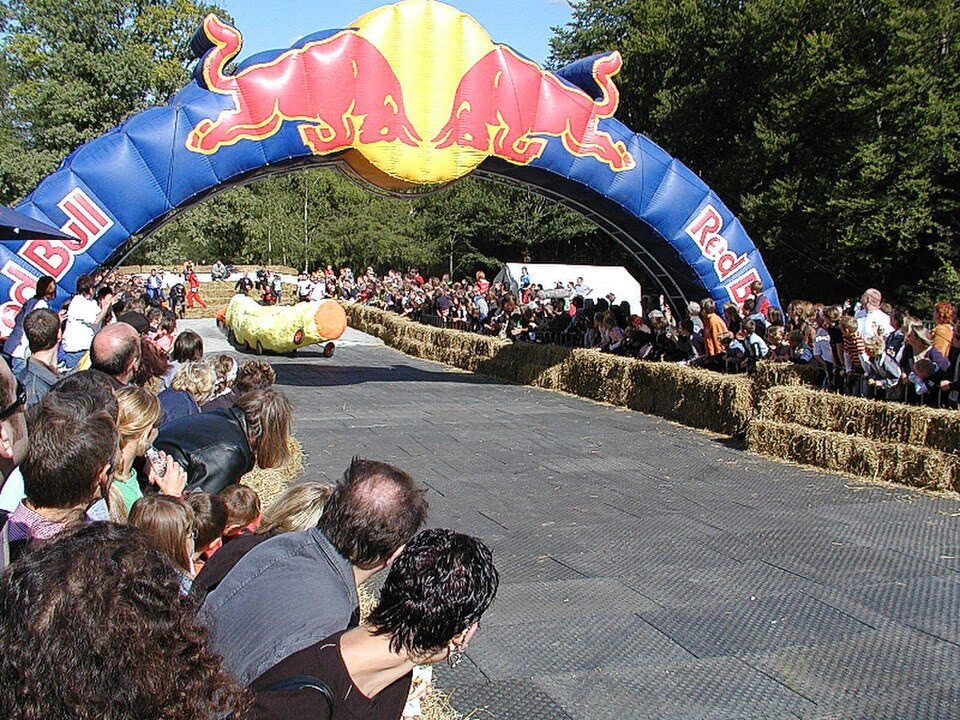
The cardinal unwritten rule of Red Bull Soapbox is that showmanship matters as much as speed. Teams that arrive with an uncreative vehicle and no performance are widely viewed as missing the point of the event. Effort on entertainment is expected from every entrant, not just competitive teams.
Gravity only — vehicles must coast downhill; Initial push at start permitted (typically 3-second team push from start gate); No engines, motors, pedaling, paddles, or stored energy (batteries, springs, etc.)
Why people argue about this
People often assume that since it's called "Permitted Propulsion," they can use some form of propulsion other than gravity for their race starts or descents, but in fact, the official rule clearly states only gravity is allowed during these phases, no engines, motors, pedaling, or stored energy.
Each team gets 1 official race run (some events allow 2 runs with best time counted); Pre-race "show" performance at the start line — 30-60 seconds of theatrical content judged separately; Race start: gravity-only descent — pushing permitted at the start, no propulsion during descent
Why people argue about this
People often assume that the initial 3-second push from teammates at the start is just a minor detail, but in reality, it's a crucial element that can give one team an unfair advantage over others, leading to heated debates about its fairness and implementation.
Soapbox vehicle: custom-built, non-motorized; weight limit 100 kg (220 lb); maximum dimensions 1.8 m × 1.8 m × 3 m (height × width × length); maximum 4 wheels; Steering mechanism required (mechanical, hand or foot operated); Functional brakes required (hand-lever or foot-pedal)
Why people argue about this
People think that the weight limit of 100 kg is too lenient, allowing overly light vehicles that can be unstable and unsafe, but actually, the rule aims to balance safety with practicality, ensuring racers have enough mass for traction without being so heavy they're prone to flipping over.
Downhill course: typically 400-600 m public street or park slope; substantial gradient (8-15%) for adequate gravity acceleration; Course features: jumps (one or more ramps for theatrical air-time), obstacles (hay bales, tire walls, sometimes water hazards), tight turns + chicanes; Padded crash ba...
Why people argue about this
People often assume that the course length is strictly 400-600 meters without considering other factors like gradient and obstacles, leading them to believe they can just make a shorter but steeper downhill track instead of adhering to the full specification.
Team size: typically 5 people (1 driver + 4 supporters/builders/performers); Driver: must be 18+, valid driving license preferred; medical clearance pre-event; Officials: race director, technical inspectors, judges panel (creativity + showmanship scoring), timing officials, course marshals, on-co...
Why people argue about this
People often assume that only one driver is needed per team, which leads to arguments about how many members are allowed. But in Soapbox Racing, Section 4 clearly states a team consists of five members including at least one eligible driver, not just one person behind the wheel.
Each team gets 1 official race run (some events allow 2 runs with best time counted); Pre-race "show" performance at the start line — 30-60 seconds of theatrical content judged separately; Race start: gravity-only descent — pushing permitted at the start, no propulsion during descent
Why people argue about this
People often assume that gravity-only descent means no assistance from team members whatsoever during the race start, which they mistakenly believe is strictly prohibited. However, the actual rule allows for an initial push from teammates to get the car moving, just not continuous propulsion throughout the entire race start sequence.
Race time: 50% of total score (fastest = highest race-points); Creativity: 25% of total score (vehicle design, theme execution); Showmanship: 25% of total score (pre-race performance, on-course theatrics)
Why people argue about this
People often assume that creativity and showmanship are equally weighted at 25% each, which they mistakenly believe means they must be exactly equal in importance. However, the confusion arises because the scoring system actually distributes points based on their perceived value to spectators rather than their relative weight, with race time being the most crucial factor for winning.
Failed safety inspection: vehicle rejected; team eliminated from race competition (may still participate in showmanship-only); Stored propulsion / illegal propulsion mechanism: disqualification; Vehicle weight over 100 kg: DQ
Why people argue about this
People often argue that a car weighing 100 kg exactly wouldn't be disqualified, thinking it's a strict cut-off at 101 kg or more. But actually, they misunderstand the rule which states any weight over 100 kg results in disqualification, so technically, even if just slightly above, like 100.1 kg, would trigger DQ.
Red Bull Soapbox Race is amateur but presents real injury risk — vehicles reach 40-60 km/h downhill with jumps. Mandatory equipment: full-face motorcycle helmet, eye protection, gloves, elbow + knee pads, closed-toe shoes.
Why people argue about this
People often assume that the mandatory safety gear is only for protection during jumps, forgetting that drivers need it throughout their entire race as cars reach up to 60 km/h on downhill sections. They overlook how essential these protective items are in preventing injuries from impacts and falls sustained at various speeds.
Maximum weight 100 kg + driver; Maximum 4 wheels; No vehicles capable of independent propulsion
Why people argue about this
People often assume that since soapbox racing involves a vehicle, they can use small engines for propulsion, thinking it's like in other car races where engines are standard. But actually, the key fact is that no motors or stored energy sources are allowed, strictly to ensure safety and fairness—no engine means no risk of mechanical failure during the race.