
🥊

🏛️Official — PFC
Loading OpenSourceSports…
Standing 10-count for knockdowns (rare but possible from accumulated body shots + dehydration); Three-knockdown rule per round = TKO; KO = total victory; TKO via referee/doctor stoppage
Why people argue about this
People often think that if a competitor gets three knockdowns in one round, they automatically get a knockout (TKO), but actually, it's just leading up to a referee or doctor stoppage because of those knockdowns; the knockouts themselves don't result in an immediate TKO.
3 rounds × 90 seconds (60-second rest between rounds); Championship fights: 3 or 5 rounds (event-dependent)
Why people argue about this
People often assume that the 90-second rounds in a PFC match are for each contestant individually, thinking it’s like boxing where you get hit by your opponent. But actually, these 90 seconds apply to both competitors simultaneously within each round, ensuring there's always some active engagement and scoring potential between them.
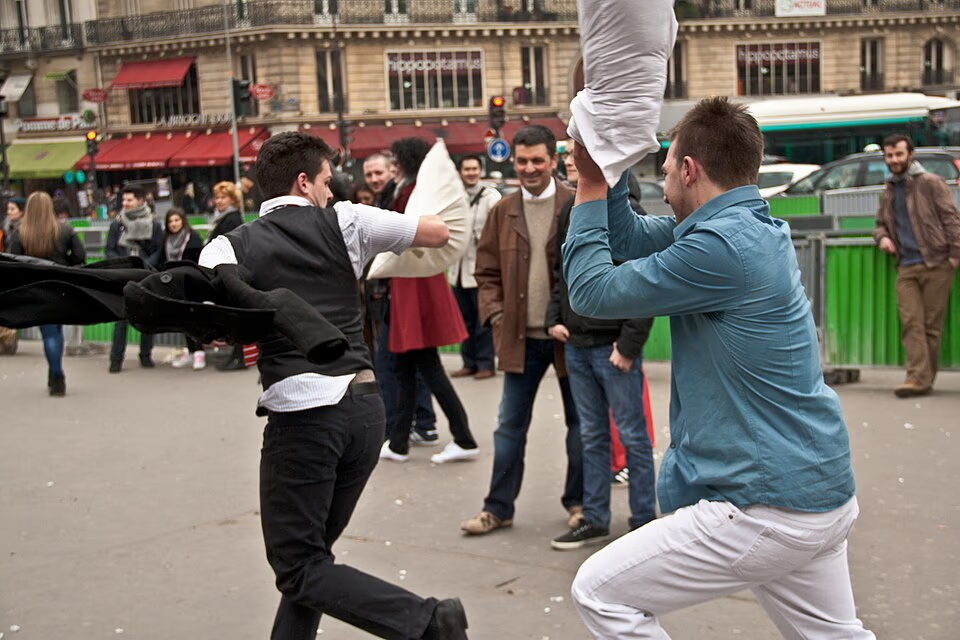
Pillow strikes only — swing the pillow at opponent's head + body; Two-handed pillow grip permitted; Spinning pillow strikes legal
Why people argue about this
People often assume that since Pillow Fighting is a playful sport, all strikes are permissible in good humor. But the official rule clearly states that only pillow strikes aimed at head and body using a two-handed grip are allowed, with no spinning strikes or grappling permitted—this confusion arises because it seems too strict for such a light-hearted game.
No closed-fist punches without pillow; No kicks, knees, elbows, head-butts; No takedowns, grappling, or ground fighting
Why people argue about this
People often assume that since it's called Pillow Fighting, you can punch with your closed fists without a pillow, which is incorrect. The rule specifically prohibits closed-fist punches entirely, regardless of whether they're used on pillows or not, leading to confusion about what techniques are allowed.
PFC regulation pillow: ~2 lb (1 kg) weighted pillow with reinforced cover — same model issued to both competitors pre-fight; Mouthguard: mandatory; Groin protector: mandatory (men); chest protector for women
Why people argue about this
People often assume that gloves are allowed in Pillow Fighting just because they're common in other martial arts, forgetting that Section 2 clearly states no gloves or street shoes are permitted. The confusion arises because this specific detail is often glossed over in the quick summaries of rules.
Padded ring or octagonal cage: 20-24 ft diameter, padded floor + rope/cage perimeter; PFC favors a square ring for traditional combat-sport aesthetics; some events use a hex/octagon; Lighting + camera positions optimized for broadcast
Why people argue about this
People often assume that the padded floor in PFC is meant for safety, when in fact it's primarily designed to look good on TV screens, thus causing confusion about its primary function.
Two competitors per match; Weight classes (Men, lb): Featherweight (-145), Lightweight (-155), Welterweight (-170), Middleweight (-185), Heavyweight (+185); Women's divisions: Strawweight, Flyweight, Bantamweight, Featherweight
Why people argue about this
People often assume that weight classes in Pillow Fighting are purely for show, a way to make matches more visually appealing by having lighter players take on heavier opponents. However, the truth is that these weight classes are crucial for ensuring fair play and safety; they help balance physical strength differences that could lead to injuries or unfair advantages during competition.
3 rounds × 90 seconds (60-second rest between rounds); Championship fights: 3 or 5 rounds (event-dependent); Pillow strikes only — swing the pillow at opponent's head + body
Why people argue about this
People often assume that since Pillow Fighting matches are only 3 rounds, each round must be exactly 90 seconds long without any rest periods between them. But actually, the key fact is that there's a 60-second break after every round, which can lead to confusion about how much actual fighting time players get in total.
10-Point Must scoring (boxing-style); Judges weight: clean pillow strikes, aggression, ring generalship, defense, frequency of significant connection; PFC Champion belt + title-fight ranking system per weight class
Why people argue about this
People often assume that scoring in Pillow Fighting is solely based on who can throw more pillow punches, forgetting that judges also evaluate factors like aggression, ring presence, defense, and how often they land significant hits — a mix of boxing criteria adapted to the sport's unique nature.
Striking without pillow (closed fist / kick / etc.): warning → point deduction → DQ; Hitting opponent while down: point deduction → DQ; Hitting after the bell: point deduction
Why people argue about this
People often argue that they can get away with hitting their opponent without a pillow if it's just for a split second, thinking it won't be noticed or penalized. However, the confusion arises because this rule specifically states striking without a pillow results in immediate disqualification (DQ), not just a point deduction after being warned.
Pillow Fight Championship dramatically reduces concussion + KO risk vs traditional combat sports due to the pillow's impact-spreading surface. Injuries are typically: shoulder strain (overuse), dehydration in long fights, occasional accidental finger-bend on pillow grip.
Why people argue about this
People often assume that since pillow fighting has a lower risk of concussion and KO compared to traditional combat sports like MMA, it must be completely safe. But they overlook the fact that injuries from shoulder strain overuse and dehydration are still prevalent in PFC events, which can significantly impact athletes' performance and enjoyment of the sport.