


🏛️Official — FIM
Loading OpenSourceSports…
Motor Sports
2–10 players
both
motorcycle, helmet, race suit
10 essential rules
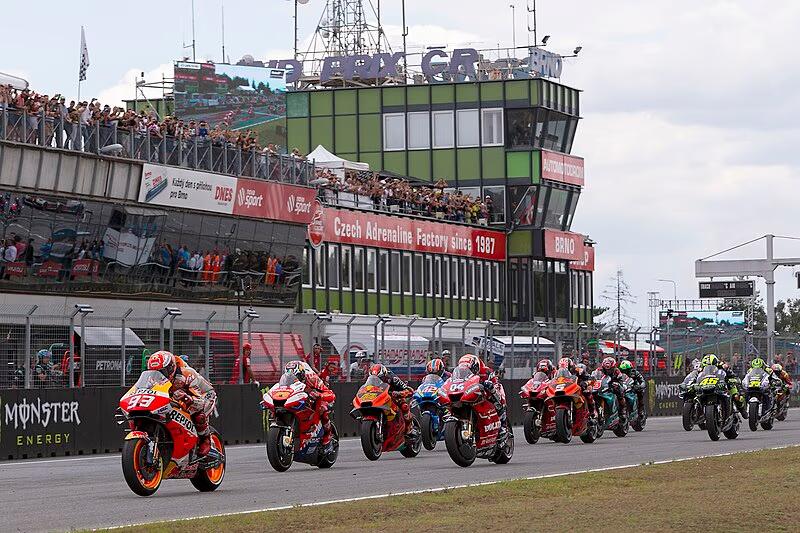
The FIM MotoGP World Championship is the premier class of the FIM Grand Prix Motorcycle Racing World Championship, governed by the Fédération Internationale de Motocyclisme (FIM) in conjunction with Dorna Sports S.L., the exclusive commercial rights holder. The championship was inaugurated in 194...
Per Article 2 of the MotoGP Technical Regulations: Engine type: 4-stroke internal combustion, naturally aspirated (no turbocharging or supercharging permitted).; Maximum displacement: 1000cc.; Maximum number of cylinders: 4.
The minimum weight of the motorcycle at any time during the event (without fuel, with all other fluids) is 157 kg (Article 3.1). If a motorcycle is found below minimum weight after a race, the rider may be excluded from the results.
To control costs, each MotoGP rider is allocated a fixed number of engines per season (Article 5): Standard allocation (Factory/Satellite teams): 7 engines per rider per season.; Concession manufacturers: manufacturers designated as "Open" or "Concession" status may receive a higher engine alloca...
All MotoGP machines must use the standardised ECU (Electronic Control Unit) hardware supplied by the official electronics provider (currently Magneti Marelli/Prometeia). Teams supply their own software within permitted parameters.
Michelin is the sole official tyre supplier for the MotoGP class (appointed by the Grand Prix Commission effective 2016). Tyre specifications, allocation quantities, and compound selections for each event are determined by Michelin in consultation with Race Direction.
All rider equipment must meet or exceed FIM homologation standards (Article 8): Helmet: Must carry a valid FIM homologation label. Acceptable standards include ECE 22.06 (most recent edition), SNELL M2020, or equivalent FIM-approved standard.; Suit: Full leather (or FIM-approved alternative) one-...
Minimum track width: 12 metres throughout the circuit layout, with wider minimums required at defined high-speed sections per the FIM Circuit Licence Regulations.; Track surface: Asphalt; must meet FIM grip and consistency standards. Concrete sections are permitted only where approved by the FIM....
Asphalt run-off areas are preferred and required at high-speed corners per current FIM Grade A standards. Gravel traps may exist at circuits with historical or physical constraints but must meet minimum depth and dimension requirements.; Tecpro barriers (or equivalent FIM-approved energy-absorbin...
All motorcycles must use the pit lane speed limiter (activated by a dedicated handlebar button) when in the pit lane. The maximum speed in the pit lane is determined per event by Race Direction; typically 60 km/h during sessions and race. The exact limit is published in Supplementary Regulations ...
A Level 2 Medical Centre (as defined by FIM Medical Code) must be present and fully operational at all times during official sessions. This includes surgical capability, anaesthesia, and intensive care facilities.
Don't hunt a rival's tow in qualifying
Deliberately slowing on an out-lap to sit behind a rival and draft their slipstream for a fast lap is considered unsporting. The cat-and-mouse crawl at session end — both riders refusing to lead — is MotoGP's most debated etiquette breach and has caused confrontations, stewards' reviews, and paddock arguments for over two decades.
Most visible at high-speed circuits like Mugello, Phillip Island, and Valencia. Rossi, Marquez, Lorenzo, Viñales, and Quartararo have all been involved in widely-covered incidents.
Yield to a rival clearly on a flying qualifying lap
A rider on a slow out-lap is expected to move wide and back off when a rival is clearly on a timed flying lap, even beyond what the written regulations strictly require. Deliberately failing to yield — even when technically within the rules — is viewed as deliberate interference and condemned in the paddock.
Race Direction can penalize impeding under written rules; the unwritten norm holds that you should yield even in borderline situations where no penalty would be issued.
Honor fallen riders with a tribute gesture after winning
When a fellow competitor has died or suffered a life-threatening crash, winning riders are expected to dedicate the result publicly — pointing skyward on the slowdown lap, wearing tribute stickers, making explicit dedications in post-race interviews. Winning without any acknowledgment after a peer's death is seen as a serious cultural failure.
Deeply embedded in MotoGP given the sport's mortality risk. Most prominently observed after Daijiro Kato (2003), Marco Simoncelli (2011), and Nicky Hayden (2017). Rossi's dedications set a cultural benchmark.
Ready to dive deeper?