


🏛️Official — UIPM
Loading OpenSourceSports…
Never publicly blame your drawn horse
Athletes are randomly assigned horses they have never ridden, with only 20 minutes of familiarization before competing. Criticizing the horse in post-round interviews, on social media, or to officials is considered among the worst sportsmanship failures in the sport. The horse did not choose you; adapting is the competitor's responsibility.
Weapon: Épée (thrusting sword). Standard FIE-approved épée with a maximum total weight of 770 g (27.2 oz) and blade length of 90 cm (35.4 in) maximum. Button (point) requires 750 g of pressure to register a touch.; Protective equipment: FIE-certified fencing mask (1600 N bib), fencing jacket (350...
Why people argue about this
People often assume that the épée's blade length of 90 cm is just for aesthetic reasons, forgetting it’s crucial for accuracy in fencing within the Modern Pentathlon's time constraints. The confusion arises because they overlook how this precise measurement impacts both technique and efficiency during competition.
Swimwear: Must comply with World Aquatics (formerly FINA) regulations. Men: jammers or briefs. Women: one-piece swimsuit. No full-body suits (banned since 2010).; Goggles: Permitted. No restrictions on type or brand.; Cap: Required. Must display the athlete's country code or name for identification.
Why people argue about this
People often assume that modern pentathlon swimming has strict equipment regulations since it's such a specialized event, but in fact, the official statement clarifies there are no specific requirements mentioned for swimming gear, leading to confusion about what is allowed or not.
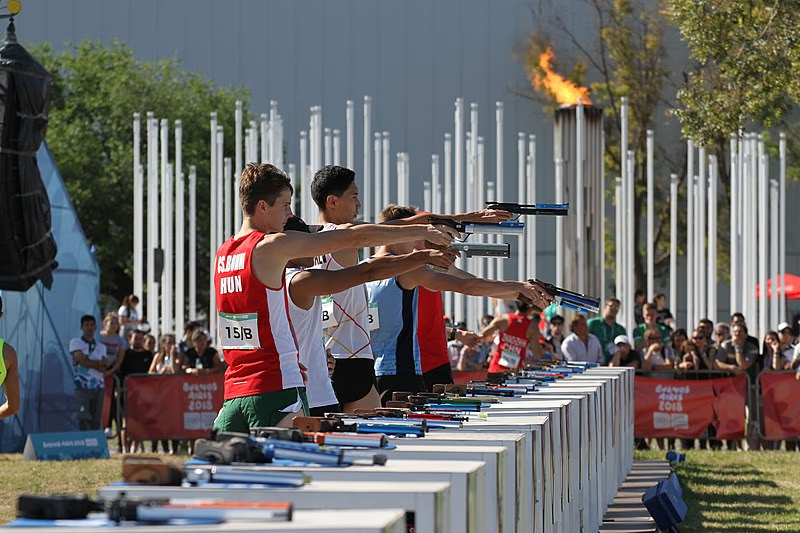
Laser pistol: Fires an infrared beam (no projectile, no ammunition). The beam registers on an electronic target. Maximum weight 1.5 kg (3.3 lb). Semi-automatic firing (one trigger pull per shot).; Grip: No restrictions on grip modifications, orthopedic grips, or palm rests, provided the total pis...
Why people argue about this
People often assume that since Laser Pistol is a firearm, it must be as dangerous as traditional firearms used in shooting sports like rifle or shotgun competitions. However, the confusion arises because Modern Pentathlon's rules for Laser Pistol are designed to ensure safety and fairness, with specific calibers and recoil mechanisms unlike any other sporting context.
Footwear: Standard running shoes. No restrictions on brand or type. Spikes are not typically permitted on paved courses.; Attire: National federation competition uniform. Race number bib must be visible on the front.; Timing chip: Transponder attached to the shoe or bib for electronic timing at e...
Why people argue about this
People often assume that running equipment in Modern Pentathlon is as simple as regular running shoes, forgetting about the specialized épée sword with its exact weight and blade length requirements. They overlook the fact that protective gear like a mask, jacket, and plastron are mandatory for safety, not realizing how crucial these items are to prevent injuries during the running events.
Attire: Form-fitting athletic wear suitable for climbing, swinging, and balancing. Grip gloves may be permitted (subject to UIPM regulations).; Obstacle specifications: Standardized obstacles approved by the UIPM, including climbing walls, balance beams, hanging obstacles, cargo nets, and travers...
Why people argue about this
People often argue that the épée equipment's weight requirement of 750g is too heavy for comfort during a physically demanding obstacle course, but actually, the FIE-certified gear design ensures that even with this heavier épée, athletes maintain optimal balance and control without feeling overly burdened.
Piste: Standard fencing piste, 14 m (46 ft) long and 1.5–2 m (5–6.5 ft) wide, with metallic or conductive surface for electronic scoring; Multiple pistes: Multiple pistes set up simultaneously to accommodate the round-robin format within the competition time frame (typically 4–6 pistes running co...
Why people argue about this
People often assume that the rule means all five Modern Pentathlon events must be held in one location, which they mistakenly believe is a logistical nightmare. In reality, it suggests venues for each event should ideally be close together to create an engaging spectator experience without forcing everything into a single site.
Pool: 50 m Olympic pool or 25 m short-course pool (25 m pool requires 200 m = 8 lengths). Must meet World Aquatics standards.; Lane assignment: Athletes are assigned lanes based on seeding (fastest seeds in center lanes); Timing: Electronic touchpad timing to 1/100th of a second
Why people argue about this
People often assume that the rule means all five Modern Pentathlon disciplines must be held in one venue, which they see as limiting their experience by forcing them to travel between events. However, the actual intent is to create a cohesive atmosphere where spectators can follow the entire competition without having to move from event to event, even if not all are at the same physical location.
Course design: A purpose-built obstacle course approximately 100–200 m in length featuring sequential obstacles of increasing difficulty; Obstacle types: Climbing walls, cargo net traversals, balance beams over water or padding, hanging ring sequences, warped walls, salmon ladders, and rope swing...
Why people argue about this
People often argue that this rule is overly prescriptive, suggesting venues must be centralized when in reality it's meant as a recommendation for creating an engaging spectator experience, allowing flexibility rather than enforcing strict venue clustering.
Running circuit: 4 laps of 800 m each (3,200 m total running distance). Flat or gently undulating course, typically within or adjacent to the stadium for spectator viewing.; Shooting range: Positioned at the start/finish area of each lap. Athletes run to the range, shoot, then depart for the next...
Why people argue about this
People often assume that this rule means all five Modern Pentathlon events must be held at a single venue, which they mistakenly believe is to create a stadium atmosphere for spectators. However, the actual intent is more about flexibility and convenience for organizing, allowing for potential logistical efficiencies without requiring everything to take place in one location.
The UIPM strongly encourages all disciplines to be held at a single venue or within a compact venue cluster to create a stadium-show atmosphere and allow spectators to follow the entire competition...
Why people argue about this
People often assume that the venue philosophy means all events must be held in one massive stadium, which they see as limiting creativity and flexibility. However, the actual intent is to cluster related disciplines close together for spectator convenience, not necessarily requiring them to be in a single large venue.
Individual competition: 36 athletes per Olympic event (18 men, 18 women). All athletes compete in all five disciplines on the same day.; Age requirement: Minimum 18 years old in the calendar year of competition; Qualification: Athletes qualify through the UIPM World Ranking system, Continental Ch...
Why people argue about this
People often assume that anyone can participate in Modern Pentathlon as long as they're interested, which misunderstands the requirement for age and qualification through UIPM rankings or events outlined in Rule 4.1. The rule is designed to ensure a competitive field representing global standards rather than open access based on interest alone.
Fencing: FIE-licensed referees oversee each piste. A Fencing Director coordinates the round-robin schedule and resolves disputes. Bout committee tracks victories and results.; Swimming: World Aquatics-certified officials including a starter, stroke judges, turn judges, and timekeepers; Obstacle C...
Why people argue about this
People often assume that these officials are appointed by national governing bodies rather than UIPM itself, which leads to misunderstandings about their authority and independence in Modern Pentathlon events. The confusion arises because the rule specifies "UIPM" appoints them, not other sports organizations.
UIPM Technical Delegate: The most senior official at the competition. Responsible for ensuring all UIPM rules are followed, approving the schedule and venues, and making final decisions on protests.; Competition Committee: Composed of the Technical Delegate, discipline directors, and a representa...
Why people argue about this
People often assume that athletes can compete in all five disciplines over multiple days, thinking it's a way to spread out the pressure. But actually, they must complete all events on the same day for each event, and there’s no flexibility allowed in scheduling due to this rule. The confusion arises because it contradicts common understanding of how other multi-day sports operate.
Format: Full round-robin — every athlete fences every other athlete in one-touch épée bouts; Bout duration: 1 minute per bout. If no touch is scored within 1 minute, both athletes are recorded as having lost (double defeat).; Scoring: A victory = 1 point. A defeat (including double defeat) = 0 po...
Why people argue about this
People often assume that since all five disciplines are completed in one day, each discipline must be equally short-lived, leading them to argue about how long they should take individually. But actually, the rule allows for flexibility within a 5-6 hour window, meaning different events can vary in length depending on their specific demands and scoring systems.
Distance: 200 m freestyle (any stroke permitted, though front crawl is universally used for speed); Pool: Athletes swim in heats, seeded by personal best times. The fastest seeds swim in the final heat for competitive motivation.; Timing: Electronic touchpad timing to 1/100th of a second
Why people argue about this
People often assume that the 200m freestyle swimming event happens immediately after all other disciplines are completed, which leads them to think it could be a quick finisher in under an hour. However, the confusion arises because this rule actually refers to the total time for completing all five events over one day, not the duration of any single discipline.
Format: Timed run through a sequential series of obstacles. Each athlete runs the course individually.; Completion: Athletes must complete each obstacle to continue. Falling off or failing an obstacle results in either a time penalty (typically 10 seconds) or a mandatory restart of that obstacle ...
Why people argue about this
People often assume that completing all five disciplines in one day means they can be done quickly without regard for difficulty or safety, but actually, the rule specifies a single day within approximately 5-6 hours of total competition time, allowing enough flexibility to manage course challenges and participant well-being effectively across different events.
Handicap start: Athletes start in order of their cumulative points from fencing, swimming, and obstacle course. The leader starts first. Each point difference = 1 second of time deficit. This system means the first athlete to cross the finish line wins the gold medal, creating a dramatic, televis...
Why people argue about this
People often assume that the Laser Run is a separate event from the shooting disciplines in Modern Pentathlon, when in fact it's integrated as part of those shooting events within a single day. The confusion arises because the Laser Run involves both running and shooting, with all five disciplines completed together in one intense, physically demanding session over approximately 5 to 6 hours.
All five disciplines are completed in a single day (approximately 5–6 hours of competition time). A typical schedule: Morning: Fencing ranking round and bonus round (2–3 hours); Midday: Swimming heats (1 hour); Afternoon: Obstacle course (1 hour)
Why people argue about this
People often assume that since all five disciplines are completed in a single day, there must be no breaks between them. But actually, the rule only specifies the total time frame for competition completion; it doesn't dictate how much rest athletes get between events. There's still flexibility on when and how long they can take their breaks.
Each discipline produces a point score. Points from fencing, swimming, and obstacle course are summed to determine the Laser Run start order.
Why people argue about this
People often assume that in Modern Pentathlon's points-based system, each athlete's total score across fencing, swimming, and obstacle course determines their Laser Run start order directly. However, they misunderstand that these scores are summed to rank athletes for Laser Run starting positions, not to calculate individual Laser Run times or outcomes based on those scores.
Baseline: 250 points for achieving 70% victories in the ranking round; Adjustment: Points added or subtracted based on victory percentage above or below 70%; Bonus round: Additional points earned through the single-elimination bracket (typically 20–40 bonus points available)
Why people argue about this
People often assume that the scoring range of 180 to 300 points is directly tied to each athlete's performance in their fencing matches, but actually, it's a calculated score based on how they perform relative to other athletes in the competition, taking into account their overall victory percentage and any bonus points earned from other events.
Baseline: 250 points for a time of 2:30.00; Conversion: 1 point per 0.33 seconds faster or slower than the baseline; Typical range: 280–340 points for elite pentathletes (typical times 1:55–2:15)
Why people argue about this
People often assume that if they swim faster than 2:30, their points will just keep getting added up without a cap; but actually, the score changes by only 1 point for every 0.33 seconds faster or slower than the baseline of 250 points at 2:30.00.
Time-based: Completion time (including penalty time for failed obstacles) converted to points; Baseline and conversion rate: Determined by the UIPM for the specific standardized course used at each competition; Penalty for failed obstacles: Fixed time addition (typically 10 seconds per failure) a...
Why people argue about this
People often assume that the 0.33-second increment is based on a perfect time of exactly 15 minutes and 30 seconds, but actually it's calculated from the baseline of 15 minutes and 30 seconds to the athlete’s actual finish time, meaning they can earn points for finishing either faster or slower than that mark within the allowed range.
Handicap start: The athlete with the most cumulative points (from fencing + swimming + obstacle course) starts first. Each point difference between athletes = 1 second of time gap at the start.; Winning: The first athlete to cross the finish line wins the gold medal, regardless of total points ac...
Why people argue about this
People think that in determining the overall winner, both fencing and swimming scores are equally crucial for placing athletes, whereas they only play a role in deciding who starts first in the Laser Run. The confusion arises because the rule states points from these two events decide start order, not their final rankings after all competitions.
Ties in the Laser Run are resolved by photo finish (time recorded to 1/100th of a second); Ties in fencing are broken by the indicator (touches scored minus touches received); Ties in swimming are broken by the photo finish timing
Why people argue about this
People often assume that if scores are tied after the Laser Run, it's automatically decided by who swam faster, forgetting about fencing altogether. But actually, the rule specifies that if swimming results in a tie, then the scoring system moves on to prioritize the fencers' times instead. This oversight or misinterpretation leads to confusion.
Corps-à-corps (body contact): Penalty touch awarded to the opponent if the contact is deliberate. Accidental contact results in halt and restart.; Covering target: Deliberately using the non-weapon hand to cover valid target area — penalty touch; Turning back to opponent: Penalty touch. In épée, ...
Why people argue about this
People often assume that accidental contact in fencing is always a restart, forgetting that deliberate double touches result in penalties instead of play continuation. This oversight leads to arguments about whether a referee correctly penalized or restarted play based on initial contact.
False start: One false start per athlete. Second false start = disqualification from that heat (applies World Aquatics rules).; Stroke violation: Any stroke is permitted in freestyle, but touching the wall during turns must follow World Aquatics rules (one hand touch for backstroke, two-hand touc...
Why people argue about this
People often assume that a false start in swimming means they get automatically disqualified right away, forgetting that it's just one of several potential penalties within the swim event. They overlook the fact that a false start only disqualifies them if they touch the wall before the starting gun or wave is heard, not if it results in them finishing last overall.
Shooting station: Athletes must stand behind the shooting line. Stepping over the line during a shooting series results in a warning. Repeated offense = 10-second time penalty.; Pistol handling: The laser pistol may only be pointed at the target. Pointing the pistol in any other direction (even t...
Why people argue about this
People often assume that simply turning back towards an opponent during a Laser Run automatically results in a penalty touch without considering other factors like equipment failure allowing for a replacement. The confusion arises because they overlook the specific conditions under which a turn back is penalized and fail to recognize when equipment issues necessitate a time-out for repair.
Unsportsmanlike conduct: Yellow card (first warning), red card (point/time penalty), black card (disqualification and removal from the competition); Anti-doping: WADA anti-doping rules apply. Positive tests result in disqualification of all results and potential suspension of 2–4 years.; Failure ...
Why people argue about this
People often assume that deliberate target coverage is only penalized in shooting events like Modern Pentathlon, forgetting that it applies across all disciplines including fencing and riding. The confusion arises because they overlook how covering targets can be seen as a strategic move rather than an accidental oversight, especially when the athlete isn't actively aiming for them.
All fencing equipment must pass FIE safety checks before competition, including mask strength tests, jacket penetration resistance, and weapon inspection; Body wires and electrical connections are inspected before each bout; A fencing doctor or paramedic must be present at the fencing venue throu...
Why people argue about this
People often assume that the immediate replacement of broken blades in fencing is solely for safety reasons, forgetting that it's also a way to keep the competition moving smoothly without delays. They overlook how crucial timely reshelving and resetting equipment can be in maintaining the flow and integrity of a fast-paced pentathlon event.
Standard pool safety per World Aquatics: lifeguards on duty, water temperature monitored, lane ropes in place; Pool depth must be a minimum of 1.35 m (4 ft 5 in) at the starting end (no diving-related injuries at proper depth); Medical team with resuscitation equipment must be present poolside
Why people argue about this
People often assume that lifeguards are only present during competition hours, forgetting they're on duty throughout the entire event for safety reasons. The misunderstanding stems from believing diving-related injuries aren't a concern in other events like shooting or show jumping, leading to complacency about pool safety.
Laser pistols are inherently safe — they fire no projectile and the infrared beam is eye-safe at the operating power level; Despite the absence of physical danger, athletes must treat the pistol as if it were a live firearm for training discipline: never point at people, always point downrange; R...
Why people argue about this
People often assume that just checking electrical connections and body wires is enough for safety inspections in Laser Pistol Safety, forgetting about other potential hazards like loose screws or improperly installed parts that could also pose a risk during competition. They overlook the comprehensive nature of what these checks are supposed to ensure, leading to misunderstandings and arguments.
All obstacles are designed with certified crash mats, padded surfaces, and water pits beneath elevated elements; Maximum fall height is limited by UIPM regulations (typically no more than 3 m / 10 ft above a padded surface); Safety spotters may be positioned at obstacles with the highest failure ...
Why people argue about this
People often assume that safety gear is only required for the equestrian event, forgetting that it applies equally to all obstacle courses from fencing to swimming, leading to misunderstandings about which athletes need to wear helmets and other protective equipment at each station.
A comprehensive medical team must be available throughout the entire competition day, covering all venues; An ambulance must be on standby with access to the venue; Heat management protocols for outdoor events: cooling stations, ice towels, modified schedules if temperatures exceed 32°C (90°F)
Why people argue about this
People often assume that just because the rule mandates medical personnel be present for immediate care, it means they're always on standby ready to treat athletes at a moment's notice. But in reality, the rule only requires them to be available and equipped to respond quickly if needed, not necessarily stationed or immediately accessible throughout the entire competition.
Weapon: Épée (thrusting sword). Standard FIE-approved épée with a maximum total weight of 770 g (27.2 oz) and blade length of 90 cm (35.4 in) maximum. Button (point) requires 750 g of pressure to register a touch.; Protective equipment: FIE-certified fencing mask (1600 N bib), fencing jacket (350...
Why people argue about this
People often assume that the weight limit for the épée in Modern Pentathlon is more generous than 770 grams, but they misunderstand the exact specifications laid out by the UIPM. In reality, the rule specifies a precise maximum of 770 grams, not allowing for any wiggle room or common misconceptions about flexibility within this parameter.
The UIPM strongly encourages all disciplines to be held at a single venue or within a compact venue cluster to create a stadium-show atmosphere and allow spectators to follow the entire competition...
Why people argue about this
People often assume that the requirement for all disciplines of Modern Pentathlon to be held at a single venue is purely about convenience for spectators, but actually, it's designed to ensure athletes have access to their equipment and minimize travel time between events, which can affect performance and fairness across different disciplines.
Individual competition: 36 athletes per Olympic event (18 men, 18 women). All athletes compete in all five disciplines on the same day.; Age requirement: Minimum 18 years old in the calendar year of competition; Qualification: Athletes qualify through the UIPM World Ranking system, Continental Ch...
Why people argue about this
People often argue that the age requirement of 18 is too high, thinking it limits participation by excluding many younger athletes who are eager to compete in such a challenging event. Actually, the rule aims to ensure experienced and mature competitors for each discipline, which can contribute to fair competition across all events.
All five disciplines are completed in a single day (approximately 5–6 hours of competition time). A typical schedule: Format: Full round-robin — every athlete fences every other athlete in one-touch épée bouts; Bout duration: 1 minute per bout. If no touch is scored within 1 minute, both athletes...
Why people argue about this
People often assume that all five disciplines of Modern Pentathlon must be completed within a single day for official competition time, which is why they argue. However, the actual rule states it can span over one to two hours across multiple days, allowing athletes more flexibility in scheduling their events.
Each discipline produces a point score. Points from fencing, swimming, and obstacle course are summed to determine the Laser Run start order.
Why people argue about this
People often assume that the Laser Run start order is determined solely by adding up their scores from fencing, swimming, and obstacle course, but actually, it's based on the lowest of these three discipline scores—meaning if you have a bad Laser Run despite scoring well in the other events, your overall score might not be as high as expected.
Corps-à-corps (body contact): Penalty touch awarded to the opponent if the contact is deliberate. Accidental contact results in halt and restart.; Covering target: Deliberately using the non-weapon hand to cover valid target area — penalty touch; Turning back to opponent: Penalty touch. In épée, ...
Why people argue about this
People often assume that using your non-weapon hand to touch a target in Modern Pentathlon is just an extra penalty point, but actually, it's considered a complete violation of the rules, resulting in disqualification because it goes against the fundamental principle that only the weapon hand can make contact with targets.
All fencing equipment must pass FIE safety checks before competition, including mask strength tests, jacket penetration resistance, and weapon inspection; Body wires and electrical connections are inspected before each bout; A fencing doctor or paramedic must be present at the fencing venue throu...
Why people argue about this
People often assume that safety checks for fencing equipment are optional if they've been done before, forgetting that each competition start requires fresh inspections per protocol. The confusion arises because they overlook the necessity of these pre-competition checks to ensure all participants have safe and properly functioning gear.