


🏛️Official — FIL
Loading OpenSourceSports…
Never show any positive reaction to a rival's crash or dangerous incident
Luge crashes carry real risk of catastrophic injury or death. Displaying satisfaction — however subtle — when a competitor crashes is considered deeply disrespectful and wholly contrary to the sport's culture of shared-risk solidarity.
Never interrupt a slider during pre-run mental rehearsal
Athletes spend several minutes in intense visualization before each run, mentally tracing every curve and body movement. Speaking to or physically approaching a competitor or teammate during this concentration window is considered a serious breach of respect — widely regarded as the most universally observed unwritten rule in the sport.
Offer solidarity to any slider or team after a serious crash
After a dangerous incident — whether in training or competition — athletes across national teams are expected to check in on the affected slider or their coaching staff. This cross-national solidarity reflects the shared awareness of the sport's inherent risks.
The combined weight of athlete(s) plus sled is also regulated. Lighter athletes may add ballast weight (lead plates secured to the sled or worn in a weight vest) up to a specified limit.
Why people argue about this
People often assume that ballast weight is only for heavier athletes to balance out their sled, which could lead them to add excessive weight, but actually, it's strictly regulated to ensure fair competition by keeping total weight within a specific limit per athlete category.
Material: tempered steel with a specific hardness range regulated by the FIL; Runner temperature: must not exceed the ice surface temperature by more than 5°C (9°F) at pre-race inspection. Artificial heating is prohibited.; Runner profile: standardised gauge dimensions. Athletes may polish and pr...
Why people argue about this
People often argue that steel runners are only necessary for maintaining speed and don't affect steering, forgetting that without them, a luge sled would be as unmanageable as a flat board down a hill. The confusion arises because they overlook how crucial these runners are in guiding the sled's direction on icy tracks.
Helmet: Aerodynamic visor helmet mandatory, conforming to FIL specifications. Full face shield required. Helmets must pass impact testing standards.; Racing suit: Skin-tight aerodynamic suit with maximum material thickness regulated to prevent concealed weight or aerodynamic modifications. Suits ...
Why people argue about this
People often assume that adding ballast is just about making themselves heavier for more stability, but in fact, it's a precise balance between weight limits to ensure all athletes have fair competition despite their varying body types and muscle densities. The confusion arises because they overlook the specific size constraints on the ballast materials as well.
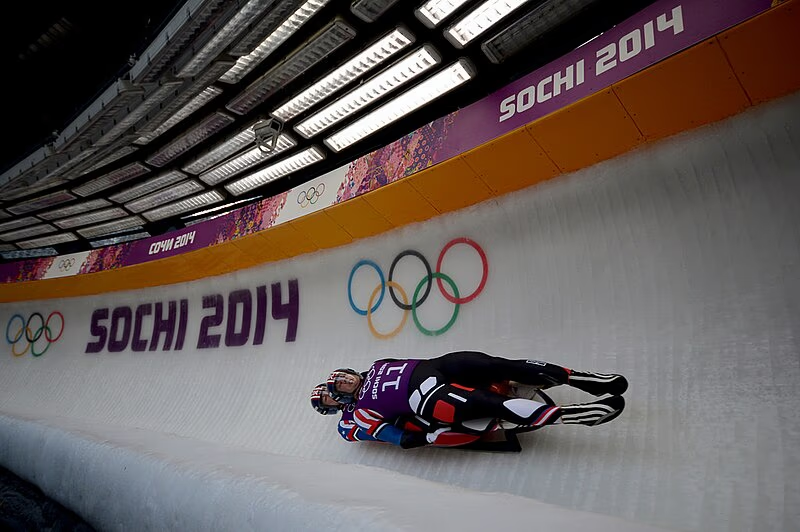
Luge competitions take place on the same artificially refrigerated tracks used for bobsled and skeleton. However, luge athletes start from different (often higher) positions on the track.
Why people argue about this
People often assume that luge starts seated is just a casual difference from bobsled's standing start, but they overlook how crucial it is for maintaining balance and control on the ice at high speeds. The specific design of fixed handles ensures athletes' bodies are perfectly aligned with the sled’s trajectory, which significantly impacts their performance and safety.
The luge start area is fundamentally different from bobsled. Athletes begin seated on the sled, gripping fixed start handles mounted alongside the track.
Why people argue about this
People often assume that luge starts are similar to bobsled due to athletes sitting on their sleds like in bobsled, but they misunderstand how fundamentally different they actually are - luge's start area is designed for athletes to begin seated and gripping fixed handles alongside the track, which is quite distinct from the sliding, upright position of a bobsled.
The finish area includes electronic timing beams that capture finish times to 1/1000th of a second (more precise than bobsled's 1/100th). A deceleration zone follows the finish, with an uphill incline and braking area to bring sleds to a safe stop.
Why people argue about this
People often assume that the deceleration zone is just a safety precaution for sleds to slow down naturally, forgetting about the electronic timing beams that are crucial for recording precise finish times right at the end of the race. The confusion arises because they overlook how these beams work in tandem with the braking area to ensure every racer's time is measured accurately and fairly.
Because luge, bobsled, and skeleton share tracks, competition scheduling requires careful coordination. Luge training and competition sessions alternate with the other disciplines.
Why people argue about this
People often assume that luge trains alongside bobsleds and skeletons on tracks, which leads to misunderstandings about their scheduling. Actually, the rule states they alternate sessions, meaning each discipline gets a turn but doesn't train or race all at once with the others, avoiding collisions and ensuring safety.
Men's Singles: One athlete per sled. Athletes must meet minimum age requirements (typically 16 for World Cup, 18 for Olympics) and hold a valid FIL licence.; Women's Singles: One athlete per sled. Same licensing and age requirements as men's.; Doubles: Two athletes on one sled, one lying on top o...
Why people argue about this
People often assume that the weight limit is purely for fairness among competitors, thinking it's about preventing one athlete from having an unfair advantage by simply being heavier. However, the actual purpose of setting a maximum combined weight is to ensure safety and prevent the sleds from becoming too heavy for the track or posing risks during travel due to inertia.
To maintain competitive fairness, the FIL sets maximum combined weights (athlete + sled): Men's singles: maximum 115 kg (253.5 lb) combined; Women's singles: maximum 92 kg (202.8 lb) combined; Doubles: maximum 180 kg (396.8 lb) combined
Why people argue about this
People often argue that they don't understand why there's a weight limit for lugers and their sleds, thinking it might affect speed or performance unfairly, but actually, the regulation is meant to ensure all athletes start from a level playing field by controlling equipment size and aerodynamics, not necessarily speed.
Race Director: Oversees the entire competition, controls start intervals, and has authority to delay, suspend, or cancel runs for safety.; Technical Delegate: FIL-appointed official responsible for equipment inspection, runner temperature checks, and sled weight verification.; Track Chief: Manage...
Why people argue about this
People often assume that luge events have always been exclusively for men, misunderstanding that the recent change allows women participation alongside men in doubles races, which they see as a significant shift from tradition. The confusion arises because this rule update is seen by some as overturning an established norm within the sport's structure and history.
Singles: 4 runs over 2 days (2 runs per day). Combined cumulative time determines the final ranking.; Doubles: 2 runs over 1 day. Combined cumulative time determines the ranking.; Team Relay: 1 run per sled, raced sequentially in a single session. Combined cumulative time of all three sleds deter...
Why people argue about this
People often assume that athletes must start immediately upon seeing the green light, which leads them to argue they didn't have enough time to prepare. Actually, the 30-second window is for getting into position and ensuring safety checks are completed before the run begins. They can take their allotted time as long as they're ready to go when the light turns green.
Athletes sit on the sled at the start position, feet on the ice, gripping the fixed start handles. When the green start light illuminates, the athlete has 30 seconds to initiate the run.
Why people argue about this
People often assume that athletes can start at their own pace once the green light comes on, thinking they have 30 seconds to decide whether to go or not. Actually, the 30-second countdown is strictly for ensuring all athletes are ready and prepared to start simultaneously, with no leeway given for individual athlete decisions.
Luge athletes steer exclusively through body movements — there is no mechanical steering mechanism. Techniques include: Calf pressure: Pressing the left or right calf against the sled's runner bracket (kufen) to flex the runner and initiate a turn.; Shoulder pressure: Shifting upper body weight t...
Why people argue about this
People often assume that luge athletes use a steering mechanism similar to other sled sports like bobsleds, thinking they must have some kind of handlebars or rudder. However, the official verdict clarifies that luge racers steer solely through body movements and there's no mechanical steering involved, which can lead to misunderstandings about how the sport is actually played.
In the Team Relay, the women's singles slider goes first, followed by the men's singles slider, then the doubles team. As each sled crosses the finish line, it activates an electronic touch pad that opens a start gate for the next sled at the top of the track.
Why people argue about this
People mistakenly believe that the order of sliders is determined by their gender rather than skill level, leading them to argue about who should go first in a team relay race. Actually, it's based on the sequence outlined in the rule for fairness and consistency across all teams.
Athletes must maintain contact with the sled throughout the run. , falling off) results in disqualification.
Why people argue about this
People often assume that maintaining contact with the sled means clinging tightly like a limpet, which they mistakenly believe is necessary for control and speed. However, the actual intent of "maintaining contact" in luge is to ensure safety by preventing athletes from sliding off or losing their grip entirely during the race, not to keep them glued to the sled as if it were a human body part.
All times are recorded electronically to 1/1000th of a second. The final ranking is determined by cumulative total time across all runs.
Why people argue about this
People often argue that they didn't have a chance against faster times simply because their initial run was slower, misunderstanding how cumulative time is calculated in luge rankings; they fail to grasp that the second run's performance can significantly impact overall ranking, even if the first run was slower than others.
Multiple timing points are recorded during each run: Start time: Measured from the first timing beam to a point approximately 50–100 m down the track. Provides a direct measure of starting technique and power.; Intermediate splits: 3–5 timing points at designated curves along the track. Used to a...
Why people argue about this
People often think that timing points in luge are just for show and don't affect the final race result, but actually, these points are meticulously recorded and can significantly impact who finishes where if they're close in time. The confusion arises because the precision of these timing points is crucial to determining the exact order of finishers, even when times are extremely tight.
In the FIL World Cup circuit, athletes earn points based on finishing position: 1st = 100 points, 2nd = 80, 3rd = 65, descending through the top 30. Season-long point totals determine the Overall World Cup standings.
Why people argue about this
People think that only top 30 positions earn points, so they miss out on earning anything for finishes outside of those spots. But actually, athletes get points for every position from first through tenth, with descending point values all along the way, regardless of their final ranking. This often leads to confusion about how many total points an athlete can potentially accumulate in a race.
Runner temperature: If runners exceed ice temperature by more than 5°C at pre-race inspection, the athlete is disqualified for that run.; Sled weight: If the sled exceeds the maximum weight limit, the athlete is disqualified.; Combined weight: If athlete + sled exceeds the maximum combined weight...
Why people argue about this
People often assume that they have unlimited time to file a protest after results are posted, misunderstanding that it must be within 15 minutes of when the official results are made available, leading to potential confusion about timing and missed deadlines in this luge rule.
Separation from sled: Complete loss of contact with the sled during a run results in disqualification (DSQ).; Start violation: Failure to start within 30 seconds of the green light results in a DNS (Did Not Start) for that run.; Obstruction: If an athlete's actions on the track endanger another s...
Why people argue about this
People often assume that they have 15 minutes from when they see the results posted, rather than from when the official announcement is made. This can lead to misunderstandings about exactly when their protest window begins and ends, causing confusion and potential missed deadlines.
Teams may file a written protest against results or technical decisions within 15 minutes of the official results being posted. A protest fee must be deposited.
Why people argue about this
People often assume that they have unlimited time to file a protest after results are announced, misunderstanding the 15-minute window stipulated in the rule. The confusion arises because the official statement specifies exactly when protests must be filed, leaving room for misinterpretation of what constitutes "after" the results are posted.
Curve walls are profiled with smooth ice surfaces to guide sleds and reduce the risk of ejection. Overflow lips at the top of walls act as containment barriers.; Crash padding (deformable material) is installed at particularly dangerous curves and transition zones.; Speed-monitoring sensors are p...
Why people argue about this
People often assume that having medical teams stationed only at the finish area means they're there to treat athletes who inevitably crash and injure themselves during their runs. However, the actual intent is to monitor for any potential hazards along the track that could pose risks, ensuring a safer environment for all participants regardless of whether an accident occurs or not.
Full-face visor helmet mandatory during all training and competition runs.; Athletes must complete a minimum number of training runs on the specific track before competing (typically 3–6 runs).; Novice athletes must progress through the FIL licensing system, starting on lower-speed tracks before ...
Why people argue about this
People often assume that just having medical teams stationed at finish areas means athletes are safe throughout their entire run, which is a misunderstanding of how safety protocols work in luge competitions. The confusion arises because this specific rule only addresses immediate post-run care and does not guarantee continuous medical supervision during the athlete's descent on the ice track.
A medical team is stationed at the finish area at all times during training and competition. Additional medical spotters are positioned at high-risk sections of the track.
Why people argue about this
People often assume that just because there's a medical team at the finish area, it means they're always on hand for every racer who might need help. However, the confusion arises because "8.3 Medical and Emergency Provisions" specifically states these teams are stationed during training and competition, not necessarily available in real-time for every individual racer throughout their entire run.
Ambient temperature, wind speed, humidity, and ice surface temperature are continuously monitored. If conditions deteriorate to the point where athlete safety is compromised (excessive wind, ice deterioration, poor visibility), the race director may delay, suspend, or cancel runs.
Why people argue about this
People often assume that environmental conditions only affect race timing, thinking the luge runs can be rescheduled at will if weather changes. But in reality, they're concerned about athlete safety first, so if conditions worsen to a point where it's unsafe for racers, the rule allows for immediate action like delays or cancellations.
The combined weight of athlete(s) plus sled is also regulated. Lighter athletes may add ballast weight (lead plates secured to the sled or worn in a weight vest) up to a specified limit.
Why people argue about this
People often assume that adding ballast weight is purely optional for athletes who want to improve their speed, forgetting that there's a strict limit on how much extra weight they can add. This leads to misunderstandings about what constitutes "optimal" strategy and adds tension in the race preparation phase.
The luge start area is fundamentally different from bobsled. Athletes begin seated on the sled, gripping fixed start handles mounted alongside the track.
Why people argue about this
People often assume that luge starts are like bobsled launches, where athletes start standing upright. However, they misunderstand that in luge, athletes begin seated on their sleds with fixed handles to help them get moving from a stationary position. This can lead to confusion about the mechanics and fairness of starting conditions between the two disciplines.
To maintain competitive fairness, the FIL sets maximum combined weights (athlete + sled): Men's Singles: One athlete per sled. Athletes must meet minimum age requirements (typically 16 for World Cup, 18 for Olympics) and hold a valid FIL licence.; Women's Singles: One athlete per sled. Same licen...
Why people argue about this
People often assume that the weight limit is purely for safety reasons, thinking it restricts heavier athletes from competing. However, the real intention behind setting a maximum combined weight is to ensure all competitors are on an even playing field in terms of energy expenditure and aerodynamics, not to prevent anyone from participating based on their body mass.
Athletes sit on the sled at the start position, feet on the ice, gripping the fixed start handles. When the green start light illuminates, the athlete has 30 seconds to initiate the run.
Why people argue about this
People often assume that athletes can start their run at any time within those 30 seconds after the green light, which leads to misunderstandings about when they must begin moving. Actually, the rule specifies they have exactly 30 seconds from the moment the green light comes on to initiate their glide down the track with their feet on the ice and hands gripping the handles firmly.
All times are recorded electronically to 1/1000th of a second. The final ranking is determined by cumulative total time across all runs.
Why people argue about this
People often argue that they don't understand how exactly the cumulative total time is calculated across all runs, thinking it's just a simple addition of times from each run when in fact, it involves averaging or summing up those times based on the number of runs completed, and sometimes even taking into account any penalties.
Teams may file a written protest against results or technical decisions within 15 minutes of the official results being posted. A protest fee must be deposited.
Why people argue about this
People often assume that they have 15 minutes from when they first see the results posted, rather than from when the official announcement is made available for protest filing. This misunderstanding stems directly from how the time limit is worded in the rule.
A medical team is stationed at the finish area at all times during training and competition. Additional medical spotters are positioned at high-risk sections of the track.
Why people argue about this
People often assume that just having medical teams at the finish area is enough for safety, forgetting about the high-risk sections of the track where crashes can happen. They overlook the need for additional spotters positioned strategically around the course to monitor racers in real-time and ensure immediate assistance if needed.