
🏛️Official — IJF
Loading OpenSourceSports…
Release submissions in practice before your partner is injured
In randori you should feel when a choke or armlock is effective and release proactively — especially with less-experienced partners — before they are forced to tap. Cranking at full pressure and waiting for every tap is considered dangerous and contrary to judo's mutual welfare principle.
Never ask your sensei when you will receive your next belt
Belt rank is awarded solely at the instructor's discretion, when they judge a student ready. Asking when you will be promoted is considered disrespectful of the teacher's authority and signals misaligned priorities — rank should follow dedication, not be pursued as a goal.
Calibrate intensity — don't apply full power against beginners
Using strongest throws or submissions at full force against lower-ranked or inexperienced players is strongly frowned upon. Higher-ranked judoka are expected to match intensity to their partner's level — providing challenge while ensuring safety and mutual development.
Do not publicly criticize referee decisions — accept the outcome
Judo culture expects athletes and coaches to accept officiating decisions without public complaint. Arguing on the mat, making dismissive gestures at referees, or publicly criticizing IJF officiating in post-match media is considered a serious breach of discipline and respect.
Accept ippon with composure — don't argue or sulk
When cleanly thrown for ippon, the loser is expected to accept the result calmly and without visible protest. Arguing with the referee, looking disgusted, or disputing the score is considered a serious breach of judo's ethos of self-control and respect for one's opponent.
Restrained celebration — no excessive shows after scoring or winning
Jubilant fist-pumping, screaming, or taunting after scoring ippon or winning is deeply frowned upon. Quiet acknowledgment is the accepted ceiling. The IJF formally penalizes extreme celebration, but the cultural norm extends well below the penalty threshold.
Athletes must bring both a white judogi and a blue judogi to competition. The color is assigned by draw: the first-called competitor wears white, the second wears blue.
Why people argue about this
People often assume that they can choose their own judogi colors based on preference, forgetting about the predetermined sequence of competitors which dictates who gets white and blue. The confusion arises because the IJF's official statement emphasizes this is decided by a random draw, not at the discretion of individual athletes.
Fingernails and toenails must be cut short to prevent injury.; Long hair must be tied back so it does not obstruct the opponent's face or interfere with gripping.; Hard objects (rings, piercings, bracelets, watches) are strictly prohibited during competition.
Why people argue about this
People often assume that they can bring just one judogi to a competition if it meets the IJF specifications, which leads to misunderstandings about needing both a white and blue uniform. The confusion arises because this rule mandates bringing at least two uniforms, not allowing substitutions or exceptions for either color.
Scoreboard: Electronic scoreboard visible to athletes, coaches, and spectators displaying scores, penalties, osaekomi time, and match clock.; Video Review System: The IJF CARE (Computer Assisted Referee Evaluation) system provides instant video replay to assist referees on contested calls.; Timin...
Why people argue about this
People often assume that the 20 cm overlap for grip is about aesthetics or comfort, when in fact it's crucial for ensuring a secure and fair hold during throws. The real confusion arises because this precise measurement prevents competitors from slipping out of each other’s grips, which can be decisive in competitive judo.
All IJF-sanctioned competitions take place on a regulation tatami (competition mat) meeting the following dimensional requirements: Total Platform: Minimum 14 m × 14 m (46 ft × 46 ft), encompassing the contest area and the safety area — the IJF rules no longer define a separate "danger zone", whi...
Why people argue about this
People often assume that the texture of the tatami mats in judo is purely for aesthetic purposes, forgetting that it's crucial for safety, preventing athletes from slipping during breakfalls which could lead to injury. The misunderstanding arises because they overlook how this surface detail directly impacts the effectiveness and safety of one of the most fundamental techniques in judo.
Tatami mats must be IJF-approved, constructed from high-density foam (typically EVA or compressed polyurethane) with a textured, non-slip vinyl surface. Mat firmness must allow safe breakfalls (ukemi) while providing enough friction to prevent uncontrolled sliding.
Why people argue about this
People often assume that the texture of the mat surface is solely for aesthetic purposes, forgetting that it's crucial for safety by preventing athletes from sliding during falls. The confusion arises because they overlook how friction impacts both the control and safety aspects of ukemi execution in judo matches.
Minimum ceiling height of 4 m (13 ft) above the mat surface (SOR 8.7).; Adequate lighting of at least 1,500 lux at mat level for competition and broadcast requirements (SOR 8.7).; Warm-up area adjacent to the competition hall with sufficient mat space for athletes to prepare (SOR 8.7).
Why people argue about this
People often assume that the size of the tatami mat doesn't matter as long as it's big enough for matches, but actually, the IJF requires a minimum dimension of 14 meters by 14 meters to ensure uniformity and safety across all competitions. They believe any large space will do, forgetting about the specific measurements needed for proper technique execution and spectator viewing angles.
Individual events are contested in seven weight categories per gender.
Why people argue about this
People often assume that weight categories in judo are fixed at seven for both genders, thinking it's a hard-and-fast rule like a limit on team sizes. But actually, the IJF can adjust these categories as needed to ensure fair competition and athlete safety, so there isn't a strict cap of seven per gender.
The Olympic mixed team event features national teams of six athletes: three men and three women. Matches are contested in a fixed weight order: Women −57 kg (SOR 2.2.2); Men −73 kg (SOR 2.2.2); Women −70 kg (SOR 2.2.2)
Why people argue about this
People often assume that mixed team events in judo are composed of three men and three women from different countries, which is a common misunderstanding. Actually, what the IJF's "4.2 Mixed Team Event" rule specifies is that each participating country sends six athletes in total to represent their nation, with no stipulation on gender distribution among those six athletes.
Each match is officiated by a panel of three: Mat Referee (Shushin): Stands on the contest area, directs the match, announces scores and penalties, and has primary authority over all decisions (IJF Refereeing Rules, Articles 1–4).; Two Side Judges (Fukushin): Seated at diagonal corners of the mat...
Why people argue about this
People often assume that each match in Judo is officiated by three referees instead of one panel of three judges, leading to misunderstandings about how matches are actually adjudicated. The confusion arises because they interpret "a panel of three" as multiple individual referees rather than a single group of three judges overseeing the entire bout.
Each athlete is permitted one coach seated in the designated coaching chair. Coaches may offer verbal encouragement but may not physically approach the mat, interfere with officials, or use electronic devices to communicate tactical instructions during the match.
Why people argue about this
People often assume coaches are allowed to give physical guidance to their athletes from behind the line, which is explicitly prohibited by the rule. The misunderstanding stems from a lack of clarity on what constitutes "verbal encouragement" versus direct physical assistance.
All individual matches at IJF-sanctioned events are 4 minutes in duration for both men and women. The clock is stopped during "matte" (halt) calls and other stoppages.
— Article 6
Why people argue about this
People often assume that the 4-minute match duration doesn't count for time-outs like matte calls, leading them to think their opponent has an unfair advantage during these pauses. Actually, the official verdict clarifies that the clock is stopped during such interruptions, so every second counts as part of the overall 4 minutes.
Athletes begin each match standing at their designated marks on the mat, approximately 4 m apart. The referee calls "Hajime" (begin) to start and "Matte" (wait/stop) to halt action.
— Article 9
Why people argue about this
People often assume that athletes can move freely between their marks before the referee says "Hajime," which leads to arguments about when a match officially starts. Actually, they must remain stationary until the referee explicitly calls "Hajime" to begin the competition. This rule is crucial for maintaining fair play and ensuring all athletes are ready at precisely the same moment.
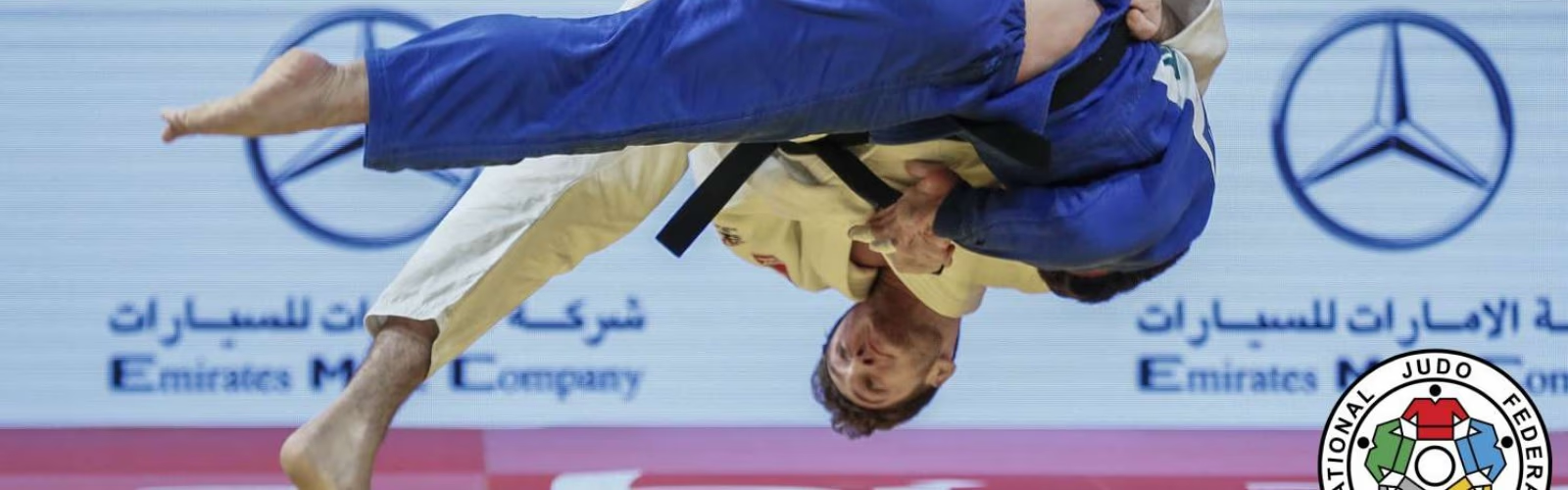
The primary objective in standing combat is to execute a throwing technique that projects the opponent onto their back. Athletes establish grips (kumi-kata) on the opponent's judogi and attempt to create off-balance (kuzushi) before executing a throw.
Why people argue about this
People often think that in tachi-waza, you're only allowed to throw your opponent onto their back, forgetting about other standing techniques like joint locks or throws where the opponent lands on their side or even gets up immediately after. But actually, this rule emphasizes throwing for a decisive submission or off-balancing win rather than just any old stand-up technique.
Ground work is permitted when there is a legitimate transition from standing to ground, including: A throw attempt that brings both athletes to the ground (Refereeing Rules Article 17).; One athlete falling or being pulled to the ground through a legitimate technique (Refereeing Rules Article 17)...
— Article 17
Why people argue about this
People often assume that ground work is only allowed when a judoka deliberately drops to the mat from above their opponent, which leads to misunderstandings about what constitutes a "legitimate transition." The confusion arises because this rule specifically allows for techniques performed while transitioning from standing to the ground, not necessarily after already being on the mat.
Since the 2013 rule revision, all direct attacks to the opponent's legs using the hands or arms are strictly prohibited. Any attempt to grab, block, or attack the opponent's legs below the belt line — whether as a primary attack, counter-attack, o...
— Article 18
Why people argue about this
People often believe that the leg grab ban only applies in throws and groundwork scenarios, thinking it restricts grappling moves like knee-on-belly. However, the actual intent is broader, prohibiting any direct attack to an opponent's legs from above or below the belt line for all types of attacks, not just those specific to throwing or ground fighting.
A technique initiated inside the contest area remains valid even if the athletes land in the safety zone, provided the attacking action began while at least one foot of the attacker was inside or on the danger zone boundary. If both athletes step ...
— Article 5
Why people argue about this
People often assume that if an athlete steps out of bounds while in motion, their technique is automatically invalid, which misunderstands the nuances of when a boundary violation actually ends a technique. The confusion arises because the rule specifies that stepping out only invalidates the technique if both athletes are outside the danger zone simultaneously, not just one stepping out first.
The four criteria for ippon are speed, force, landing on the back, and skilful control maintained until the end of the landing (Article 14). Scoring requires a continuous action: if there is a stop in the action, there is no score, and the techniq...
— Article 14, Article 16
Why people argue about this
People often assume that an ippon is just a point scored in judo, when in fact it's considered such a decisive victory that it instantly ends the match, which can lead to misunderstandings about how other points are supposed to influence the outcome.
Waza-ari is announced when the technique lands the opponent more than 90 degrees of the shoulder axis but not on the back, or when the four ippon criteria are not fully achieved (Article 15). A score is given for a whole side of the body landing e...
— Article 15, Article 16
Why people argue about this
People often think that Waza-ari in judo is awarded just for getting a hold of their opponent's shoulder, but actually, it's about landing more than 90 degrees of the shoulder axis and not necessarily on the back, or failing to meet all four ippon criteria, which can lead to confusion over what exactly constitutes a Waza-ari.
Yuko — glossed in the IJF terminology as "nearly waza-ari" — is awarded in tachi-waza for (Article 15): A side landing at 90 degrees, or more toward the front landing (Article 15).; Landing on the upper back (Article 15).; Landing on the side on the shoulder axis with one elbow or one hand (Artic...
— Article 15
Why people argue about this
People often think that a Yuko in Judo is awarded simply for landing on their side with one arm, which isn't quite accurate according to the IJF rules. Actually, it's more nuanced: a Yuko can be given if the opponent lands on their upper back or at 90 degrees toward the front, not just any lateral roll. This rule ambiguity leads to misunderstandings and disputes during matches.
If a match reaches the end of regulation time without an ippon, the athlete with the higher score wins. The levels rank: Ippon — immediate victory; the match does not reach time (Article 14).; Waza-ari — outranks any number of yuko (Articles 15, 16).; Yuko — counted, but never aggregating into wa...
— Article 14, Article 15, Article 18, Article 16
Why people argue about this
People often assume that a judoka needs only one waza-ari to win a match, forgetting that it must outrank all yuko counts combined, leading to confusion about when exactly they can secure victory through score hierarchy alone.
A shido is a minor penalty assessed for rule violations that do not endanger the opponent. Shidos accumulate during the match: the first and second serve as warnings, while the third shido results in hansoku-make (disqualification).
— Article 18
Why people argue about this
People often think that a shido is just a minor warning that won't affect their match outcome, forgetting that three of these can lead to hansoku-make – essentially disqualification. But actually, they overlook how each shido serves as a cumulative reminder before the final consequence of being out for the match.
Hansoku-make is assessed in two forms: Accumulated hansoku-make: Results from receiving a third shido in a single match. The athlete loses the match but retains eligibility for repechage (bronze medal contest) in the tournament (Refereeing Rules Article 18).; Direct hansoku-make: Awarded for a se...
— Article 18
Why people argue about this
People often assume that Hansoku-make is only about striking opponents with their hands, forgetting that it can also be triggered by a wrestler's submission hold being too dominant or controlling for too long, which confuses them into thinking it’s strictly about punches and elbows. They overlook the broader interpretation of what constitutes "too dominant" in Judo matches.
Coaches may not formally challenge a referee's decision. However, the CARE system supervisors may intervene if a clear factual error is detected on video review.
— Article 11
Why people argue about this
People think coaches can't challenge a referee's decision in Judo unless it's caught by video review, but actually, they can only formally challenge if a CARE system supervisor flags a clear factual error on replay, which is quite different from their common misconception.
To protect developing athletes, the IJF and most national federations enforce strict age-based technique restrictions: Cadets (Under 18): Kansetsu-waza (arm locks) and shime-waza (chokes) are completely prohibited. Any attempt, even in a playful or accidental manner, results in matte and a warnin...
Why people argue about this
People often assume that mastering ukemi is solely for safety reasons during throws, forgetting that it's also a crucial technique in its own right. They misunderstand that proficiency in ukemi isn't just about falling safely but also about executing complex and effective techniques like back falls and rolling falls to control opponents effectively on the mat.
Medical Staff: At least one qualified doctor must be present at each competition mat. Major events require a full medical team with emergency resuscitation equipment (SOR 8.8; Refereeing Rules Article 20).; Blood Rule: If an athlete is bleeding, the referee immediately calls matte. The athlete ha...
— Article 20
Why people argue about this
People often assume that mastering ukemi is solely for self-protection during falls, but in judo, it's crucial for maintaining control over your opponent and ensuring they don't get injured too. The confusion arises because the rule emphasizes proficiency in all types of ukemi not just as a safety measure, but also to uphold the integrity of throws and submissions.
Tatami mats must be inspected before each competition day for proper alignment, firmness, and absence of tears or seam gaps (SOR 8.7).; The safety zone must be kept clear of chairs, equipment, bags, and spectators at all times (SOR 8.7).; When multiple competition areas are in use, adjacent safet...
Why people argue about this
People often assume that mastering ukemi is solely for avoiding injury during practice, when in fact it's crucial for ensuring safety on mats and within facilities throughout a judoka’s career, as improper techniques can lead to serious injuries like broken bones or concussions. The rule underscores the importance of proper technique from the start to prevent such incidents.
All competitive judoka must be proficient in ukemi (breakfall techniques) before entering competition. Proper ukemi — including back falls (ushiro-ukemi), side falls (yoko-ukemi), front falls (mae-ukemi), and rolling falls (zenpo-kaiten-ukemi) — is the primary defense against injury from throws.
Why people argue about this
People often assume that mastering ukemi is only a personal choice for individual athletes, forgetting that it's mandated by the IJF as a safety measure before entering competition. The confusion arises because they overlook the official requirement and potential risks involved in not having proficient breakfall techniques, which can lead to serious injuries during falls.
The IJF adheres to the World Anti-Doping Agency (WADA) Code. All athletes at IJF-sanctioned events are subject to in-competition and out-of-competition testing.
Why people argue about this
People often assume that anti-doping rules only apply during competition hours, so they argue why athletes aren't tested out of competition when they're resting or training. But actually, all IJF-sanctioned events require athletes to be ready for testing at any time, not just during matches, to ensure fair play throughout their entire preparation period.
Athletes must bring both a white judogi and a blue judogi to competition. The color is assigned by draw: the first-called competitor wears white, the second wears blue.
Why people argue about this
People often assume that choosing between white and blue judogi is purely a matter of luck based on their draw number, forgetting that they must bring both colors for competition as per section 2. The confusion arises because the rule mandates bringing two different colored uniforms, not just wearing one color during matches.
All IJF-sanctioned competitions take place on a regulation tatami (competition mat) meeting the following dimensional requirements: Total Platform: Minimum 14 m × 14 m (46 ft × 46 ft), encompassing the contest area and the safety area — the IJF rules no longer define a separate "danger zone", whi...
Why people argue about this
People often assume that any foam mat will suffice for a judo match, forgetting about the crucial aspects like firmness for safe falls and texture to prevent sliding. They overlook how these factors are essential for both competitors' safety and maintaining fair play in every technique demonstration.
Individual events are contested in seven weight categories per gender.
Why people argue about this
People often assume that Judo's seven weight categories per gender apply only to individual events, forgetting that they also cover team competitions. The confusion arises because the IJF has recently expanded its rules to include these weight categories in team matches as well, which wasn't previously stipulated.
All individual matches at IJF-sanctioned events are 4 minutes in duration for both men and women. The clock is stopped during "matte" (halt) calls and other stoppages.
— Article 6, Article 9, Article 17, Article 18, Article 5
Why people argue about this
People often assume that the 4-minute match duration applies strictly to each individual bout, forgetting that it covers the entire match period, including any breaks for rest periods or penalties. This oversight leads to misunderstandings about how much time is actually available in a full match.
Judo scores at three levels — ippon, waza-ari and yuko. Yuko was removed from the scoring table in the 2017 revision and has since been reinstated: in the rules in force from 21 January 2026, Article 15 is titled "Waza-ari and Yuko" and defines yu...
— Article 15, Article 14, Article 16, Article 18
Why people argue about this
People often assume that an ippon means the match is over right away, but in reality, it triggers a sequence of points where multiple more ippons can be scored before the match ends. The confusion arises because they don't fully grasp how judo's scoring system works, especially its complexity and layered nature beyond just one ippon.
A shido is a minor penalty assessed for rule violations that do not endanger the opponent. Shidos accumulate during the match: the first and second serve as warnings, while the third shido results in hansoku-make (disqualification).
— Article 18, Article 11
Why people argue about this
People often think that a shido is just a minor warning you get for almost breaking a technique rule, like forgetting to keep your feet within the mat lines. But actually, it's part of how points are deducted throughout a match; three shidos lead to disqualification, not just as a final warning.
To protect developing athletes, the IJF and most national federations enforce strict age-based technique restrictions: Cadets (Under 18): Kansetsu-waza (arm locks) and shime-waza (chokes) are completely prohibited. Any attempt, even in a playful or accidental manner, results in matte and a warnin...
— Article 20
Why people argue about this
People often assume that mastering ukemi is solely a safety precaution, forgetting that it's also an essential skill for executing judo techniques effectively. The misunderstanding stems from believing ukemi is only about dodging attacks; in reality, proper ukemi forms the foundation of effective throws and groundwork, making proficiency mandatory for all competitors.