
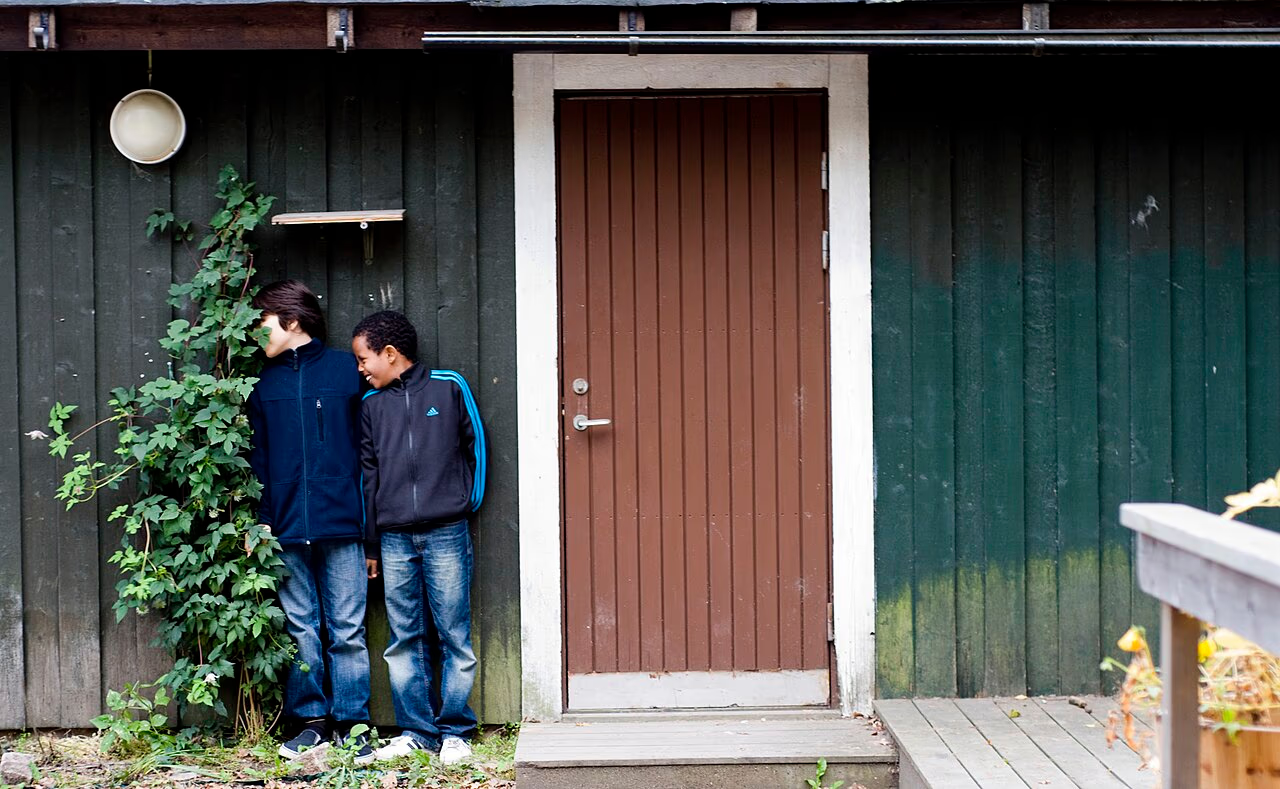

Hide and Seek·Playground Games
Hide and Seek
🌱Community
Loading OpenSourceSports…
One player is designated as the "seeker" (often through a selection method like drawing straws, counting out, or volunteering); The seeker closes their eyes or faces a wall at the designated home base and counts aloud to a predetermined number (typically 20-100, depending on the size of the playi...
Why people argue about this
People often assume that hiding in plain sight is perfectly acceptable as long as they're quick about it, but actually, the rule states all players must be hidden before the seeker can start counting; otherwise, it's considered a foul and restarts from the beginning.
Peeking: Seeker looking before counting is complete; Out of Bounds: Hiding outside the designated play area; Moving: Changing hiding spots after the seeker has finished counting
Why people argue about this
People often assume that if they're moving during a seeker's search, it only means they've been found immediately - which isn't quite what the rule states. Actually, the key point is that if observed by the seeker, you are automatically "found," not just assumed to be found based on movement alone.
Peeking: Restart counting, often with additional time added; Out of Bounds: Automatic "found" status; Moving: Automatic "found" status if observed by seeker
Why people argue about this
People often assume that peeking just results in a penalty like adding time, forgetting that it can also lead to disqualification if it happens multiple times or during critical moments of play, causing confusion about its severity and impact on game flow.
Hide and Seek requires minimal equipment: No specialized equipment required; Optional: timer or stopwatch for timed rounds; Optional: boundaries markers (cones, chalk, or natural landmarks)
Why people argue about this
People often assume that Hide and Seek doesn't need any equipment at all, which misunderstands the official intent. The 'minimal' in the rule is meant to imply no specialized gear like uniforms or protective pads are required for play, but it doesn’t mean participants can go barefoot or without basic safety items like helmets if playing in a potentially dangerous environment.
The game can be played in various environments: Indoor: A house, building, or defined indoor space with multiple hiding spots; Outdoor: A yard, park, playground, or other outdoor area with natural hiding places; Clear boundaries should be established before play begins
Why people argue about this
People often assume that "various environments" in Hide and Seek means they can play anywhere - parks, backyards, even indoors. But the official verdict clarifies it's about different settings like open spaces versus enclosed areas where visibility might be compromised, not that you're free to choose any location at all for the game.
Hide and Seek is flexible in terms of participants: Minimum: 2 players (1 seeker, 1 hider); Optimal: 4-10 players; No officials required; players self-regulate
Why people argue about this
People often assume that Hide and Seek must be played with a fixed number of players from start to finish, which is incorrect. The official verdict actually clarifies that while the basic concept remains flexible—meaning you can add or remove players as needed—the core game dynamics still apply regardless of how many are involved at any given time.
One player is designated as the "seeker" (often through a selection method like drawing straws, counting out, or volunteering); The seeker closes their eyes or faces a wall at the designated home base and counts aloud to a predetermined number (typically 20-100, depending on the size of the playi...
Why people argue about this
People often assume that once a player is caught, they can't be found again until the game restarts from home base, but actually, players who are caught remain in play as part of the seeker team and continue to look for other players. This oversight leads to arguments about whether caught players should be counted towards finding all hiding spots or not.
Hide and Seek typically doesn't use a formal scoring system, but common victory conditions include: Last player found wins the round; Players who reach home base without being caught win the round; For competitive play, points can be awarded based on: Time hidden without be...
Why people argue about this
People often assume that Hide and Seek requires a formal scoring system like other team sports, so they argue about points and wins when in reality, it's meant to be a free-form game where players hide and seek without numerical scores. The confusion arises because some participants expect traditional game metrics despite the game's nature as an unstructured, player-versus-player pursuit.
Peeking: Seeker looking before counting is complete; Out of Bounds: Hiding outside the designated play area; Moving: Changing hiding spots after the seeker has finished counting
Why people argue about this
People often assume that a seeker can simply start over from where they left off without adding extra time, forgetting about the penalty of restarting with additional seconds added to their total playing time. They miss understanding that the key fact is not just about resuming from where they stopped but also includes the necessity for the extra penalty time.
Establish clear boundaries and off-limits areas before play begins; Ensure all hiding places are physically safe (no locked spaces, dangerous heights, etc.); For younger players, adult supervision is recommended
Why people argue about this
People often assume that since Hide and Seek is a game of hide-and-seek, safety measures are automatically built into its execution, leading them to overlook the need for clear boundaries and adult supervision, which can lead to misunderstandings about why these rules are necessary in actual gameplay scenarios.
First player found becomes the seeker in the next round; Last player found wins the round and earns the right to hide in the next round; One player hides while all others count
Why people argue about this
People often assume that if a player is found last in traditional Hide and Seek, they automatically lose their spot for the next round, but actually, it's the opposite - they get to be the seeker. This rule can lead to confusion because players might not fully grasp how the roles switch based on who gets found last.