


🏛️Official — NCAA
Loading OpenSourceSports…
Return Possession After Injury Stoppage
If a team intentionally plays the ball dead or out of bounds to allow an injured opponent to receive treatment, the opposing team is expected to return possession when play resumes. Scoring or retaining aggressive possession after such a gesture is considered a serious breach of honor.
Honor the Post-Game Handshake Line
After the final whistle, both teams line up and shake hands or tap sticks down the line. Players are expected to participate with genuine respect regardless of the result. Halfhearted participation or avoiding the line is considered disrespectful.
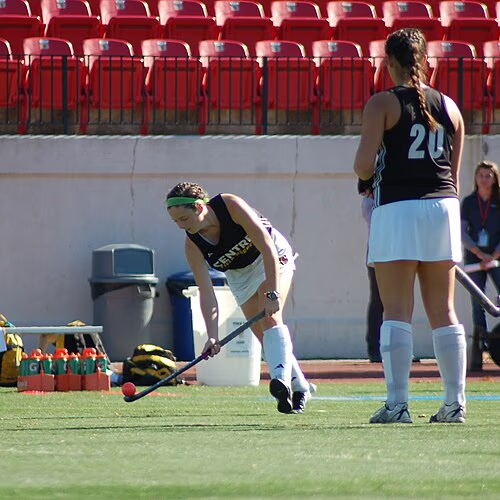
Stick (Rule 4, The Stick): J-shaped, max length 105 cm, max weight 737 g, made of wood/composite; only the flat side may be used to play the ball; Ball (Rule 5, The Ball): hard, spherical, 22.4 cm circumference, 156-163 g, white with raised seams; Goalkeeper equipment (Rule 3, Players' Clothing a...
— Rule 4, Rule 5, Rule 3, Rule 7
Why people argue about this
People often assume that the stick's J-shape is purely aesthetic, when in reality it's crucial for control and balance on the field, leading to arguments about whether a slightly curved or angled stick would suffice. The confusion arises because the exact shape of the stick is not only functional but also integral to the sport's technical demands.
Field (Rule 6, The Field of Play): 91.40 m long × 55 m wide (FIH spec); NCAA may use slightly smaller fields; Surface: water-based artificial turf preferred (FIH spec); some NCAA venues use sand-based turf or natural grass; Two 22.90-m lines (originally "25-yard line"); one halfway line (Rule 6)
— Rule 6, Rule 7, Rule 12, Rule 13
Why people argue about this
People often assume that NCAA field dimensions are exactly as specified by FIH, leading to misunderstandings about their actual sizes. The confusion arises because they believe the official verdict stating "slightly smaller" is a discrepancy rather than a clarification of different standards for different levels of competition.
11 players per team on field including 1 goalkeeper (Rule 2, Composition of Teams); Roster: typically 16-22 players for NCAA D1; up to 18 may be in match-day squad; Substitutions: unlimited and rolling (Rule 2 framework as modified by NCAA — distinct from FIFA limited subs); player exits, substit...
— Rule 2
Why people argue about this
People often assume that unlimited substitutions at the 22.90-m line mean players can come on and off the field whenever they want, which leads to confusion about timing and strategy. The actual rule stipulates unlimited subs but with brief stoppages, so it's a fine balance between keeping the game moving and ensuring fair play.
Match (Rule 8, Start and Restart of Play): 4 quarters of 15 minutes each (FIH format adopted from 2014 onward; NCAA aligns); 2-minute breaks between Q1/Q2 and Q3/Q4; 5-10 minute halftime; Overtime — updated for 2026: under the 2026 Division I Field Hockey Rules Modifications, an NCAA Tournament m...
— Rule 8, Rule 9, Rule 12, Rule 13, Section 4
Why people argue about this
People often assume that each quarter is a standalone 15-minute interval without considering how breaks between quarters affect overall game flow. They forget about the two-minute halftime break, making them think the entire match lasts only 60 minutes instead of the actual 75 minutes with those breaks included.
Goal (Rule 9, Conduct of Play): the ball must wholly cross the goal line between the posts, propelled from inside the shooting circle by an attacking player's stick; A shot originating from outside the circle does not count as a goal; The team with the most goals at the end of regulation — or, in...
— Rule 9, Section 5
Why people argue about this
People often assume that a goal is scored if the ball even touches the post or crossbar before crossing the goal line, which isn't true according to NCAA rules. The confusion arises because they overlook the crucial part: the ball must wholly cross between the posts and be propelled by an attacking player's stick from inside the shooting circle for it to count as a score.
Common fouls (Rule 9, Conduct of Play): obstruction, dangerous play, third-party block, playing the ball with the rounded side of the stick, foot kick, raised hit outside the circle; Card framework: green card (warning, possible 2-minute temporary suspension), yellow card (5-10 minute suspension ...
— Rule 9, Rule 12, Rule 13
Why people argue about this
People often assume that yellow cards in Field Hockey are just warnings like in soccer, so they don't realize how serious accumulating multiple yellow cards can be until it leads to a suspension - which is actually governed by NCAA-specific rules and not based on the number of infractions alone, unlike red cards which result in immediate ejection.
Mandatory mouthguard use is required at the NCAA level. Goggles are strongly recommended given the incidence of stick-strike eye injuries.
— Rule 3, Section 4
Why people argue about this
People often assume that only players who get hit by a stick need mouthguards, so they argue against wearing them. However, the rule actually mandates their use due to high incidences of facial injuries from stick strikes, even if it's not always immediately obvious who might be hit.