


🏛️Official — World Aquatics
Loading OpenSourceSports…
Never interrupt a competitor's pre-dive mental routine
Competitive divers invest years developing specific visualization and mental rehearsal sequences before each dive. Speaking to, jostling, or deliberately distracting a competitor who is in their pre-dive routine — whether in the ready area or on the platform — is one of the most serious breaches of sportsmanship in the sport.
Silence while a diver is preparing and executing
Coaches, competitors, and spectators maintain complete silence once a diver steps to the end of the board or platform to begin their approach. Any noise — shouting instructions, cheering, commentary — during the diver's mental preparation and execution is considered a serious breach of the competition environment.
Synchro partners present a united front after a poor dive
In synchronized diving, it is expected that partners never visibly blame each other — through looks, words, or body language — after a badly synchronized or failed dive. Whatever frustration exists is handled privately. Public expressions of blame toward a partner are considered a serious breach of the partnership contract and the sport's respect culture.
Heights: 1 m and 3 m above the water surface. The 3 m board is used in Olympic competition; the 1 m board is used in NCAA and other domestic events.; Board dimensions: Length 4.87 m (16 ft), width 0.50 m (1 ft 8 in). Constructed from extruded aluminum alloy (typically Maxiflex Model B or equivale...
Why people argue about this
People often assume that the 1.50-meter extension is purely for safety reasons, ensuring divers have enough space to spring off safely. However, they overlook the fact that this length also affects the dive's trajectory and potential scoring in competitions, as judges measure takeoff distance from the edge of the board, not its full length.
Olympic height: 10 m (32 ft 10 in) above the water surface. Training and junior platforms available at 5 m and 7.5 m.; Dimensions: Minimum length 6.0 m (19 ft 8 in), minimum width 2.0 m (6 ft 7 in). Multiple platforms may be installed on the same tower.; Construction: Rigid concrete or reinforced...
Why people argue about this
People often assume that the height of 1 m or 3 m for the springboard is a strict requirement without room for adjustment, but actually, it's specified as adjustable with an extruded aluminum alloy material to ensure safety and flexibility, which can be adjusted during competitions based on athletes' needs.
Swimwear: Competitive swimwear conforming to World Aquatics regulations. No loose-fitting fabric; suits must be form-fitting. Two-piece suits permitted for women but must not be excessive in coverage.; Chamois (shammy): Small synthetic towel used to dry skin and hands between dives. Helps maintai...
Why people argue about this
People often assume that the chamois towel is only for drying their body after a dive, forgetting about the board entirely. However, the official rule specifically states they can use it to dry the diving board between dives as long as it's not used to clean or manipulate the board in any way. This oversight leads to misunderstandings and arguments about its proper use.
Minimum depth: 5.0 m (16 ft 5 in) below the 10 m platform; 3.5 m (11 ft 6 in) below the 3 m springboard; 3.0 m (9 ft 10 in) below the 1 m springboard.; Minimum area: The clear water zone directly below each board or platform must be at least 5.0 m x 4.0 m free from obstructions.; Ceiling height: ...
Why people argue about this
People often assume that the agitation system is there solely for aesthetic reasons, making it seem unnecessary, but in reality, it's crucial for ensuring fair diving competitions by providing a consistent surface disturbance that all divers can rely on for judging their dives accurately.
A mechanical surface agitation system is mandatory at all World Aquatics-sanctioned competitions. This system produces a visible disturbance on the water surface (bubbles, spray jets, or drip jets) so divers can judge their height and distance from the water during flight.
Why people argue about this
People often assume that the agitation system is there solely for aesthetic reasons, making the pool look more exciting for spectators. However, the real purpose of these systems is to provide a consistent disturbance on the water surface so divers can better judge their dive's height and distance from impact with the water. They're not just about visual appeal.
Hot tub / shower area: Located adjacent to the pool for divers to maintain body temperature between dives. Water temperature typically 37–40 °C (99–104 °F).; Dry-land training: Purpose-built dryland facility with overhead spotting rigs (harnesses), trampolines, and foam pits for learning new dive...
Why people argue about this
People often assume that the 5.0 m ceiling height requirement is solely for safety reasons, forgetting that it also ensures there's enough space below each diving board or platform for spectators to stand comfortably without their heads touching the water. The rule actually balances both athlete and audience needs, which can lead to misunderstandings about its primary purpose.
Each diver competes alone, performing a prescribed number of dives from a published dive list. Preliminary rounds narrow the field to 18 (semifinal) and then 12 (final).
Why people argue about this
People often think that in individual diving events, each diver performs all their dives without repetition, which leads to a lot of dives being repeated across preliminary rounds. However, actually, divers only perform the dives listed on their published dive list for their event, and they do not repeat dives from different lists within the same competition.
A pair of divers from the same country performs the same dive simultaneously. Partners are assessed both on their individual execution and on how closely they match each other in takeoff, height, rotation speed, and entry angle.
Why people argue about this
People often assume that in synchronized diving, partners are only judged based on their individual performance, forgetting that they're also scored on how closely they match each other's movements from takeoff through entry. The confusion arises because the rule emphasizes synchronization as a key factor for scoring, not just execution.
Seven judges score each dive. The two highest and two lowest marks are discarded, leaving three counting scores.
Why people argue about this
People often assume that the middle score is always the highest of the three remaining after discarding the two lowest marks, which leads to confusion since it's actually the average of those three scores that determines the final result for each dive in diving judging under this rule.
Eleven judges are used: three assess execution of diver A, three assess execution of diver B, and five assess synchronization. The execution panels each drop the high and low mark (one counting score per panel).
Why people argue about this
People often assume that only one judge scores for each execution panel, leading them to believe the total number of judges used is 18 instead of 3 + 3 + 5 = 11. They overlook how the high and low marks are counted by each panel, thinking it applies differently than in individual diving events where a single score per panel indicates the full mark for that aspect.
The referee supervises the competition, signals when the diver may proceed, and resolves disputes. The announcer calls each dive by number, position letter, and degree of difficulty before the diver approaches.
Why people argue about this
People often assume that only the referee is responsible for signaling when a diver can proceed, forgetting about the role of the announcer who also calls each dive by number, position letter, and difficulty level before it happens. This oversight leads to misunderstandings about whose responsibility it really is in terms of timing and communication during competition.
Men's 3 m Springboard: 6 dives in the final (no DD limit).; Women's 3 m Springboard: 5 dives in the final (no DD limit).; Men's 10 m Platform: 6 dives in the final (no DD limit).
Why people argue about this
People often assume that the DD number is solely based on the type of dive (running, standing, or armstand), but in reality, it's calculated using a complex formula that includes somersaults, twists, and body position as well, leading to significant variations even among dives with similar starting positions.
Each diver submits a dive list specifying every dive they intend to perform in each round. The list must include the dive number, position letter, and degree of difficulty.
Why people argue about this
People often believe that the DD is solely based on a dive's difficulty, like somersaults and twists count alone, but actually, it incorporates multiple factors including body position, starting approach, and even dive group to determine its overall value.
The DD is a numerical coefficient calculated from a formula published in the World Aquatics DR tables. It accounts for the dive group, number of somersaults, number of twists, body position, and starting position (running approach, standing, or armstand).
Why people argue about this
People often believe that the DD is solely based on the number of somersaults and twists a diver performs, which leads them to overlook other critical factors like body position and starting approach. The confusion arises because they fail to realize how all these elements are weighted in the complex formula used by World Aquatics for calculating the DD.
Forward approach (springboard): Minimum 3 steps plus a hurdle (final jump onto the end of the board). The approach must appear smooth, confident, and controlled.; Standing takeoff (back, inward): The diver stands at the end of the board, arms at sides or above the head, and initiates the dive fro...
Why people argue about this
People often argue that a diver should enter the water at an angle for added speed, thinking it's faster than a vertical entry. But they misunderstand that "5.4 Approach and Takeoff" specifically emphasizes the ideal rip entry as perfectly vertical to minimize splash, which is crucial for scoring higher in diving competitions.
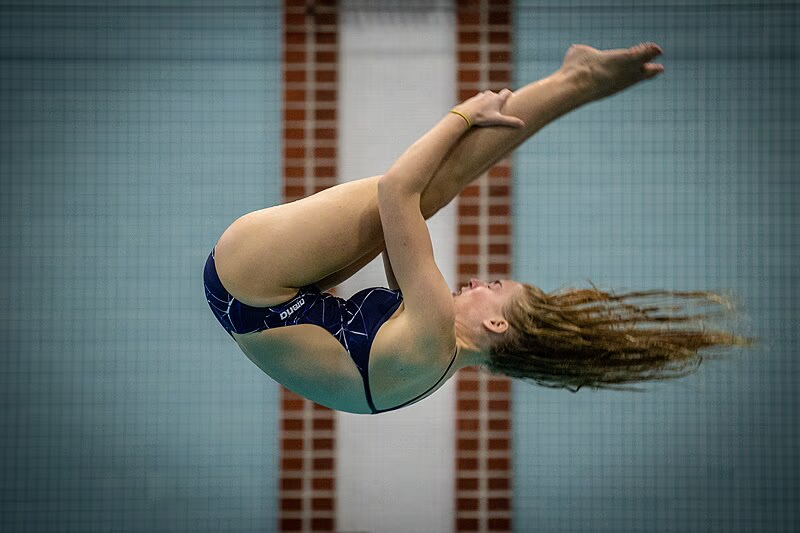
The entry into the water is the final phase of every dive and critically affects scores. The ideal "rip entry" is perfectly vertical (head-first or feet-first depending on the dive), with the body fully extended and aligned, creating minimal splash.
Why people argue about this
People often assume that a perfect "rip entry" is solely about verticality and minimal splash, forgetting that it must also be perfectly aligned and fully extended for full credit, leading to debates on what exactly constitutes an ideal dive.
Each judge awards a score from 0 to 10 in half-point increments. The descriptive scale is: 0: Completely failed; 0.5–2.0: Unsatisfactory; 2.5–4.5: Deficient
Why people argue about this
People often think that the DD (difficulty) factor is applied only after dropping the highest and lowest scores, which leads them to believe they should calculate it with all 6 marks before discarding two. But in fact, the DD is multiplied by the sum of the remaining three scores after those extremes are removed.
From 7 judges, the 2 highest and 2 lowest marks are dropped. The remaining 3 marks are summed and multiplied by the DD.
Why people argue about this
People often assume that only the two highest scores are dropped from consideration, which leads to a misunderstanding of how the final score is calculated. They forget about the requirement to also drop the two lowest marks before summing up the remaining three for multiplication by DD, thus missing out on a crucial part of the scoring process.
Execution scores: each panel of 3 (for diver A and diver B) drops its high and low, leaving 1 counting mark per panel. Synchronization panel of 5 drops high and low, leaving 3 counting marks.
Why people argue about this
People often assume that only one mark from each panel is dropped for synchronization, thinking it's a simple average of five marks, but actually, three out of five are considered valid in the final score calculation due to "6.3 Synchronized Score Calculation." This discrepancy leads to confusion and arguments about how scores should be interpreted.
The competition score is the sum of all dive scores across the round. The diver (or pair) with the highest total wins.
Why people argue about this
People often assume that only individual scores count towards a diver's final standing, forgetting that pairs' combined scores are also considered in diving competitions. The confusion arises because they overlook how pair scores factor into determining overall winners alongside solo divers.
Athletes must balance difficulty against execution risk. A dive with DD 3.5 performed with mediocre execution (average judge score of 6.0) yields 3 × 6.0 × 3.5 = 63.0 points, while a simpler dive with DD 2.5 performed excellently (average 8.5) yields 3 × 8.5 × 2.5 = 63.75 points.
Why people argue about this
People often assume that a DD 3 score of 10 means it's an automatic gold medal dive, which is incorrect. Actually, the 6.5 Scoring Strategy emphasizes athletes should balance difficulty with execution risk; a perfect 10 doesn't guarantee victory as dives can still be penalized for poor form or technique despite their complexity.
A dive is declared failed and scored 0 if the executed dive differs significantly from the announced dive — for example, performing the wrong number of somersaults, wrong group, or wrong position. The referee makes this determination.
Why people argue about this
People think they can get away with minor variations in their dive execution as long as it's still recognizable, but actually, the rule strictly defines what constitutes a "failed dive," where even slight deviations like one less somersault or changing the position are grounds for disqualification and zero points.
A balk occurs when the diver begins the approach but stops or restarts without completing the dive. On the first balk, the referee instructs the judges to deduct 2 points each from their scores for that dive.
Why people argue about this
People often assume that a balk happens when you completely stop in mid-air during your dive, forgetting their definition is about stopping before even starting. The confusion arises because they overlook the fact that it's the act of beginning and then halting or restarting the approach altogether that constitutes a balk, not necessarily missing part of the actual dive itself.
Divers must begin their approach within one minute of the referee's signal. Failure to do so results in a warning; continued delay may result in the dive being declared failed.; On platform, a diver who loses balance during the armstand may restart once. A second failed armstand start results in ...
Why people argue about this
People often assume that the rule is only about deliberate delays during diving attempts, forgetting that it also covers disruptive behavior and influencing judges in any way, whether through actions or words, which can happen at various points before and after a dive. They overlook how this extends to pre-dive preparations as well, not just during the actual execution of the dive.
Incorrect starting position (e.g., arms not in specified position) results in judge deductions of 0.5–2.0 points per judge.; Excessive splash on entry: deductions at judges' discretion, typically 0.5–1.5 points.; Insufficient distance from the board (dangerously close pass): judges deduct for uns...
Why people argue about this
People often assume that they can manipulate judges by slowing down their dive execution or deliberately delaying if it benefits them, misunderstanding that the rule is strictly about disruptive behavior and attempts to influence judges, regardless of whether that affects their score directly. They overlook the fact that even a minor delay could be seen as an attempt to sway judges' opinions.
Disruptive behavior, deliberate delays, or attempts to influence judges are grounds for disqualification by the referee.
Why people argue about this
People often assume that the "7.5 Unsportsmanlike Conduct" rule only applies to physical altercations during a dive or competition, but in reality, it covers much broader behaviors like deliberate delays or attempts to sway judges' decisions, which can happen through various means including verbal arguments or strategic use of time.
Mechanical agitation (bubbles or spray) is mandatory during all competition and practice sessions. The system must produce visible surface disturbance directly below all boards and platforms in use.
Why people argue about this
People think they can get away with minimal water disturbance as long as it's barely noticeable, but actually, the rule requires visible surface agitation directly below all diving boards and platforms in use during competitions and practices.
Minimum pool depths are strictly enforced: 5.0 m under the 10 m platform, 3.5 m under the 3 m springboard. Adjacent platforms must have minimum horizontal separation of 2.50 m to prevent collision.
Why people argue about this
People often assume that the depth rules apply only during competition dives, forgetting that these depth requirements are in effect all year round for safety reasons. The confusion arises because they overlook how crucial proper pool depths are to prevent injuries and ensure safe diving conditions even when there's no competition happening.
A qualified medical team must be present at poolside for all sanctioned competitions and training sessions.; Spinal injury immobilization equipment (backboard, cervical collar) must be immediately accessible.; Underwater rescue divers are stationed at major competitions in case of unconscious entry.
Why people argue about this
People often assume that the use of water bubbler machines during training is strictly for safety reasons only, forgetting that these machines are also used as a dry-land equivalent to the 10-meter platform diving, allowing divers to get accustomed to the feeling and impact of jumping from such heights without risking their health.
New dives are first learned using dry-land equipment (trampoline, foam pit, overhead harness rig), then progressed to 1 m springboard, then 3 m, and finally 10 m platform. Water bubbler machines can be activated at maximum output during training t...
Why people argue about this
People often assume that divers can start practicing their new dives directly in a 10-meter platform pool without dry land progression, which leads to misunderstandings about the official training progression rules set by World Aquatics. The rule specifically outlines a progressive approach using various equipment before moving to actual competition settings like platforms.
Lighting: Indoor venues must provide uniform illumination of at least 1,500 lux at the water surface, with no glare on the water that could impair a diver's ability to see the surface during flight.; Water temperature: Pool water must be maintained at 26–28 °C (79–82 °F). Excessively cold water i...
Why people argue about this
People often assume that diving competitions are immune from doping tests, thinking they're too focused on skill rather than performance-enhancing substances. However, the official stance is clear: World Aquatics does indeed conduct WADA anti-doping regulations at all major championships, including diving events, to ensure fair play regardless of the sport's nature.
Wrist and hand injuries: Repeated high-speed entries can cause stress fractures and sprains. Proper hand-clasp technique (flat-hand entry) distributes impact forces.; Shoulder injuries: Overhead entry forces stress the rotator cuff. Conditioning programs focus on shoulder stability and range of m...
Why people argue about this
People often assume that diving is exempt from anti-doping regulations simply because it's a water sport, but in reality, World Aquatics enforces WADA’s anti-doping rules equally across all disciplines, including diving competitions at major championships.
World Aquatics enforces WADA anti-doping regulations. In-competition and out-of-competition testing is conducted at all major championships.
Why people argue about this
People often assume that anti-doping rules only apply to out-of-competition testing at World Aquatics events, forgetting about in-competition screenings too. But the official verdict clarifies that both types of tests are conducted during championships, leading to misunderstandings if athletes aren't fully aware of all testing protocols.
Heights: 1 m and 3 m above the water surface. The 3 m board is used in Olympic competition; the 1 m board is used in NCAA and other domestic events.; Board dimensions: Length 4.87 m (16 ft), width 0.50 m (1 ft 8 in). Constructed from extruded aluminum alloy (typically Maxiflex Model B or equivale...
Why people argue about this
People often assume that diving boards must be exactly 1.50 meters overhanging for compliance, forgetting about the platform itself, which can add a bit more length without breaking the rules. They overlook how the total length of the board from its edge to where it meets the platform counts towards the 1.50 meter requirement, not just the overhang alone.
A mechanical surface agitation system is mandatory at all World Aquatics-sanctioned competitions. This system produces a visible disturbance on the water surface (bubbles, spray jets, or drip jets) so divers can judge their height and distance from the water during flight.
Why people argue about this
People often assume that the agitation system is purely for aesthetic reasons to make diving looks more impressive, but in reality, it's crucial for ensuring fair judging by divers who need a clear view of their entry point into the water. The confusion arises because they overlook how vital this visual clarity is for executing dives accurately and safely.
Each diver competes alone, performing a prescribed number of dives from a published dive list. Preliminary rounds narrow the field to 18 (semifinal) and then 12 (final).
Why people argue about this
People often assume that divers compete against each other in preliminary rounds, thinking it's a head-to-head competition like in swimming finals. But actually, these preliminary rounds are designed to determine who advances based on their scores and placements, not for direct rivalry among competitors. The focus is more on fair play and selection criteria rather than individual matchups.
The DD is a numerical coefficient calculated from a formula published in the World Aquatics DR tables. It accounts for the dive group, number of somersaults, number of twists, body position, and starting position (running approach, standing, or armstand).
Why people argue about this
People often assume that DD is solely based on somersaults and twists without considering other factors like starting position and body position, leading to disputes over how these variables are weighted in the formula.
Each judge awards a score from 0 to 10 in half-point increments. The descriptive scale is: 0: Completely failed; 0.5–2.0: Unsatisfactory; 2.5–4.5: Deficient
Why people argue about this
People often think that the 2 highest and 2 lowest scores are automatically dropped based on their value, but in reality, it's about which marks they are - the middle two after removing the extremes, not necessarily the highest or lowest ones directly.
A dive is declared failed and scored 0 if the executed dive differs significantly from the announced dive — for example, performing the wrong number of somersaults, wrong group, or wrong position. The referee makes this determination.
Why people argue about this
People often assume that if their dive looks different from what they announced, it's automatically a fail. But in reality, the referee only declares a failed dive when there’s a significant difference—like performing an incorrect number of somersaults or changing positions—that clearly deviates from what was initially announced and agreed upon beforehand.
Mechanical agitation (bubbles or spray) is mandatory during all competition and practice sessions. The system must produce visible surface disturbance directly below all boards and platforms in use.
Why people argue about this
People think that they can get away with a quiet system as long as there's no visible water disturbance, but actually, the rule requires a system that produces enough surface agitation directly below all boards to ensure safety, which includes both bubbles and spray.