
🏛️Official — NFLIn Season
Loading OpenSourceSports…
Team Sports
11 players
both
football, helmet, face mask
10 essential rules
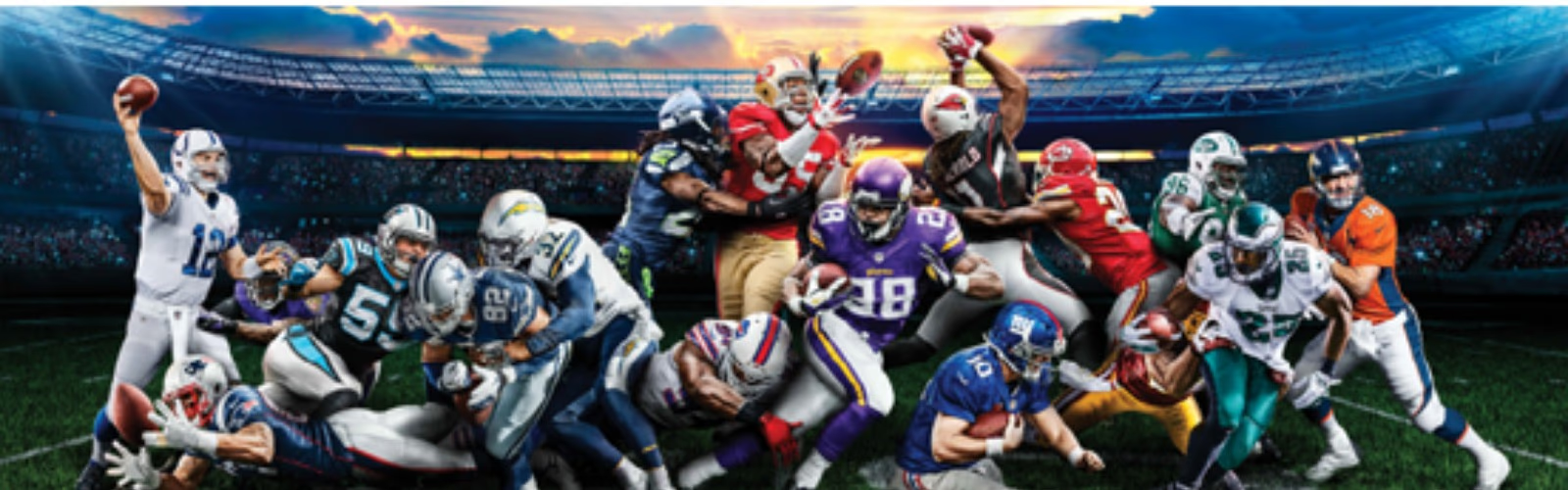
The National Football League (NFL) is the premier professional American football league in the world, consisting of 32 teams divided equally between the American Football Conference (AFC) and the National Football Conference (NFC). Founded in 1920 as the American Professional Football Association...
The NFL operates one of the most comprehensive concussion protocols in professional sports. Any player suspected of sustaining a concussion is immediately removed from the game and evaluated by the team's medical staff in the sideline medical tent or locker room.
Defensive Pass Interference (spot foul + automatic first down): A defender physically hinders a receiver's opportunity to catch a forward pass. Penalty is enforced at the spot of the foul (Rule 12).; Roughing the Passer (15 yards + automatic first down): Hitting the quarterback after the ball has...
The offensive team has four downs (plays) to advance the ball at least 10 yards from the original line of scrimmage. Successfully gaining 10 or more yards results in a new first down.
The NFL and NFLPA jointly test and rank all helmets used in the league via laboratory impact testing. Helmets that do not meet minimum performance thresholds are prohibited.
Replay assist may now review the following safety-related penalties when a flag has been thrown: Facemask fouls (Rule 15); Horse collar tackles (Rule 15); Hitting a defenseless player (Rule 15)
Yard lines: Marked every 5 yards across the width of the field, numbered every 10 yards from each goal line to the 50-yard line (Rule 1); Hash marks: Short lines at 1-yard intervals between the yard lines, positioned 70 feet 9 inches from each sideline. All plays begin on or between the hash mark...
The NFL now uses Sony Hawk-Eye technology (virtual first-down measurement) as the primary measurement system at all 30 stadiums. Traditional chain crews remain as a backup.
An NFL game consists of four 15-minute quarters, divided into two halves with a halftime intermission of approximately 12–15 minutes (longer for special events like the Super Bowl). The game clock ...
Referee: The crew chief with final authority on all rule interpretations. Positioned behind the offensive backfield. Wears a white cap (all other officials wear black caps) (Rule 19).; Umpire: Positioned in the defensive backfield. Monitors line play, holding, and illegal use of hands (Rule 19).;...
Positioned at the center of the end line (back of the end zone) (Rule 1); Crossbar height: 10 feet (3.05 m) above the ground (Rule 1); Uprights: 18 feet 6 inches (5.64 m) apart, extending at least 30 feet above the crossbar (Rule 1)
Don't run up the score
When holding a large lead late in a game, winning coaches are expected to pull starters, abandon the passing game, and run out the clock. Continuing to score aggressively is considered disrespectful, widely seen as embarrassing opponents, and is believed to invite retaliation in future matchups.
Never put bounties on or intentionally target injured opponents
Deliberately targeting a known opponent injury or incentivizing hits designed to knock out key players violates the most fundamental player code. The 2012 New Orleans Saints 'Bountygate' scandal—where coaches paid players to injure opponents—became the most notorious violation, drawing unprecedented suspensions.
Commissioner Roger Goodell called it 'conduct detrimental to the integrity of the NFL.' Four coaches and players received suspensions.
Don't disrespect the opponent's midfield logo
A team's painted logo at midfield is considered sacred territory. Celebrating, dancing, or lingering on it during warmups or after a win is viewed as a direct sign of disrespect. Multiple confrontations—including repeated Cowboys-Redskins incidents—have erupted specifically over players standing on the opponent's logo.
Particularly charged in the NFL where home-field identity and franchise symbols carry deep cultural weight.
Ready to dive deeper?
Honor the victory formation — don't attack a kneeling QB
When a leading team takes a knee to run out the clock, the trailing defense is expected to apply only token pressure rather than crash the line gambling on a fumble. Aggressively attacking the kneeling quarterback is widely condemned as poor sportsmanship beyond competitive necessity.
Don't fake injuries to stop the clock
Deliberately feigning injury to slow an opponent's hurry-up offense or stop the clock without using a timeout is condemned as cheating that violates competitive integrity. Coaches and teams have faced widespread public backlash, and the NFL has issued guidance attempting to deter the practice.
The locker room code of silence
Players are expected not to disclose internal team conflicts, play-calling strategies, or teammate disputes to the media. Leaking locker-room information is treated as a serious betrayal, often permanently damaging the player's standing within the team and the broader league.