


🏛️Official — NCAA
Loading OpenSourceSports…
Don't poach a set race course outside official windows
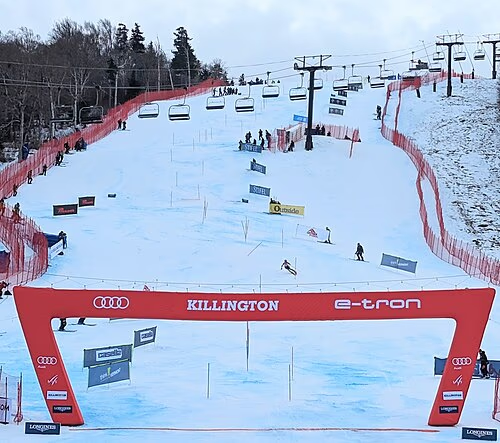
Skiing a freshly set race course — especially GS or slalom — outside of official inspection or training allocations is a serious breach. It can damage gate panels, alter snow surface, and give an unauthorized advantage. The race course is off-limits until the venue officially opens it.
Don't 'burn' the course during inspection
Pre-race course inspection is for sideslipping and studying each gate. Skiing at racing speed through inspection — memorizing the line by feel while potentially displacing gates or icing a track — for competitors behind you is considered a serious breach of racing etiquette. Inspection is visual, methodical, and shared.
Clear the course immediately after a crash or missed gate
If you crash or miss a gate (DNF), the expectation is to exit the course laterally as fast as possible — ideally without disturbing remaining gates — so the next starter is not delayed and the course is not further damaged. Lingering or sliding down inside the course is strongly frowned upon.
Skis: FIS-approved per discipline; slalom skis 165 cm minimum (men) / 155 cm (women); GS skis 195 cm minimum (men) / 188 cm (women); Bindings: FIS-approved with appropriate DIN setting; Boots: FIS-approved per discipline
Why people argue about this
People often assume that FIS-approved skis are just any old skis labeled as such, without realizing they must meet exact technical specifications for length and other features tailored to alpine skiing disciplines. They also mistakenly believe helmets are optional if they're comfortable enough, not understanding the mandatory N-1600 standard ensures maximum safety on the slopes.
Slalom course: short turns through closely-spaced gates; vertical drop typically 140-220 m for women / 180-220 m for men; gate count high (55-75 gates); Giant slalom course: longer turns through wider-spaced gates; vertical drop 250-450 m; gate count lower (35-55 gates); FIS-approved homologated ...
Why people argue about this
People often assume that the exact number of gates required (55-75) is a maximum limit, thinking it's an absolute cap on course design, when in fact, it's more like a minimum threshold to ensure enough turns and drop for competitive racing conditions. They overlook the flexibility FIS allows within these parameters, leading to misunderstandings about what constitutes a valid race course.
NCAA team: 6 skiers per team in each gender (men's + women's events scored separately, combined for team championship); Top 3 individual scores per gender count toward team total per event; Officials: technical delegate (TD), course setters, gate judges, starter, finish judges, FIS-certified timer
Why people argue about this
People often assume that all 6 skiers from each team must compete in every event of a championship, which leads to misunderstandings about how scores are calculated. However, the actual rule is that each team can choose up to 3 male and 3 female skiers for scoring purposes across events, not that they have to participate in all competitions.
Each event: 2 runs on 2 different course sets; Time = sum of run 1 + run 2; lowest combined time wins; Course inspection: 30-60 min before each run; no run-throughs allowed
Why people argue about this
People often assume that missed gates only result in disqualification if they're due to equipment failure, forgetting that gate passage requires correct order regardless of whether it's a technical issue or not. They also misunderstand that course inspection is mandatory 30-60 minutes before each run, thinking it’s just for the first run and not needed again for the second.
Individual event: lowest combined 2-run time wins; NCAA team scoring: places 1-30 score points per published table (1st = 60 pts, 2nd = 50 pts, etc., scaling down); Team total: top 3 scores per gender per event combined
Why people argue about this
People often assume that individual event scores are added together instead of using the lowest combined time for a win, leading to disputes over who actually won an individual race in NCAA Alpine Skiing. The confusion arises because scoring is based on the lowest total time per athlete rather than summing up all times individually.
Missed gate: DSQ from the run; Course interference (e.g., not following marked course): DSQ; Equipment violation (illegal ski length, illegal binding setting): DSQ
Why people argue about this
People often assume that a missed gate in alpine skiing only results in a DSQ for the entire race, forgetting that each gate is an individual challenge. The confusion arises because they overlook the fact that if you miss one gate, it's considered a failed attempt at that specific gate and not necessarily the whole run, leading to penalties per gate missed rather than a full race disqualification.
Mandatory FIS-approved helmets reduce head-injury risk. Course safety: B-net safety fencing on dangerous sections; padded gates; safety crews at risk points.
Why people argue about this
People often assume that mandatory helmet use in alpine skiing is solely for cosmetic reasons, forgetting that it significantly reduces head injuries and protects athletes from serious trauma during high-speed descents. The confusion arises because they overlook how crucial these helmets are in preventing catastrophic injuries like skull fractures or brain damage.