


🏛️Official — NCAA
Loading OpenSourceSports…
Winter Sports
1–2 players
outdoor
ski, pole, helmet
7 essential rules
NCAA Alpine Skiing is the collegiate variant of alpine skiing contested by NCAA Division I, II, and III institutions in the winter semester. NCAA Skiing combines Alpine Skiing (slalom + giant slalom only — speed events not contested at NCAA level due to course/safety constraints) and Nordic Skiin...
Skis: FIS-approved per discipline; slalom skis 165 cm minimum (men) / 155 cm (women); GS skis 195 cm minimum (men) / 188 cm (women); Bindings: FIS-approved with appropriate DIN setting; Boots: FIS-approved per discipline
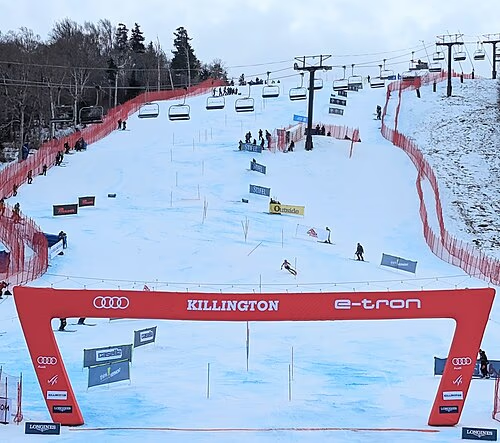
Slalom course: short turns through closely-spaced gates; vertical drop typically 140-220 m for women / 180-220 m for men; gate count high (55-75 gates); Giant slalom course: longer turns through wider-spaced gates; vertical drop 250-450 m; gate count lower (35-55 gates); FIS-approved homologated ...
NCAA team: 6 skiers per team in each gender (men's + women's events scored separately, combined for team championship); Top 3 individual scores per gender count toward team total per event; Officials: technical delegate (TD), course setters, gate judges, starter, finish judges, FIS-certified timer
Each event: 2 runs on 2 different course sets; Time = sum of run 1 + run 2; lowest combined time wins; Course inspection: 30-60 min before each run; no run-throughs allowed
Individual event: lowest combined 2-run time wins; NCAA team scoring: places 1-30 score points per published table (1st = 60 pts, 2nd = 50 pts, etc., scaling down); Team total: top 3 scores per gender per event combined
Missed gate: DSQ from the run; Course interference (e.g., not following marked course): DSQ; Equipment violation (illegal ski length, illegal binding setting): DSQ
Mandatory FIS-approved helmets reduce head-injury risk. Course safety: B-net safety fencing on dangerous sections; padded gates; safety crews at risk points.
Don't poach a set race course outside official windows
Skiing a freshly set race course — especially GS or slalom — outside of official inspection or training allocations is a serious breach. It can damage gate panels, alter snow surface, and give an unauthorized advantage. The race course is off-limits until the venue officially opens it.
Results in disqualification and potential disciplinary action when detected, but the prohibition is enforced partly by cultural pressure before officials act.
Don't 'burn' the course during inspection
Pre-race course inspection is for sideslipping and studying each gate. Skiing at racing speed through inspection — memorizing the line by feel while potentially displacing gates or icing a track — for competitors behind you is considered a serious breach of racing etiquette. Inspection is visual, methodical, and shared.
Applies to FIS-sanctioned NCAA races where all competitors inspect the same freshly-set course in a designated window.
Clear the course immediately after a crash or missed gate
If you crash or miss a gate (DNF), the expectation is to exit the course laterally as fast as possible — ideally without disturbing remaining gates — so the next starter is not delayed and the course is not further damaged. Lingering or sliding down inside the course is strongly frowned upon.
Ready to dive deeper?