


🏛️Official — UWW
Loading OpenSourceSports…
Always complete the post-match handshake
After every match, competitors are expected to shake hands with the opponent and the referee. Refusing or giving a disrespectful handshake — even after a disputed loss — is considered one of the gravest breaches of wrestling etiquette and has triggered international incidents at World Championships and Olympic Games.
Don't sandbag or manipulate brackets
Deliberately underperforming in preliminary rounds to land in a more favorable bracket position, or losing intentionally to avoid a difficult opponent, is considered deeply dishonorable. Wrestling culture places strong value on competing honestly every match. High-profile sandbagging accusations have damaged reputations significantly.
Win with dignity — no excessive celebration
Taunting, prolonged celebration, or showboating after pinning or defeating an opponent is strongly frowned upon. The expectation is to acknowledge the win briefly and immediately show respect to your opponent. This norm is especially strong after a pin, where the defeated wrestler is already in a physically and psychologically vulnerable position.
No trash talk or verbal taunting on the mat
Wrestling is culturally a silent competition. Verbal taunting, intimidation, or trash talk directed at an opponent during a match is considered dishonorable. The mat is understood as a space where the contest speaks for itself. Coaches may communicate to their athlete, but wrestler-to-wrestler verbal aggression violates the culture strongly.
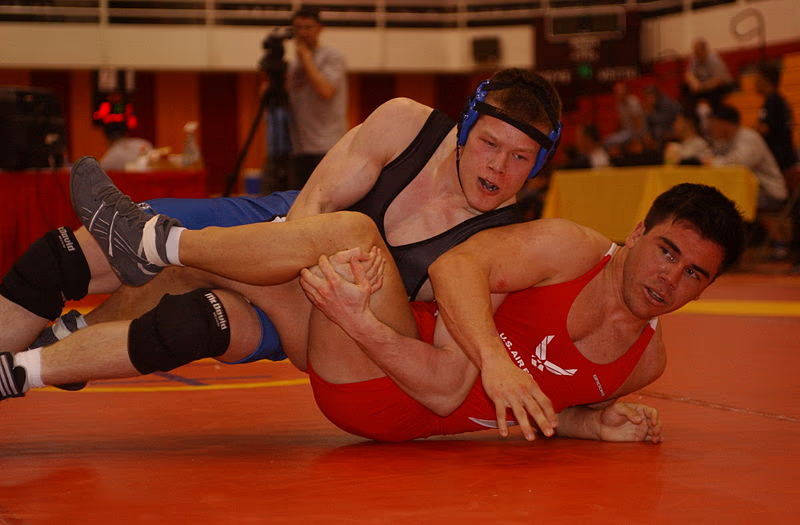
Wrestlers must wear a one-piece wrestling singlet in either red or blue, as assigned by the competition draw. The singlet must be UWW-approved, tight-fitting to the body, and made of a non-abrasive material.
Why people argue about this
People often assume that the color of the singlet is randomly assigned by a competition draw, which leads them to believe they have no say in choosing their preferred color. Actually, the color is predetermined based on the wrestler's initial draw and remains consistent throughout their match series, regardless of who wins or loses any given bout.
Athletes must wear approved wrestling shoes that cover and support the ankle. Shoes must have soft, non-marking soles with no heels.
Why people argue about this
People often assume that wrestling shoes are just for looks, but in reality, they're crucial for ankle support and non-marking soles prevent injuries during matches, which is why athletes must wear them as per the 2.2 rule.
Headgear (ear guards) is optional in senior international competition but strongly recommended to prevent cauliflower ear (auricular hematoma). Headgear is mandatory at Cadet (U17) and some Junior (U20) age levels, as determined by UWW regulations.
Why people argue about this
People often assume that since headgear is optional in senior international competition, wrestlers can compete without it if they choose. However, the truth is that while optional at these levels, UWW regulations mandate its use for Cadet and some Junior age groups to prevent a condition called cauliflower ear, which can severely impair hearing and wrestling performance.
Handkerchief (Blood Rag): Every wrestler must carry a handkerchief tucked into the singlet during competition. This is used for immediate blood management if bleeding occurs.; Nails: Fingernails and toenails must be trimmed short before competition. Referees inspect nails at the pre-match equipme...
Why people argue about this
People often assume that the singlet's tight fit requirement is solely for comfort and aesthetics, forgetting that it’s crucial for preventing clothing entanglement during matches, which can lead to dangerous situations or disqualifications. They overlook how this specific design feature ensures fair play by avoiding such complications.
All UWW-sanctioned competitions take place on a regulation wrestling mat. The mat is a square platform with a circular competition surface marked upon it.
Why people argue about this
People often assume that the regulation mat dimensions are fixed at a certain size, arguing over how big it should be. Actually, what they misunderstand is that the key aspect isn't the exact size of the mat but rather its square shape with a circular competition area marked on it—any mat as long as it fits this description can be used for UWW-sanctioned events.
The mat must be at least 6 cm (2.4 in) thick, constructed from high-density, shock-absorbing foam covered with a smooth, non-abrasive vinyl surface. The surface must provide adequate grip without causing mat burns.
Why people argue about this
People often assume that the thickness requirement is only about making sure the mat doesn't collapse under weight, forgetting that it's also crucial for preventing injuries from impacts, which aligns with the shock-absorbing foam part of the rule. They might overlook how a thinner mat could compromise safety and comfort during matches.
Red and blue corner marks are placed diagonally opposite each other on the mat edge, corresponding to the assigned wrestler colors. The central circle includes a starting line for each wrestler.
Why people argue about this
People often assume that the red and blue corner marks are randomly placed anywhere on the mat edge without regard for assigned wrestler colors, but actually they must be diagonally opposite each other corresponding to the wrestlers' color assignments as per the official verdict.
Wrestling is an individual sport. Each match features two athletes competing one-on-one.
Why people argue about this
People often assume that wrestling matches are team competitions where multiple wrestlers from each side fight together, which is a common misunderstanding of what 4.1 Competitors actually means in UWW rules - it clearly states wrestling is an individual sport with just two competitors per match.
UWW recognizes the following competitive age divisions, each with its own weight classes: Schoolboys/Schoolgirls: 14–15 years old; Cadets: 16–17 years old; Juniors: 18–20 years old
Why people argue about this
People often assume that the age categories in wrestling are strictly based on chronological age, which can lead to arguments about whether a wrestler should be moved up or down due to their physical maturity rather than their birthday. The confusion arises because the UWW rule 4.2 Age Categories actually considers both height and weight when determining an athlete's category, not just their age.
Each match is overseen by a three-person officiating panel to ensure accuracy and fairness: Mat Referee: The primary official on the mat. The referee controls the action, starts and stops the bout, awards points, issues cautions and passivity calls, and ensures wrestler safety. The referee wears ...
Why people argue about this
People often assume that the three-person officiating panel is there solely for timing purposes, thinking they're just keeping track of time intervals between moves or penalties. But actually, these officials are crucial in enforcing all aspects of the rules, from scoring to count-outs and even handling controversial situations that might arise during a match.
A standard senior match consists of 2 periods of 3 minutes each, with a 30-second rest period between them. The clock runs continuously during each period and is stopped only by the referee for injuries, equipment issues, blood time, or official consultations.
— Section 6
Why people argue about this
People often assume that a 3-minute period means wrestling goes for exactly 9 minutes per match, forgetting about the mandatory 30-second rest between periods. This leads to misunderstandings about how long matches actually last and can cause arguments during scheduling or when discussing match lengths with referees.
Each period begins with both wrestlers in the standing (neutral) position, facing each other at the center of the mat. The referee blows the whistle to start and restart action.
Why people argue about this
People often assume that a wrestler can only pin their opponent to win by fall, forgetting that pins are just one way to score points; they also earn 1 point for each of their opponent's shoulders down on the mat at any time during the match, leading to many debates about which scoring method is more advantageous.
The fall is the highest achievement in wrestling and results in an immediate victory regardless of the score. A fall is awarded when both of the opponent's shoulder blades are held in continuous contact with the mat long enough for the referee to observe and confirm the pin.
Why people argue about this
People often assume that a pin happens instantly when one wrestler's shoulders touch the mat, which leads them to believe they can win quickly by just touching down their opponent. However, the actual rule states that both shoulder blades must be held in contact with the mat for a continuous observation period by the referee to confirm it as a fall and award victory.
If at any point during the match one wrestler establishes a lead of 10 points or more, the match is stopped and that wrestler is declared the winner by technical superiority (also called technical fall). This rule prevents unnecessarily one-sided ...
Why people argue about this
People often assume that a 10-point lead is just for show, thinking it's easier to achieve than it actually is in real matches, but the truth is, it requires precise execution of technique and control over multiple rounds to accumulate such an overwhelming advantage within wrestling's technical framework.
In Freestyle wrestling, athletes may use their entire body for offensive and defensive techniques. Key characteristics include: Leg attacks: Single-leg and double-leg takedowns are core techniques, targeting the opponent's legs to bring them to the mat.; Leg lace (ankle lace): A turning technique...
Why people argue about this
People often assume that in freestyle wrestling, you're only allowed to use your arms for offense and defense, which is a common misconception. The actual rule states you can use your entire body, leading many to believe they must limit their movements out of fear of breaking the rules when they might not have intended to do so.
Greco-Roman wrestling restricts all holds and attacks to the upper body only (above the waist). This creates a uniquely powerful and explosive style.
Why people argue about this
People often argue that UWW's stance on penalizing passive wrestling in Greco-Roman style matches is overly harsh, thinking it unfairly targets wrestlers who prefer a more defensive approach. Actually, they misunderstand that this rule is designed to promote active offense and fair competition by ensuring both sides are actively engaging with each other throughout the match.
UWW actively penalizes passive wrestling. If a wrestler is not initiating attacks or attempting to score, the following sequence occurs: The referee issues a verbal warning ("Red/Blue, attack!") to encourage activity.; If passivity continues, the referee calls passivity, awarding the active wrest...
Why people argue about this
People often assume that the Passivity Rule in UWW is about wrestlers who are physically inactive, when in reality it targets those who remain motionless or unresponsive to their opponent's attacks for an extended period, which can be seen as a form of cheating and discourages fair competition.
When wrestlers move into the protection area (outside the competition surface), the referee stops the action. If a wrestler is pushed out while their opponent maintains position inside, the wrestler who forced the action out may receive 1 point (stepping out).
Why people argue about this
People often assume that if their opponent steps out of bounds while they're still in, they automatically get a point for forcing them out, but actually, it's the wrestler who forced their opponent out of bounds who receives the point—irrespective of which side was inbounds initially.
Each wrestler (or their corner coach) is entitled to one challenge per match. A challenge requests a video review of a specific call by a review jury.
Why people argue about this
People often assume that a challenge in wrestling is as simple as raising your hand when you disagree with a call, but they misunderstand that each wrestler or their coach gets only one challenge per match, which can lead to strategic decisions about where and when to use these limited opportunities wisely.
Points are accumulated throughout the match.
Why people argue about this
People often assume that points are awarded only for successful maneuvers like takedowns or submissions, forgetting that they can also be earned through maintaining control of the match's tempo, positioning, and overall effort over time, which is explicitly stated in 6.1 but not always immediately obvious to observers.
A match can end in the following ways, listed from most decisive to least: Fall (Pin): Both shoulders held on the mat. Instant win. Classified as Victory by Fall (VFA).; Default / Injury: Opponent cannot continue or does not appear. Victory by Default (VFO) or Injury (VIN).; Technical Superiority...
Why people argue about this
People often assume that if a match ends in a tie at regulation time, it's automatically decided by judges' scoresheets alone, but actually, the priority order of determining the winner includes factors like disqualification and whether one wrestler was forced to submit or touched their headgear—confusing these specifics can lead to disputes.
If the score is tied at the end of regulation, the winner is determined by the following criteria, applied in order until a winner is identified: Highest-value scoring technique: The wrestler who scored the single highest-value move during the match wins. For example, if both wrestlers have 4 poi...
Why people argue about this
People often assume that if a match ends in a tie at the end of regulation, they'll have to go through a coin toss to decide who wins, which is actually incorrect. The official document specifies that after regulation time, the judges will use specific criteria like submission attempts or points scored to break the tie, not by flipping a coin.
In dual meet (team vs. team) competitions, classification points are awarded based on the manner of individual victories.
Why people argue about this
People often assume that team scoring in wrestling is based solely on who wins individual matches, but actually it's about how those victories are achieved—whether by fall, submission, or technical superiority—and these outcomes can be split among all members of a team if they participate effectively throughout the match.
A caution is a formal penalty issued by the referee for rule violations. Each caution results in 1 or 2 points awarded to the opponent, depending on the severity.
Why people argue about this
People often think that a caution in wrestling is just a warning with no consequences, forgetting that it results in points for their opponent, which can significantly affect the match's outcome. They overlook how crucial even minor infractions are when they're worth actual points awarded to the competitor who didn't break any rules.
In Greco-Roman wrestling, additional violations apply due to the upper-body-only restriction: Any leg attack (single-leg, double-leg) results in a caution and 1–2 points to the opponent; Using the legs to hook, trip, or block the opponent, even defensively; Holding below the waist or gripping the...
Why people argue about this
People often assume that in Greco-Roman wrestling, you're only allowed to use your legs for throws, which leads them to argue about when they can or cannot use their arms during a match. However, the misunderstanding arises because this rule specifically restricts arm movements and holds above the waist, not completely prohibiting leg techniques as some might think.
Actions deemed brutal or dangerous carry more severe penalties: Caution and 2 points: A throw executed with intent to injure, slamming the opponent headfirst into the mat, or any technique performed with excessive and unnecessary force beyond what is required for the hold.; Immediate disqualifica...
Why people argue about this
People often argue that this rule is too subjective and hard to judge accurately, thinking it's simply about who they think was passive, when in fact, the system relies on judges scoring based on specific criteria like body positioning or movement, which can be quite nuanced and open to interpretation.
While not a formal caution, passivity calls carry tangible consequences. A wrestler deemed passive receives a passivity mark, and their opponent is awarded 1 point.
Why people argue about this
People often assume that passivity penalties are just a formality with no real impact on the match outcome, but in fact, they can be quite significant as they directly award points to the opponent who notices the passive wrestler and takes advantage of it.
Coaches must remain seated in their designated chair at matside and may only communicate verbally with their wrestler. A coach who stands, enters the mat area, physically interferes, or directs abusive language at officials may be ejected from the competition area.
Why people argue about this
People often assume that coaches can only stand up if they're trying to give their wrestler a pep talk or support during a match, but actually, the rule is about preventing physical interference and abusive language to maintain fair competition and referee authority, so standing alone isn't necessarily wrong as long as it's not combined with other prohibited actions.
A qualified competition doctor and paramedic team must be present at matside for all UWW-sanctioned events. Medical personnel have the authority to examine injured wrestlers during designated stoppages.
Why people argue about this
People often assume that wrestlers can make their weight at any time before competition day, thinking it's flexible like in other sports where a day-before weigh-in is common. But actually, the official verdict clearly states they must make their weight on the day of competition itself, with no flexibility for earlier weigh-ins.
Official weigh-in is conducted on the morning of competition, typically 2–3 hours before the first bout. Wrestlers must make weight on the day they compete (no day-before weigh-in).
Why people argue about this
People often assume that they can skip the weigh-in if they've already made their weight at a previous event, which leads to misunderstandings about needing to be weighed in again on competition day as per UWW's 8.2 rule. The confusion arises because this rule specifically mandates wrestlers must make their competition weight on the day of the event itself, not just any other qualifying event.
Prior to competition, all wrestlers undergo a skin check by the competition doctor to screen for communicable skin conditions such as ringworm, impetigo, herpes simplex, and other contagious infections. Wrestlers found with active skin infections ...
Why people argue about this
People often assume that skin checks are only for visible infections like ringworm, ignoring other serious conditions like herpes simplex mentioned in the rule. They mistakenly believe they're only checked if they have a rash or visible blemish, not realizing they could be screened for less obvious and potentially more dangerous issues.
If a wrestler begins bleeding during a match, the referee stops the clock and grants blood time for treatment. The bleeding must be controlled and the wound properly dressed before the wrestler may continue.
Why people argue about this
People often assume that blood time only applies if a wrestler is bleeding heavily enough to be seen by everyone in the arena, but actually, it's about controlling the bleed so the wrestler can continue fighting, regardless of how much blood they're losing. The rule ensures safety first before allowing competition to resume.
If a wrestler is injured during a match (without blood), the referee may grant injury time of up to 2 minutes. The competition doctor evaluates the wrestler during this time.
Why people argue about this
People often assume that injury time is only granted if a wrestler has visible blood, forgetting that it can be awarded for injuries without bleeding as well—this rule's gray area leads to misunderstandings.
The following techniques are banned to protect wrestlers from serious injury: Full nelson: Applying a double nelson (both hands behind the opponent's neck) is illegal due to the risk of cervical spine injury.; Headlock without arm: A headlock must include at least one of the opponent's arms to pr...
Why people argue about this
People often assume that the "8.6 Prohibited Techniques for Safety" rule in UWW wrestling is solely about preventing cheating, but they misunderstand its primary purpose. Actually, it's designed to safeguard wrestlers from serious injury by banning techniques like eye-gouging and headbutting, which are inherently dangerous and can lead to severe injuries or even fatalities.
Wrestling mats are inspected before each competition day for proper thickness (minimum 6 cm), surface integrity, and secure positioning. Mats on elevated platforms must have additional crash padding on all sides.
Why people argue about this
People often assume that mat thickness alone is enough to prevent injuries, so they argue about why additional crash padding on elevated mats isn't necessary since mats are already checked for proper thickness. The confusion arises because they overlook how elevation can increase risk and thus justify extra safety measures like crash pads.
Wrestlers must wear a one-piece wrestling singlet in either red or blue, as assigned by the competition draw. The singlet must be UWW-approved, tight-fitting to the body, and made of a non-abrasive material.
Why people argue about this
People often assume that the color of the singlet is chosen randomly by each wrestler, forgetting that it's assigned based on a competition draw, leading to misunderstandings about their own team colors. The confusion arises because they don't realize the color allocation is predetermined and not decided at the last minute or by individual preference.
All UWW-sanctioned competitions take place on a regulation wrestling mat. The mat is a square platform with a circular competition surface marked upon it.
Why people argue about this
People often assume that UWW-sanctioned competitions can take place anywhere as long as they're on a mat, but in reality, it's precisely about adhering to the regulation wrestling mat with its specific square platform and circular competition surface outlined by Section 3. This oversight leads to arguments over where exactly the mats are placed during matches.
Wrestling is an individual sport. Each match features two athletes competing one-on-one.
Why people argue about this
People often assume that wrestling matches are inherently team competitions since there are multiple competitors listed on a roster sheet. But in UWW (Universal Wrestling Federation), each match is indeed one-on-one between two athletes, making this rule crucial to understanding how points and scoring work within the competition structure.
A standard senior match consists of 2 periods of 3 minutes each, with a 30-second rest period between them. The clock runs continuously during each period and is stopped only by the referee for injuries, equipment issues, blood time, or official consultations.
— Section 6
Why people argue about this
People often assume that the 30-second rest period between periods is a break where both wrestlers can walk around freely, which they mistakenly believe lasts for the full 30 seconds. However, the actual rest period is when neither wrestler can move or be active in any way until the referee signals it's over, even if the clock hasn't hit 30 seconds yet.
Points are accumulated throughout the match.
Why people argue about this
People often assume that points are only awarded for submissions and falls during a wrestling match, forgetting that points can also be earned through control of the mat—like when an opponent is forced to stay in their corner or loses balance outside the ring area. The confusion arises because they overlook the comprehensive scoring system outlined in Section 6.
A caution is a formal penalty issued by the referee for rule violations. Each caution results in 1 or 2 points awarded to the opponent, depending on the severity.
Why people argue about this
People often think that a caution in wrestling means the referee is just giving their opinion on whether it was a foul or not, but actually, it's an official penalty decided by the officials based on severity, and results in points for the opponent regardless of who called it initially.
Official weigh-in is conducted on the morning of competition, typically 2–3 hours before the first bout. Wrestlers must make weight on the day they compete (no day-before weigh-in).
Why people argue about this
People often assume that wrestlers can weigh in at any time before their bout, thinking it's flexible like other sports. However, under UWW rules, they must make weight on the day of competition as specified, which can lead to last-minute stress and confusion about when exactly they need to be ready for weighing-in.