


🏛️Official — NCAA
Loading OpenSourceSports…
Give a genuine post-match handshake
The handshake after the final whistle is the most sacred ritual in wrestling culture. A limp, avoided, or deliberately disrespectful handshake — including turning away before the referee directs you to shake — is considered a cardinal violation of the sport's code, regardless of the match result.
Don't celebrate excessively after a pin
After recording a fall, a composed acknowledgment is expected — pointing to the crowd or a brief fist pump is accepted, but extended taunting, standing over the opponent, or chest-beating while the opponent is still on the mat is seen as a serious breach of the sport's etiquette and reflects poorly on the program.
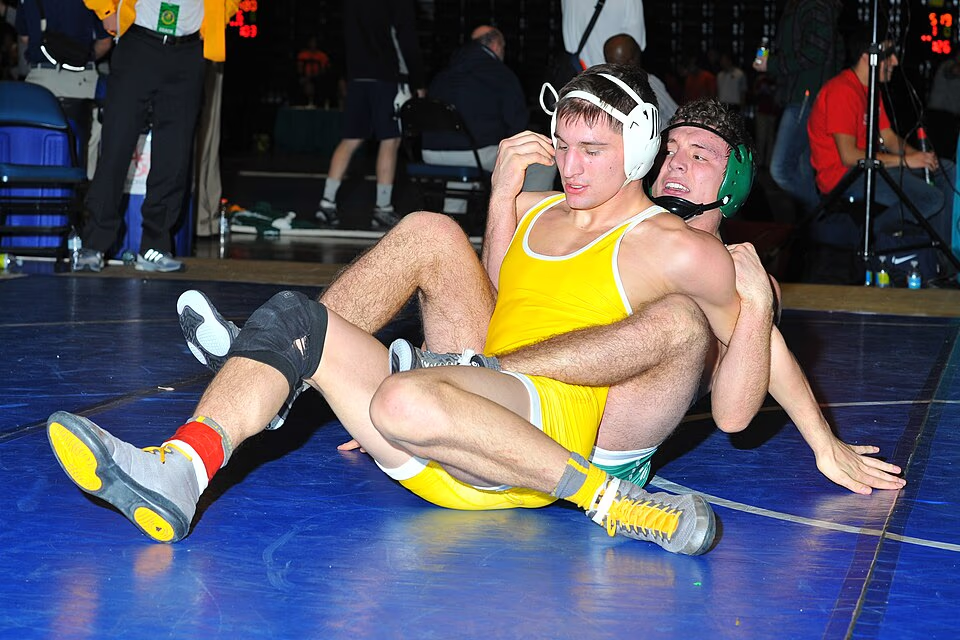
Singlet: NCAA-approved (1- or 2-piece per NCAA rule); Wrestling shoes: NCAA-approved with secure ankle support; Headgear: optional (different from NCAA Men's Wrestling where headgear is required)
Why people argue about this
People often assume that the NCAA-approved singlet is just a standard sports bra with no special features, when in fact it's a specialized uniform designed for wrestling, featuring unique materials and designs to enhance performance and safety standards. The confusion arises because they overlook how crucial these specific elements are in this high-impact sport.
Mat: 12 m × 12 m square mat with 8-9 m circular wrestling area marked in the center; Protection zone: ≥1.5 m around the wrestling area; Center circle: 1 m diameter at the center of the wrestling area
Why people argue about this
People often assume that the circular wrestling area is just a smaller circle within the larger square mat, which leads them to overlook the crucial 1-meter diameter center circle at its exact center. This oversight causes confusion because it's not just about where you're allowed to wrestle; it also affects positioning for holds and movements around the central circle.
NCAA W's Wrestling weight classes (10 classes per UWW): 109, 116, 123, 130, 136, 143, 155, 170, 191, 235 lb (NCAA-specific in pounds; UWW uses kg equivalents); Each program enters one wrestler per weight class for dual matches; Officials: 1 referee on the mat + 1 mat chairman + 1 judge (3-officia...
Why people argue about this
People often assume that having a 3-official crew means each official gets equal time refereeing, which leads to misunderstandings about how many matches one official might oversee in an entire tournament. Actually, it's the number of wrestlers per weight class entering that determines how many matches are officiated, not necessarily the number of officials per match.
Match: 2 periods of 3 minutes with a 30-second break (UWW freestyle format; NCAA aligns); Tied at the end of regulation: criteria for winner — most recent technical points scored wins (not overtime); Periods are continuous in regulation (no clock stops for stalemates per UWW)
Why people argue about this
People often assume that a match ends in overtime if it's tied at the end of two three-minute periods, which isn't explicitly stated here. However, the official verdict clarifies that there is no overtime for ties; instead, the winner is determined by the most recent technical points scored throughout both periods.
Takedown: 2 points (4 if a "throw" — high-amplitude lift); Exposure (back to mat at less than 90°): 2 points; Reversal: 2 points
Why people argue about this
People often assume that a reversal is worth just 1 point in NCAA Women's Wrestling, misunderstanding Section 6's clear statement that it actually awards 2 points. The confusion arises because some judges or officials might inadvertently award only one point for reversals, leading to disputes and arguments about the correct score.
Caution: minor infraction (incorrect grip, brief illegal hold) — verbal + opportunity to correct; Caution + 1 point: passivity, fleeing the mat, brief illegal hold; Caution + 2 points: continued passivity, more egregious illegal hold
Why people argue about this
People often assume that getting disqualified in wrestling means you're automatically out of the match, forgetting that disqualification is just one form of penalty under Section 7. The confusion arises because they overlook other penalties like warnings or points deductions, thinking only severe actions lead to immediate elimination.
Mandatory mat thickness + foam compliance; protection zone ≥1.5 m. NCAA weight management framework: official minimum weight assessment + hydration testing pre-season; weight loss limits enforced.
Why people argue about this
People often assume that the mandatory mat thickness + foam compliance rule is solely about ensuring a cushion for falls, forgetting that it's also designed to prevent injuries like bruises or skin abrasions from mats being too hard. They overlook how this regulation contributes to creating a safer environment by reducing the risk of impact-related injuries during matches.