


🏛️Official — NCAA
Loading OpenSourceSports…
Shake hands with your opponent and the opposing coach after every match
Post-match handshakes with both the opponent and the opposing coach are the most deeply ingrained ritual in wrestling. Refusing is one of the most serious breaches of the code, has led to public censure and disciplinary action at state championships and NCAA events, and is viewed as a profound disrespect for the sport and the opponent.
Don't use injury time deceptively to rest or break momentum
Each wrestler is entitled to injury time per match. Using it opportunistically — feigning a problem to rest, cool down, or kill a clock when leading — is viewed as gaming the rules and is widely condemned within the sport. Coaches and trainers are expected to discourage it.
Don't taunt or showboat over a pinned or beaten opponent
Standing over a fallen opponent, flexing in their face, pointing down at them, or otherwise showboating after a pin or technical fall is a serious breach. The opponent is already in a vulnerable position; adding humiliation violates the core respect expected in a combat sport where the winner physically dominates.
Don't trash-talk during live action
The extreme physical proximity of wrestling — bodies locked together for extended periods — makes verbal taunting during live action especially offensive. Whispering insults, making demeaning comments, or taunting inside a scramble is widely considered a serious breach of mat etiquette at all levels.
Don't show satisfaction or relief when an opponent is injured
If an opponent is hurt and requires trainer attention or cannot continue, any visible satisfaction, celebration, or relief from the other wrestler or their corner is considered deeply disrespectful. The expectation is concern or neutral composure regardless of competitive stakes.
Don't take late cheap shots as time expires
Delivering a deliberate late slam, hard shove, or cheap move after the buzzer is a serious breach. Wrestlers are expected to disengage cleanly when time expires rather than exploiting the final chaotic moments to get in a last shot under the guise of still competing.
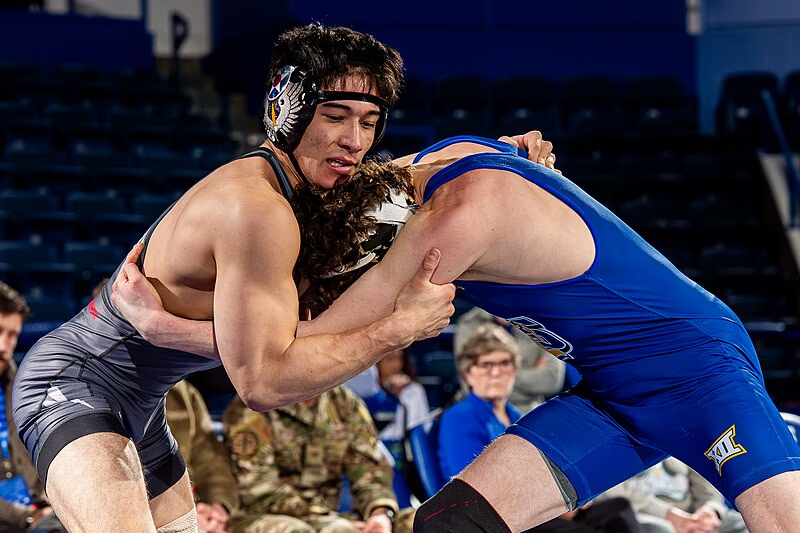
Headgear: Protective ear guards are mandatory in NCAA wrestling. This is a critical difference from UWW, where headgear is optional for senior-level competitors. Headgear must have a chin strap and be properly fastened. It must be approved by the manufacturer for wrestling use.; Wrestling singlet...
Why people argue about this
People often assume that protective ear guards with chin straps are optional for safety reasons, which leads to misunderstandings about their mandatory nature in NCAA Folkstyle wrestling. The confusion arises because these ear guards are explicitly stated as a required piece of equipment to protect athletes from hearing damage and enhance overall safety during matches.
Headgear: Protective ear guards are mandatory in NCAA wrestling. This is a critical difference from UWW, where headgear is optional for senior-level competitors. Headgear must have a chin strap and be properly fastened. It must be approved by the manufacturer for wrestling use.; Wrestling singlet...
Why people argue about this
People often assume that mandatory ear guards with chin straps are just a safety precaution, forgetting that these rules also dictate which manufacturers' products are approved for use in NCAA Folkstyle wrestling matches. This oversight leads to confusion about why certain brands of ear protection aren't allowed, despite the equipment being perfectly safe and effective.
Fingernails must be trimmed short and smooth.; Wrestlers must be clean-shaven or have facial hair that is trimmed close and not abrasive. A referee may require a face covering for facial hair.; Hair must be contained in a legal hair cover if it extends below the earlobes in the back, below the ey...
Why people argue about this
People often assume that protective ear guards are only for protection against hearing damage from wrestling mats, when in fact they serve a crucial role in preventing skin irritation and infections caused by sweat and friction during matches, which is why their mandatory use under NCAA Folkstyle's personal hygiene rule is so important.
Greasy or slippery substances on the body; Any equipment with buckles, hard plastic, or metal components; Unapproved braces or supports with exposed hard materials (must be padded and covered)
Why people argue about this
People often assume that the prohibition of shoes with buckles, zippers, or protruding hardware is about comfort or style, but actually it's meant to prevent any kind of advantage in grip or leverage during matches, as these features could give an athlete a hidden edge they can exploit.
The NCAA wrestling mat is a circular competition surface with the following dimensions: Overall mat area: Minimum 42 feet (12.8 meters) in diameter, providing a large safety zone.; Wrestling area: 32-foot (9.75-meter) inner circle where competition takes place. This is bounded by a 1-inch boundar...
Why people argue about this
People often assume that the circular shape of the mat is purely for aesthetic reasons, but in reality, it's designed to ensure fair play by providing equal leverage opportunities for both competitors regardless of their starting position on the mat. They overlook how this design prevents any player from having an inherent advantage based solely on where they begin their match.
The NCAA wrestling mat is a circular competition surface with the following dimensions: Overall mat area: Minimum 42 feet (12.8 meters) in diameter, providing a large safety zone.; Wrestling area: 32-foot (9.75-meter) inner circle where competition takes place. This is bounded by a 1-inch boundar...
Why people argue about this
People often assume that the circular shape of the mat is purely for aesthetic reasons, but in reality, it's designed to ensure fair competition by providing equal space for both competitors regardless of their starting position on the mat. The circle also helps prevent players from gaining an unfair advantage by positioning themselves closer to one side of the mat compared to another.
The mat must be of uniform thickness (minimum 1 inch / 2.54 cm of shock-absorbing material) and provide adequate cushioning.; Starting lines in the center: two parallel 1-inch lines, 3 feet long, placed 12 inches apart at the center of the 10-foot circle. One line is green (for the wrestler assig...
Why people argue about this
People often assume that the uniform thickness requirement means all parts of the mat must be exactly 1 inch thick, leading to disputes about whether seams or variations in material density are acceptable. The confusion arises because they misinterpret "uniform thickness" as a literal measurement across every part of the mat rather than an average consistency throughout its surface.
A minimum of 5 feet of clear space must surround the mat on all sides, free of obstructions.; Team benches and the scorer's table are positioned outside this safety zone.; The scorer's table should be elevated or positioned for clear visibility of the mat.
Why people argue about this
People often assume that the 5-foot apron simply means wrestlers can't step outside a 5-foot radius from their starting position during a match, but actually, it's about creating a safety buffer zone around the mat edge to prevent accidental injuries or equipment damage when competitors are moving within the actual wrestling area.
NCAA Division I wrestling features ten weight classes (in pounds): 125 lbs (56.7 kg); 133 lbs (60.3 kg); 141 lbs (64.0 kg)
Why people argue about this
People often assume that the one-pound allowance applies only to wrestlers who missed their weight on the first day of competition, forgetting that it's given for those who make it but just barely on the second day. This oversight leads to arguments about whether a wrestler can still use this grace period if they were close but didn't quite qualify initially.
NCAA Division I wrestling features ten weight classes (in pounds): 125 lbs (56.7 kg); 133 lbs (60.3 kg); 141 lbs (64.0 kg)
Why people argue about this
People often assume that if they qualify for a weight class, they can weigh as much as their limit on competition day without issue. But actually, there's a one-pound buffer zone allowed in case of slight fluctuations due to factors like hydration or food intake, which is why the rule specifies this allowance applies only to the second day of multi-day events.
NCAA wrestling uses a single-referee system, which is a significant departure from UWW's three-official crew (referee, judge, and mat chairman). The single referee is responsible for all scoring decisions, penalty calls, and match management.
Why people argue about this
People often assume that having a single referee in NCAA Folkstyle wrestling means less oversight of matches compared to UWW's three-official system, but actually, it leads to more scrutiny because every decision is up for review post-competition by the National Wrestling Alliance (NWA), ensuring fairness despite the reduced number of officials on-site.
A dual meet consists of 10 individual matches, one at each weight class. The team accumulating the most points wins the dual.
Why people argue about this
People often assume that a dual meet in NCAA Folkstyle Wrestling is decided solely by who wins more matches, rather than by points scored across all 10 matches at different weight classes. The confusion arises because they miss the point system where each match awards points based on how well competitors perform, not just who wins outright.
An NCAA wrestling match consists of three periods totaling seven minutes: 1st Period: 3 minutes — both wrestlers begin in the neutral (standing) position.; 2nd Period: 2 minutes — one wrestler chooses starting position (top, bottom, neutral, or defer).; 3rd Period: 2 minutes — the other wrestler ...
Why people argue about this
People often assume that choosing your position for the second period means you get to pick which side of the mat you start on, but actually, they're only deciding where you stand during the 2nd period - it doesn't change your starting spot at all. They might also think deferring is a way to avoid picking sides altogether, when in reality, it just moves the decision to the third period instead.
An NCAA wrestling match consists of three periods totaling seven minutes: 1st Period: 3 minutes — both wrestlers begin in the neutral (standing) position.; 2nd Period: 2 minutes — one wrestler chooses starting position (top, bottom, neutral, or defer).; 3rd Period: 2 minutes — the other wrestler ...
Why people argue about this
People often assume that choosing first period position is a huge advantage in wrestling, so they argue about deferring it for the sake of potentially gaining an edge later. However, the actual confusion arises because this rule only applies to the second period, not the third, which means wrestlers are still free to choose their spot at the end of the match if they win the coin toss.
Neutral position: Both wrestlers standing, facing each other on the starting lines. Used to begin the 1st period and when selected by choice.; Referee's position (top/bottom): The bottom wrestler kneels on both knees with hands placed on the starting lines. The top wrestler kneels to the side wit...
Why people argue about this
People often assume that if both wrestlers step out of bounds simultaneously without a score in progress, they should be allowed to restart from where they stepped out. But actually, the rule dictates that the referee stops the match and restarts at the center line because it maintains fairness by not giving either wrestler an advantage.
Action is considered in-bounds when the supporting parts of either wrestler remain inside or on the boundary line. If both wrestlers go out of bounds without a scoring situation in progress, the referee stops the match and restarts at the center.
Why people argue about this
People often assume that if both wrestlers step out of bounds simultaneously without a score in progress, it's automatically a foul, but actually, the referee stops the match and restarts at center because they want to avoid penalizing either wrestler for something unintentional like stepping off together by accident.
Riding time is the defining feature of folkstyle wrestling and does not exist in any UWW style. It is the cumulative time advantage one wrestler has in the top (controlling) position over the other.
Why people argue about this
People often assume that riding time is simply about who's on top more during a match, which leads them to focus too much on countering their opponent’s offense rather than maintaining control themselves. However, the true essence of riding time is actually in managing your own position and not just reacting defensively to keep your adversary off balance.
If the score is tied at the end of regulation, the match proceeds to overtime: Sudden victory (1st overtime): One 1-minute period in neutral position. The first wrestler to score wins.; Tiebreakers (2nd/3rd overtime): Two 30-second periods in referee's position. Each wrestler gets one period on b...
Why people argue about this
People often assume that overtime in wrestling means a sudden-death format where one wrestler wins by scoring first, forgetting that it's more about maintaining control for longer periods rather than just getting points quicker. The confusion arises because they overlook the fact that wrestlers can score multiple times during an overtime period, not just once like in a sudden death situation.
A fall occurs when any part of both shoulders or both scapulae are held in contact with the mat for one continuous second. In UWW, the pin is instantaneous — this longer duration in NCAA makes folkstyle pins more deliberate and gives the defensive wrestler more opportunity to escape.
Why people argue about this
People often assume that a pin in NCAA Folkstyle wrestling happens instantly like in UWW, missing the crucial difference in duration—1 second for NCAA vs. no specified time for UWW—which leads to debates about when exactly a pin is called and how it affects strategy.
A technical fall occurs when one wrestler builds a 15-point lead at any time during the match. The match is stopped immediately.
Why people argue about this
People often assume that a technical fall happens only when one wrestler scores 15 points in total over the course of an entire match, forgetting that it can occur at any point if they build up a 15-point lead at any time during the bout. The confusion arises because this rule allows for a quick end to a match based on scoring alone, not just accumulated totals.
At the NCAA national tournament, team scoring is based on individual advancement and placement:
Why people argue about this
People often assume that team scores are calculated based on how many matches each wrestler wins individually, thinking it's a simple sum of individual victories. However, the actual scoring system in NCAA Folkstyle wrestling at nationals is more complex: it’s determined by the number of wrestlers advancing to championship bouts and their final placements, not just the total number of victories.
At the NCAA national tournament, team scoring is based on individual advancement and placement:
Why people argue about this
People often think that individual match scoring doesn't affect team standings at all, which leads to misunderstandings about how their team's success is determined. Actually, each wrestler’s performance in individual matches contributes directly to their team's score, as placements and wins are tallied towards the overall team total, not just for personal accolades.
A critical distinction: In UWW freestyle, brief exposure of the back to the mat (even momentarily) can score 2 or 4 points. In NCAA folkstyle, near fall points require the offensive wrestler to maintain control while holding the opponent in a near-fall position for a minimum of 2 seconds.
Why people argue about this
People often think that the "6.2 Near Fall vs. UWW Exposure" rule only affects individual matches and doesn't impact team scoring at the NCAA national tournament, but actually, it's used to determine which teams receive bonus points for near falls in their matches, thereby influencing overall team scores through these individual advancements.
At the NCAA national tournament, team scoring is based on individual advancement and placement: Advancement points: Points for each win in the championship and consolation brackets.; Bonus points: Additional points for falls, technical falls, and major decisions.; Placement points: Points for fin...
Why people argue about this
People often think that team scoring in NCAA Folkstyle wrestling is solely based on individual placings like wins and losses, but actually it's calculated by adding up all the points earned from each match a wrestler participates in throughout the tournament, regardless of their own personal results. This can lead to misunderstandings about how a team’s total score is determined.
Fall/Pin: Match terminated by pinning both shoulders for 1 second.; Technical Fall: 15-point lead at any time.; Major Decision: Win by 8–14 points.
Why people argue about this
People often assume that a near fall is only awarded if one shoulder touches the mat for exactly 2 seconds continuously, which leads them to miss scoring opportunities where just holding an opponent's shoulders at specific angles counts as a near fall too—like when one shoulder is on the mat with the other at 45 degrees for those crucial two seconds.
Stalling is one of the most actively enforced infractions in NCAA wrestling, contrasting sharply with UWW's passivity system. A wrestler is considered stalling when they are not making a genuine effort to wrestle aggressively regardless of position.
Why people argue about this
People often think that stalling is just about a wrestler holding their breath or not moving, which they see as laziness. But actually, it's about whether they're actively trying to make moves and compete aggressively, regardless of where they are in the match—whether on top, bottom, or even if they’re down for points.
Stalling is one of the most actively enforced infractions in NCAA wrestling, contrasting sharply with UWW's passivity system. A wrestler is considered stalling when they are not making a genuine effort to wrestle aggressively regardless of position.
Why people argue about this
People think that stalling only applies when a wrestler is in an offensive position, but actually, it's about making a genuine effort regardless of where they are on the mat—whether leading or trailing. The confusion arises because NCAA rules emphasize aggressive wrestling over passivity, which can lead to misinterpretation if one assumes stalling is solely about being passive.
The following are illegal in NCAA wrestling: Full nelson: Both arms under the opponent's arms and behind the head (half nelson is legal).; Slam: Lifting and returning the opponent to the mat with unnecessary force. The lifting wrestler is responsible for the safe return of the opponent.; Headlock...
Why people argue about this
People often assume that the "7.2 Illegal Holds & Maneuvers" rule in NCAA Folkstyle wrestling is just about grabbing an opponent's clothing or headband, but actually it encompasses a much broader range of techniques like using your knees on the back or twisting their arm behind the back in ways that are not only uncomfortable but also potentially dangerous under the rules.
When in the top position on the mat, a wrestler may not lock hands (grip one hand with the other) around the torso or both legs of the bottom wrestler unless the opponent is on their feet or within a near-fall count. This is unique to folkstyle — ...
Why people argue about this
People often assume that the locked hands penalty only applies when the bottom wrestler is on their feet, which leads to arguments about whether it can be called during a near-fall count where the top wrestler has control but isn't necessarily in full control of the bout. The rule's specificity around "top position" and its unique application in folkstyle wrestling adds to this confusion.
Unsportsmanlike conduct includes taunting, excessive celebration, abusive language to officials, throwing headgear, and physical acts of aggression outside normal wrestling action. Coaches can also receive unsportsmanlike conduct penalties.
Why people argue about this
People often assume that injury time applies only per period instead of cumulatively throughout a match, leading to disputes over when to stop play for bleeding or other injuries during periods. The confusion arises because the official verdict specifies "per match," not "per period," which isn't immediately clear from how the rule is typically applied in matches.
Acts of flagrant misconduct (striking, kicking, biting, intentionally injuring) result in immediate disqualification and ejection. The offending wrestler's team forfeits the match (6 team points), and the individual may face further suspension from competition.
Why people argue about this
People often assume that injury time is only for actual physical harm during a match, forgetting about blood time, which can occur from cuts or injuries sustained before the start of the match. They overlook the fact that bleeding stops play entirely and allows the wrestler to manage their own wounds within reasonable limits.
Each wrestler is allowed a cumulative total of 1 minute and 30 seconds of injury time per match (not per period). Blood time is tracked separately — the referee stops the match for bleeding, and the wrestler has a reasonable amount of time to control the bleeding.
Why people argue about this
People often assume that injury time is only 1:30 per wrestler in total across all periods, forgetting that it resets with each period start. However, the actual rule states it's a cumulative total of 1:30 per match, not per period, which can lead to misunderstandings and disputes during matches.
The NCAA Weight Management Program is the most rigorous weight-cutting prevention system in wrestling and has been a model for other organizations. It was introduced to combat dangerous rapid weight loss practices that historically plagued the sport.
Why people argue about this
People often assume that the safety considerations rule in NCAA Folkstyle wrestling is solely about preventing weight cutting, when in reality it encompasses a broader spectrum of health and performance issues, including proper nutrition, hydration, and overall athlete well-being beyond just managing pre-season weight fluctuations.
The NCAA Weight Management Program is the most rigorous weight-cutting prevention system in wrestling and has been a model for other organizations. It was introduced to combat dangerous rapid weight loss practices that historically plagued the sport.
Why people argue about this
People often assume that the NCAA Weight Management Program is solely about preventing weight-cutting practices, when in reality it's also designed to ensure wrestlers maintain a healthy body composition throughout their season, balancing both weight class and overall health rather than just focusing on pre-tournament weight loss.
Skin infections are the most common health concern in wrestling. The NCAA mandates: Pre-participation skin checks by medical personnel before all competitions.; A standardized physician release form (NCAA Skin Condition Report) for any wrestler with a diagnosed skin condition.; Conditions such as...
Why people argue about this
People often assume that skin infections are rare in wrestling, thinking they're more concerned with injuries like bruises and cuts. But the reality is, the official verdict highlights how skin health issues are actually the most frequent health concern among wrestlers due to close contact and shared mats, leading to misunderstandings about which health risks are highest.
The NCAA follows a standardized concussion management protocol. Any wrestler suspected of sustaining a concussion must be immediately removed from competition and may not return until cleared by a qualified medical professional.
Why people argue about this
People often assume that if a wrestler shows no immediate symptoms of a concussion during competition, they can continue fighting as long as they feel okay. But actually, the rule mandates removal from play at the first suspicion of a concussion, regardless of apparent symptoms, to ensure proper medical evaluation and prevent further injury.
Unlike UWW senior-level competition where headgear is optional, NCAA mandates headgear for all competition and practice. This requirement specifically protects against cauliflower ear (auricular hematoma), one of the most common wrestling injuries.
Why people argue about this
People often think that headgear is optional in NCAA wrestling because they're used to UWW senior-level competition where it's indeed optional. But they misunderstand that this mandatory headgear is specifically there to prevent cauliflower ear, which isn't as prevalent in UWW and thus not a top priority for them.
The referee has the authority and obligation to stop any potentially dangerous hold before injury occurs. If a wrestler is applying a legal hold that becomes potentially dangerous due to positioning or the opponent's flexibility, the referee will ...
Why people argue about this
People often assume that if a hold is technically legal under NCAA Folkstyle rules, it's automatically safe for both wrestlers involved. But they misunderstand that the referee has ultimate responsibility to ensure safety first, even with a legal move – especially when it could become dangerous due to positioning or flexibility variations.
Any time blood is present, the referee must stop the match immediately. The bleeding wrestler must have the wound cleaned, treated, and securely covered before resuming.
Why people argue about this
People often assume that the blood must be actively flowing for the referee to stop the match, which leads them to think they can just clean up a cut before play resumes. However, the rule actually states that if ANY blood is present at all — even dried or old blood — the referee must halt the match until proper treatment occurs and the wound is secure.
Practice room temperatures should be maintained at a reasonable level — excessively heated practice rooms are prohibited under the weight management program.; Adequate hydration must be available at all practices and competitions.; Lightning protocols apply for any outdoor events.
Why people argue about this
People often argue that the Environmental Safety rule in NCAA Folkstyle wrestling is too vague, thinking it means they can't use certain mats or surfaces at all. Actually, what it does is require officials to ensure a safe environment for matches by checking conditions like temperature and humidity levels before each bout starts, not restricting which types of mats are used.