


🏛️Official — NCAA
Loading OpenSourceSports…
Best of 5 sets; Sets 1-4: rally scoring to 25 points, must win by 2; Set 5 (decider, only if needed): rally scoring to 15 points, must win by 2
Why people argue about this
People often assume that in volleyball's 1-2 set format, teams must win by just one point instead of two, leading to frequent debates over when a team actually clinches a match. The confusion arises because they misinterpret the "winning by two points" stipulation as meaning only one more point than their opponent is needed for victory.
First referee (R1, on the elevated stand); Second referee (R2, opposite the R1); Two or four line judges
Why people argue about this
People often assume that the coaches' challenge in volleyball is limited strictly to ball-handling calls at the first referee's discretion, forgetting about other critical reviews like antenna contact or foot fault on serve. This oversight leads to misunderstandings and disputes during games where these calls could significantly impact the outcome.
Ball: spherical, leather/synthetic, 65-67 cm circumference, 260-280 g, FIVB/Molten approved; Net: 2.24 m height (women's), 1 m wide × 9.5-10 m long; Antennas on each side of the net marking the legal crossing zone
Why people argue about this
People often assume that the exact size range for the ball (65-67 cm circumference) is more critical than the weight range (260-280 g), but actually, it's crucial to have a ball that meets both criteria approved by FIVB or Molten, as these specifications ensure consistent gameplay and fairness across all matches.
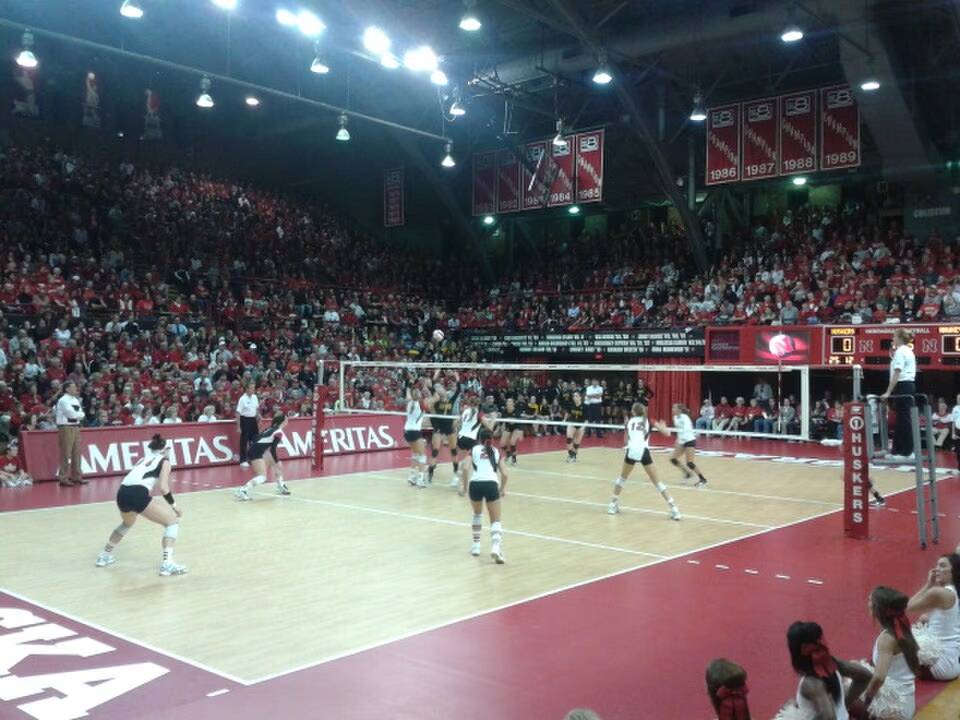
Court: 18 m × 9 m rectangular, divided by a center line into two 9 m × 9 m halves; Attack line: 3 m from the center line on each side, defining the front zone vs back zone; Service zone: behind the end line, full court width
Why people argue about this
People often assume that the 9-meter width is measured from side-to-side at the net height, leading to arguments about where exactly the center line should be placed on the court. The confusion arises because they overlook the official definition stating it's a measurement across the entire playing area, not just from the net down.
NCAA Women's Volleyball uses a coaches' challenge / video review framework allowing review of: ball in/out (touch), antenna contact, foot fault on serve, net touch, ball-handling judgments at the 1st referee's discretion. Each team is allowed a de...
Why people argue about this
People often assume that only coaches can request a review under the NCAA Women's Volleyball rules, forgetting that teams are allowed one challenge per set. They mistakenly believe it’s limited to ball in/out calls, when in fact they have challenges for multiple infractions including foot faults and net touches.
Best of 5 sets; Sets 1-4: rally scoring to 25 points, must win by 2; Set 5 (decider, only if needed): rally scoring to 15 points, must win by 2
Why people argue about this
People often assume that a 25-point margin is only needed in set 5 when it's actually true for all sets from 1 to 4 under rally scoring in NCAA women's volleyball matches. They overlook the rule stating "a 2-point margin needed to win" applies across the entire match, not just the deciding fifth set.
Rally scoring: a point is awarded on every rally regardless of which team served; Set 1-4: first to 25 points (must win by 2); set 5: first to 15 (must win by 2); Match won by first team to 3 sets
Why people argue about this
People often assume that if a match goes into a fifth set, it's automatically decided by a two-point margin, which leads them to overlook how close games can get in those deciding sets where ties are extremely common and result in deuces (scores like 24-24). They forget the crucial part about each set needing to be won by at least three points.
Faults causing loss of rally: ball lands out, four contacts, double contact (controlled), catch or throw, net touch by player, antenna contact, crossing the centerline interfering with opponent, foot fault on serve, illegal server (out of rotation); Hand-setting standard: must be clean (no extend...
Why people argue about this
People often think that yellow cards are just warnings like in soccer, but they're actually more serious penalties in volleyball where a team can face expulsion for accumulating both yellow and red cards. They also misunderstand how misconduct is penalized with only warnings or disqualification, not the full spectrum of punishments from Section 7 as outlined by NCAA rules.
NCAA concussion protocol: removal for actual or suspected concussion + graduated return-to-play assessment. Court surface and post padding inspected pre-match.
Why people argue about this
People often assume that just checking court surface and padding before a game is enough to ensure safety, forgetting about the actual protocol for handling concussions during play as outlined by the NCAA's concussion protocol section. They overlook how serious it is to remove players who show signs of a concussion and how they must go through a graduated return-to-play assessment afterward.
Service rotation: clockwise position rotation each side-out; Serve must clear the net within the antennas; serve may contact the net (let serve permitted); Each team may contact the ball up to 3 times before returning over the net (block contact does not count as one of the 3 in indoor volleyball)
Why people argue about this
People often assume that a team can only touch the ball three times in total for an entire game, not including service rotations, leading to misunderstandings about how many contacts are allowed per rally. The confusion arises because they overlook the fact that each time a team serves and receives the ball, it resets the contact count for that rally sequence.
Up to 15 substitutions per set (NCAA framework — broader than FIVB's 6); substituted players may re-enter; Libero replacements (libero in for back-row player) do not count against the 15 substitutions
Why people argue about this
People often assume that coaches can challenge every single call made by the first referee in volleyball, which isn't true according to the official framework. The confusion arises because they misinterpret the scope of video review opportunities listed for different fouls and errors, thinking it includes all calls versus only specific ones like ball-in/ball-out or foot faults on serve.
6 players on court per team; Roster: typically 12-18 players for NCAA D1; one or two designated liberos; Libero: defensive specialist who wears a contrasting jersey, plays only in the back row, and may replace any back-row player without counting against the substitution limit
Why people argue about this
People often assume that coaches' challenges in volleyball are only for ball-in/ball-out decisions at the 1st referee's discretion, but they overlook other key calls like antenna contact or foot faults on serve, which can significantly impact game outcomes and lead to unnecessary arguments.
Two team timeouts per set (60 seconds each in NCAA); Technical timeouts at 8 and 16 points in sets 1-4 (per NCAA framework / conference adoption)
Why people argue about this
People often assume that NCAA women's volleyball allows for three timeouts per set at 60 seconds each, which leads to misunderstandings when they learn it’s actually just two timeouts of 60 seconds each. The confusion arises because this rule is so different from what many athletes and coaches expect based on other sports or their own experiences with the game.
NCAA Women's Volleyball uses a coaches' challenge / video review framework allowing review of: ball in/out (touch), antenna contact, foot fault on serve, net touch, ball-handling judgments at the 1st referee's discretion. Each team is allowed a de...
Why people argue about this
People often assume that only coaches can request a video review under the NCAA Women's Volleyball rules, forgetting that assistant coaches are allowed one challenge per set as well. The confusion arises because the official framework specifies different teams (coaches) have challenges, but doesn't clarify who exactly gets to use them.