

🏛️Official — ITF
Loading OpenSourceSports…
Bow sincerely — never perfunctorily
The opening and closing bows (charyot/kyongye) before and after a match or sparring session must be slow, deliberate, and genuine. A fast or shallow bow is considered an insult to the opponent and to the art. This applies both in competition and in the dojang.
Accept the referee's decision without protest
Visibly arguing, gesturing in disgust, or verbally contesting a scoring decision violates the tenet of self-control and is considered deeply dishonorable. Coaches may formally appeal through designated channels; competitors themselves must not react.
Senior belts control power against junior opponents
Higher-ranked competitors and practitioners are expected to calibrate their power downward when sparring against significantly lower ranks. Overwhelming a junior with full force is considered a failure of self-control — one of the five tenets — not a display of skill.
Do not celebrate excessively after scoring
Pumping fists, yelling at an opponent, or performing overt celebrations after a point is scored is considered contrary to the tenet of courtesy. A brief, controlled kihap (spirit yell) at the moment of technique is acceptable; theatrics directed at the opponent are not.
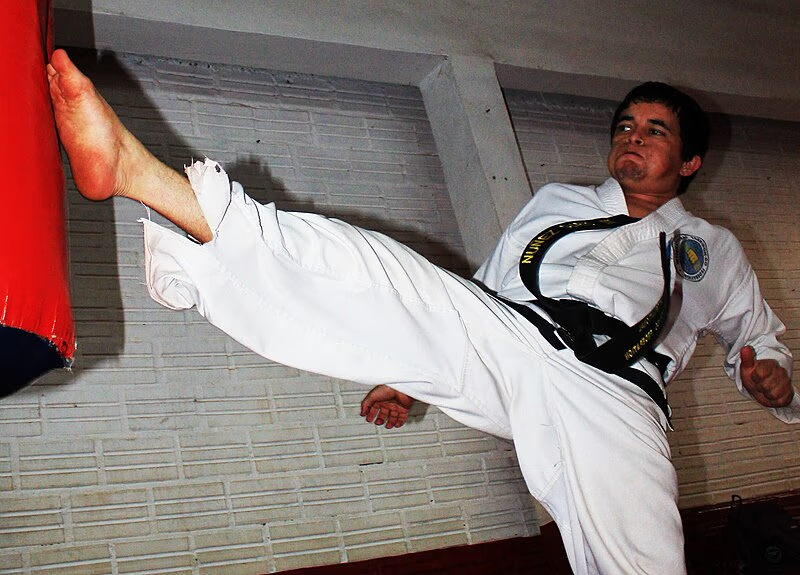
ITF competitors wear a distinctive dobok that differs visually from the WT uniform. The ITF dobok features a cross-over (overlap) front top, secured by a tie on the right side, in contrast to the V-neck pullover top used in WT competitions.
Why people argue about this
People often assume that the ITF uniform's cross-over front is purely for aesthetic reasons, forgetting that it also serves as a practical safety feature by preventing the top from slipping off during intense sparring. The confusion arises because this design detail significantly impacts the effectiveness of protective gear worn underneath and affects overall competition strategy.
The ITF belt ranking system progresses through the following colors: White (10th Gup — signifying innocence), Yellow (8th–9th Gup — the earth from which the plant grows), Green (6th–7th Gup — the growing plant), Blue (4th–5th Gup — the sky toward ...
Why people argue about this
People often assume that the belt colors in ITF Taekwondo represent stages of spiritual enlightenment, which is a common misconception. In reality, these colors are symbolic of progression through training levels, with each color corresponding to specific skill and experience milestones rather than religious or philosophical concepts.
ITF sparring does not use the electronic trunk protector (hogu) or electronic headgear employed in WT competition.
Why people argue about this
People often assume that since ITF sparring uses hogu (protective trunk gear), it must also use electronic versions like those in WTF competition, but actually, the official verdict clarifies that ITF does not employ these electronic devices for safety reasons specific to their competitive environment.
Power breaking events use standardized wooden boards, typically pine or paulownia, of regulated thickness (approximately 2.5 cm per board for adults). Spacers may be used to separate stacked boards.
Why people argue about this
People think that the height of targets is randomly decided by officials, but actually it's precisely measured based on the event type (distance vs breaking technique) to ensure safety and fairness. The confusion arises because different heights are needed for each category to accommodate various techniques effectively.
Special technique events require height-adjustable targets — typically small padded boards or breakable targets suspended at measured heights above the ground. For distance events, a horizontal obstacle (such as a vaulting box or rope) is placed a...
Why people argue about this
People often assume that special technique events in Taekwondo require elaborate equipment like fancy mats or complex target systems, but the official rule specifies height-adjustable targets at measured heights above the ground – no need for complicated setups. The confusion arises because they overlook this specific detail about simple yet effective equipment solutions.
The ITF sparring competition area is a square mat measuring 9 meters × 9 meters, clearly demarcated by boundary lines. This differs from the octagonal competition area used in WT events.
Why people argue about this
People often assume that ITF and WTF (World Taekwondo) use identical competition ring dimensions for sparring matches, so they're surprised when they hear the ITF uses a square mat versus the octagonal one used by WTF. They miss the distinction between ITF's standard and WTF's preferred format, leading to misunderstandings about which rules apply in different tournament settings.
A safety zone of at least 2 meters must surround the competition area on all sides, free from any obstacles, equipment, or spectators. The total required floor space is therefore a minimum of 13 meters × 13 meters.
Why people argue about this
People often assume that spectators can be within 2 meters of the competition area as long as they're not touching anything else, but actually, the rule strictly prohibits any obstacles or spectators at all within a 2-meter radius to ensure safety for athletes.
Starting positions for the two competitors are marked at the center of the ring, approximately 1.5 meters apart, facing each other. The competitor designated as "blue" (chong) stands to the referee's right, and the competitor designated as "red" (hong) stands to the referee's left.
Why people argue about this
People often assume that the 1.5-meter distance is a fixed measurement for every match, forgetting that it's just an approximate guideline set by officials. This leads to arguments about whether competitors should be pushed closer or further apart based on their body types and stance preferences.
The center referee operates within the competition area. Four corner judges are seated at the four corners of the ring, each equipped with scoring devices (flags, clickers, or electronic input pads depending on the tournament).
Why people argue about this
People often assume that the four corner judges are supposed to stand at their respective corners instead of sitting down, leading to arguments about their positioning during matches in Taekwondo ITF. The confusion arises because the rule explicitly states they should be seated for better visibility and easier communication with the center referee.
Pattern competitions require a flat, unobstructed area of at least 10 meters × 10 meters, covered with appropriate matting. Breaking and special technique events require additional clearance for run-up space (minimum 5 meters) and overhead clearance of at least 4 meters for jumping techniques.
Why people argue about this
People often assume that the pattern area only needs to be 10x10 meters without considering the need for appropriate matting underneath, leading to misunderstandings about how safe and stable the floor must be for these competitions.
Competitors must hold a valid ITF rank (or equivalent recognized rank) appropriate to the division entered. Most ITF tournaments require a minimum rank of yellow belt (8th Gup) for colored belt divisions and 1st Dan for black belt divisions.
Why people argue about this
People often assume that the color of the flag raised by a corner judge indicates which competitor won points in that round, when in reality it's just their signal for who scored - whether it’s chong or hong - and they use different colored flags to differentiate between them, not to show who won.
ITF sparring features multiple weight categories, typically including the following for senior male black belt divisions: Fin weight (under 54 kg), Fly weight (54–58 kg), Bantam weight (58–63 kg), ...
Why people argue about this
People often assume that judges use colored flags for scoring in ITF Taekwondo sparring, which is a misconception. Actually, they use electronic devices instead of physical flags as per official rules to ensure accuracy and consistency across competitions. The confusion arises because the visual aspect of flag-raising seems more traditional and intuitive compared to electronic scoring.
The center referee controls the match from within the competition area. Responsibilities include starting and stopping the bout, issuing warnings and penalties, ensuring competitor safety, and declaring the winner.
Why people argue about this
People often assume that only one judge can score a point for each technique attempted in a match, which leads to misunderstandings about how points are awarded. Actually, each of the four corner judges independently scores based on colored flags or electronic devices, so multiple judges could signal a point if they all agree on the same technique execution.
Four corner judges are positioned at the corners of the competition ring. Each judge independently awards points by raising colored flags (blue for chong, red for hong) or pressing electronic scoring devices.
Why people argue about this
People often assume that corner judges are solely responsible for scoring based on which flag they see raised, without considering their role in assessing technique validity, leading to misunderstandings about how points are actually awarded. The confusion arises because they overlook the fact that judges also evaluate if techniques were performed correctly before awarding points.
A jury president oversees the officiating panel and may intervene to correct procedural errors. The jury does not directly award points but may instruct the referee to review a decision.
Why people argue about this
People often assume coaches can freely enter the competition area during breaks just to give a quick pep talk, misunderstanding that they're only allowed in the designated zone for coaching purposes. The confusion arises because the rule specifies "during rest periods" and not during active play or between rounds.
Each competitor is permitted one coach seated in the designated coaching zone near their corner. Coaches may provide verbal instruction between rounds and during rest periods but must not enter the competition area during active play.
Why people argue about this
People often assume that coaches can only give instructions verbally during rest periods, forgetting that they're also allowed to provide verbal instruction between rounds. This leads to misunderstandings about when exactly coaches are permitted to talk to their athletes.
Individual free sparring matches for senior competitors consist of 2 rounds of 2 minutes each, separated by a 1-minute rest period. Some tournament formats use 3 rounds.
Why people argue about this
People often assume that all ITF Taekwondo tournaments follow the exact 2-round format for senior matches, forgetting that some events might use a 3-round system instead of the standard 2 rounds with a rest period between each round. This oversight leads to confusion and sometimes disputes over which format is being used in specific tournament settings.
The defining characteristic of ITF sparring is its light or semi-contact approach. Techniques must be delivered with controlled power — sufficient to demonstrate technical proficiency and targeting accuracy, but without excessive force intended to injure.
Why people argue about this
People often assume that ITF sparring is completely non-contact, which leads them to misunderstand the principle of light/semi-contact. In reality, it allows for controlled power delivery but emphasizes avoiding actual contact meant to cause injury, not just a lack of physical impact.
ITF sparring permits a wider range of hand techniques than WT competition. The following are legal scoring techniques: Hand techniques (jirugi) — punches and strikes to the mid-section (trunk) and head. This is a major distinction from WT, which only permits punches to the trunk protector, not th...
Why people argue about this
People often assume that ITF sparring allows only traditional kicking techniques like kicks and knee strikes, forgetting that hand techniques are also part of its legal repertoire. This leads to misunderstandings about what’s allowed in ITF sparring versus World Taekwondo competition rules.
Pattern competition showcases the 24 patterns of the Chang-Hon system, developed by General Choi. The patterns range from Chon-Ji (19 movements, representing the creation of the world) through to Tong-Il (56 movements, representing the reunification of Korea).
Why people argue about this
People often assume that in power-breaking tests, competitors are judged solely on how much force they can generate, without considering technique accuracy. However, the real assessment is about both the destructive potential of their techniques and their precision adherence to proper form and execution guidelines set by ITF rules.
Power breaking tests a competitor's ability to generate destructive force through correct technique. Events are typically divided by technique category: hand techniques (punch, knife-hand, elbow strike), foot techniques (side kick, turning kick, b...
Why people argue about this
People often assume that in power breaking competitions, athletes are just aiming to break boards with brute force alone, which leads them to misunderstand how technique is crucial. Actually, it's about using precise techniques like elbow strikes or side kicks to generate maximum destructive force efficiently and effectively through correct form and speed.
Special technique events test jumping ability and aerial kicking skill. Common events include: flying side kick (kick a target at maximum height), flying front kick (kick a target over a high obstacle), flying turning kick (kick a target at height with a mid-air turn), and flying back kick.
Why people argue about this
People often assume that in a special technique event like flying side kick, you're only judged on how high your kick goes—like it's just about jumping ability. But actually, it's more complex; judges also evaluate the power and precision of the landing to ensure safety, not just the height reached during the jump.
A competitor is considered out of bounds when any part of their body touches beyond the boundary line. Intentionally stepping out to avoid engagement results in a warning.
Why people argue about this
People often argue that stepping out intentionally is only a warning, thinking it's an automatic point against them without seeing if they touched the boundary first. The actual rule states you get warned for stepping out to avoid engagement, but not just for stepping out alone. They miss this nuance and assume any intentional step out equals a penalty.
ITF sparring uses a tiered point system that rewards technical difficulty and accuracy: 1 point — Hand technique (punch/strike) to the mid-section; 1 point — Foot technique (kick) to the mid-section; 2 points — Foot technique (kick) to the head
— section 1, section 2, section 3
Why people argue about this
People often assume that electronic impact sensors automatically award points based on a strike's force or accuracy, which they see in other sports like boxing. But here in ITF Taekwondo, it’s actually human judges using flags who decide if a technique is valid and thus earn the point, leading to much debate over what exactly constitutes a 'valid scoring technique'.
Points are awarded by human judges using flags or clickers, not by electronic impact sensors. When a corner judge observes a valid scoring technique, they raise the appropriate colored flag or press their scoring device.
Why people argue about this
People often assume that since Taekwondo uses electronic impact sensors for scoring in other forms of competition (such as WTF), the ITF must use similar technology here. But they misunderstand that ITF still relies on human judges and flags because it's about tradition, precision, and ensuring fairness through direct observation rather than relying solely on tech.
For a technique to score, it must meet all of the following criteria: Delivered to a legal target area (front/side of trunk or head); Executed with correct form (proper chamber, extension, and tool); Applied with controlled contact (sufficient to demonstrate accuracy, not excessive)
Why people argue about this
People often assume that scoring in Taekwondo depends solely on power output, thinking judges only care about how hard a technique is executed. However, they overlook the critical aspect of technical accuracy - correct stances, techniques, angles, and targets - which are just as crucial for a pattern to be validly scored.
The competitor with the higher point total at the conclusion of all rounds wins the match. In the event of a tie, the following tiebreakers apply in order: (1) the competitor with fewer warnings an...
Why people argue about this
People often argue about how judges score patterns in Taekwondo ITF sparring because they misunderstand that while judges evaluate technical accuracy, power, and rhythm, their final decision is based on a collective consensus among the panel of 5 to 7 judges rather than averaging individual scores, leading to perceived inconsistencies.
Patterns are scored by a panel of judges (typically 5 or 7) on a scale that evaluates: technical accuracy (correct stances, techniques, angles, and targets), power (appropriate tension and force in techniques), rhythm and timing (proper tempo chan...
Why people argue about this
People often assume that judges score patterns based solely on their technical accuracy, forgetting about power and rhythm, leading to arguments over whether a technique was performed correctly or if it lacked the necessary force or timing. The confusion arises because these other factors are equally important in evaluating a pattern's execution.
Breaking competitions are scored objectively: the competitor who breaks the most boards with each technique wins that event. In special technique events, the competitor who successfully strikes the target at the greatest height wins.
Why people argue about this
People often think that breaking boards is purely about who breaks the most boards, forgetting that height also matters in special techniques. They overlook the fact that even if one competitor breaks more boards, another might have struck at a higher height, winning by scoring under the special technique category.
The following actions result in a verbal warning. Two warnings in the same category result in a penalty point deduction: Attacking a fallen opponent; Intentionally stepping out of the ring to avoid combat; Grabbing, holding, or pushing the opponent
Why people argue about this
People often assume that a warning in Taekwondo means just that - a simple verbal caution without serious consequences. But in ITF rules, a "Kyong-go" (or warning) offense can escalate to disqualification if it's repeated or severe enough, leading to confusion about when exactly the threshold for this consequence is crossed.
The following serious violations result in an immediate penalty point deduction (1 point awarded to the opponent): Excessive contact — delivering techniques with force beyond controlled contact, particularly to the head. This is the most common penalty and reflects ITF's emphasis on control.; Att...
Why people argue about this
People often assume that a Gam-jeom offense is only about hitting an opponent's head with their hand in Taekwondo, but actually, it encompasses any illegal strike or action, including elbow strikes to the body and knee strikes to the head, which aren't as commonly recognized as headbutt penalties.
A competitor is disqualified from the match or tournament for: Accumulating a specified number of penalty deductions (typically 3 full penalties, equating to -3 points); Intentionally injuring an opponent through excessive or reckless contact; Refusing to comply with the referee's instructions
Why people argue about this
People often think that if a competitor accidentally touches their opponent's head with their hand during an attack, they'll be disqualified under 7.3 Disqualification (Sil-gyeok). However, actually, it's only Sil-gyeok (headbutt) that is penalized in ITF Taekwondo, not accidental contact; the rule specifically targets deliberate and intentional strikes to the head area.
A coach may lodge a formal protest with the jury president if they believe a procedural error or incorrect decision has occurred. Protests must be filed immediately (typically within 1 minute of the disputed decision) and may require a protest fee.
Why people argue about this
People often assume that a protest must be lodged immediately after ANY decision, regardless of its impact on their team's outcome, which can lead to misunderstandings about when it’s appropriate to file one. The confusion arises because this rule specifically states protests should be filed within 1 minute of the disputed decision, not every single decision made during a match.
A qualified medical officer (physician, paramedic, or certified sports medic) must be present throughout all competition sessions. A designated first aid station with appropriate emergency equipmen...
Why people argue about this
People often assume that if a competitor is just using light/semi-contact in ITF Taekwondo, they can get away with anything as long as it's not full contact. But actually, this rule emphasizes that even in less intense sparring, the center referee has ultimate authority to stop matches if excessive force is used, ensuring safety regardless of technique intensity level.
The light/semi-contact nature of ITF sparring is itself the primary safety mechanism. The center referee is empowered and expected to stop the match immediately if a competitor loses control and delivers excessive-force techniques.
Why people argue about this
People often assume that ITF sparring is completely contact-free, which leads them to misunderstand when a referee should step in. The actual confusion arises because they think hitting or blocking hard enough constitutes 'excessive-force techniques,' but the rule specifically addresses losing control and delivering techniques with such force that could cause injury, not just any level of impact.
All protective equipment must pass inspection prior to competition. Inspectors verify that hand and foot protectors have adequate foam density and coverage, head guards are properly fitted and undamaged, mouthguards are present and functional, and groin/chest protectors are worn correctly.
Why people argue about this
People often assume that protective equipment only needs a visual inspection for damage, forgetting about its core function of protecting them during competition. They misunderstand that the mandatory equipment inspection also involves checking the integrity and effectiveness of these pieces of gear to ensure they're doing their job properly before matches start.
When a competitor is injured during a match, the referee stops the bout and allows the medical officer to assess the competitor on the mat. The competitor is given a recovery period (typically 1 minute for minor injuries, up to 5 minutes for more serious cases) to determine if they can continue.
Why people argue about this
People often assume that if a competitor is injured during a match in ITF Taekwondo, they automatically get a 5-minute recovery period just because it's specified as "more serious cases." Actually, the referee decides whether an injury warrants such a long recovery time based on the severity of the injury and the need for medical attention.
Despite ITF's controlled-contact approach, head contact does occur. Any competitor suspected of sustaining a concussion — exhibiting symptoms such as disorientation, balance impairment, loss of consciousness, or amnesia — must be immediately remov...
Why people argue about this
People often assume that since ITF Taekwondo uses a controlled-contact approach, head contact is completely avoided. However, they misunderstand that even in controlled environments, concussions can still occur due to unpredictable factors like student reflexes or unexpected movements during sparring sessions, leading them to argue about how the rule should be applied when such incidents happen.
Junior and children's divisions enforce stricter contact limitations. In many ITF tournaments, competitors under 14 or 16 are restricted to no head contact or touch contact only to the head.
Why people argue about this
People often assume that head contact is completely banned for all juniors under 14 or 16 years old in ITF Taekwondo, but actually, they're only restricted to no head contact allowed and can touch the head with other parts of their body. This distinction leads to a lot of confusion among younger athletes and coaches who might not fully grasp the nuances of what's permitted.
Breaking events carry inherent risk of hand and foot injuries. Competitors must demonstrate proper technique during warm-up, and officials may disallow a breaking attempt if the competitor's technique appears likely to result in injury.
Why people argue about this
People often assume that if a competitor demonstrates proper technique during warm-up, they can proceed with their breaking attempt without fear of disqualification. However, the confusion arises because the official verdict specifies that officials may still disallow a break attempt if they judge the competitor's likely risk to be too high based on their observed technique alone.
Competition venues must provide adequate lighting (minimum 500 lux over the competition area), ventilation or climate control to prevent heat-related illness, and clearly marked emergency exits. The competition floor surface must be level, clean, and free of moisture.
Why people argue about this
People often assume that adequate lighting is solely about brightness levels, forgetting that the quality of light (color temperature, glare reduction) can significantly impact visibility and safety in a competition environment, leading to misunderstandings about what "adequate" means here.
ITF competitors wear a distinctive dobok that differs visually from the WT uniform. The ITF dobok features a cross-over (overlap) front top, secured by a tie on the right side, in contrast to the V-neck pullover top used in WT competitions.
Why people argue about this
People often assume that the cross-over front top in ITF Taekwondo is just a stylistic choice for looks, but actually, it's designed to enhance defense by creating more surface area for blocking and grappling techniques. They overlook how this design change impacts the effectiveness of certain moves and strategies.
The ITF sparring competition area is a square mat measuring 9 meters × 9 meters, clearly demarcated by boundary lines. This differs from the octagonal competition area used in WT events.
Why people argue about this
People often assume that ITF sparring uses an octagonal area like WT, which leads to misunderstandings when they see a square mat instead of expecting eight corners. The confusion arises because the official description specifies dimensions and shape distinctly, but some observers jump to conclusions based on visual similarities rather than reading the rule carefully.
Four corner judges are positioned at the corners of the competition ring. Each judge independently awards points by raising colored flags (blue for chong, red for hong) or pressing electronic scoring devices.
Why people argue about this
People often assume that each corner judge can only award points based on their visual judgment of which technique is more effective, forgetting that they also have electronic devices at their disposal for scoring. This leads to misunderstandings about whether judges should rely solely on flags or use the tech when it might give them a clearer picture of what happened in real-time.
Individual free sparring matches for senior competitors consist of 2 rounds of 2 minutes each, separated by a 1-minute rest period. Some tournament formats use 3 rounds.
Why people argue about this
People often assume that all ITF Taekwondo tournaments use 3 rounds for individual free sparring matches, forgetting that some formats stick with a more traditional 2-round structure of 2 minutes each round, separated by a minute break. This discrepancy can lead to confusion and arguments among competitors who might not be aware of the specific tournament format being used.
ITF sparring uses a tiered point system that rewards technical difficulty and accuracy: 1 point — Hand technique (punch/strike) to the mid-section; 1 point — Foot technique (kick) to the mid-section; 2 points — Foot technique (kick) to the head
— section 1, section 2, section 3
Why people argue about this
People often assume that scoring in ITF Taekwondo is automatically recorded by electronic sensors like in some other martial arts forms, so they're surprised when it's actually done manually by judges with flags or clickers. The confusion arises because this system seems less precise and immediate compared to the automated methods they might be accustomed to seeing in other sports.
The following actions result in a verbal warning. Two warnings in the same category result in a penalty point deduction: Attacking a fallen opponent; Intentionally stepping out of the ring to avoid combat; Grabbing, holding, or pushing the opponent
Why people argue about this
People often assume that disqualification in Taekwondo ITF for a foul means it's always about hitting below the beltline or using too much force. However, the confusion arises because Section 7 also covers violations like blocking with the arm instead of the hand, which can be equally penalized and isn't necessarily related to how hard you hit.
The light/semi-contact nature of ITF sparring is itself the primary safety mechanism. The center referee is empowered and expected to stop the match immediately if a competitor loses control and delivers excessive-force techniques.
Why people argue about this
People often assume that ITF sparring is inherently safe due to its light contact nature, so they misunderstand why a referee might suddenly stop a match if a competitor uses excessive force—thinking it's only when someone loses control and goes too far, but not realizing the rule allows for immediate stopping based on perceived risk or potential harm.