


🏛️Official — Nihon Sumo Kyokai
Loading OpenSourceSports…
Never celebrate or show emotion after winning
A rikishi who wins must exit the dohyo without any display of joy, triumph, or relief—no raised fists, shouting, or gestures to the crowd. The winner bows, collects any prize envelope, and departs composedly. Exuberant post-win behavior is considered a serious breach of the dignity the sport demands of its participants.
A Yokozuna must retire rather than accept demotion
A Yokozuna who performs poorly cannot be formally stripped of rank—the JSA has no demotion mechanism for the title. Instead, cultural and institutional pressure requires voluntary retirement. When the Yokozuna Deliberation Council issues public statements 'encouraging retirement,' this functions as a near-mandatory demand; ignoring it repeatedly is viewed as deeply dishonorable.
Lose quietly—no protest, no lingering on the dohyo
After a loss, the rikishi must exit immediately and in complete silence. Challenging a gyoji's call before a mono-ii (judges' review) is requested, visibly showing frustration, or lingering near the dohyo is considered disrespectful to the sport and opponent alike. A composed exit is expected regardless of the circumstances of the loss.
Absolute deference to the oyakata (stablemaster) within the stable
Within the heya (stable), the oyakata's authority over training, scheduling, diet, and career decisions is not publicly questioned by rikishi. A wrestler who openly challenges or criticizes their stablemaster violates the foundational iemoto (master-apprentice) social contract that structures sumo stable life.
A Yokozuna unable to perform dohyo-iri is expected to consider retirement
The dohyo-iri ring-entering ceremony at each honbasho is both privilege and obligation for a Yokozuna. Repeatedly missing or being physically unable to complete this ceremony is understood culturally as a signal that the wrestler can no longer fulfill the rank's duties and should retire. There is no written rule—the pressure is entirely social and institutional.
No closed-fist punches (open-hand slaps permitted); No kicking; No grabbing hair
Why people argue about this
People often assume that if techniques are banned, they can't be part of winning a match, so they're confused when they see sumo wrestlers using what they perceive as "banned" moves during competitions. The confusion arises because the official statement clarifies that while these techniques aren’t officially recognized as wins, they’re still allowed and sometimes used in matches.
82 officially recognized winning techniques (kimarite) — including yorikiri (force-out grip), oshidashi (push-out), uwatenage (overarm throw), shitatenage (underarm throw), various trips + lifts + slap-downs; Each match victory recorded with the kimarite used — kimarite history is preserved as pa...
Why people argue about this
People often assume that only a wrestler's shoulders crossing over their opponent's shoulders (the most common winning technique) is considered kimarite, but actually, there are 82 officially recognized ways to win in sumo, including various throws, trips, and even holds that aren't as straightforward. This leads to debates about whether a particular move qualifies under the official guidelines.
No fixed time limit — matches typically last 5-30 seconds; most are over within 10 seconds; Pre-match ritual (shikiri) takes 4+ minutes; salt-throwing + facing-off; the actual bout is brief
Why people argue about this
People often assume that sumo matches have a strict time limit like other combat sports do, so they are surprised when informed that there's no set duration; instead, most bouts last just 10 seconds or less, including the pre-match ritual. This discrepancy leads to misunderstandings about how and why these matches conclude so quickly.
Mawashi (silk belt loincloth): the rikishi's only attire during competition; ~9-13 m long, folded + wrapped around the waist + crotch; color varies by rank (Makuuchi: vibrant colored; lower divisions: black cotton); Chonmage (topknot hair-style): traditional samurai-style hair worn by all profess...
Why people argue about this
People often assume that sumo rikishi use special dohyo mats for comfort when in fact they compete barefoot on a traditional clay surface. The misconception stems from the visual similarity between dohyo and running tracks, leading folks to believe protective mats are used instead of feet.
Dohyo (土俵): elevated clay-and-sand ring, raised ~50 cm above the floor; Inner ring diameter: 4.55 m bounded by a circular rope (tawara) embedded in the clay; Outer dohyo platform extends an additional ~2 m beyond the rope
Why people argue about this
People often assume that dohyo's ritual cleaning with salt is meant for hygiene purposes, forgetting its deeper spiritual significance in Shinto rituals, which adds a layer of misunderstanding about its true purpose beyond just cleanliness.
Two rikishi per match (1-on-1); No weight classes — all rikishi within a division compete open-weight; Divisions (highest to lowest): Makuuchi, Juryo, Makushita, Sandanme, Jonidan, Jonokuchi, Maezumo
Why people argue about this
People often assume that sumo's tradition of excluding women from dohyo entries is solely about hygiene concerns, but in reality, it stems from a deeper cultural belief system within the sport, rooted in traditions and aesthetics that have been upheld for centuries.
No fixed time limit — matches typically last 5-30 seconds; most are over within 10 seconds; Pre-match ritual (shikiri) takes 4+ minutes; salt-throwing + facing-off; the actual bout is brief; Force opponent out of the dohyo (any part of body steps outside the rope), OR
Why people argue about this
People often assume that sumo matches should have a set time limit like other combat sports, thinking they last minutes. But the key fact is that sumo matches don't have fixed times; most are over within 10 seconds, with some lasting up to 30 seconds at most. This can lead to confusion because it's so different from what people expect based on their experience in other disciplines.
Each match: 1 win or 1 loss recorded per rikishi (no scoring beyond W/L); Each basho: 15 days × 1 match per rikishi = up to 15 wins; Kachi-koshi: 8 or more wins in a 15-day basho = winning record (promotion + bonus)
Why people argue about this
People often assume that winning 8 matches is just a statistical average, when in fact it’s a hard-fought number representing an actual promotion threshold based on both skill and luck over multiple tournaments. They overlook the competitive nature of each bout and how even with consistent wins, unforeseen circumstances like injuries or matchups can still affect their final tally.
Banned technique (kinjite): immediate loss + potential commission discipline; Mawashi failure (belt comes off during match): immediate loss (rare, considered dishonorable); Premature start (henka jump): tactical move (not technically illegal) but heavily frowned upon at Yokozuna rank
Why people argue about this
People often assume that a banned technique (kinjite) in Sumo only disqualifies you if you're caught by your opponent, but actually, it can be called by an official at any point during the match, even before your opponent touches you, leading to confusion about when exactly this penalty applies.
Professional sumo's injury profile: severe limb fractures (especially knees), neck injuries from being thrown, shoulder + back strain from grappling at high body weights (rikishi often 130-200+ kg)...
Why people argue about this
People often assume that sumo's safety measures are lax due to its traditional nature, forgetting that strict protocols exist to minimize injuries. However, they overlook the immense physical demands on rikishi, like severe limb fractures from grappling at such high weights, which can be misunderstood as a lack of care rather than acknowledging the inherent risks involved in this sport.
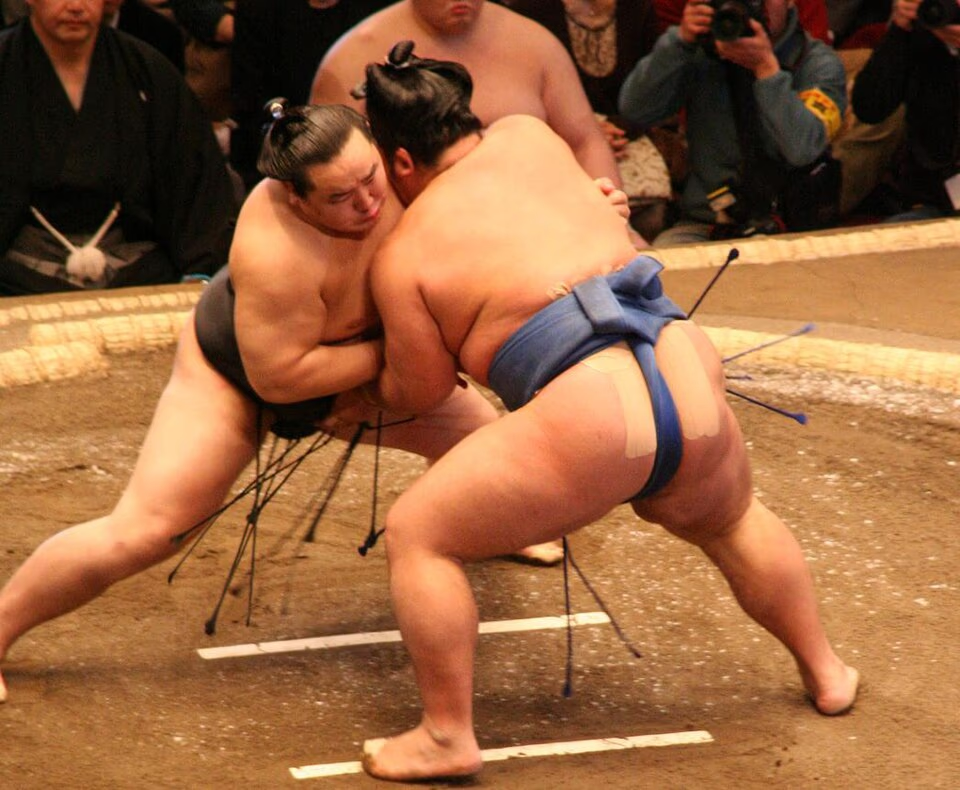
Force opponent out of the dohyo (any part of body steps outside the rope), OR; Force opponent to touch the dohyo with any body part other than feet (knee, hand, even hair) — falling, being thrown, or losing balance
Why people argue about this
People often assume that a sumo wrestler wins simply by touching their opponent outside the dohyo; they overlook the complexity of needing to force them out or use one of 82 officially recognized techniques to win. This oversight leads to debates on whether a touch alone is sufficient under the official verdict.