
🏛️Official — WSF
Loading OpenSourceSports…
Call your own tin and double-bounce honestly
In self-refereed squash — the norm at amateur and recreational levels — players are expected to call their own down balls (tin hits) and double-bounces without waiting to be challenged. Failing to do so is a serious breach of the code; squash's culture prizes self-honesty above almost all else.
Do not deliberately target the opponent with the ball
When an opponent is obstructing your shot and you could claim a let, deliberately blasting the ball directly at their body instead is considered dangerous and unsporting. The enclosed glass-and-plaster court makes a hard ball at close range genuinely hazardous; taking the let is always the expected choice.
Volunteer the let or stroke when you've clearly obstructed
If you know you impeded your opponent — blocking their swing path or cutting off their line to the ball — good sportsmanship dictates conceding the let, or even the stroke, before they ask. Waiting for your opponent to appeal when you know you obstructed them is considered poor form.
Accept referee decisions without prolonged dissent
At the professional and elite level, disputing a referee's let or stroke decision beyond a brief query is strongly frowned upon. Players may politely ask for clarification but extended argument, visible frustration directed at officials, or repeated challenges to rulings is considered conduct unbecoming.
Do not overclaim lets
Requesting a let when you clearly had no genuine shot at the ball — because you were out of position, hit a poor shot, or the interference was trivial — is widely condemned as gamesmanship. The let system exists for genuine interference, not as a tactical reset.
Call a let — don't swing — when you've turned on the ball
When a ball passes behind you and you consider turning to play it with your opponent in the swing arc, the strong cultural expectation is to stop and call a let rather than swing. The closed court makes a turning swing genuinely dangerous. Even if you could have hit a winner, a stroke should never be claimed after turning.
The ball used in official play must conform to WSF specifications and carry WSF approval. The ball is hollow and made of rubber compound.
Why people argue about this
People often assume that any rubber ball will do for squash matches, forgetting about WSF specifications and approval, which is why they argue; actually, the ball must be hollow and made of a specific rubber compound to meet official standards.
The frame and strings must be of uniform colour or combination of colours. A player whose racket is found to be non-compliant during a match may be required to change rackets.
Why people argue about this
People often assume that the color of their racket doesn't matter as long as it's visible from a distance, leading to misunderstandings about what constitutes "uniform colour" under this rule. The confusion arises because they overlook the requirement for both the frame and strings to be in unison with each other, not just the overall appearance.
Players must wear appropriate squash attire. In WSF-sanctioned events, players must wear predominantly white or light-coloured clothing on glass show courts unless a special colour exception is granted by the event organisers.
Why people argue about this
People often assume that the white clothing requirement is solely for visibility during play, forgetting that it's also about maintaining a clean, professional appearance on glass courts where sweat can easily stain the surface. They overlook the fact that exceptions are granted by event organizers, so not all matches require players to wear predominantly white or light-colored clothes.
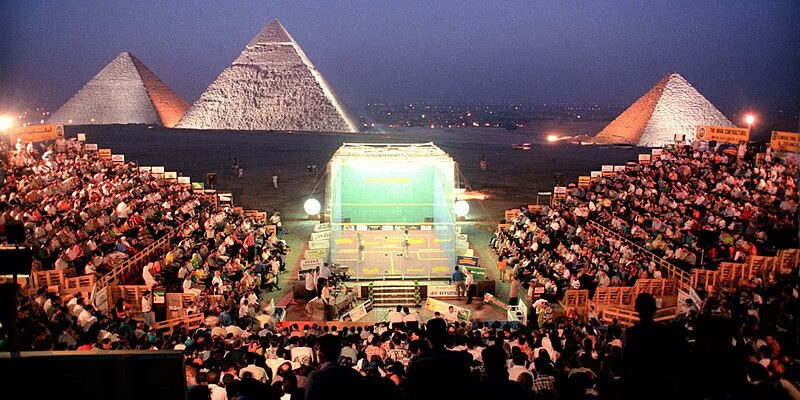
A singles squash court is a rectangular enclosed space with the following official dimensions: Length (front wall to back wall): 9.750 m (32 feet 0 inches); Width (side wall to side wall): 6.400 m (21 feet 0 inches); Diagonal (floor): 11.665 m (38 feet 3 inches)
Why people argue about this
People often assume that the court dimensions are set in stone without considering variations for different playing surfaces like carpet versus rubberized floor. The actual confusion arises because they overlook the flexibility of these measurements when adjusted for specific flooring types, leading to misunderstandings about what constitutes a 'standard' squash court size.
Out Line (top boundary): 4.570 m (15 feet 0 inches) above the floor — a horizontal line across the full width of the front wall. Any ball striking the out line or above is out.; Service Line: 1.830 m (6 feet 0 inches) above the floor — a horizontal line across the front wall. Service must strike ...
Why people argue about this
People often assume that the out line slopes downward at a height of 2 meters from the front wall all the way to the back wall, but actually it only does so along each side wall until they meet at the back corner, creating an angled boundary rather than sloping continuously across the width of the court.
The out line continues from the front wall top (4.570 m) along each side wall, sloping downward to the back wall at a height of 2.130 m (7 feet 0 inches). This sloping line on each side wall marks the upper boundary.
Why people argue about this
People often assume that the side wall markings mean the out line follows a straight path from top of the front wall to the back wall, but actually it slopes downward at 2 meters to meet the back wall, leading to misunderstandings about its exact trajectory and where exactly the boundary lies on the side walls.
The back wall minimum height is 2.130 m (7 feet 0 inches). The out line on the back wall is at 2.130 m.
Why people argue about this
People often assume that the 2.130m back wall height is just a suggestion for players to aim for, but actually, it's a mandatory requirement set by the WSF to ensure fair play and consistent conditions across all courts worldwide. The misunderstanding stems from thinking it’s merely an optional guideline rather than a strict rule that defines the playing surface itself.
Short Line: A line drawn across the full width of the floor, parallel to the front and back walls, at 5.490 m (18 feet 0 inches) from the front wall (equivalently, 4.260 m / 14 feet from the back wall). The short line divides the court into the front court (service courts) and the back court.; Ha...
Why people argue about this
People often assume that the floor markings in squash are marked with paint or some other easily removable substance, leading them to believe they can be moved around as needed during a match. However, the official verdict clarifies that these markings are actually fixed and made of materials like sprung hardwood, meaning their position is permanent and cannot be altered by players or officials.
Court walls are typically constructed of plaster, plywood, or glass panels. , maple).
Why people argue about this
People often assume that court walls must be made of glass for safety reasons, forgetting that plaster, plywood, and even some types of glass can also provide adequate protection while being more cost-effective and durable than glass alone. The confusion arises because they overlook how other materials like wood or plastic could also meet the structural requirements without compromising on safety.
A singles match is contested between two players. Each player is responsible for knowing and applying the rules of the game.
Why people argue about this
People often assume that in a singles match of squash, one player is simply playing against the referee instead of another human opponent. They misunderstand that there are actually two separate individuals actively competing on their own behalf to win points and ultimately the game, each responsible for adhering strictly to the rules they've studied.
The Marker calls the score and announces decisions. Specific duties include: Calling "Fault," "Foot fault," "Not up," "Down," or "Out" for incorrect play; Repeating the Referee's decisions and calling the score after each rally; Calling "Hand out" to indicate a change of service
Why people argue about this
People often assume that if a Marker isn't sure about a ball's position, they should make an educated guess rather than letting the rally continue. However, the actual rule dictates that the Marker must remain impartial and allow the rally to proceed until they're certain of the ball’s status, ensuring fairness in every shot.
The Referee is responsible for the conduct of the match and has final authority over all decisions. Specific duties include: Deciding all appeals by players against the Marker's calls (Rule 17.1); Awarding lets and strokes when interference occurs (Rule 12); Applying Conduct regulations (Rule 15)
— Rule 17.1, Rule 12, Rule 15
Why people argue about this
People often assume that the Referee's authority is limited to enforcing the rules strictly, when in reality, they have broader responsibilities including ensuring fair play and maintaining order throughout the match, which can lead to disagreements on how exactly these duties are carried out or interpreted by players and officials alike.
At WSF World Championships and major PSA events where video replay technology is available, the Referee may use video review to assist in determining whether a ball was in or out, or for other factual decisions at the Referee's discretion.
Why people argue about this
People often assume that the video replay system is only used for deciding if a ball was in or out, which they believe is the sole purpose of VAR/Hawk-Eye technology in squash. However, the actual rule allows referees to use this technology for other factual decisions at their discretion, not limited just to ball-in-ball-out calls.
When no officials are appointed (recreational or club play), both players act as joint referees. Either player may call a let.
Why people argue about this
People often assume that either player can call a let whenever they want, thinking it's an open invitation for constant interruptions. But actually, the rule specifies it should only happen when no match officials are appointed, implying there must be specific circumstances where neither player is actively refereeing and a let needs to be called.
Before the first game, a spin of the racket or other fair method determines which player has the choice of serving first or which side of the court to serve from first. The winner of the spin has the choice.
Why people argue about this
People often assume that the 5-minute warm-up period applies only before each game starts instead of before the entire match begins, leading to misunderstandings about how much time they actually have for warming up on court.
Players are entitled to a warm-up period on court before the match commences. At WSF-sanctioned events the warm-up is 5 minutes.
Why people argue about this
People often assume that the 5-minute warm-up period applies only before their match starts, forgetting it also includes any time they spend warming up during the break between games if there are multiple matches in a session. They overlook the fact that this rule is meant to ensure players have enough time for proper preparation without extending into match time unnecessarily.
If service is not good for any reason, it is a fault and a hand-out is declared. The receiver becomes the new server.
— Rule 7, Rule 7.1, Rule 7.2, Rule 7.3, Rule 7.4, Rule 7.5
Why people argue about this
People often assume that if a service isn't good for any reason, it's automatically a point won by the receiver rather than declaring a fault and handing out the serve. But in reality, the correct response is to declare a "hand-out," meaning the server gets to serve again from where they left off, maintaining continuity of play.
A player may also play the ball onto a side wall or the back wall first, provided the ball then strikes the front wall above the tin and below the out line (these are called "boast" or "angle" shots).
— Rule 9.1, Rule 10, Rule 10.1, Rule 10.2, Rule 10.3, Rule 10.4, Rule 10.5, Rule 10.6
Why people argue about this
People often assume that a player can only play the ball onto the side wall first if it's going to be returned directly back over the net. They misunderstand that "boast" shots are allowed as long as the ball then hits the front wall within the specified lines, regardless of where it started its bounce on the court.
Interference is one of the most complex aspects of squash rules. Interference occurs when a player's access to the ball, their swing, or their movement toward the ball is obstructed by their opponent.
— Rule 12.1, Rule 12.4, Rule 12.6
Why people argue about this
People often assume that interference only applies when their opponent physically touches them during a shot, forgetting that it can also occur if their body blocks their own swing or movement towards the ball. The confusion arises because they overlook the subtle ways in which an opponent's positioning can hinder a player’s ability to execute shots effectively.
A let is the replaying of a rally. Lets are awarded in addition to interference situations in the following circumstances: The ball breaks during play (Rule 13.1.1); The ball strikes any object that has fallen onto the court (Rule 13.1.2); The Referee is unable to make a decision on an interferen...
— Rule 13.1.1, Rule 13.1.2, Rule 13.1.3, Rule 13.1.4
Why people argue about this
People often assume a let means the server gets another chance at serving immediately after missing a shot, forgetting that it's about replaying the entire rally from where it left off, which could be anywhere on the court and doesn't necessarily mean starting over with service.
Between games: 90 seconds maximum (Rule 6.1); Prior to the fifth game (if applicable): 120 seconds maximum (Rule 6.2); Intervals begin when the previous game ends. Players must be ready to resume at the expiration of the interval. Failure to be ready may result in a Conduct Warning.
— Rule 6.1, Rule 6.2
Why people argue about this
People often assume that the 5-minute warm-up period applies only before their match starts, but actually, it's for both matches in a session - so if they have multiple games back-to-back, they can use this time to get ready between each game rather than having separate pre-match warm-ups.
The WSF uses Point-a-Rally (PAR) scoring, also referred to as PARS-11. Under this system, a point is scored on every rally regardless of which player served.
Why people argue about this
People often assume that in Point-a-Rally scoring, a point is awarded only when the server wins the rally, forgetting that a point is still scored on every single rally regardless of who won it. This oversight leads to confusion about how many points are actually being played per game under this system.
A game is won by the first player to reach 11 points, provided that player leads by at least 2 points (Rule 5.1). If the score reaches 10-10, play continues until one player leads by 2 points.
— Rule 5.1
Why people argue about this
People often assume that if a game gets tied at 10-10, it goes straight to sudden death until one player reaches 11 points, but actually, they must lead by two points (from Rule 5.1) for the score to count as a win in this scenario.
A standard match is the best of five games (first to win three games wins the match) (Rule 5.3). At the WSF World Championships and most major PSA World Tour events, the best-of-five format is used.
— Rule 5.3
Why people argue about this
People often assume that a standard squash match is best of three games instead of five, leading to arguments when they realize it's actually the opposite - first player to win three out of five games wins the match. The confusion arises because the rule text mentions "best of five" without explicitly stating it applies only to matches, not individual games within a match.
The server is determined at the start of the match by spin. At the start of each subsequent game, the player who won the previous game serves first.
— Rule 5.2
Why people argue about this
People often assume that spin determines serving order only at the very start of a match, forgetting that it resets after every game win. Thus, they mistakenly believe the server alternates between players based solely on who won the previous point, rather than starting from scratch with each game.
The Marker calls the score after each rally, announcing the server's score first. For example, "3-2" means the server has 3 points and the non-server has 2 points.
Why people argue about this
People often assume that if they see a score like "3-2," it means their opponent has 3 points and they have 2. But actually, in squash, "3-2" indicates the server (the player who started the rally) has 3 points, while the non-server is up by 2 points. This confusion stems from not fully grasping how scores are structured in this specific scoring system.
Under the Conduct regulations (Rule 15), the Referee may award a Conduct Stroke (one point to the opponent), a Conduct Game (the current or next game to the opponent), or a Conduct Match. These are counted in the score as if played.
— Rule 15, Section 7
Why people argue about this
People often assume that a Conduct Game means losing just one game outright instead of potentially having to lose an entire match, which can lead to misunderstandings about how severe these penalties are perceived to be in squash matches.
A service is a fault (resulting in a hand-out — the opponent becomes the new server) when: The server fails to keep at least one foot inside the service box at the moment of striking the ball (foot fault) (Rule 8.1); The served ball strikes the front wall on or below the service line, or on or ab...
— Rule 8.1, Rule 8.2, Rule 8.3, Rule 8.4, Rule 8.5
Why people argue about this
People often think that a service fault happens only when you hit the ball out of bounds, but they overlook the fact that if your shot hits the front wall before hitting the back, it's also considered a fault and results in a hand-out. They miss understanding that the rule extends beyond just missing the court boundaries to include hitting the wall improperly too.
A player loses the rally when the ball is "not up" — meaning the player failed to return the ball before it bounced twice, or struck it after two bounces. The Marker calls "Not up" to end the rally.
Why people argue about this
People often assume that a ball is only considered "not up" if it bounces twice before being hit back by their opponent, but actually, it's about failing to return the ball at all or hitting it after it has already bounced twice — either scenario results in a loss of rally, leading to confusion.
A rally is lost immediately when the ball strikes the tin (the board at the base of the front wall), strikes the front wall below the tin level, strikes the floor before reaching the front wall, or strikes on or above the out line on any wall. The...
Why people argue about this
People often argue that if their shot hits the front wall just below the tin level, they've lost a point even though it didn't actually hit the tin itself; misunderstanding that hitting anywhere on or above the out line is automatically a fault regardless of where else the ball touches first.
If a player deliberately impedes the opponent, the Referee shall award a Stroke to the opponent and may also award a Conduct Warning or Conduct Stroke (Rule 12.5). Excessive or repeated accidental ...
— Rule 12.5
Why people argue about this
People often assume that "deliberate time-wasting" in squash means only explicitly holding up a ball for an unfair amount of time. However, the confusion arises because they misunderstand that it also includes situations where a player is clearly not playing actively or engaging with the game, even if the time isn't strictly measured.
The Referee has authority to enforce Conduct regulations to prevent behaviour detrimental to the game. The progressive scale of sanctions is: Conduct Warning (yellow card): A formal caution. No point is deducted. The Referee announces "Conduct Warning [player name] for [reason]." (Rule 15.1); Con...
— Rule 15.1, Rule 15.2, Rule 15.3, Rule 15.4
Why people argue about this
People often assume that "deliberate time-wasting" in squash means only intentionally holding up the game for personal gain, but actually, it covers any waste of time by a player, regardless of intent, as long as it disrupts the flow of play and is not justified by circumstances like injury or equipment issues.
If a player is injured during play, the Referee shall stop the match. If the injury is caused by the opponent's action, the injured player is allowed reasonable time to recover (Rule 14.1).
— Rule 14.1, Rule 14.2, Rule 14.3
Why people argue about this
People often assume that if a player gets injured during a match, they can just take as much time as needed to recover without any restrictions, which leads to misunderstandings about how long recovery periods are allowed. The confusion arises because the rule states "reasonable time," leaving room for interpretation on what constitutes reasonable in terms of duration and when play should resume.
If the ball breaks during a rally, a let is played. The broken ball must be replaced.
Why people argue about this
People often assume that if a ball breaks during play, they simply need to replace it without playing a let. But in reality, the official verdict mandates that before replacing the broken ball, a let is played first to ensure fairness and continuity of the rally. This rule aims to prevent players from gaining an unfair advantage by claiming their opponent's equipment failure as a break.
Eye injuries represent the most serious safety risk in squash due to the enclosed court, small ball, and high swing speeds. The WSF and all national federations strongly recommend that all players wear WSF-approved protective eyewear at all times during play and warm-up.
Why people argue about this
People often assume that eye protection is only for new players or those with pre-existing eye conditions, misunderstanding that it's a mandatory safety measure to protect everyone from potential serious injuries during high-impact squash games.
A core safety principle in squash is that players must not strike their opponent with the racket or ball. A player is expected to stop playing and appeal for a let or stroke rather than risk striking the opponent.
— Rule 12.4.3, Rule 12, Rule 12.6
Why people argue about this
People often assume that if they accidentally hit their opponent by mistake, it's still a foul. But in reality, the key misunderstanding is thinking you can't be penalized for hitting your opponent on purpose; the rule specifically forbids striking them intentionally with either the racket or ball, not just accidentally.
Players must not play recklessly or in a manner likely to cause injury. Excessive backswings that endanger the opponent are considered dangerous play.
Why people argue about this
People often assume that hitting the ball with a backswing is inherently dangerous in squash, forgetting that as long as it's done safely without risking an opponent's safety, it’s part of the game. The confusion arises because they overlook how controlled and calibrated such swings are meant to be by skilled players for precise shots.
The WSF publishes standards for court construction to ensure player safety. Glass courts used for show court matches must meet WSF glass court specifications, including the use of toughened or laminated safety glass.
Why people argue about this
People often assume that if a player just slips and falls due to wet court conditions, it's their fault and play should continue. But actually, they misunderstand that the referee must stop play immediately when any hazard exists, regardless of who caused it or how minor the slip might seem. This rule aims to ensure safety for all players on the court at all times.
If the court floor becomes wet (due to sweat, a leaking roof, or condensation on a glass court) or dangerous in any way, the Referee must stop play. The match may not resume until the hazard has been eliminated.
Why people argue about this
People often assume that if a court gets wet from sweat alone, play must stop immediately, forgetting about other potential hazards like leaking roofs or condensation on glass courts, which could be dangerous in their own right and require stopping regardless of how quickly they might dry.
If a player collapses, loses consciousness, or suffers a medical emergency, the Referee must immediately stop the match and summon medical assistance. The match result is determined in accordance with WSF rules for injury where necessary, but play...
Why people argue about this
People often assume that if a player has a medical emergency during a squash match, play can simply resume after basic first aid is administered, which isn't always correct according to the WSF rules. The confusion arises because they overlook the need for the referee to immediately stop the game and call for professional medical assistance as per 8.6 Medical Emergencies.
Squash is an extremely high-intensity sport. Players are permitted to bring water to the court and may take brief drinks between games and during injury time-outs.
Why people argue about this
People often think that drinking water is strictly prohibited during games in squash, which leads them to believe they can't hydrate properly without risking a foul. However, the official verdict clarifies that players are allowed to bring their own water and take brief sips between points and when an injury timeout occurs, thus avoiding this misconception.
The ball used in official play must conform to WSF specifications and carry WSF approval. The ball is hollow and made of rubber compound.
— Rule 2, Rule 1
Why people argue about this
People often assume that any rubber ball will do for squash matches, forgetting about the crucial detail of WSF approval and specifications. They overlook how important it is for balls to meet these exacting standards to ensure fair play and consistent gameplay conditions.
A singles squash court is a rectangular enclosed space with the following official dimensions: Length (front wall to back wall): 9.750 m (32 feet 0 inches); Width (side wall to side wall): 6.400 m (21 feet 0 inches); Diagonal (floor): 11.665 m (38 feet 3 inches)
— Rule 1
Why people argue about this
People often assume that the dimensions listed are for a singles court only, forgetting they also apply to doubles courts which have different official dimensions altogether. The confusion arises because the rules specify "singles court" but don't immediately clarify it's referring to a singular or both singles and doubles configurations.
A singles match is contested between two players. Each player is responsible for knowing and applying the rules of the game.
— Rule 16, Rule 17, Rule 17.1, Rule 12, Rule 15
Why people argue about this
People often assume that knowing all the rules is solely the responsibility of the match officials, forgetting their own role in understanding and enforcing them too. The confusion arises because they overlook the fact that both players are equally responsible for knowing and applying the game's rules during a singles match.
Players are entitled to a warm-up period on court before the match commences. At WSF-sanctioned events the warm-up is 5 minutes.
— Rule 3, Rule 4, Rule 7, Rule 7.1, Rule 7.2, Rule 7.3, Rule 7.4, Rule 7.5, Rule 9.1, Rule 10, Rule 10.1, Rule 10.2, Rule 10.3, Rule 10.4, Rule 10.5, Rule 10.6, Rule 12, Rule 12.1, Rule 12.4, Rule 12.6
Why people argue about this
People often assume that the 5-minute warm-up period applies only before each game starts, rather than before the entire match begins. This misunderstanding stems from the casual familiarity with other sports where players might have a separate warm-up time for each set or frame, leading them to extend this concept to squash matches.
The WSF uses Point-a-Rally (PAR) scoring, also referred to as PARS-11. Under this system, a point is scored on every rally regardless of which player served.
— Rule 5, Rule 5.1, Rule 5.3, Rule 5.2, Rule 15, Section 7
Why people argue about this
People often assume that a point is only scored when one player wins a rally by winning the serve, forgetting that under PAR scoring, a point is awarded with every single rally regardless of who served. This oversight leads to confusion about how many points are actually being played in each game session.
A service is a fault (resulting in a hand-out — the opponent becomes the new server) when: The server fails to keep at least one foot inside the service box at the moment of striking the ball (foot fault) (Rule 8.1); The served ball strikes the front wall on or below the service line, or on or ab...
— Rule 8, Rule 8.1, Rule 8.2, Rule 8.3, Rule 8.4, Rule 8.5, Rule 10, Rule 12, Rule 12.5, Rule 15, Rule 15.1, Rule 15.2, Rule 15.3, Rule 15.4, Rule 14, Rule 14.1, Rule 14.2, Rule 14.3
Why people argue about this
People often argue that a service fault happens when your racket hits the net instead of the top of the court boundary, but actually, it's about hitting the front wall with the ball before it bounces once. They overlook the rule stating "the ball must clear the service box and land in the opponent’s service court" as their main confusion.
Eye injuries represent the most serious safety risk in squash due to the enclosed court, small ball, and high swing speeds. The WSF and all national federations strongly recommend that all players wear WSF-approved protective eyewear at all times during play and warm-up.
— Rule 12, Rule 12.4.3, Rule 12.6
Why people argue about this
People often assume that wearing protective eyewear is optional for squash players, misunderstanding the severity of eye injuries in enclosed courts with fast-moving balls. In reality, they fail to grasp how these factors combine to make eye protection a mandatory safety measure as recommended by governing bodies like the WSF.