


🏛️Official — NCAA
Loading OpenSourceSports…
Don't steal or run aggressively when a run-rule lead is in reach
When leading by enough that the run rule (run-ahead rule) could end the game, teams are expected to stop stealing bases, executing hit-and-runs, or using aggressive tactics to pile on. Continuing to do so is considered disrespectful to the opposing team and contrary to competitive fairness norms at the collegiate level.
Slap-hitters must go all-out on every slap attempt
Left-handed slap hitters are expected to commit fully and sprint through every slap, including balls likely to be fielded. Soft-pedaling the run, peeling off early, or not giving maximum effort is seen as disrespectful to the craft and to teammates depending on her speed.
Don't talk about a no-hitter or perfect game while it's in progress
Players, coaches, and broadcasters avoid explicitly mentioning that a no-hitter or perfect game is ongoing, believing it will jinx the pitcher. Teammates stay away from her in the dugout and avoid the subject entirely until the final out.
Run out every ball — never jog to first base
Players are expected to sprint to first base on every batted ball, regardless of how routine the out appears. Jogging on a pop-up or ground ball that results in an out is considered disrespectful to the game. Coaches and teammates view full effort on every play as non-negotiable.
No leadoffs: A base runner may not leave the base until the pitch is released by the pitcher. Leaving early is an out (or the play is otherwise penalized as provided in the rules).; Stealing: Once the pitch is released, runners may attempt to steal.; Look-back rule: When the pitcher has possessio...
Why people argue about this
People often assume that NCAA softball has strict base running rules, similar to baseball's intricate tagging plays at home plate, when in fact, NCAA softball places more emphasis on fair play and safety over specific base-running procedures, leading to less controversy around this aspect of the game.
Bat certification requirements and championship bat/compression testing keep batted-ball speeds within the intended performance window — a safety measure as much as a competitive one.
Why people argue about this
People often argue that bat compliance testing is too strict, thinking it unnecessarily slows down games by prolonging at-bats due to potential slow bats, but in reality, the main goal of this rule is to ensure batted-ball speeds remain within a safe and competitive range, protecting players from excessive ball velocity risks.
Certification: Bats must bear the certification mark recognized by the NCAA and appear in compliance with the approved-bat standards. Aluminum and composite bats are permitted within those standards.; Bat testing: At NCAA championships, and at the discretion of the host, bats are subject to compr...
Why people argue about this
People often assume that bat certification is only about appearance and forget that it's crucial for safety, so they misunderstand why bats need a recognized certification mark. They also think compliance with approved standards means just following the rules without realizing bat testing before games ensures each bat meets stringent performance criteria to prevent unsafe hits.
Batters hit in the order listed on the lineup card. A strikeout, a fly ball caught, or being thrown or tagged out retires the batter; reaching base safely keeps the inning alive.; Bunting and slap hitting are legal offensive techniques and are common in the college game.; A batter must remain wit...
Why people argue about this
People often assume that the pitch must be thrown underhand solely for safety reasons, forgetting that softball's pitching motion can also be overhand, as long as it’s delivered in one continuous motion from the pitcher's plate. The confusion arises because they overlook the rule's flexibility and focus too much on the delivery method rather than the sequence of events.
Batting out of order: An appealable violation; the proper penalty (an out and adjustment of the order) depends on when the appeal is made.; Leaving a base early: A runner who leaves before the pitch is released is penalized as provided in the rules.; Interference: When a runner, batter, or coach ...
Why people argue about this
People often assume that batting out of order is only a non-appealable infraction resulting in an automatic out for the team at bat, but actually, it's considered appealable by the umpire and can lead to adjustments in the batting order if challenged correctly. This confusion stems from softball rules where the initial assumption might be influenced by baseball’s stricter rule enforcement.
The NCAA Division I Softball Championship is a bracketed postseason: 16 four-team double-elimination regionals, then best-of-three super regionals, leading to the eight-team Women's College World Series, which is itself a double-elimination tournament followed by a best-of-three championship seri...
Why people argue about this
People often assume that if a game is tied at the end of regulation time in softball, it would go into extra innings until one team scores more runs, but actually, if the game ends early due to time constraints or other stipulated reasons, then the score from when play was halted is considered final, regardless of whether runs were scored.
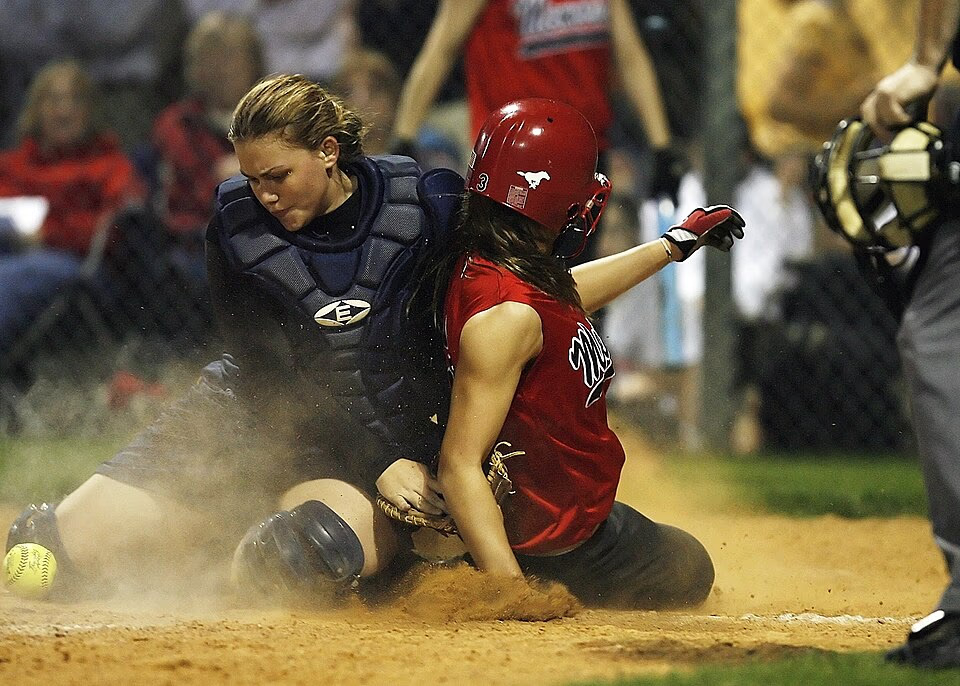
The must-avoid-contact and malicious-contact rules, together with the double base at first, are designed to reduce collisions between runners and fielders.; The look-back rule keeps base running orderly once the pitcher controls the ball in the circle.
Why people argue about this
People often assume that the double base at first only exists for safety, thinking it's a direct result of Collision Avoidance rules meant to prevent dangerous collisions. However, the actual intent is broader - to provide runners with more time and space to safely reach each base, regardless of whether there’s contact or not.
Unsportsmanlike conduct by players or coaches — abusive language, throwing equipment, contact with an official — results in warnings, ejection, and, where applicable, further disciplinary action by the conference or the NCAA.; An ejected individual must leave the playing area; the head coach is r...
Why people argue about this
People often assume that ejections are reserved only for serious acts of unsportsmanlike conduct like arguing calls or fighting with an umpire. They misunderstand that even minor infractions like repeatedly failing to wear a properly fitted helmet can lead to an ejection, thinking this is too harsh and not directly related to on-field play.
The rules limit the number of charged conferences — both defensive (coach visits to the pitcher) and offensive — a team may take in a game. Exceeding the defensive-conference limit requires the pitcher to be removed from the pitching position.
Why people argue about this
People often assume that the seven-inning regulation is a hard-and-fast rule for every softball game, forgetting that it's only enforced in conference play where conferences set their own rules. The confusion arises because they overlook the fact that this specific rule applies within the framework of NCAA-conferred conferences, not to all college softball games.
The team with more runs at the end of a regulation (or extra-innings) game wins.; A game ended early by the run-ahead rule is complete, and the score stands.; Called and suspended games: If a game is stopped for weather or darkness, the rules define when it is a complete game, when it is suspende...
Why people argue about this
People often assume that the official scorer's rulings are final without realizing they can be challenged by coaches or officials based on game observations. The confusion arises because these rulings aren't always accepted at face value; observers sometimes dispute them, especially if they believe a play was incorrectly assessed as an error or run wasn’t earned.
Illegal or non-compliant bat: Use of a bat that is altered, non-certified, or that fails bat/compression testing carries a penalty that can include calling the batter out, ejection, and removal of the bat from play.; Helmet and equipment requirements: Failure to wear required protective equipment...
Why people argue about this
People often assume that equipment violations in softball are only about aluminum bats, forgetting that other items like gloves can also be non-certified or altered, leading to penalties. The confusion arises because they overlook the broader definition of what constitutes "equipment" and thus miss understanding how easily they could fall foul of these rules unintentionally.
A regulation game is seven innings. The home team does not bat in the bottom of the seventh if it is already ahead.; If the score is tied after seven innings, the game continues into extra innings.
Why people argue about this
People often assume that if a softball game goes into extra innings, it will simply continue until one team scores more runs in total over all those innings. But actually, they stick with the original seven-inning format, just playing out each additional inning as per the rules until someone wins - meaning there's no limit to how many extra innings can be played if needed.
Gloves and mitts: Fielders use gloves within the size limits of the rules; the catcher and first baseman may use mitts.; Batting helmets: All batters, on-deck batters, and base runners must wear a double-ear-flap batting helmet equipped with a face mask/guard. Helmets must not be altered.; Catche...
Why people argue about this
People often assume that any ball with a certification marking is fair game for play in NCAA softball games, leading to misunderstandings about which balls are actually allowed under the official guidelines. The confusion arises because they overlook the specific wording of the rule stating only "balls bearing the required certification marking" may be used, not just any marked ball.
Umpires: Games are worked by an umpire crew — a plate umpire plus one to three base umpires (two-, three-, or four-umpire crews). The plate umpire calls balls and strikes and has general charge of the game; base umpires rule on plays on the bases and in the outfield.; Official scorer: Keeps the o...
Why people argue about this
People often assume that entering as a substitute in NCAA softball is just like in baseball - you can run out onto the field at any time. But actually, there are strict entry rules for substitutes, including needing to use designated player (DP) or flex roles, and they must enter via specific pathways designed by coaches, which can lead to confusion about when and how substitutions should be made.
The pitch is delivered underhand, typically with a windmill motion. The pitcher must begin with the required contact with the pitcher's plate and deliver in one continuous motion to the batter.; The rules govern the legal start position, the step, and the permitted drag of the pivot foot; a deliv...
Why people argue about this
People often assume that pitchers can throw with their dominant hand in softball, which is incorrect since they must deliver underhand. The real misunderstanding stems from believing a pitch doesn't have to start from the required contact area or follow step and pivot foot rules; this leads to many illegal pitches being overlooked by umpires and coaches alike.
Illegal pitch: A delivery that does not meet the legal-pitch requirements. The penalty is a ball awarded to the batter, and base runners are awarded as provided by the rule.
Why people argue about this
People often think that an illegal pitch in softball is only about the ball being hit out of play, forgetting that it also results in a ball awarded to the batter and base runners advancing. The confusion arises because they overlook the part where base runners can advance, which isn't always clear or emphasized in explanations.
NCAA concussion-management protocols require removal from play and clearance before return for any athlete with a suspected concussion.; Athletic trainers and medical personnel are present at competition, and venues maintain emergency action plans.; Field maintenance — level infield, safe outfiel...
Why people argue about this
People often argue that mandatory protective gear is too cumbersome and expensive, so they misunderstand the rule as optional rather than a critical safety measure in softball. They also fail to grasp how bat certification and testing contribute directly to player health by ensuring batted balls don't pose an unreasonable risk of injury, thus confusing it with just another regulation.
Double-ear-flap batting helmets with face masks/guards are mandatory for all batters, on-deck batters, and base runners.; The catcher's full protective set (helmet and mask with throat protector, chest protector, shin guards) is required.; Defensive face masks/guards are permitted for the pitcher...
Why people argue about this
People often assume that face masks are optional for all players except catchers, misunderstanding that both require them under NCAA rules. The real confusion stems from believing only catchers need throat protectors, when in fact, they mandate full protective gear including a throat protector for all catchers.
Run-ahead ("mercy") rule: If one team is ahead by the rule's margin after the prescribed number of innings — commonly 8 or more runs after 5 innings — the game is ended.; Extra-innings tiebreaker: Beginning in the prescribed extra inning, each half-inning starts with a base runner placed on secon...
Why people argue about this
People often think that if their team is winning by a run after seven innings, they get an extra inning just like in baseball. But actually, the Run-Ahead Rule specifically states that teams do not bat in the bottom of the seventh when already ahead, ensuring fair play and preventing unnecessary games.
A run scores each time a runner legally touches first, second, third, and home before the third out of the inning.; A run does not count if the third out is a force out, is made on the batter-runner before reaching first, or is the result of a preceding runner failing to touch a base on an appeal.
Why people argue about this
People often assume that scoring runs is straightforward—just add up hits and errors—but in softball, it's more nuanced. The real confusion arises because a run can be considered "earned" or "unearned," depending on whether the batter would have scored even if not for an error by their own team. This distinction isn't always clear-cut and often leads to disagreements among scorers.
Size: A 12-inch (30.5 cm) circumference fastpitch softball.; Construction and color: Optic yellow cover with contrasting (red) stitching, built to the NCAA-specified coefficient of restitution and compression standard so that ball performance is consistent across the game.; Only balls bearing the...
Why people argue about this
People often assume that all softball balls must be exactly 12 inches in circumference without considering variations allowed by performance standards. They overlook the fact that while the official size is specified, there can still be slight deviations as long as they meet performance criteria.
Base paths: 60 feet (18.29 m) between bases.; Pitching distance: 43 feet (13.11 m) from the front edge of the pitcher's plate to the back point of home plate.; Home plate: A five-sided rubber plate with batter's boxes marked on each side.
Why people argue about this
People often assume that the 60-foot base paths are measured from home plate to first/second/third bases directly, but actually they refer to the distance between the bases along the foul lines extending from home plate. This can lead to misunderstandings about where exactly the bases start and end on the field layout.
Each team plays nine defensive players: pitcher, catcher, four infielders (first, second, third base, and shortstop), and three outfielders (left, center, right).; The batting order lists the players who will bat; it must be followed in order through the game.; The NCAA permits a Designated Playe...
Why people argue about this
People often assume that a Designated Player (DP) in softball is interchangeable with their baseball counterpart, thinking they can be used in any spot on the field like a regular player. However, the NCAA's specific rule about Flex allows them to only bat for a defensive player known as the Flex and not replace them at any other position, leading to confusion about their versatility and use.
A regulation game is seven innings. The home team does not bat in the bottom of the seventh if it is already ahead.; If the score is tied after seven innings, the game continues into extra innings.; The pitch is delivered underhand, typically with a windmill motion. The pitcher must begin with th...
Why people argue about this
People often assume that extra innings in softball games are decided by runs scored after a tie, which isn't always the case. The confusion arises because while they do continue until one team has more points at the end of an inning, it's actually seven full innings (not just runs) that determine the winner if tied after regulation play.
The official scorer records each at-bat, run, hit, error, and the line score by inning. The scorer's rulings on hits versus errors and on earned versus unearned runs follow the scoring rules in the rules book.
Why people argue about this
People often assume that the official scorer decides whether a hit is earned or unearned based solely on their judgment without referring to scoring rules in the book, which can lead to disputes because the actual criteria for determining these are detailed and nuanced within those rules.
Illegal pitch: A delivery that does not meet the legal-pitch requirements. The penalty is a ball awarded to the batter, and base runners are awarded as provided by the rule.; Illegal or non-compliant bat: Use of a bat that is altered, non-certified, or that fails bat/compression testing carries a...
Why people argue about this
People often assume that an illegal pitch in softball means the batter automatically gets a hit, which they mistakenly believe is akin to baseball's walk. However, the correct interpretation is that it results in a ball awarded to the batter and base runners advancing as if there had been no pitch at all—essentially treating it like they didn't even try to throw anything.
Double-ear-flap batting helmets with face masks/guards are mandatory for all batters, on-deck batters, and base runners.; The catcher's full protective set (helmet and mask with throat protector, chest protector, shin guards) is required.; Defensive face masks/guards are permitted for the pitcher...
Why people argue about this
People often assume that only batters need double-ear-flap helmets, forgetting that runners also require them under this rule. The misconception stems from focusing solely on the batter's side of the plate without considering the full scope of protective equipment needed across all positions.
Substitutes enter by being reported to the plate umpire.; Starter re-entry: A starting player who is substituted for may re-enter the game once, but must return to the same spot in the batting order.; A substitute (non-starter) who leaves the game may not return.
Why people argue about this
People often assume that a player can only come in as a substitute if they've already been out of the game, forgetting that softball's DP/Flex system allows for players to switch roles between offense and defense multiple times throughout an inning, leading to confusion about when exactly they're allowed to re-enter.
On-deck circles: Marked areas where the next batter prepares.; Coaches' boxes: Marked near first and third base for the base coaches.; Dugouts / team areas: Enclosed and, where possible, screened for protection from foul balls.
Why people argue about this
People often assume that foul lines extend all the way out into the outfield, which isn't specified in the official rules. Actually, the rule only states that foul lines extend from home plate to the outfield fence, leaving ambiguity about how far they go beyond that point.
Each team plays nine defensive players: pitcher, catcher, four infielders (first, second, third base, and shortstop), and three outfielders (left, center, right).; The batting order lists the players who will bat; it must be followed in order through the game.
Why people argue about this
People often assume that only the designated player can come in as a pinch hitter during softball games, forgetting that any defensive player can be replaced by another on the roster, including pitchers or catchers who might need to leave due to fatigue or strategy changes. This oversight leads to misunderstandings about which players are eligible to enter the game via substitutions.
Size: A 12-inch (30.5 cm) circumference fastpitch softball.; Construction and color: Optic yellow cover with contrasting (red) stitching, built to the NCAA-specified coefficient of restitution and compression standard so that ball performance is consistent across the game.; Only balls bearing the...
Why people argue about this
People often assume that the exact circumference of 12 inches means every softball must be precisely 12 inches all around - length, width, height - but in reality, as long as it's within a certain tolerance (usually plus or minus 0.125 inches), any ball meeting this criterion is acceptable for play, regardless of its exact shape.
The official scorer records each at-bat, run, hit, error, and the line score by inning. The scorer's rulings on hits versus errors and on earned versus unearned runs follow the scoring rules in the rules book.
Why people argue about this
People often assume that the official scorer's decisions about whether a hit was earned or unearned are based solely on their judgment of the play, but actually, these rulings follow specific scoring rules detailed in the NCAA softball rulebook, leading to potential misunderstandings and arguments over interpretation.
The NCAA permits a Designated Player (DP) who bats for a defensive player known as the Flex. The DP occupies a spot in the batting order; the Flex plays defense and does not bat (unless entered into the DP's batting spot).; The DP and Flex give coaches flexibility to separate offensive and defens...
Why people argue about this
People often assume that the Designated Player (DP) is solely for strategic purposes, like pinch hitting, but they misunderstand that Flex allows a coach to replace ANY defensive player with the DP at any time during the game, which can lead to confusion about when and why this substitution happens.
Base paths: 60 feet (18.29 m) between bases.; Pitching distance: 43 feet (13.11 m) from the front edge of the pitcher's plate to the back point of home plate.; Home plate: A five-sided rubber plate with batter's boxes marked on each side.
Why people argue about this
People often assume that the distance between bases in softball is exactly 60 feet like in baseball, which leads to misunderstandings when they see it's actually 60 feet from home plate to second base and only 43 feet from the pitcher’s mound to home plate. This discrepancy can cause confusion about what constitutes a "base hit" or how far players need to run between bases.
Outfield fence: Home-run fence distances are set within the rules book's range — generally on the order of 190 to 235 feet (about 58 to 72 m) down the lines and to center, with a recommended range for new fields.; The outfield must be a clear, level playing surface free of hazards out to the fence.
Why people argue about this
People often assume that the outfield fence is just a boundary line like in baseball, thinking it marks an out-of-play area. However, in NCAA softball, the fence is actually considered part of the foul lines, which can lead to arguments about whether a ball hit near the fence has been legally played within fair territory or not.
Pitcher's plate ("rubber"): A rubber slab set into the ground at the pitching distance, from which the pitcher must deliver.; Pitcher's circle: A 16-foot (4.88 m) diameter circle centered on the pitcher's plate. The circle defines where the look-back rule applies once the pitcher has possession o...
Why people argue about this
People often believe that the pitcher's plate is just a rubber slab without a circle around it for positioning purposes, but in reality, the official definition includes both - a 16-foot diameter circle around the 43-foot plate from home plate where the pitcher must stand during their turn. This discrepancy leads to confusion and arguments about proper positioning.
Uniforms: Teammates wear like-colored uniforms with unique numbers. Jewelry and equipment that could be dangerous are prohibited.; Footwear: Cleats are worn; shoe regulations follow the rules book.; Bases: The bases are anchored at the corners of the diamond. A double base (a colored "safety" por...
Why people argue about this
People often assume that softball uniforms must be a certain color like baseball jerseys, which is incorrect. The real issue lies in misunderstanding that while uniforms have color standards, they don't affect the bases or balls at all; this rule specifically deals with what colors are allowed on players' shirts and pants, not how the game's key elements function.
Lightning: Games are suspended and the field cleared when lightning is in the area, following the NCAA's lightning-safety guidance, and resume only after the prescribed all-clear interval.; Heat: Hydration and heat-management practices are followed during hot-weather competition.; Play is also su...
Why people argue about this
People often assume that protective equipment is only for safety against collisions and isn't meant to limit ball speed, leading to misunderstandings about why bat certification exists in NCAA softball rules. The confusion arises because they overlook how controlling ball speeds with certified bats helps protect players from unexpected impacts during games played under various weather conditions.