


🏛️Official — NCAA
Loading OpenSourceSports…
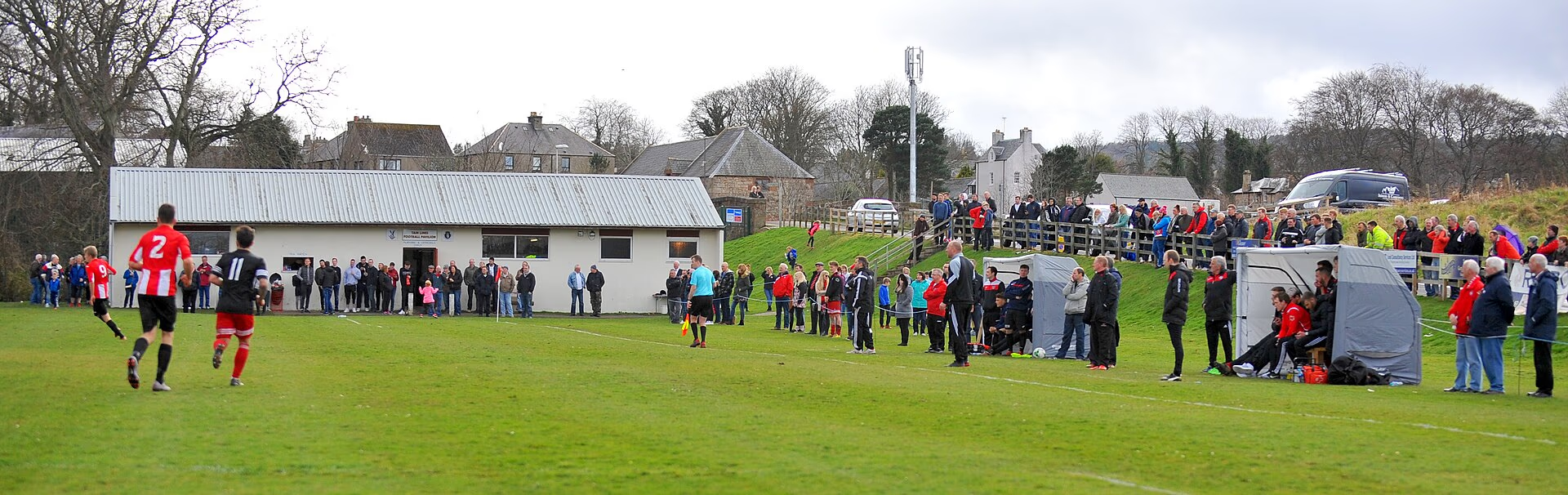
Head coach, assistant coaches, athletic trainer(s), and named substitutes in the technical area. Bench conduct subject to NCAA Sportsmanship Code; ejections carry suspension review.
Why people argue about this
People often assume that anyone in the technical area can be ejected for misconduct, including players warming up on the sidelines, which isn't true according to NCAA rules. The confusion arises because they overlook the specific list of permitted personnel and only focus on ejections without understanding who is allowed there initially.
Yellow card cautionable offenses: unsporting behavior, dissent, persistent infringement, delaying restart, failure to respect required distance, entering/leaving without permission; Two yellow cards in same match = automatic red card (sent off); Direct red card offenses: serious foul play, violen...
Why people argue about this
People often assume that a player can only be sent off for serious offenses like violent conduct, and they forget about other severe penalties like sending off for unsporting behavior or handling the ball during play (aside from kicks). The confusion arises because these lesser-known sanctions are sometimes overlooked in the heat of games.
Per the 2026 and 2027 NCAA Soccer Rules Book rule changes, in matches where video review is used, each head coach is granted two video challenges per game. Coach-initiated challenges may be used at any point in the match, subject to the two-challenge limit.
Why people argue about this
People often assume that each coach gets only one video challenge per game, thinking it's a strict limit of two challenges total for both coaches combined. However, the actual rule allows each head coach to use up to two challenges individually at any point during the match, not limiting the total number of challenges across all coaches.
Per the 2026 and 2027 NCAA Soccer Rules Book rule changes, institutions may display up to four commercial logos on the field of play — no more than two per half. Each logo is limited to a 15-foot-by-15-foot square, must not be placed within the pe...
Why people argue about this
People often assume that these logos can be placed anywhere they want as long as they fit within the 15x15 square, but actually, the confusion arises because each team is only allowed to have two logos per half-time break, and they must strategically place them outside of the designated playing area to avoid interference.
NCAA concussion management protocol: any player with actual or suspected concussion is removed from play immediately and is subject to a graduated return-to-play assessment before being cleared. Concussion substitution permits an additional substitution beyond the normal framework.
Why people argue about this
People often assume that concussion substitution is a way for players to get back into games faster just by having a doctor's note, but in reality, it requires a comprehensive return-to-play assessment following immediate removal from play as outlined in the protocol. This can lead to misunderstandings about how quickly or easily a player can come back once they're cleared.
Lightning detection halts outdoor play within the standard radius of detected strikes; resumption only after the all-clear interval. Field surface inspected pre-match; unsafe conditions cause delay.
Why people argue about this
People often assume that if lightning is detected within a certain radius, play must immediately stop for an indefinite period just because of weather concerns, but actually, it's only halted until the all-clear interval after which teams can resume based on safety assessments. They overlook the flexibility and specific conditions under which play resumes once deemed safe by officials.
Goals 7.32 m wide × 2.44 m high, white, securely anchored, fitted with nets (IFAB Law 1).
— Law 1
Why people argue about this
People often assume that the 7. 32 meters wide goal frame is meant to accommodate the width of a player running into it, but actually, it's designed to account for the size of the largest professional soccer ball in play, ensuring fair play regardless of how far a player can kick or run towards the goal line.
Goalkeeper may handle the ball within the penalty area; IFAB 2025 amendment: goalkeeper has 8 seconds to release the ball after gaining hand control; failure is a corner kick to the opposing team (NCAA aligns with this IFAB change); Back-pass rule: goalkeeper may not handle a deliberate pass from...
Why people argue about this
People think that only defenders are allowed to take goal kicks, but actually, any player can do so as long as they're not in their own penalty area. The confusion arises because players often assume it must be a defender due to the position of the ball and the restart.
WBGT-based heat thresholds for cooling breaks and play modifications. Mandatory water/cooling breaks at high WBGT.
Why people argue about this
People often assume that heat-related rules in soccer only apply during official games, forgetting about practices where players are just as vulnerable to heat exhaustion. The confusion arises because the mandatory cooling breaks for high WBGT conditions extend beyond game time and into practice sessions too.
Two 45-minute halves; halftime up to 15 minutes; NCAA uses a visible countdown clock managed in coordination with the referee — historically a key NCAA-vs-FIFA distinction; the referee remains the on-field clock authority and signals stoppages; Regular season: tied matches end at full time (no ex...
Why people argue about this
People often assume that after five kicks per side are taken in a penalty shootout, if tied, the match is over immediately with no further attempts. But actually, the IFAB (International Football Association Board) protocol allows for up to 10 kicks total from each team before deciding by sudden death, which can lead to even longer shootouts and more argumentation among officials and fans alike.
Each NCAA-sanctioned game requires at least one certified athletic trainer on the bench. Championship-level competition adds team physicians and EMT/ambulance coverage on site.
Why people argue about this
People often assume that having one certified athletic trainer is just for pre-game warm-ups and isn't necessarily there in case of injuries during the game itself, but actually, these trainers are required to be present throughout the match to ensure immediate medical attention if needed. They're not just observers or coaches' assistants.
Player ejected (red card) is suspended for the team's next regularly-scheduled match (one-game minimum); Two ejections in a season: extended suspension review; Yellow-card accumulation: typically tracked across the season; conferences set thresholds for accumulation suspensions
Why people argue about this
People often assume that if a player commits an offside offense during a penalty kick situation, it results in a direct free kick for the opposing team instead of just letting play continue as per the official verdict. But actually, the IFAB Law 12-14 clearly states that any offside offense doesn't change the nature of the penalty kick and simply allows play to resume normally.
Effective for the 2026 and 2027 seasons, the NCAA Soccer Rules Book makes a fourth official mandatory for Division I men's and women's matches. Where video review is used, a video match official may be assigned to assist the referee with all aspec...
Why people argue about this
People think that all NCAA matches use three referees plus a fourth official for every game, including regular-season conference games, which they misunderstand as being true only at championship-level events like the NCAA Tournament. The confusion arises because the rule specifies different numbers of officials for different levels of play without clarifying this distinction.
Direct free kicks, indirect free kicks, and penalty kicks per IFAB Law 12-14. Penalty kick from 12 yd / 11 m mark; goalkeeper must be on the goal line at the moment of release.
— Law 12
Why people argue about this
People often assume that if a foul happens anywhere within the penalty area, it automatically results in a direct free kick instead of a more severe penalty kick offense. The confusion arises because they overlook the specific IFAB Law 12-14 which states that only fouls inside this marked area can lead to a penalty kick, not any other type of free kick.
Jersey with sleeves, shorts, socks, shin guards covered by socks, footwear (cleats appropriate to surface); Goalkeeper wears distinguishing colors; Religious head coverings, prescription eyewear, soft headbands permitted
— Law 4
Why people argue about this
People often assume that the goal size of 7 meters wide is just a suggestion, but in reality, it's an official standard set by FIFA and implemented by IFAB, meaning every NCAA soccer field must be exactly 7 meters wide for games to adhere strictly to the rules. This precision requirement can lead to arguments about whether a goal was scored within the correct dimensions or not.
Throw-ins, goal kicks, corner kicks, free kicks (direct + indirect), and penalty kicks per IFAB Law 8-17 with NCAA-specific timing for restart pace. Drop ball used for stoppage restarts.
— Law 8
Why people argue about this
People often assume that all restarts in soccer are instant, forgetting about the time it takes for a referee to signal and players to get into position with throw-ins or goal kicks. The confusion arises because they expect these restarts to happen almost immediately after an incident ends, not accounting for the actual process of signaling and positioning needed by both teams.
11 players on field per team; team must have at least 7 players to start/continue a match; Match-day roster: institution-defined; typical D1 squad 25-30 players
Why people argue about this
People commonly argue that NCAA soccer matches should always use four officials instead of three for regular-season games, thinking it's a standard across all levels just because championship-level events have more. The confusion arises because they don't realize the official decision is based on event type and not a universal rule change.
FIFA Quality Programme approved size 5 ball: spherical, 68-70 cm circumference, 410-450 g start-of-match weight, 0.6-1.1 atmospheres pressure (IFAB Law 2). Conference- or championship-issued match ball.
— Law 2, Law 4, Law 1
Why people argue about this
People often assume that the weight range for a soccer ball is just one number (like 410-450 g), but actually it's two—0.6g to 1g—to account for variations in materials and manufacturing processes, leading to some confusion about which end of the spectrum they should be checking when inspecting balls.
Per the 2026 and 2027 NCAA Soccer Rules Book rule changes, institutions may display up to four commercial logos on the field of play — no more than two per half. Each logo is limited to a 15-foot-by-15-foot square, must not be placed within the pe...
Why people argue about this
People often assume that only natural grass surfaces are allowed in NCAA soccer fields, misunderstanding that hybrid grass and FIFA Quality Pro synthetic turf options are also acceptable under the official guidelines for playing areas. They overlook the institution's responsibility to ensure compliance with these approved surface standards.
Effective for the 2026 and 2027 seasons, the NCAA Soccer Rules Book makes a fourth official mandatory for Division I men's and women's matches. Where video review is used, a video match official may be assigned to assist the referee with all aspec...
Why people argue about this
People often assume that all NCAA soccer games use the same number of officials for every match, regardless of whether it's a regular season game or a championship one. But in reality, the difference lies in the presence of video review technology (VAR), which is used exclusively at championship-level events like the NCAA Tournament, not affecting the number of officials on the field.
Per the 2026 and 2027 NCAA Soccer Rules Book rule changes, in matches where video review is used, each head coach is granted two video challenges per game. Coach-initiated challenges may be used at any point in the match, subject to the two-challenge limit.
— Law 8
Why people argue about this
People often assume that after five kicks each from the penalty mark, if tied, a sudden death shootout continues with one more kick per side until a winner is decided. However, they misunderstand that IFAB (International Football Association Board) has specific procedures for NCAA soccer, which likely includes some NCAA-specific adjustments or variations to this standard FIFA rule.
Conference standings typically use 3-1-0 points (win-draw-loss). Tiebreakers vary by conference and may include head-to-head, goal differential, goals scored, and other published criteria.
— Law 10
Why people argue about this
People often assume that a 1-0 win is always worth three points in NCAA soccer, forgetting about tiebreakers that can make it less clear-cut, like head-to-head results or goal differential if scores are tied. They overlook how different conferences might value these tiebreaker criteria differently.
Per the 2026 and 2027 NCAA Soccer Rules Book rule changes, the determination of whether an ejection meets the criteria for Violent Behavior II, Fighting, or Referee Assault is no longer made by the on-field referee in the moment. The referee's rol...
— Law 12
Why people argue about this
People often assume that a penalty kick is awarded simply for tripping inside the penalty area, but actually, it's only given if the trip occurs when the ball is within 12 yards/meters of the goal line and the kicker must be positioned on the goal line at the moment of release to ensure fairness.
NCAA concussion management protocol: any player with actual or suspected concussion is removed from play immediately and is subject to a graduated return-to-play assessment before being cleared. Concussion substitution permits an additional substitution beyond the normal framework.
Why people argue about this
People often assume that this rule only applies during games, thinking it's about removing players for minor injuries like bruises. But in reality, it specifically addresses actual or suspected concussions, requiring immediate removal from play and a thorough medical assessment before returning to action, regardless of the sport’s standard substitution rules.
Five alternating kicks per team from the penalty mark; if tied, sudden death continues until a winner. IFAB KFTPM procedure with NCAA-specific implementation.
Why people argue about this
People often assume that in a shootout, each team gets only three kicks instead of five, leading to frustration when their side doesn't score enough goals to win quickly. The confusion arises because the official procedure specifies alternating kicks for five rounds, not just three, which can lead to longer shootouts than expected and cause more arguments over scoring sequences.
Conference standings typically use 3-1-0 points (win-draw-loss). Tiebreakers vary by conference and may include head-to-head, goal differential, goals scored, and other published criteria.
Why people argue about this
People often assume that all conferences use the exact 3-1-0 points system for standings, forgetting that different leagues might have their own unique tiebreakers, leading to confusion about which criteria are actually used in specific conferences.
NCAA permits substitution and re-entry — distinguishing it from FIFA/IFAB rules where substitution removes a player permanently; Standard NCAA framework: unlimited substitutions during regulation; substituted players may re-enter beginning in the second half (specific re-entry rules per the rule ...
Why people argue about this
People often assume that all NCAA soccer games use the same number of officials for every match, forgetting about the difference between regular-season conference matches and championship-level events like the NCAA Tournament, which employ more officials with video review technology.
FIFA Quality Programme approved size 5 ball: spherical, 68-70 cm circumference, 410-450 g start-of-match weight, 0.6-1.1 atmospheres pressure (IFAB Law 2). Conference- or championship-issued match ball.
— Law 2
Why people argue about this
People often assume that all soccer balls are perfectly spherical, forgetting that some imperfections are allowed as long as they don't significantly affect gameplay. The official verdict specifies a range for circumference (68-70 cm), which can lead to misunderstandings about what constitutes an "acceptable" ball size if someone thinks every ball must be exactly 69 cm in diameter.
Per the 2026 and 2027 NCAA Soccer Rules Book rule changes, the determination of whether an ejection meets the criteria for Violent Behavior II, Fighting, or Referee Assault is no longer made by the on-field referee in the moment. The referee's rol...
Why people argue about this
People often assume that the ejection decision for Violent Behavior II is made by the referee in real-time during a game, but now it's actually reviewed after the match according to new NCAA rules. This shift can lead to confusion because fans and players might not realize they need to check post-game documentation or reports for their team’s final verdict on such serious infractions.
Per the 2026 and 2027 NCAA Soccer Rules Book rule changes, all yellow cards issued to a team's coaching staff (bench personnel) are now charged to the head coach for accumulation purposes, rather than tracked individually per staff member.
Why people argue about this
People think that yellow cards are only issued to players for misconduct during games, so they assume that coaches won't be penalized in a similar way. But actually, under the new 2026-27 rule, all yellow cards given to coaching staff members will now be counted against the head coach, creating confusion about who exactly is responsible for accumulating disciplinary points.