


🏛️Official — NCAA
Loading OpenSourceSports…
Absolute silence while any shooter on the relay is in their shot sequence
Unnecessary talking, movement, or audible noise while a relay is underway is considered a serious breach. The expectation of near-total quiet among competitors, coaches, and spectators near the line far exceeds what any rulebook mandates and is enforced entirely through social pressure.
Never handle another shooter's rifle without explicit permission
A competitor's rifle is their most personalized and precisely adjusted piece of equipment. Touching it — even briefly, even helpfully — without asking first is a serious breach of respect universally observed across all levels of competitive shooting.
Pre-event equipment inspection at championship: rifle weight, jacket fit, boot height, glove specs all checked per ISSF Equipment Standards.
Why people argue about this
People often assume that only the rifle itself is inspected for weight during pre-event checks, forgetting about other seemingly unrelated items like jacket fit and boot height. They overlook how these factors can affect a shooter's performance or comfort on the field, mistaking them as less critical than the weapon’s specifications.
Smallbore 3-position (3P): 60-shot match — 20 prone, 20 standing, 20 kneeling; Air rifle: 60-shot standing match; NCAA Aggregate: smallbore + air rifle scores combined for team championship
Why people argue about this
People often assume that only the rifle itself needs inspection for weight at championship events, forgetting about other crucial items like the jacket fit, boot height, and glove specs—all of which are meticulously checked according to ISSF standards. The confusion arises because these seemingly minor details can significantly impact performance and safety on the shooting range.
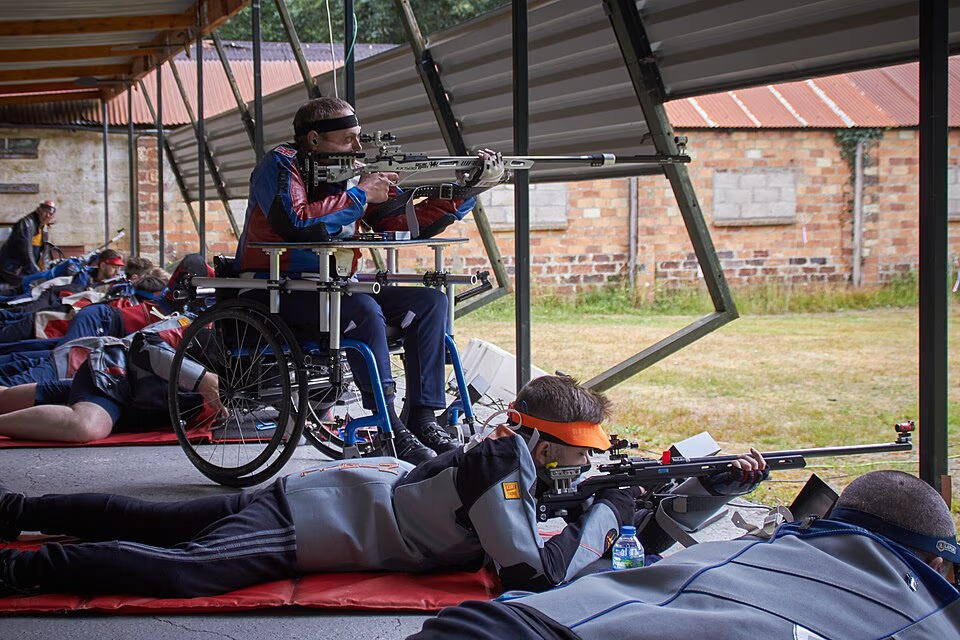
Prone: lying on ground, rifle supported by elbows + sling; Standing: upright, no support beyond the body; Kneeling: kneeling on right knee, sitting on right heel, support via the left elbow on left knee
Why people argue about this
People often assume that the equipment inspection process is just a formality, thinking it's only about checking if their gear meets basic standards. But in reality, these inspections are crucial for ensuring fair play by strictly enforcing ISSF Equipment Standards, which can lead to heated debates over seemingly minor details like rifle weight or boot height.
Rifle: per ISSF spec for the discipline (smallbore .22 LR or air rifle 4.5 mm); Smallbore: .22 LR rifle, max weight 8 kg, single-shot bolt action; iron sights or scope per ISSF; Air rifle: 4.5 mm pellet, max weight 5.5 kg, max muzzle velocity 200 m/s
Why people argue about this
People often assume that just owning a .22 LR rifle is enough for NCAA Rifle competition, forgetting about other crucial components like the shooting jacket and mandatory ear protection specified in Section 2. The confusion arises because these additional pieces are not always readily available or easily accessible to all competitors.
Indoor shooting range with multiple firing positions (typically 8-20 lanes); Smallbore: 50 ft (NCAA spec) firing distance with 50-ft target; Air rifle: 10 m firing distance with 10-m target
Why people argue about this
People often assume that the backstop is only for safety training purposes, forgetting its crucial role in actual matches as a barrier between shooters and their targets, leading to misunderstandings about how it should be used during competitions.
NCAA team: 5 shooters per team in each event; top 4 scores count for team total (drop the lowest); Roster: typically 6-12 athletes for NCAA D1; co-ed competition; Officials: chief range officer, range officer, target judges, scorer, equipment inspector
Why people argue about this
People often assume that only the top 4 scores count towards their team's total score, forgetting they're dropping the lowest of those 4 scores instead. This leads to confusion about whether a single shooter breaking 100 is enough to save their team from elimination or if it needs to be part of one of the top 4 performances.
Pre-event equipment inspection at championship: rifle weight, jacket fit, boot height, glove specs all checked per ISSF Equipment Standards.
Why people argue about this
People often assume that the pre-event inspection only applies to equipment like rifles and gloves, forgetting about the jacket fit and boot height checks. They think these minor details are overlooked or irrelevant, but in fact, they're crucial for ensuring fair play according to ISSF standards.
Each shot scored 1-10 (10 inner ring center); NCAA scoring: integer scoring (1-10) — different from ISSF's decimal scoring (10.9 max per shot); Match score: sum of 60 shots (max 600)
Why people argue about this
People often assume that NCAA rifle scoring uses decimal scores like ISSF's system, which leads to confusion when they learn it only assigns integer scores from 1 to 10 per shot. This discrepancy can cause misunderstandings about how points are accumulated in matches.
Equipment violation (oversized jacket, illegal sling, etc.): warning + correction; subsequent = 2-point deduction or DQ per severity; Time violations: shots fired after time = DQ for those shots; Position violations: improper position support = warning; subsequent = score deduction
Why people argue about this
People often argue that they were pointing their rifle in a safe direction when ejected from the event, misunderstanding what constitutes an unsafe direction under Range safety guidelines. The confusion arises because different shooters have varying interpretations of which directions are considered unsafe based on their shooting position and angle at the range.
Range safety is paramount: muzzle discipline (always pointed downrange), action open when not firing, ear/eye protection, no live ammunition outside the firing line. Range safety officer enforces all safety rules; violations cause immediate ejection.
Why people argue about this
People often assume that just pointing the rifle downrange is enough for muzzle discipline, forgetting about how quickly a misstep can lead to accidents. The confusion arises because they overlook the importance of keeping their sights or scopes aligned downwards at all times, even when not actively aiming, to prevent accidental discharges from ricochets off walls or other surfaces.
Smallbore 3P: 1 hour 45 min for 60 shots + sighters; Air rifle: 1 hour 15 min for 60 shots + sighters
Why people argue about this
People often assume that the time limit for pre-event inspections is just about getting all the equipment checked quickly, but in fact, it's a meticulous process designed by the International Shooting Sport Federation (ISSF) to ensure fair play and adherence to strict safety standards, which can lead to disagreements over how long each item should take.