


🏛️Official — UPA-A
Loading OpenSourceSports…
No volleys while standing in NVZ or with momentum carrying into NVZ; Foot fault if any part of body touches NVZ during volley
Why people argue about this
People often assume that you can only stand in the kitchen for a split second before hitting the ball, which leads to foot faults if they touch it during their volley. Actually, the rule is about staying out of the kitchen entirely while volleying - moving through or even touching it during the shot is what triggers a foot fault, not just standing there briefly.
Traditional: games to 11, win by 2 (best of 3 or 5); Rally scoring (MLP): point on every rally regardless of server; games to 21, win by 2; Dreambreaker (MLP tiebreaker): singles rotation, first to 21
Why people argue about this
People often assume that Rally Scoring in Pro Pickleball means you win by 3 points instead of 2, leading to arguments about when a game should end once one player reaches their score. The confusion arises because traditional scoring format is so ingrained in pickleball culture, making players and spectators expect the classic 11-2 victory condition even when Rally Scoring is in play.
Paddle: must appear on the UPA-A approved paddle list (separate from USAP-approved list); pro-only restrictions on core hardness and surface friction; PBCoR (Paddle-Ball Coefficient of Restitution) testing required; Paddle dimensions: combined length + width ≤ 24 in (61 cm); max length 17 in (43....
Why people argue about this
People often assume that only professional players are affected by this rule, thinking it's a way to level the playing field for amateurs. However, the reality is that even recreational pickleballers with lower skill levels might be impacted if they use paddles outside of what UPA-A specifies as pro-only equipment standards for core hardness and surface friction.
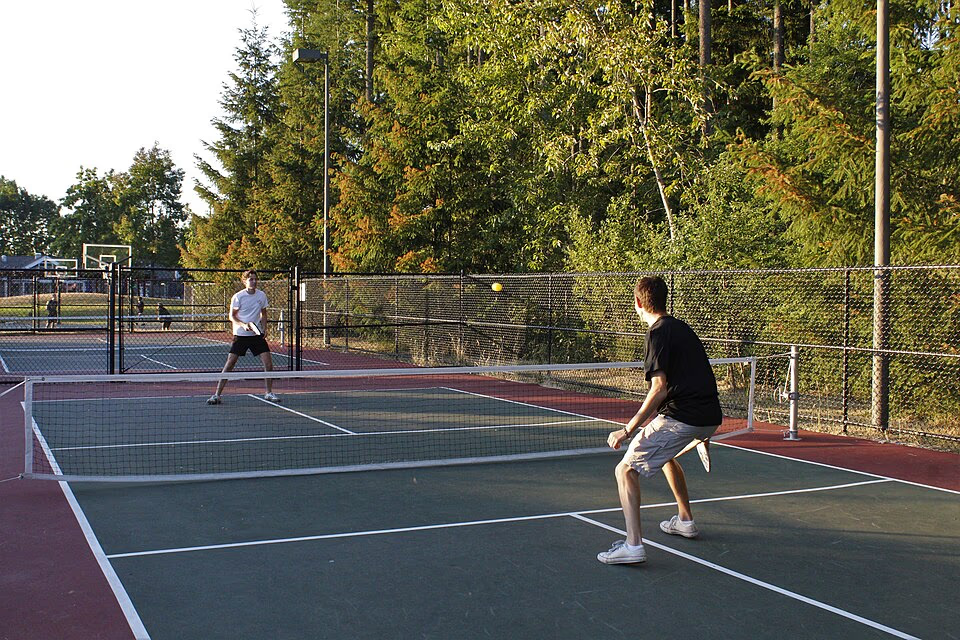
Court: 20 ft × 44 ft (6.10 m × 13.41 m) — same as USAP; Net: 36 in (91.4 cm) at posts, 34 in (86.4 cm) at center; Non-Volley Zone ("kitchen"): 7 ft from net on each side
Why people argue about this
People often assume that the non-volley zone extends only 3 feet from either net side in Pro Pickleball, but actually it's 7 feet wide on each side of the net, creating a much larger restricted area than they expect. This discrepancy leads to arguments about whether their shots are within or outside the designated volley zone.
Singles: 1 v 1 — most common in PPA Tour individual events; Doubles: 2 v 2 — standard pro doubles + mixed doubles; MLP Team format: 4-player teams (2M + 2W) play men's doubles, women's doubles, and 2 mixed doubles per match; tiebreaker dreambreaker singles
Why people argue about this
People often assume that Pro Pickleball's switch from PPA and MLP rankings to a UPA-A points system means it's no longer compatible with these other ranking systems, but actually, players can still participate in both systems if they choose to do so, just under different scoring structures.
Underhand serve below the waist; drop-serve permitted (USAP 2021+ rule adopted); Service must clear NVZ; lands diagonally in opponent's service court; One-fault rule (no second-serve)
Why people argue about this
People often assume that if their serve hits the NVZ line, it's automatically a fault, which isn't correct. Actually, they must hit the NVZ on purpose for a fault; hitting it accidentally doesn’t count as an error under UPA-A rules.
PPA Tour traditional: best-of-3 to 11, win by 2; finals best-of-5; MLP rally scoring: games to 21, win by 2; match decided by aggregate match points across 4 mini-matches + dreambreaker if tied 2-2; UPA-A Tour Championship: $500K+ events with multi-stage knockout brackets
Why people argue about this
People often assume that a single dreambreaker point decides multi-stage tiebreakers in Pro Pickleball UPA-A, but actually it's about aggregate match points from 4 mini-matches plus one final dreambreaker if all matches are tied at 2-2. This oversight leads to confusion and disputes over who wins the crucial tiebreaker round.
Foot faults: service foot fault, NVZ foot fault; Service violations: illegal serve motion, contact above waist, drop-serve infractions; Code violations: verbal abuse, racket abuse, unsportsmanlike conduct → warning → point penalty → game penalty → match forfeit
Why people argue about this
People often assume that verbal abuse in Pro Pickleball is strictly about yelling at opponents during matches, which they think means only shouting insults. However, the confusion arises because the rule covers any form of abusive language or behavior towards officials, teammates, or spectators throughout all phases of play and even before and after games, not just during matches themselves.
Pro Pickleball is a low-impact racquet sport; primary injury risks are ankle sprains (rapid lateral movement), Achilles strain, and shoulder/elbow overuse. Tour events require an on-site athletic trainer + AED + EMT.
Why people argue about this
People often assume that since Pro Pickleball is low-impact, there's no need for medical professionals on-site. But they misunderstand that even in a seemingly safe sport like this one, quick lateral movements can still lead to serious injuries requiring immediate attention, which is why having an athletic trainer and AED are crucial safety measures.
Underhand serve below the waist; drop-serve permitted (USAP 2021+ rule adopted); Service must clear NVZ; lands diagonally in opponent's service court; One-fault rule (no second-serve)
Why people argue about this
People often assume that in Pro Pickleball, a service must be below the waistline and clear of the non-volley zone (NVZ) just by looking at it visually. However, the actual implementation requires precise observation using an official net height gauge to ensure compliance with the rule, leading to many misunderstandings and arguments about whether a serve has been correctly executed.
Returning team must let serve bounce; serving team must let return bounce — then volleys allowed
Why people argue about this
People often assume that the Two-Bounce Rule only applies when serving from the deuce court, forgetting that it's a universal rule in Pro Pickleball (UPA-A). The confusion arises because they overlook the fact that both teams must follow this protocol to ensure fair play and adhere to the spirit of keeping the ball in motion.