


🏛️Official — World Lacrosse
Loading OpenSourceSports…
Honor the Creator's Game
Lacrosse was created by the Haudenosaunee (Iroquois Confederacy) as a sacred gift and is widely called 'The Creator's Game.' Players across all levels are expected to treat the game with reverence — acknowledging its Indigenous origins, not disrespecting the game through excessive aggression, taunting, or contemptuous play. This is considered the foundational cultural norm of the sport.
Shake hands sincerely after the game
The post-game handshake line is a deeply ingrained tradition. Walking through it half-heartedly, avoiding eye contact, or refusing to participate — especially after a physical or contentious game — is viewed as a serious breach of the sport's honor code. Both teams are expected to mean it.
Don't run up the score against a clearly outmatched opponent
When a team has a commanding lead, it is expected to ease off — substituting heavily, holding the ball, or avoiding unnecessary goals. Continuing to shoot freely against a weaker opponent deep in the second half is seen as disrespectful and a failure of sportsmanship by the coaching staff.
The official lacrosse ball must be solid rubber. Per World Lacrosse specifications: Circumference: Not less than 19.7 cm (7¾ inches) and not more than 20.3 cm (8 inches); Weight: Not less than 142 g (5 oz) and not more than 149 g (5¼ oz); Color: White, yellow, or orange for men's field; yellow or...
Why people argue about this
People often assume that the crosse's mesh pocket is merely decorative, forgetting its crucial role in catching and holding the ball securely. Actually, it’s a vital component ensuring players can carry and pass the ball effectively without dropping it.
The crosse is the primary implement used by players to carry, pass, and shoot the ball. It consists of a handle (shaft) and a head, which contains a mesh or leather pocket.
Why people argue about this
People often assume that the crosse's pocket can be made of almost any material they prefer, leading them to think it doesn't matter what goes inside as long as it fits snugly. However, the official rule actually specifies that the pocket must contain mesh or leather only, which is why arguments arise when players try materials like plastic or rubber instead.
The following equipment is mandatory for all players in men's field lacrosse: Helmet: Must be a lacrosse-specific helmet meeting NOCSAE (National Operating Committee on Standards for Athletic Equipment) or equivalent World Lacrosse-approved standard. Must have a face mask and chin strap securely ...
Why people argue about this
People often assume that just because protective equipment is mandatory in men's field lacrosse doesn't mean players are required to wear helmets. They might think a helmet would be an unnecessary luxury when they see other players donning them, but actually, it’s about ensuring safety and preventing head injuries, which can happen even without the ball in play.
Eyewear/Goggles: Mandatory for all field players. Must meet ASTM F803 or equivalent standard.; Mouthguard: Mandatory; must be a color other than white or clear.; Gloves: Optional for field players.
Why people argue about this
People often assume that the contrasting jersey colors are just for aesthetic purposes, forgetting that their primary function is to help players distinguish between teammates and opponents in fast-moving games, especially when visibility can be compromised by sunlight or rain. The confusion arises because they overlook how crucial it is for clear communication and safety on the field.
Each team must wear matching jerseys of a contrasting color to the opposing team. Jersey numbers are required and must be clearly visible.
Why people argue about this
People often assume that it's just about having matching jerseys in a different color from the other team, but they overlook the requirement for jersey numbers to be clearly visible, which can lead to misunderstandings during games where visibility is crucial for officials and players alike.
The men's lacrosse field is a rectangular grass or artificial turf surface with the following official dimensions per World Lacrosse Men's Field Rules:
Why people argue about this
People often think that the 3.1 Men's Field Dimensions rule is just about the size of the field, but in reality, it specifies exact measurements for things like goalmouth width, midfield lines, and crease dimensions, which can lead to arguments over whether a player is within legal playing space or not.
Length: 110 yards (100.6 m) recommended; minimum 90 yards (82.3 m); Width: 60–70 yards (54.9–64.0 m); A center circle of 9.1 m (10 yards) diameter is marked at midfield.
Why people argue about this
People often assume that these restraining lines are for blocking purposes, thinking they're like goalies in hockey who can restrict movement near their crease. However, the actual purpose of these 20-yard lines is to define the boundaries within which women's field players must stay during play, ensuring fair competition and adherence to gender-specific playing conditions.
Goal posts: 1.83 m (6 feet) apart, inside measurement; Crossbar height: 1.83 m (6 feet) from the ground to the underside of the crossbar; The goal is positioned 15 yards (13.72 m) from the end line.
Why people argue about this
People often assume that these restraining lines are meant to stop players from entering a certain area when they're actually there to mark where the crease ends at each end of the field. They help define boundaries but don't restrict movement within them, which can lead to misunderstandings about their purpose and application in gameplay.
Goal posts: 1.83 m (6 feet) apart, inside measurement; Crossbar height: 1.83 m (6 feet) from the ground; The goal is positioned 15 yards (13.72 m) from the end line.
Why people argue about this
People often assume that these restraining lines are meant to prevent players from entering the crease area, which is incorrect. In reality, they're designed to stop women's field players from encroaching on men’s field goal areas and vice versa, ensuring fair play between genders in mixed-gender games.
, 30 yards from each end line). " During a face-off, all players other than the two taking the face-off and the goalkeepers must remain in the wing areas or beyond the restraining line until possession is gained or the ball crosses the restraining line.
Why people argue about this
People often assume that the 3.5 Restraining Lines in men's field lacrosse are meant to restrict players from entering certain areas of the field, but actually they're designed to mark where defensive players must stay when a penalty is called against an offensive team, ensuring fair play and preventing unfair advantages.
Wing areas are located at midfield, 10 yards (9.14 m) on each side of the center line. During a face-off, one player from each team (the wing midfielders) must remain in the wing areas until the ball is possessed or passes the restraining line.
Why people argue about this
People often assume that the wing areas are simply 10 yards out from midfield, which can lead to misunderstandings about where they actually are on the field. The confusion arises because these areas extend laterally along the center line, creating a diamond shape with the goalmouths at each end, not just being straight lines 10 yards away.
A designated substitution box is located along one sideline at midfield, typically 10 yards (9.14 m) on each side of the center line. Substitutions must be made within this area.
Why people argue about this
People often assume that the substitution box is a fixed point at midfield, overlooking the fact that it's along one sideline at midfield, typically 10 yards from the center line. This discrepancy can lead to confusion about where exactly substitutions should be made during a game.
Each team consists of ten (10) players on the field at one time: 1 Goalkeeper (GK); 3 Defensemen — primarily positioned in the defensive half; 3 Midfielders — free to play the full field
Why people argue about this
People often assume that in men's field lacrosse, like women's, all players are unrestricted runners everywhere on the field. But actually, while there are no positional restrictions by official rule, coaches still dictate tactical positions based on play style and strategy, leading to confusion about where certain players should be at any given time.
Each team consists of twelve (12) players on the field at one time: 1 Goalkeeper (GK); 5 Defenders; 3 Midfielders
Why people argue about this
People often assume that in women's field lacrosse, players are restricted to certain positions like midfielders or attackers based on their jersey number, but actually, there are no positional restrictions by rule; all players can move anywhere on the field as per this rule, which leads to misunderstandings about player roles and movements.
At all times during play, each team must have a minimum of: Three (3) players — including the goalkeeper — in its defensive half of the field; Three (3) players in its offensive half of the field
Why people argue about this
People often assume that offside in lacrosse is just like in soccer - only one player can be behind the defensive line at a time. But actually, it's more complex; the 4.3 Offside Rule for men’s field states you can have up to three players on either side of the attack line as long as they're not all directly behind it, leading to confusion about how many and which players are allowed where.
Substitutions may be made at any time during play (on-the-fly). Substituting players must enter and exit through the substitution box on the sideline.
Why people argue about this
People often assume that substitutions must be made only at dead ball situations, which leads them to argue about when they can make their changes. The actual rule states substitutions can happen anytime during play, but players still have to enter and exit through the designated substitution box on the sideline, not just anywhere near the field.
Men's and women's field lacrosse are officiated by a crew of officials: Men's Field (World Lacrosse international): Three officials — one referee and two umpires — work the game. Each official has jurisdiction over specific areas of the field. A table crew manages the scoreboard, shot clock, and ...
Why people argue about this
People often assume that men's and women's lacrosse use different official crews due to gender differences, but in reality, the 4.5 rule clarifies that both men’s and women’s field lacrosse are officiated by the same crew of officials regardless of gender. The confusion arises because this detail isn’t always highlighted or emphasized in general discussions about lacrosse officiating.
Only credentialed team personnel (coaches, medical staff, team managers) are permitted in the team bench area. Coaches may stand in a designated coaches' box during play.
Why people argue about this
People often assume that all team personnel are allowed in the bench area for quick interventions during play, thinking it's a free-for-all zone. But actually, only credentialed coaches, medical staff, and managers can be there, with coaches restricted to a designated box, leading to misunderstandings about who is permitted where.
A standard men's field lacrosse game at the international level consists of four (4) quarters of fifteen (15) minutes each, for a total of sixty (60) minutes of playing time. Overtime procedures apply if the score is tied at the end of regulation.
Why people argue about this
People often assume that each quarter is exactly 15 minutes long, forgetting that there's a clock running continuously throughout the game, including stoppages for fouls, timeouts, and injuries, which can add up to more than half of those 15-minute quarters. The confusion arises because they don't account for these interruptions when calculating the total playing time.
Players may contest possession of a loose ball using their crosses. A player who has possession of the ball may shield the ball with their body, but may not use their free hand to clamp or carry the ball.
Why people argue about this
People often assume that using their free hand to clamp or carry the ball is allowed when a player has possession of the ball, which leads to arguments since the official rule explicitly states they may not do so. The confusion arises because this specific detail about free-hand use seems counterintuitive and at odds with common offensive play techniques in lacrosse.
International women's field lacrosse is played in two (2) halves of thirty (30) minutes each, for a total of sixty (60) minutes. A half-time of at least ten (10) minutes separates the two halves.
Why people argue about this
People often assume that the ten-minute half-time break is only for players to rest, forgetting that it's also a crucial moment where coaches can confer with their teams about strategy or make substitutions. This oversight leads to misunderstandings and disputes during halftime, as some coaches might feel rushed to implement changes before the second 30-minute period begins.
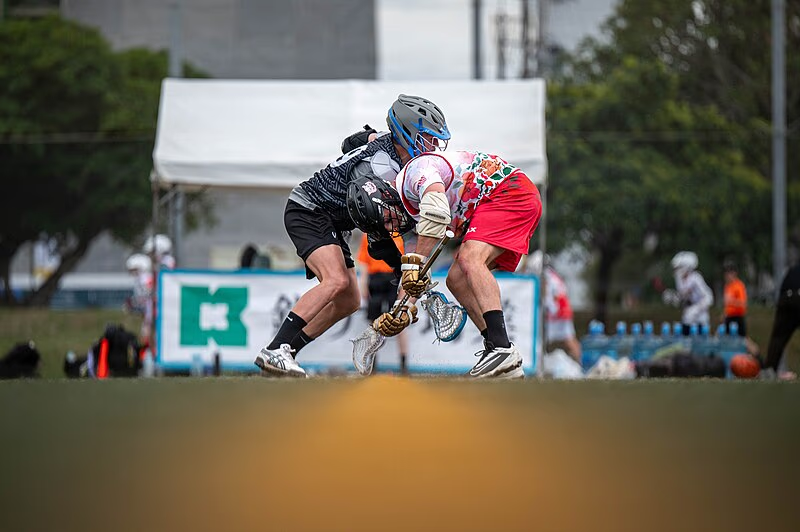
Play begins with a face-off at the center circle at the start of each quarter and after each goal. Two opposing players take the face-off: Both players crouch with their crosses on the ground, parallel to and on either side of the center line, with the ball between them.; On the official's whistl...
Why people argue about this
People often assume that in men's field lacrosse, face-offs are conducted with two opposing players standing at midfield instead of at the center circle, leading to confusion about where and how they occur. The actual rule specifies they happen at the center circle, which can cause misunderstandings if not clearly explained.
Women's lacrosse begins each half and restarts after each goal with a draw at the center circle. Two opposing players stand at the center circle with their crosses held at hip height.
Why people argue about this
People often assume that only one player from each team is allowed at the center circle for the draw, which leads to arguments about whether a second defender can join in or if it's strictly just two players per side. The confusion arises because of misinterpreting the rule that specifies "two opposing players" rather than limiting it to just one defender and one attacker.
The ball is in play from the moment the official sounds the whistle to commence play. The ball becomes dead and play stops when: A goal is scored; The ball goes out of bounds; A foul is committed and the official sounds the whistle
Why people argue about this
People often assume that as soon as the whistle blows, play automatically starts with a ball in motion, forgetting about players who might still have possession or control of the ball. The confusion arises because they overlook the fact that once the whistle sounds, it's only when the official throws the ball into play by tossing it to one team that the ball officially becomes "in play.
When the ball goes out of bounds, possession is awarded to the team that did not touch the ball last before it went out (except after an unsuccessful shot on goal — see Section 6). On a shot that goes out of bounds, possession is awarded to the te...
— Section 6
Why people argue about this
People often assume that if a shot goes out of bounds, possession is always awarded to the team who last touched it before going out, which contradicts the official rule stating possession switches to the other team on shots that go out. The confusion arises because they misinterpret Section 6's exception for unsuccessful shots as applying to all shots, not just those that miss the goal.
Each team is granted: Men's Field: Two (2) time-outs per game, each lasting 90 seconds. One additional time-out per overtime period.; Women's Field: Two (2) time-outs per game, each lasting 90 seconds.; Time-outs may only be requested by the head coach or a player in possession of the ball. Time-...
Why people argue about this
People often assume that time-outs in lacrosse are awarded randomly throughout a game, like flipping a coin, when in fact they're granted based on how many times each team requests them within their allotted timeouts per half of play. The confusion arises because the rulebook doesn't specify when or why teams get these timeouts; it just states they can be used at any time during the game.
If the score is tied at the end of regulation in men's field lacrosse, a sudden-victory overtime period is played. The first team to score wins.
Why people argue about this
People think that if a game ends scoreless in regulation, it automatically goes into sudden-victory overtime with no extra time added, but actually, teams must play at least 5 more minutes of full regulation before considering overtime. This often leads to confusion about when the actual overtime period begins.
The goalkeeper has special privileges within the crease: The goalkeeper may touch the ball with any part of the body (including hands) while within the crease.; Opposing players may not enter the crease or make contact with the goalkeeper within the crease.; In men's field, the goalkeeper has fou...
Why people argue about this
People often assume that goalkeepers can use their free hand to carry or carry out a loose ball, which they believe is allowed under this rule. However, actually, the rule only permits them to use their body to shield the ball, not to carry it in any way. This leads to confusion because carrying is generally seen as a more active role than simply shielding.
A goal is scored when the ball passes completely through the plane of the goal from front to back, between the goal posts and beneath the crossbar. The entire ball must cross the entire goal line for a goal to count.
Why people argue about this
People often assume that a goal is scored as soon as part of the ball touches the backboard; they misunderstand that for a goal to count, the entire ball must pass completely through from front to back beneath the crossbar and entirely across the goal line. They miss the crucial detail about the whole ball crossing both the plane and the line for it to be valid.
A goal is valid only if the following conditions are met: The goal was scored by an attacking player's crosse, body, or deflected off a defensive player — it may not be deliberately kicked or thrown with the hand by an attacking player.; The attacking player who last touched the ball before it en...
Why people argue about this
People often assume that a goal is only valid if the ball completely crosses the goal line before hitting the backboard, forgetting that as long as it enters the net regardless of how or where it hits the board, it counts - even if it bounces off another player first. This oversight leads to arguments about whether the ball hit the backboard or not after crossing the line.
A goal will be disallowed if: An attacking player or any part of their body is in the crease at the moment of the shot or entry of the ball.; The ball was propelled by a deliberate kick or thrown by hand by an attacking player immediately prior to entering the goal.; The ball entered the goal aft...
Why people argue about this
People often assume that if a goalkeeper accidentally scores against their own net, it's still counted as an opposing team goal, which is incorrect. Actually, in lacrosse, such goals are disallowed and don't count for the opposing side; they're simply ruled invalid. The confusion arises because of how similar this rule sounds to others where accidental goals do count, leading to misinterpretation.
If a defensive player causes the ball to enter their own goal, the goal is credited to the opposing team. If a goalkeeper accidentally puts the ball into their own net, the goal counts for the opposing team.
Why people argue about this
People often assume that if a defensive player accidentally sends the ball into their own net, it's still considered an own goal against their team, but actually, under 6.4 Own Goals in World Lacrosse, such incidents are ruled as goals for the opposing team, not just penalties or warnings.
When a shot on goal is taken and the ball goes out of bounds without entering the goal, possession is awarded as follows: The team whose player was closest to the ball when it went out of bounds is awarded possession at the spot where the ball crossed the boundary.; If equidistant players from op...
Why people argue about this
People often assume that if a shot misses the goal completely and goes out of bounds, it's awarded to the opposing team simply for missing. However, the actual rule states possession is awarded based on where the ball exits the field, not whether it hit the goal or not. The confusion arises because they overlook the specific clause about shots on goal.
The team with the greater number of goals at the end of regulation wins the game. In the event of a tie, overtime procedures (see Section 5.8) determine the winner.
— Section 5.8
Why people argue about this
People often assume that a two-point goal is awarded for shots taken from behind the two-point line simply because it's called a 'two-point' goal line, but actually, it's only given when the ball goes in directly off the stick of the shooter after being shot from behind this line - no assists or other players touching the ball are involved.
In the Lacrosse Sixes format (the Olympic discipline), a two-point goal line is marked on the field. A shot taken from behind this line that results in a goal counts as two (2) points.
Why people argue about this
People often assume that a two-point goal in Lacrosse Sixes means the shooter gets two points directly for making it over the line, but actually, it's about the positioning of the goalkeeper—when they're behind the two-point line and miss blocking the shot, then it counts as a two-pointer.
World Lacrosse rules categorize fouls into two main types: Technical Fouls: Minor violations resulting in loss of possession or a 30-second suspension from the field (served in the penalty box) if the offending team had possession at the time of the foul.; Personal Fouls: More serious violations ...
Why people argue about this
People often assume that technical fouls are only for minor infractions like holding the ball too long or taking an extra step during a pass, but actually, they encompass a wide range of situations including encroachment (entering restricted areas) and interference with the ball carrier, which can be quite nuanced and sometimes contentious.
Technical fouls include (but are not limited to): Holding: A player uses their free hand, arm, or any part of their body to hold or pin an opponent's crosse or body.; Pushing: A player pushes an opponent with the hands or arms from behind or in an unsafe manner.; Withholding the ball from play: D...
Why people argue about this
People often assume that technical fouls in men's field lacrosse only involve minor infractions like holding the ball for too long or pushing an opponent offside. However, they overlook the fact that these fouls can also encompass more complex situations such as failing to properly mark an opposing player during a face-off, which is crucial for maintaining fair play and game flow.
Personal fouls are more serious and result in a mandatory penalty suspension: Slashing: A player swings or strikes an opponent with the crosse in a reckless or uncontrolled manner — not in a legal check attempt. Penalty: 1-minute suspension.; Tripping: A player obstructs an opponent below the kne...
Why people argue about this
People often assume that just because a personal foul is more serious, it means players get suspended for multiple games as punishment. But in reality, while these fouls are indeed considered more severe, they typically result in immediate ejections from the game and can lead to fines or other disciplinary actions rather than mandatory suspensions.
A player serving a personal foul penalty must leave the field and sit in the designated penalty area (penalty box).
Why people argue about this
People often assume that in man-down situations, a team must always play with only one player short of their full complement, but actually, they can field up to seven players short, as long as at least three are in the attack position and two are not throwing balls (the goalkeeper is exempt). This rule's complexity leads to misunderstandings about its application.
In women's lacrosse, fouls are adjudicated differently: Minor fouls: The fouled player is awarded a free position — unguarded possession at the spot of the foul. The fouling player must move four (4) meters away.; Major fouls: The fouled player is awarded a free position at the spot of the foul o...
Why people argue about this
People often assume that in women's field lacrosse, a free position is awarded for every foul committed by an opposing player, but actually, fouls are only penalized if they result in a clear advantage to the team committing them. This leads to misunderstandings about how frequently and under what circumstances these penalties occur.
A player may be ejected from the game for: Five personal fouls in men's field lacrosse (fouling out); A flagrant foul — any act deemed by the official as deliberately violent or dangerous; Receiving a red card in women's lacrosse
Why people argue about this
People often assume that if a player is ejected from a game for misconduct, they can't be replaced at all during their suspension period, which isn’t accurate according to the rule. Actually, while they are suspended and cannot play themselves, another player can step in until their non-releasable suspension ends, allowing the team continuity.
An attacking player entering the crease before, during, or after a shot nullifies any goal scored on that play. The ball is awarded to the defending team.; A defensive player other than the goalkeeper who enters the crease to gain an advantage may be assessed a technical foul.; An attacking playe...
Why people argue about this
People often assume that crease violations are just about stepping into the crease, which isn't entirely accurate. The real misunderstanding stems from believing that only direct contact with a defender in the crease is penalized; they overlook the broader rule that includes interference or obstruction of the goalkeeper within this protected area, even if no physical contact occurs.
All players must wear the mandatory protective equipment specified in Section 2 before being permitted to take the field. Officials are required to inspect equipment prior to the start of each game.
— Section 2
Why people argue about this
People often assume that just wearing a helmet is enough for compliance under 8.1, but actually, they must wear all the mandatory protective equipment listed in Section 2, which includes things like mouthguards, gloves, and chest protectors, not just helmets.
World Lacrosse follows international best practices regarding head injuries and concussion management: Any player who displays signs or symptoms of a concussion (loss of consciousness, confusion, unsteady gait, or reports of headache and dizziness following a blow to the head) must be immediately...
Why people argue about this
People often assume that the Head and Neck Injury Protocol in lacrosse is overly restrictive, thinking it bans all contact entirely. In reality, it simply prohibits certain types of hits designed to protect players from severe head and neck injuries, like spearing or leading with the helmet, allowing for safe stick-to-stick contact and other forms of play.
Certain contact is explicitly prohibited to protect player safety: No contact to the head or neck: Any hit, check, or contact directed at a player's head or neck is a personal foul regardless of whether it was intentional.; No checks from behind: Checks delivered to the back of a player who is un...
Why people argue about this
People often think that the illegal contact rules in lacrosse are too vague, leading them to believe they can't play aggressively. However, the actual intent is to ensure players use proper technique and avoid dangerous hits, which isn't about stifling aggression but rather protecting against injuries like concussions or broken bones.
Officials and event organizers are empowered and obligated to address unsafe weather and environmental conditions: Lightning: Play must be immediately suspended upon any observed lightning within 8 miles (approximately 13 km) of the playing venue. Play may resume no sooner than 30 minutes after t...
Why people argue about this
People often assume that this rule only applies during actual games, forgetting that it covers practice sessions too. The confusion arises because they overlook the fact that environmental conditions can be hazardous even before a game starts, affecting players' safety on practice fields and training camps.
World Lacrosse international competitions require: At least one qualified medical professional (sports medicine physician or certified athletic trainer) present at the venue for all games.; Emergency medical services (EMS) on-call or on-site at the venue.; Each team must have a designated medical...
Why people argue about this
People often assume that only acts explicitly listed as dangerous in the rules can be penalized by officials, forgetting that the overarching principle is player safety. They overlook the fact that "8.5 Medical Personnel Requirements" allows for discretion to penalize anything that poses a risk of injury, even if not specifically named in the rulebook.
Officials may inspect any player's equipment at any time during the game, including the crosse pocket depth: The pocket test is conducted by placing the ball in the pocket of the crosse and holding the head horizontal. If the top of the ball falls entirely below the bottom edge of the sidewall, t...
Why people argue about this
People often assume that if a player's equipment isn't explicitly mentioned in the rules as dangerous, it can never be penalized for safety reasons. But actually, officials retain broad discretion to penalize anything they deem potentially harmful or likely to cause injury, even if not specifically listed, based on their interpretation of the guiding principle of player safety.
Officials retain broad discretion to penalize any act that they deem dangerous or likely to cause injury, even if not explicitly enumerated in the rules. The guiding principle is player safety.
Why people argue about this
People often assume that the official's discretion in ruling dangerous play is limited strictly to acts explicitly named in the rules, forgetting that "dangerous" can encompass behaviors not specifically listed. The confusion arises because they overlook how officials interpret player safety broadly beyond the text of the rulebook.
The official lacrosse ball must be solid rubber. Per World Lacrosse specifications: Circumference: Not less than 19.7 cm (7¾ inches) and not more than 20.3 cm (8 inches); Weight: Not less than 142 g (5 oz) and not more than 149 g (5¼ oz); Color: White, yellow, or orange for men's field; yellow or...
Why people argue about this
People often assume that the crosse's mesh pocket is optional for shooting purposes, which leads to arguments about whether players can shoot without a pocket. However, the official verdict clearly states that the head must contain a mesh or leather pocket, emphasizing its necessity for all ball-handling actions, including shooting.
The men's lacrosse field is a rectangular grass or artificial turf surface with the following official dimensions per World Lacrosse Men's Field Rules:
Why people argue about this
People often assume that the grass versus artificial turf debate is solely about player comfort, when in reality it's more about the ball’s behavior on different surfaces. They overlook how the type of playing surface can affect the trajectory and speed of the lacrosse ball, leading to disagreements over which material provides the most consistent gameplay conditions.
Each team consists of ten (10) players on the field at one time: 1 Goalkeeper (GK); 3 Defensemen — primarily positioned in the defensive half; 3 Midfielders — free to play the full field
Why people argue about this
People often assume that since there are no positional restrictions in women's lacrosse, all players can run anywhere on the field without regard for their role or position. However, the confusion arises because while they can move freely, tactical positioning is still expected based on each player’s skill and game plan, not just random movement.
A standard men's field lacrosse game at the international level consists of four (4) quarters of fifteen (15) minutes each, for a total of sixty (60) minutes of playing time. Overtime procedures apply if the score is tied at the end of regulation.
— Section 6
Why people argue about this
People think that each quarter is exactly 15 minutes long, but they often argue over whether it's strictly enforced as such due to timekeeping variations or when a timeout changes the clock reading mid-quarter. The confusion arises because in real games, quarters can sometimes be slightly longer or shorter than 15 minutes if there are adjustments for timeouts and other stoppages.
A goal is scored when the ball passes completely through the plane of the goal from front to back, between the goal posts and beneath the crossbar. The entire ball must cross the entire goal line for a goal to count.
— Section 5.8
Why people argue about this
People often think that a goal is scored as soon as part of the ball crosses the goal line, but they misunderstand that for it to count, the entire ball must pass completely through from front to back between the posts and under the crossbar - not just touch or partially enter the net. They miss the crucial detail about the whole ball needing to go all the way through for a legitimate score.
World Lacrosse rules categorize fouls into two main types: Technical Fouls: Minor violations resulting in loss of possession or a 30-second suspension from the field (served in the penalty box) if the offending team had possession at the time of the foul.; Personal Fouls: More serious violations ...
Why people argue about this
People often argue that technical fouls are only about minor infractions like holding the ball for too long, when in reality, they encompass a wide range of situations including offside violations, illegal use of hands, and improper stick handling techniques—any rule breach can be categorized as a technical foul if it doesn't fit into more specific categories.
All players must wear the mandatory protective equipment specified in Section 2 before being permitted to take the field. Officials are required to inspect equipment prior to the start of each game.
— Section 2
Why people argue about this
People often assume that protective gear is just for show or optional, leading them to argue about why they need to wear it when they feel fine without. The confusion arises because in lacrosse, safety is a top priority, and Section 8 clearly mandates mandatory equipment to prevent injuries during games.