

🏛️Official — JJIF
Loading OpenSourceSports…
Release immediately upon the tap or verbal submission
When an opponent taps the mat, their body, or the competitor's body — or calls 'maitta' — joint locks and chokes must be released at once, even a fraction of a second before the referee signals. Holding on past the tap is considered a serious breach of the martial arts code and can end careers or cause permanent injury.
No trash talk or psychological intimidation on the mat
Verbal taunting, stare-downs designed to intimidate, or any psychological pressure tactics before or during a match are considered contrary to the martial spirit. Unlike combat sports with showmanship traditions, Ju-Jitsu's budo roots make such behavior stigmatizing even when not penalized by referees.
Do not apply joint locks with sudden, wrenching force in training
In the training context that precedes and parallels competition, joint locks are applied with progressive pressure, giving the partner time to tap. Snapping on an armbar or shoulder lock without controlled escalation — especially against a less experienced partner — is a serious breach of trust and dojo culture.
Single 3-minute period (4 minutes for Senior major championship); Match is continuous; the three "phases" describe the techniques permitted at any given moment, not separate timed sub-rounds
Why people argue about this
People often assume that JJIF matches are divided into distinct 3-minute periods like in other combat sports, leading to arguments about when a period ends or how many there should be. However, the official verdict clarifies that match length is actually continuous, with phases of competition dictating technique use rather than separate time intervals.
Light-contact punches + kicks to permitted target areas; 1 point per clean strike; No knockouts permitted — heavy contact is penalized
Why people argue about this
People often assume that since strikes are allowed in Phase 1 of Ju-Jitsu Fighting, they can go as far as causing a knockout, which is actually prohibited according to the official verdict. The confusion arises because some practitioners and spectators might overlook or misinterpret the specific prohibition on knockouts despite allowing strikes.
Throws scored 2-7 points depending on amplitude + landing; Ippon (full throw to back): 7 points; Wazari (partial back-landing): 5 points
Why people argue about this
People often assume that just because a throw lands perfectly with the opponent's back facing them (Ippon), it automatically scores 7 points without considering other factors like amplitude or how hard they threw it. But actually, the rule states throws score between 2 to 7 points based on these specific criteria, not solely by whether it's an Ippon.
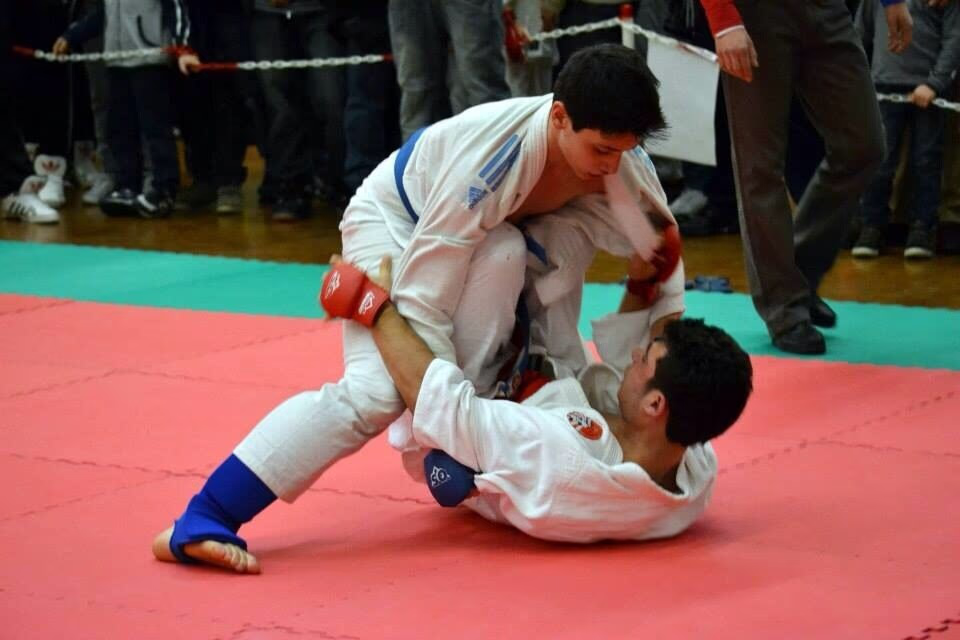
Pin (15 seconds): 5 points; Submission via tap = total victory (ippon); Joint locks on arms + chokes legal at Senior level; restricted in Junior
Why people argue about this
People often think that leg locks are allowed in Newaza phase of Ju-Jitsu Fighting at Senior level simply because they're mentioned as legal, but actually, it's a common point of contention since many practitioners and officials argue over whether or not these leg locks should be permitted given their potential for causing injury.
Continuous flow: referee directs transitions based on competitor actions; Stalemate in any phase → referee restart in standing
Why people argue about this
People often think that the Groundwork phase only involves pinning their opponent, forgetting that a submission win through joint locks is also possible in this category, leading to confusion about what exactly constitutes a Groundwork victory.
Gi (Kimono): JJIF-approved white gi (Phase 2 + 3); red/blue belt for distinguishing competitors; Hand pads / open-fingered gloves: for Phase 1 striking — lightly padded, similar to amateur boxing; Headgear: mandatory in Junior categories; optional in Senior
Why people argue about this
People often assume that groin protectors are only for men due to their traditional use in male sports, so they're surprised when JJIF mandates them for all senior men regardless of gender. Meanwhile, some women argue against the chest protector rule, thinking it's unnecessary or uncomfortable since most fights don't involve direct contact with chests anyway.
JJIF-standard tatami: 8m × 8m competition area + padded safety zone; Mat materials must meet JJIF specifications for both striking-impact + groundwork comfort
Why people argue about this
People often assume that the 8m × 8m mat size is just for convenience, but in reality, it's crucial for providing a balanced playing surface where both striking impact and groundwork movements can be safely executed according to JJIF standards. They overlook how this specific area ensures all competitors have an equal chance regardless of their fighting style or technique.
Two competitors per match; Weight classes follow JJIF schedule (Men: -56, -62, -69, -77, -85, -94, +94 kg; Women similar consolidation); Age categories: Cadet, Junior, Senior, Veteran
Why people argue about this
People often assume that JJIF allows mixed-gender matches where men compete against women in different weight classes, which they think would create unfair advantages based on gender rather than weight. However, the actual rule specifies separate competitors per match regardless of gender, maintaining fairness by focusing solely on weight categories for each individual participant.
Single 3-minute period (4 minutes for Senior major championship); Match is continuous; the three "phases" describe the techniques permitted at any given moment, not separate timed sub-rounds; Light-contact punches + kicks to permitted target areas
Why people argue about this
People often assume that since there are no knockouts allowed in JJIF's Phase 1: Striking, it means fighters can't get injured at all during these 3 minutes. But actually, what this rule does is prevent fighters from ending matches via knockout due to strikes alone; injuries and submission wins are still possible within the time limit.
Decision priority: ippon/submission > points > referee decision; Tournament: single-elimination + repechage; Gold/Silver/two Bronze per weight + gender + age
Why people argue about this
People often assume that in single-elimination JJIF tournaments, ippon (submission) is only awarded for points when other methods fail, which they mistakenly believe means it's a rare occurrence. However, the rule actually states ippon has the highest priority, so even if points aren't earned, an ippon can still be scored and result in a win.
Heavy contact in Phase 1 (striking too hard): warning → point deduction → DQ; Illegal techniques (eye-poke, throat, spine, head-butts, leg locks, etc.): caution → DQ; Stalling / passivity: warning → caution → opponent advantage
Why people argue about this
People often assume that a warning is just a verbal reminder without consequences, forgetting that it leads directly to point deductions if Phase 1 continues with heavy contact. This oversight frequently causes confusion because they miss the severity of the initial warning in JJIF's rule structure for maintaining safety and fairness.
JJIF Fighting's light-contact striking rule (vs full-contact alternatives) substantially reduces concussion risk. Mandatory headgear for Junior categories adds protection.
Why people argue about this
People often argue that the mandatory headgear requirement for Junior categories in JJIF Fighting is too restrictive, thinking it limits their ability to fight effectively or hurts their performance. But actually, they misunderstand how crucial protection is at such a young age to prevent injuries like concussions and other head trauma. The rule aims to balance safety with fair competition.