

🏛️Official — JJIF
Loading OpenSourceSports…
Release the submission immediately on tap
The moment an opponent taps — whether the mat, your body, or their own body — you release the lock or choke without hesitation. Holding even a fraction of a second past the tap to 'finish' is considered a serious breach of the code and a genuine safety violation. This norm predates written rules and is the bedrock ethic of all grappling arts.
Check on an opponent who goes limp in a choke
If an opponent loses consciousness during a strangle rather than tapping, the accepted norm is to release immediately and assist or signal for medical attention rather than celebrating or walking away. The practitioner applying the choke is expected to ease the opponent to the mat safely.
Don't crank submissions — apply with progressive control
Submissions should be applied with increasing, controlled pressure, giving the opponent a window to recognize they are caught and tap. Jerking or cranking a joint lock on explosively — especially in randori — is seen as reckless and disrespectful, as it denies the opponent a chance to submit safely.
5 minutes (single period); If tied: 2-minute golden-score overtime, first scoring action wins
Why people argue about this
People often assume that if a match is tied at 5 minutes, it automatically goes into overtime with no scoring required for either side to win. But actually, only when there's a clear scoring action (like a submission or reversal) does the 2-minute overtime start, ensuring fairness and preventing prolonged tie-ups from extending the game unnecessarily.
2 points: Takedown, Sweep, Knee-on-Belly; 3 points: Guard Pass; 4 points: Mount, Back Mount
Why people argue about this
People often assume that scoring in Ne-Waza only includes takedowns and sweeps for 2 points each, forgetting about the other advanced maneuvers like knee-on-belly (3 points) or submission wins (instant win). They overlook how crucial these additional techniques are to a full-scoring match, leading to misunderstandings.
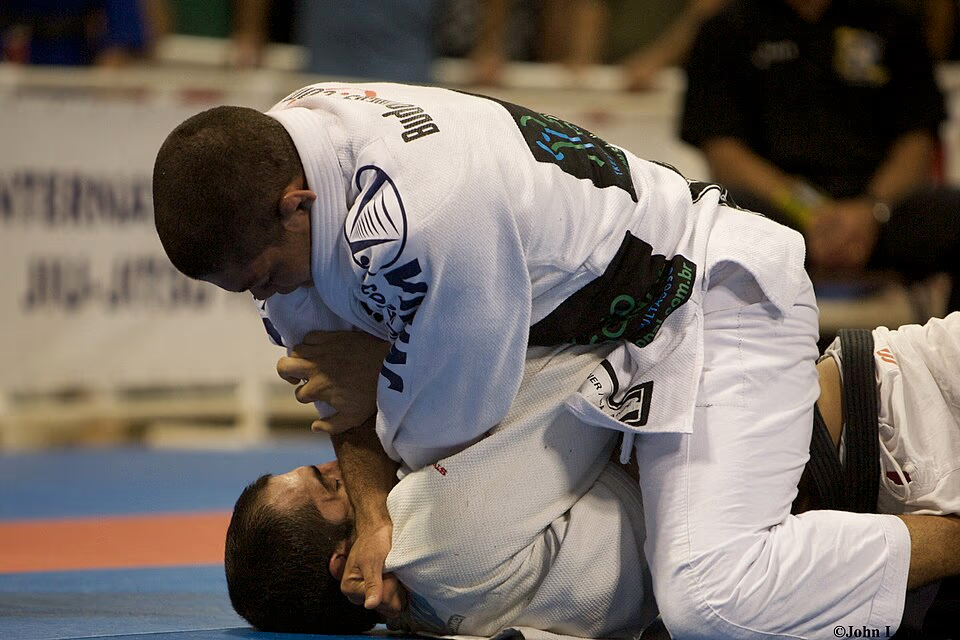
Gi (Kimono): JJIF-approved white gi for Gi category; colored belt + red/blue sash for distinguishing competitors; No-Gi: rashguard + shorts; rashguard color (red/blue) for competitor distinction; Mouthguard recommended; protective cup permitted (men)
Why people argue about this
People often assume that since protective cups are permitted in No-Gi Jiu-Jitsu under JJIF's rules, they can be worn at will during training sessions without considering potential injuries or equipment malfunctions. However, the actual rule states these must be used with caution and only by men, leading to misunderstandings about their proper use and necessity.
JJIF-standard tatami: 8m × 8m competition area + padded safety zone; Multiple parallel mats at major championships
Why people argue about this
People often assume that all Jiu-Jitsu Ne-Waza competitions are held on a standard 8m x 8m tatami mat without any safety zone or additional mats, which leads to misunderstandings about the actual playing area dimensions and setup at major championships. The confusion arises because these details aren't always clearly communicated in initial rule explanations or promotional materials.
Two competitors per match (red sash/rashguard + blue sash/rashguard); Weight classes follow JJIF schedule; Age categories: Cadet, Junior, Senior, Veteran
Why people argue about this
People often assume that only one mat referee is needed for Ne-Waza matches in Jiu-Jitsu, misunderstanding the official roster which includes two corner judges alongside a scoring official and timekeeper, leading to confusion about the exact number of officials involved.
5 minutes (single period); If tied: 2-minute golden-score overtime, first scoring action wins; Match begins standing; both competitors approach + engage
Why people argue about this
People often think that the golden-score overtime is solely about submissions, forgetting that takedowns, sweeps, knee-on-belly positions, guard passes, mounts, and back mounts are also scored during this crucial 2-minute period, leading to confusion on what exactly constitutes a win in overtime.
Decision priority: submission > points > golden score > referee decision; Tournament: single-elimination + repechage; Gold/Silver/two Bronze per weight + gender + age + format (gi vs no-gi)
Why people argue about this
People often assume that in Jiu-Jitsu Ne-Waza, points are given more importance than submissions when deciding a winner, which leads to arguments since the official rule actually prioritizes submission over points and golden scores before considering referee decisions in single-elimination tournaments. The confusion arises because many overlook this specific detail about scoring priorities.
Stalling: verbal warning → caution → opponent advantage; Illegal submissions: caution → DQ; Slamming: DQ
Why people argue about this
People often assume that stalling in Jiu-Jitsu Ne-Waza is just about holding your breath or moving slowly, but actually, it's more nuanced - the rule covers any deliberate action to delay the match without making a legitimate attempt at scoring points, which can be hard to discern from strategic play.
Ne-Waza injury profile: joint injuries (shoulder, elbow, knee), neck strain, occasional concussion. JJIF restricts high-risk submissions (heel hooks, twisters) more strictly than ADCC or even IBJJF.
Why people argue about this
People often think that the JJIF's strict restrictions on high-risk submissions like heel hooks and twisters are overly harsh, but actually, they're trying to balance safety with the risk of injury, which is a key concern highlighted in Section 8 about safety considerations for Ne-Waza. They aim to prevent injuries without completely banning techniques that could be used safely under supervision.
Match begins standing; both competitors approach + engage; Pulling guard permitted but referee may intervene if continuous pulling without action
Why people argue about this
People often assume pulling guard is strictly prohibited in Jiu-Jitsu Ne-Waza, which leads to misunderstandings about when it's acceptable. However, the official verdict clarifies that while pulling guard isn't explicitly forbidden, referees intervene if a competitor continuously pulls without engaging with their opponent, thus maintaining the flow and fairness of the match.
Joint locks legal on arms; some on legs (varies by belt + age); Chokes legal at Senior level; No heel hooks, no twisters, no neck cranks (more restrictive than ADCC or modern no-gi grappling)
Why people argue about this
People often assume that joint locks are automatically illegal in Jiu-Jitsu Ne-Waza just because they're called submissions. But actually, the key is which moves are specifically prohibited; some joint locks are allowed under certain conditions, leading to much debate and misunderstanding among competitors and spectators alike.