


🏛️Official — INDYCAR
Loading OpenSourceSports…
Never squeeze a competitor into the wall at oval speeds
Deliberately or carelessly forcing another driver toward the outside wall on an oval at 220+ mph is considered one of the gravest breaches in IndyCar culture. Drivers are expected to leave racing room even under hard competition. The potential for catastrophic injury at these speeds elevates this beyond mere etiquette to a near-absolute imperative.
Clear the racing line immediately for a car on a flying qualifying lap
When a driver is on a hot qualifying lap, all others on track are expected to yield immediately and move fully off the racing line. Impeding a qualifying run — particularly during the high-stakes Indianapolis 500 qualification weekends with bumping — can unfairly eliminate a rival and is considered a serious breach drawing stern paddock criticism.
Do not retaliate by deliberately wrecking another driver
Even when a driver feels genuinely wronged by a rival's aggressive or dirty move, intentionally causing a crash as payback is universally condemned in IndyCar. Open-wheel speeds make deliberate wrecking potentially lethal, and drivers who pursue on-track revenge lose the respect of the entire paddock regardless of the original provocation.
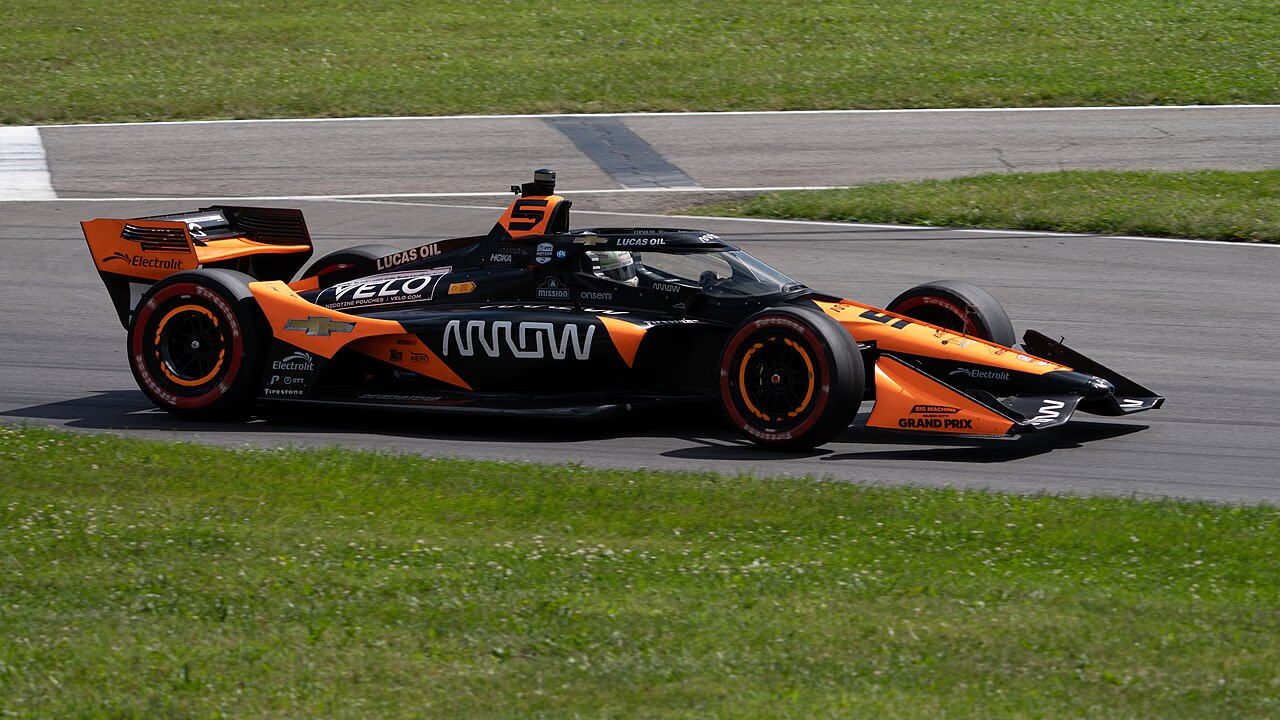
Aeroscreen: The titanium-framed ballistic screen protects the driver's head from debris and impacts while keeping the open-cockpit character of the car.; Survival cell: The carbon-fiber monocoque, with front, rear, and side impact structures, is engineered to absorb crash energy and protect the d...
Why people argue about this
People often assume that these safety structures are just for show, thinking they're purely cosmetic additions meant to enhance the car's appearance rather than protect drivers in a crash. However, the truth is, INDYCAR mandates these titanium-framed aeroscreens and carbon-fiber survival cells as essential components designed to absorb impact and save lives in high-speed collisions.
Full-course caution: When an incident or debris makes the track unsafe, a full-course yellow is called, the pace car is deployed, and the field closes up at reduced speed behind it. Pit-stop rules during cautions (when the pits open, the order of cars) are defined in the rulebook.; Local yellow: ...
Why people argue about this
People often assume that red flags in INDYCAR are used randomly based on their color alone, forgetting that they're only deployed when conditions become unsafe or during official caution periods, which is clearly stated in the rules but can lead to confusion given how quickly racing can escalate under pressure.
SAFER barriers: Energy-absorbing barriers line oval walls and high-risk points on road and street courses to soften impacts.; Run-off and barriers: Road courses use gravel traps and run-off; street courses use tire packs and reinforced walls where run-off is limited.; Debris management: Full-cour...
Why people argue about this
People often assume that SAFER barriers are only for protection during crashes, forgetting they're also installed as a preventative measure to reduce debris on the track post-incident. They think these barriers absorb all impacts, but in reality, their primary function is to minimize damage and injuries by deflecting cars off the walls, not just absorbing them like a cushion.
INDYCAR is unusual among major championships in racing on three fundamentally different kinds of circuit within a single season: Ovals: Ranging from the 2.5-mile Indianapolis Motor Speedway superspeedway to short ovals under one mile. Cars run the low-downforce superspeedway aero kit on the faste...
Why people argue about this
People often assume that INDYCAR races are all held on oval tracks, thinking it's a one-circuit type league due to its name. However, the official verdict clarifies that within a single season, INDYCAR does indeed feature three fundamentally different circuit types—ovals, road courses, and street circuits—which can lead to confusion about what they're used for or how they affect racing strategies.
Drivers must meet fitness standards appropriate to the physical demands of oval and road/street racing.; Pit crew members are required to wear fire-resistant gear and helmets while working on pit lane.; Mandatory orientation and refresher programs ensure drivers are prepared for the specific dema...
Why people argue about this
People often assume that just because INDYCAR has a comprehensive safety system in place, drivers are never at risk during races. But actually, they misunderstand that while these systems significantly reduce risks like head injuries from crashes and debris, there's still no guarantee of 100% protection, which leads to ongoing debates about the absolute safety measures needed for racing.
Helmet and head-and-neck restraint: An approved racing helmet plus a head-and-neck restraint (HANS-type) device are mandatory.; Fire-resistant gear: Multi-layer fire-resistant suit, underwear, gloves, socks, and shoes meeting motorsport standards.; Restraint system: A multi-point harness secures ...
Why people argue about this
People often assume that the carbon-fiber monocoque is just a fancy looking shell for aerodynamics, when in reality it's designed as a crucial safety structure to protect drivers in case of crashes, which can lead to misunderstandings about its primary function and value beyond aesthetics.
Drivers must hold a valid INDYCAR license for the category. New drivers, and drivers returning to a circuit type, complete a Rookie Orientation Program or refresher, particularly for oval and superspeedway running.; Indianapolis 500 participation requires completion of the Indianapolis-specific o...
Why people argue about this
People often assume that just having a valid license is enough for INDYCAR drivers, without realizing they also need to complete orientation programs as required by the rules. They might think it's an extra step or unnecessary, but in fact, these programs are designed to ensure all drivers have the necessary knowledge and skills to operate safely within the series' regulations.
A typical event weekend consists of practice sessions, qualifying, and the race. Session lengths and the number of practices vary by circuit type and are set in the event bulletin.
Why people argue about this
People often assume that all INDYCAR events follow a rigid 3-session format without considering individual circuit specifics. They overlook the fact that session lengths and practice counts can vary significantly from one track to another, leading to misunderstandings about what they should expect at each event.
Race Director: The senior race official, responsible for the conduct of the event — starts, restarts, caution and red-flag decisions, and the application of penalties during the race.; Stewards: A panel that reviews incidents, hears the entrant's position, and issues or confirms penalties; certai...
Why people argue about this
People often assume that officials in INDYCAR are only responsible for enforcing penalties, when in fact they oversee all aspects of event conduct like starts, restarts, and red-flag decisions, which can lead to confusion about their full role and responsibilities on race day.
Avoidable contact: Contact judged to be avoidable that affects another competitor draws penalties ranging from a position penalty to a drive-through.; Blocking: Reactive moves to defend position that force another driver to take evasive action are penalized.; Jumping a start or restart / passing ...
Why people argue about this
People think that just bumping into another car is penalized, but actually it's only avoidable contact and blocking that affects other competitors which gets penalties. The confusion arises because jumping a start or restart can also result in penalties, often seen as less severe than track violations.
In-race penalties include drive-through penalties, stop-and-hold penalties, and time penalties; grid penalties apply to qualifying offenses.; Post-event sanctions include fines, points deductions, probation, suspension, and disqualification.; The Race Director may apply penalties during the race;...
Why people argue about this
People often assume that penalties in INDYCAR are solely for avoiding contact with other cars, forgetting that they also cover blocking, which is when a car intentionally impedes another racer's path or slows them down without causing direct harm. The confusion arises because "blocking" isn't just about being hit; it’s about obstructing the flow of racing unfairly.
Pit lane runs parallel to the start/finish straight and is divided into team pit boxes assigned by the rulebook's order (often by championship position or qualifying).; A strictly enforced pit lane speed limit applies whenever the pits are open; cars are monitored electronically.; Pit entry and e...
Why people argue about this
People often think that INDYCAR assigns pit boxes by team size or budget rather than championship position or qualifying order, which leads to misunderstandings about who gets what box in Pit Lane. The confusion arises because they assume financial factors influence allocation instead of performance metrics like championships and qualifications.
Pit stops are used to refuel, change tires, and make permitted adjustments. Work must be performed within the team's assigned pit box.; Pit-lane speed limits, safe-release rules (a car must not be released into the path of another), and equipment-over-the-wall limits are strictly enforced.; On ro...
Why people argue about this
People often think that INDYCAR's multi-round qualifying process is just a fancy way of saying they're going to have one big race at the end, but actually it's designed to ensure more competitive grids by giving drivers multiple chances to improve their position through strategic driving and tire management in each round.
Pit speeding: Exceeding the pit-lane speed limit draws a time or drive-through penalty.; Unsafe release: Releasing a car into the path of another, or work done outside the assigned box, is penalized.; Equipment, fueling, and crew-over-the-wall infractions carry defined penalties.
Why people argue about this
People often assume that just because a car has non-homologated components doesn't automatically mean they'll be disqualified. They mistakenly think it's only about race cars having parts from other manufacturers, forgetting that technical infractions like incorrect tire pressures or brake temperatures can also trigger penalties in pit-lane violations, not just component issues.
Engine: A 2.2-liter twin-turbocharged V6, supplied by one of the series' engine manufacturers (Honda or Chevrolet), built to INDYCAR specification with controlled boost levels.; Hybrid system: INDYCAR cars run a hybrid energy-recovery unit packaged with the engine; it captures and deploys electri...
Why people argue about this
People often assume that INDYCAR's 2.2-liter V6 engine is a standard formula where all cars run at exactly 2.2 liters, but actually, what the official verdict clarifies is that each car can have its own unique displacement within this range, allowing for customization and innovation in powertrain design without breaking the rule.
Results are first published as provisional and become official after post-race technical inspection and the resolution of any penalties or reviews.; A car found non-compliant in post-race inspection can be penalized in the results or disqualified.
Why people argue about this
People often assume that provisional results are automatically considered official after a race, leading to disputes when they aren't ratified. Actually, these provisional results only become official once the IndyCar Series confirms them, which can sometimes lead to confusion and arguments among fans who might not realize this crucial step in the process.
On road and street courses, drivers have a limited "push to pass" overtake system that provides a temporary engine boost. Each driver has an allocation of time (or activations) per race, with restrictions — for example, it is not available on the first lap or during cautions/restarts as specified...
Why people argue about this
People often assume that Push to Pass is a standard feature across all INDYCAR races, forgetting its exclusive use in qualifying rounds on ovals and during the multi-day Indianapolis 500 format. They overlook the rule's specific application, leading to misunderstandings about when it can be used.
Road and street courses: A multi-round knockout qualifying format. The field is split into groups; the fastest advance through successive rounds, culminating in a final shootout (the "Fast Six") that sets the front of the grid, while eliminated cars are ordered by their best times.; Ovals: Cars q...
Why people argue about this
People often think that INDYCAR's qualifying system for road courses is just a single round of eliminations, forgetting about the multi-round knockout format where drivers compete in multiple heats until only the top 12 advance to the grid. They overlook how this complex structure ensures a more competitive and unpredictable starting lineup each race.
Championship points are awarded by finishing position, with the race winner receiving the largest single allocation and points scaling down through the full field so that every classified finisher scores.; Bonus points are available for qualifying on pole position, for leading at least one lap, a...
Why people argue about this
People often assume that race points are solely awarded for winning a race, forgetting about bonuses for pole position and leading laps, which can significantly alter their strategy and perception of what's important in INDYCAR races. The confusion arises because these additional incentives make it harder to predict the exact outcome based on just finishing positions alone.
The AMR INDYCAR Safety Team travels with the series and is stationed around every circuit for rapid response to incidents — extrication, fire response, and initial medical care.; INDYCAR Medical provides on-site physicians and a medical center at each event; drivers involved in significant incide...
Why people argue about this
People often assume that aeroscreens are only for protection from debris, forgetting that they also serve as a last line of defense in case of driver ejections during high-speed crashes, which can be misleading if they're solely seen as a safety feature for drivers.
All entries use a common Dallara chassis (the IR-18 generation) built to INDYCAR specification. Teams may not deviate from the homologated design except as permitted by the rulebook.
Why people argue about this
People often assume that since all cars are built to a common design, teams can't make any modifications at all. But in reality, they're allowed minor adjustments as long as they don’t deviate from the homologated design, leading to arguments about what exactly constitutes a 'minor adjustment'.
INDYCAR is unusual among major championships in racing on three fundamentally different kinds of circuit within a single season: Ovals: Ranging from the 2.5-mile Indianapolis Motor Speedway superspeedway to short ovals under one mile. Cars run the low-downforce superspeedway aero kit on the faste...
Why people argue about this
People often assume that INDYCAR's decision to race on three fundamentally different circuit types within a single season is solely for variety, but actually, it's about maximizing performance across various track conditions by testing drivers and teams under diverse challenges, which can lead to unpredictable outcomes and thus more arguments over strategy and preparation.
Drivers must hold a valid INDYCAR license for the category. New drivers, and drivers returning to a circuit type, complete a Rookie Orientation Program or refresher, particularly for oval and superspeedway running.; Indianapolis 500 participation requires completion of the Indianapolis-specific o...
Why people argue about this
People often assume that just having a valid INDYCAR license means you can race without needing to complete orientation programs, which is actually part of the same requirement under Section 4. The confusion arises because they might overlook or misinterpret the comprehensive nature of what's required for participation in INDYCAR events.
A typical event weekend consists of practice sessions, qualifying, and the race. Session lengths and the number of practices vary by circuit type and are set in the event bulletin.
Why people argue about this
People often assume that all INDYCAR events have exactly four practice sessions as stated in the bulletin, forgetting that some tracks might use a different format like three or even no official practices at all, leading to confusion about how many they'll actually see on race weekend.
Championship points are awarded by finishing position, with the race winner receiving the largest single allocation and points scaling down through the full field so that every classified finisher scores.; Bonus points are available for qualifying on pole position, for leading at least one lap, a...
Why people argue about this
People think that scoring is solely based on finishing position, forgetting about bonuses for pole position, leading laps, and overall race leadership. But actually, these additional factors significantly impact a driver's total points and championship standing in INDYCAR races.
A car that fails pre-event, post-qualifying, or post-race technical inspection can lose its qualifying time, be sent to the rear of the grid, lose points, or be disqualified, depending on the severity of the breach.; Use of non-homologated or modified components outside the rulebook's allowances ...
Why people argue about this
People often assume that if a car fails pre-event inspection, it can only lose its qualifying time, forgetting about potential disqualification entirely. The misunderstanding lies in believing the severity factor is solely about losing qualifying spots, overlooking the possibility of outright elimination from the race altogether based on how severe the violation was deemed.
Aeroscreen: The titanium-framed ballistic screen protects the driver's head from debris and impacts while keeping the open-cockpit character of the car.; Survival cell: The carbon-fiber monocoque, with front, rear, and side impact structures, is engineered to absorb crash energy and protect the d...
Why people argue about this
People often assume that INDYCAR's safety measures are solely about protecting drivers from crashes by providing aeroscreens and survival cells. However, they overlook the fact that these structures also serve as crucial barriers to shield drivers from debris during high-speed turns, which is a significant aspect of their design and function in IndyCar racing.
Each entrant fields one or more cars, each with an assigned car number, and is responsible for the car's compliance with the rulebook.; Crew members working on pit lane must be registered and wear required protective equipment.
Why people argue about this
People often assume that just because a car has an assigned number, it automatically means all cars in the team must have numbers too, leading to arguments about which vehicles should be numbered. The confusion arises because INDYCAR rules require each car to be numbered, not necessarily every vehicle within a team, including support cars or non-competitive entries.
A car that fails pre-event, post-qualifying, or post-race technical inspection can lose its qualifying time, be sent to the rear of the grid, lose points, or be disqualified, depending on the severity of the breach.; Use of non-homologated or modified components outside the rulebook's allowances ...
Why people argue about this
People often assume that technical non-compliance in INDYCAR only affects race results like disqualification, forgetting that it can also lead to losing qualifying time or grid placement changes, which directly impact their starting position and race strategy. They miss the severity of these penalties on their overall performance trajectory.
All entries use a common Dallara chassis (the IR-18 generation) built to INDYCAR specification. Teams may not deviate from the homologated design except as permitted by the rulebook.
Why people argue about this
People often assume that teams are allowed minor tweaks to their Dallara chassis without realizing they're strictly prohibited from deviating from the homologated design as outlined in the rulebook, leading to misunderstandings and arguments about what modifications are permissible within INDYCAR's stringent regulations.
The driver with the most championship points at the end of the season is the series champion and wins the Astor Challenge Cup.; Entrant (team) and engine-manufacturer championships are scored in parallel.; Ties in the standings are broken by performance criteria defined in the rulebook — most com...
Why people argue about this
People often assume that just winning races automatically secures you the championship, forgetting about qualifying positions and how they factor into the overall points tally. The confusion arises because the rule explicitly states ties are broken by performance in both race finishes and qualifying, which can lead to unexpected champions if a driver excels solely in one area over another.
The Indianapolis 500 is run over 200 laps of the 2.5-mile Indianapolis Motor Speedway oval — a total race distance of 500 miles — with a starting field of 33 cars arranged in 11 rows of 3.; The "Month of May" build-up includes practice, the multi-day qualifying weekend that locks in the field and...
Why people argue about this
People often assume that the cars are simply eliminated from contention if they finish last in qualifying, which isn't quite accurate. The official term is that "slowest cars may be 'bumped' from the grid," meaning their positions might not necessarily be fixed at the bottom; other factors like engine performance and strategy could still affect where they start.
INDYCAR uses rolling starts: the field forms up behind the pace car and takes the green flag in formation. Standing starts may be used at selected road/street events when specified.; Passing before the start/finish line on a start or restart, or before the designated restart zone, is not permitte...
Why people argue about this
People often assume that in INDYCAR races, only the fastest cars get to start at the front, forgetting about the "bumped" strategy for the Indianapolis 500 where the slowest qualifiers are pushed back into qualifying positions to make way for faster cars, leading to a mix of timed laps and multi-round qualifying.
Firestone is the series' tire supplier. Dry tires are provided in a primary compound and a softer alternate compound on road and street courses, and oval-specific constructions for ovals.; On road and street courses, rules require the use of both dry compounds during the race. Wet-weather tires a...
Why people argue about this
People often assume that INDYCAR's tire strategy is dictated by the Dallara chassis, thinking it forces teams into certain setups or strategies. However, the key fact is that while the Dallara chassis is standardized for all entries, it doesn't dictate tire choices; teams can still choose their own compounds and manage them as they see fit based on aerodynamics and other factors.
Start/finish line and electronic timing loops placed around the circuit record each car's position and lap and sector times.; Flag stations are positioned around the circuit; flags (green, yellow, red, white, checkered, blue, black, and the warning flags) communicate track status to drivers.; On ...
Why people argue about this
People often assume that INDYCAR's three circuit types—ovals, permanent road courses, and street circuits—are interchangeable in terms of preparation and strategy, but actually each type requires distinct setups to optimize performance due to varying track conditions like surface texture, elevation changes, and wind patterns.
On road and street courses, racing continues in the rain on wet-weather tires when conditions allow; the Race Director may red-flag for standing water or poor visibility.; Oval racing is stopped for rain, because the cars cannot run safely on a wet oval; sessions are delayed or rescheduled.; Ligh...
Why people argue about this
People often assume that INDYCAR's safety measures are solely about titanium-framed aeroscreens and carbon-fiber monocoques for driver protection in crashes, but they overlook SAFER barriers, which are equally crucial as they absorb impacts on circuits, ensuring drivers' safety during high-speed turns and other maneuvers.