


🏛️Official — UWW
Loading OpenSourceSports…
Shake hands respectfully after every match
Competitors are expected to shake hands firmly and with eye contact immediately after the final whistle, win or lose. A limp, delayed, or withheld handshake is a serious breach of wrestling's honor code and draws heavy criticism from coaches, officials, and peers. Notable refusals at Olympic and World Championship events have sparked formal review.
Two 3-minute periods (30-second break); Total: 6 minutes of competition; If tied at time end: 1-minute overtime → if still tied, last-scoring competitor wins
Why people argue about this
People often assume that if a match is tied after 6 minutes (3 per period), it automatically goes straight into overtime without any further scoring attempts, which confuses them because in reality, both competitors get one more minute to score and win before the overtime begins.
2 points: Takedown ending in dominant position, Sweep, Knee-on-Belly; 3 points: Guard Pass; 5 points: Mount, Back Mount
Why people argue about this
People often think that scoring 5 points for a submission is less valuable than other takedowns because they assume it's reserved only for late-game scenarios where time is running out, but actually, submissions are worth five points regardless of when in the match they occur, as long as they're valid and not disallowed.
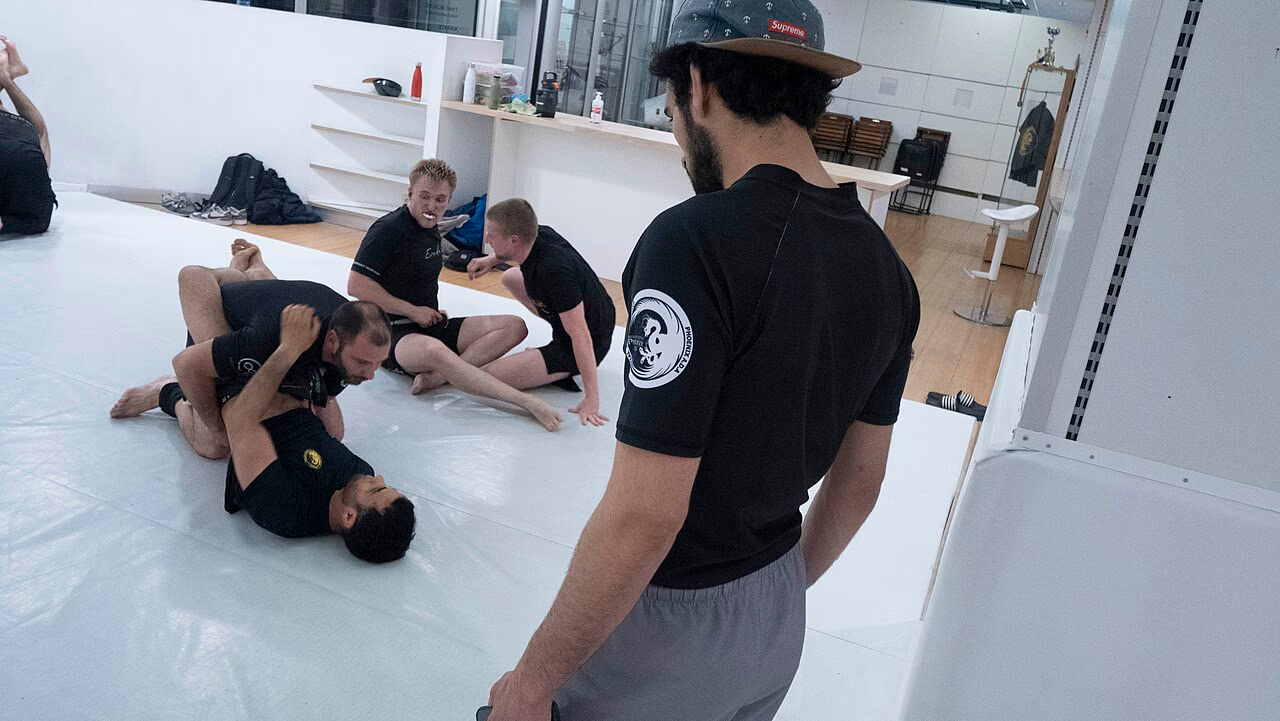
Grappling Gi: approved kimono (jacket + pants); colored belt by rank; Grappling (no-gi): rashguard + shorts (or grappling pants); rashguard covers torso; Mouthguard recommended; protective cup permitted (men)
Why people argue about this
People often assume that colored belts are optional for no-gi matches in UWW grappling, misunderstanding that they must be worn as per the rule. In reality, the rule clearly states a colored belt is required by rank for no-gi competition, not just an option.
UWW-standard wrestling mat: 12m × 12m total, with central 9m × 9m competition circle; Padded outer safety zone; Single championship mat at finals; multiple parallel mats at qualifiers
Why people argue about this
People often assume that all mats in UWW grappling are identical in size, forgetting about the central competition circle of 9m x 9m. This oversight leads to misunderstandings about where competitors actually compete within a larger mat setup.
Two competitors per match; Weight classes follow UWW wrestling-style weight categories adapted for grappling (Men: -62, -71, -80, -92, +92 kg); Age categories: Cadet, Junior, Senior, Veteran
Why people argue about this
People often assume that all competitors in a UWW grappling match are of the same age category, which leads to arguments about who should be on the mat at any given time. However, the actual rule specifies different weight categories for each age group, leading to confusion when it comes to determining which competitor is eligible to compete based on both their weight and age.
Two 3-minute periods (30-second break); Total: 6 minutes of competition; If tied at time end: 1-minute overtime → if still tied, last-scoring competitor wins
Why people argue about this
People often think that takedowns are worth more points than submissions in Grappling governed by UWW, but actually, both takedowns and submissions carry equal point value, with sweeps being a third scoring category. This confusion arises because submissions can lead to immediate victory through a submission win rather than just earning points over time.
Decision priority: submission > technical superiority > points > last-scoring competitor; Tournament: single-elimination bracket + repechage (for bronze); Gold/Silver/two Bronze per weight + format (gi vs no-gi)
Why people argue about this
People often assume that in UWW Grappling, submission is merely a tiebreaker for deciding who wins when it's a dead heat between two competitors, but actually, scoring prioritizes submission over technical superiority and points to determine winners, even if both competitors are equally skilled or have similar scores otherwise.
Passivity / stalling: verbal warning → caution + point to opponent (3 cautions = DQ); Fleeing mat: caution; Illegal submissions (age/category-restricted): caution → DQ
Why people argue about this
People often assume that a passive stalling or fleeing move is just as penalized as actively trying to score points, which leads to arguments when they receive only a caution instead of a more severe penalty like disqualification. The confusion arises because under UWW rules, the severity of penalties for such behavior is tiered based on frequency and intent, not just the act itself.
UWW Grappling combines wrestling injury profile (shoulder, knee, neck) with BJJ joint-lock risk. Age-graded submission restrictions enforced strictly.
Why people argue about this
People often assume that the strict submission restrictions in UWW Grappling are solely about protecting against BJJ joint locks, but they overlook the inherent risk of shoulder and knee injuries common in wrestling. This leads to misunderstandings because the rule aims to balance safety across multiple disciplines rather than focusing narrowly on one aspect.
Joint locks + chokes legal; specific restrictions vary by age group; Heel hooks legal in senior no-gi categories (more permissive than IBJJF, less than ADCC); Submission = instant win
Why people argue about this
People often assume that heel hooks are only illegal in grappling, forgetting they're explicitly banned by UWW regardless of category. The real confusion here stems from the blanket statement about senior no-gi categories allowing them, which overlooks their outright prohibition across all divisions.
Match ends early if scoring differential reaches 14 points
Why people argue about this
People often assume that technical superiority is about who's technically better at grappling overall, when in fact it’s strictly about scoring differential - if one competitor scores 14 points more than their opponent before the time limit, they win by this rule, regardless of how many techniques each used or which side was technically superior.