


🏛️Official — FIE
Loading OpenSourceSports…
Combat Sports
1 players
indoor
piste, face mask, glove
10 essential rules
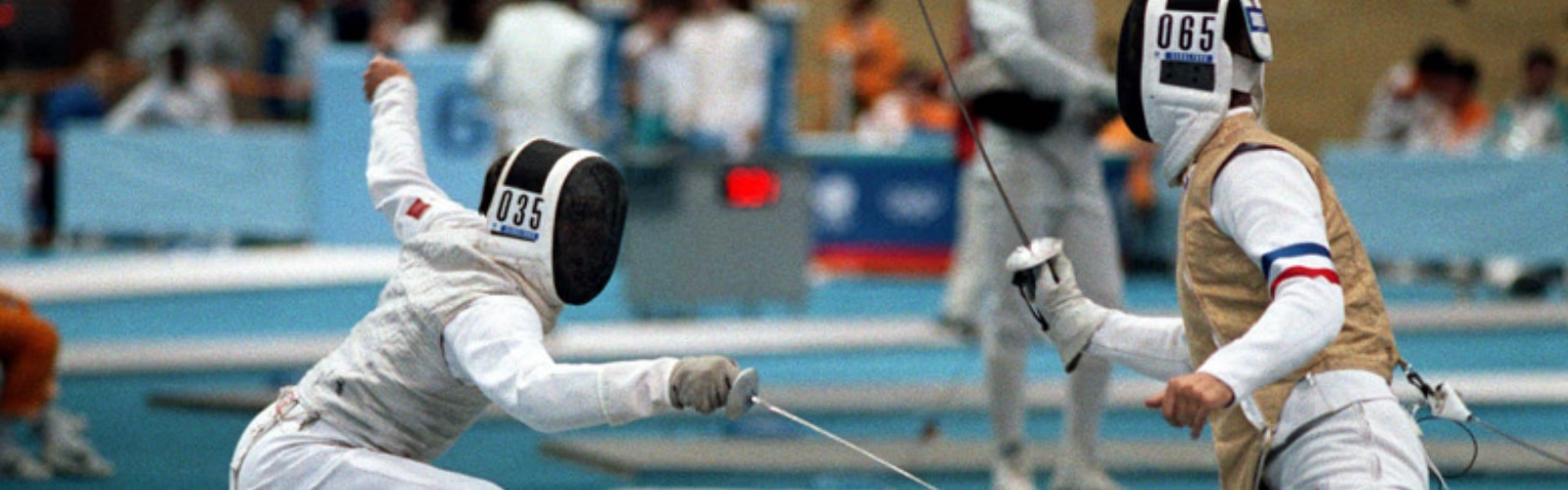
Fencing is one of only five sports contested at every modern Olympic Games since their inception in Athens 1896. The Fédération Internationale d'Escrime (FIE), founded in Paris on November 29, 1913, serves as the global governing body. The FIE administers the sport under its Rules for Competition...
Each weapon has precise FIE specifications governing weight, length, blade profile, and electrical components (Material Rules m.1–m.24): Foil: Maximum total weight 500 g (Material Rules m.6). Maximum overall length 110 cm (m.7). Flexible rectangular-section blade, maximum blade length 90 cm (m.8....
The mask is the most critical piece of safety equipment. FIE-homologated masks must meet the manufacturing and safety standards set out in Annexe A to the Material Rules.
At the start of every pool, team match, or direct-elimination bout, the referee must assemble both competitors and verify that the FIE guarantee label is present on all clothing and masks, that the conductive jacket conforms to the relevant articl...
Foil and sabre require a conductive lamé worn over the jacket to define the valid target area electronically: Foil lamé: Covers the torso (front, sides, and back) and the groin flap, matching the valid target defined in Technical Rules t.77. When the foil tip depresses against the lamé, it comple...
Body Cord: A wire running from the weapon, through the fencer's sleeve and jacket, connecting to a spring-loaded reel at the end of the piste.; Scoring Reel: A spring-loaded cable reel at each end of the piste that maintains electrical connection while allowing free movement.; Wireless Scoring: F...
All bouts take place on a regulation fencing strip known as the piste (Technical Rules t.16–19): Length: 14 m, with a total tolerance of 4 cm (t.18.2); Width: The combat area is 1.50 m wide (t.18.1); Run-back zone: Each competitor, placed 2 m from the centre line, has 5 m of retreating distance a...
Five lines must be drawn clearly across the piste at right angles to its length (Technical Rules t.19): Center line: Divides the piste into two equal halves, drawn as a broken line (t.19.1); En-garde lines: Two lines located 2 m from the center line on each side (t.19.2). Fencers begin each engag...
For foil and épée, the conductive surface must cover the whole of the length and breadth of the piste, including its run-back extension (Technical Rules t.18, Material Rules m.57). This prevents touches to the floor from registering on the scoring apparatus.
” A fencer who has crossed the lateral boundaries of the piste must be placed on guard at the correct distance even if this means being placed behind the rear line and thus causes a technical hit to be awarded against them (Technical Rules t.22.10, t.35.1, t.148).
Fencing competitions feature both individual and team events. In individual events, a single fencer competes against opponents through pool rounds and direct elimination brackets.
Perform the post-bout salute and handshake with genuine respect
After every bout, fencers remove their mask, strip the glove from the sword hand, and shake hands with the opponent and referee. This ritual is technically required, but the cultural expectation goes further: it must be performed with visible sincerity. Doing it grudgingly, perfunctorily, or refusing it entirely is considered one of the gravest breaches of fencing etiquette.
Do not scream or celebrate aggressively toward an opponent
Ripping off one's mask and screaming, yelling, or pumping fists directed at the opponent after scoring a touch—especially the winning touch—is considered deeply unsportsmanlike. This became a documented controversy at FIE World Cups and the Olympics, drawing formal commentary and informal condemnation from coaches, officials, and longtime fencers.
Most prevalent in modern sabre and foil, where quick decisive touches invite emotional reactions; the issue was prominent enough that FIE revisited conduct guidelines
Ready to dive deeper?