

🏛️Official — FIS
Loading OpenSourceSports…
Lend a broken pole or equipment to a competitor in distress
When a competitor suffers a broken pole or critical equipment failure mid-race, rivals and even opposing national teams are expected to offer a replacement if they have a spare. This is considered the defining measure of Nordic sportsmanship and has been observed at Olympic and World Championship level. Refusing is a serious reputational harm.
Call 'Track!' (Spor/Spur) before overtaking a slower skier
Approaching skiers are expected to call 'Track!' (Norwegian: 'Spor!', German/Swedish variant: 'Spur!') audibly before overtaking. The slower skier is then expected to yield promptly. This applies in training, touring, and recreational settings and is considered non-negotiable etiquette across all Nordic nations.
Do not skate-ski through set classic tracks
Skiers using the skate technique are expected never to ski through or along machine-set classic tracks. Destroying the tracks for classic skiers — especially in shared training venues or on citizen-race courses — is treated as a serious breach. The classic tracks are considered communal infrastructure to be protected.
Classic skis: Minimum length = competitor’s height minus 20 cm. Maximum width 48 mm (1.89 in). Feature a “wax pocket” or “kick zone” under the foot for grip wax or mechanical grip patterns (fish scales, skin inserts). Relatively soft flex to engage the kick zone underfoot.; Skating skis: Minimum ...
Why people argue about this
People often assume that the width limit of 48 mm is about the skis' overall thickness rather than their maximum width from toe to heel, leading to misunderstandings on how to measure compliance with this rule in cross-country skiing.
Classic (ICR 343.8.1): Maximum pole length = 83% of body height (measured with the athlete standing in ski boots on a flat surface), except in Popular Cross-Country Competitions; Skating: Maximum pole length = 100% of body height; Pole baskets must not exceed 100 cm² (15.5 in²) in area
Why people argue about this
People often assume that FIS-approved poles are just any old ski poles as long as they're used in cross-country skiing, but actually, it's about ensuring safety and performance with an FIS-approved binding system - a crucial component since the pole’s length and shape can be optimized for efficiency when paired with the right binding.
Classic boots: Low-cut, flexible sole for ankle articulation during diagonal stride; Skating boots: High-cuff design with ankle support for lateral stability during skating push; Must be commercially available models (no custom prototypes at World Cup level without prior FIS approval)
Why people argue about this
People often assume that FIS-approved equipment standards are just about the boots being waterproof and warm enough for all weather conditions, but actually, it extends to clothing like bibs and gaiters designed specifically for cross-country skiing to prevent snow from getting into their bindings and gear, which could cause accidents or injuries.
Kick wax (classic only): Applied to the grip zone; must be matched to snow temperature and humidity. Harder waxes for cold/dry, softer waxes (klisters) for warm/wet conditions.; Glide wax: Applied to tips and tails (classic) or full base (skating). Ironed into the base structure for maximum speed...
— Article 343.10
Why people argue about this
People often assume that the ban only affects synthetic wax, thinking it's about fluorocarbon compounds in general, when in reality, the rule specifically targets fluorocarbon compounds used for waxing or other similar substances on skis. They overlook the precise wording of "fluorocarbon compounds" and focus too much on the term "fluorocarbon," leading to misunderstandings.
FIS-homologated courses must provide a balanced test of uphill, flat, and downhill ability. Under ICR 311.1.2, the course profile should include approximately one-third uphills (gradient between 9%...
Why people argue about this
People often assume that the 30-30-30 split for uphill, flat, and downhill terrain means an equal amount of each in terms of length or difficulty, but actually, it's about ensuring a balanced test across all types of terrain to fairly challenge athletes' skills without favoring any particular strength.
Sprint (1.0–1.8 km): Total climb 30–60 m (98–197 ft). Maximum single climb 30 m (98 ft). Course designed for spectator-friendly layout with multiple passing opportunities.; 10 km: Total climb 250–420 m (820–1378 ft). Maximum single climb 50–80 m (164–262 ft). Laps of 2.5–5.0 km.; 15 km: Total cli...
Why people argue about this
People often think that the 30-60 m climb requirement applies only to the entire course length, but they misunderstand that it refers specifically to the sprint events, which are typically shorter distances like 1.5 km or less. They forget that this rule is tailored for these specific sprint conditions where steep climbs significantly impact performance and time.
Classic technique (Interval Start, ICR 311.2.6): Minimum 3 m (9.8 ft) wide, with machine-set parallel tracks; Free technique (Interval Start, ICR 311.2.6): Minimum 4 m (13.1 ft) wide, groomed flat surface without set tracks; mass-start free technique courses require a minimum of 9 m; Course marke...
Why people argue about this
People often assume that track width in Cross-Country Skiing is solely about providing enough space for competitors to navigate without hitting each other, but actually, it's crucial for ensuring a fair test of athletes' abilities as per FIS standards, which includes factors like optimal line choice and speed control on varied terrain.
Stadium must accommodate: start area, finish area with electronic timing, penalty loop (for sprint), warm-up area, wax cabins, and spectator zones (ICR 312); Finish straight: minimum 50 m long, with photo-finish camera and electronic timing mat (ICR 312.3.1); Exchange zone (relay): minimum 30 m l...
Why people argue about this
People often assume that the stadium area in Cross-Country Skiing is solely about aesthetic design, forgetting that it must also test a skier's complete skill set from uphill to downhill, as per FIS guidelines. Thus, they overlook how crucially balanced and varied this area needs to be for fair competition.
Olympic: maximum 4 athletes per nation per individual event (based on FIS points ranking and continental quotas); World Cup: nation quotas based on FIS Nations Cup standings; top nations may enter 8–10 athletes; Athletes must hold a valid FIS license and meet minimum FIS points thresholds for entry
Why people argue about this
People often assume that the quota of 4 athletes per event is based on their personal performance rankings rather than their country's overall ranking in FIS points, leading to misunderstandings about who gets to represent a nation at the Olympics. The confusion arises because this quota system combines both individual athlete and national team considerations.
Interval start: Athletes depart individually at 30-second intervals (standard) or 15-second intervals (sprint qualification). Start order determined by FIS points (best athletes start later for optimal course conditions).; Mass start: All competitors start simultaneously. Grid positions assigned ...
Why people argue about this
People often assume that in Interval starts, all skiers start at 30-second intervals regardless of their starting position, which leads to misunderstandings about how the race unfolds. The confusion arises because they overlook the fact that within each interval, skiers are assigned specific grid positions based on their ranking from qualifying events, ensuring a fair and organized start sequence.
Competition jury: FIS Technical Delegate (TD), Chief of Competition, Competition Secretary (ICR 303.1); Technique controllers: Stationed along the course in classic races to detect skating violations; equipped with video cameras; Track controllers: Positioned along the course to monitor course co...
Why people argue about this
People often assume that competition officials choose start formats based solely on who skis which country (Norway, Finland, etc.), but actually they consider FIS points rankings to ensure optimal race conditions for all competitors, aiming for a fair and competitive event regardless of national bias.
Wax technicians: prepare race skis, test multiple pairs on course snow, apply final structure; Coaches: stationed at designated feed zones; may provide drinks but no physical assistance; Feed/drink zones: located at approximately 5 km intervals on longer courses; athletes may take drinks from a t...
Why people argue about this
People often assume that team support personnel are explicitly mentioned somewhere in section 4 of the Cross-Country Skiing FIS rules, but they're actually nowhere to be found there. The confusion arises because this specific detail about team support is tucked away in a different section, leading to missed references and potential misunderstandings among athletes and coaches.
Skating movements strictly prohibited on flat and uphill terrain; both skis must remain in the set tracks; Herringbone (V-step without glide) permitted on steep uphills only; Snowplow permitted for downhill braking
Why people argue about this
People often assume that herringbone patterns are allowed on flat ground for classic technique, which leads to arguments when they encounter officials enforcing the rule strictly as stated - only permitted on steep uphill sections. The confusion arises because this specific detail isn't widely publicized or understood outside of technical ski circles.
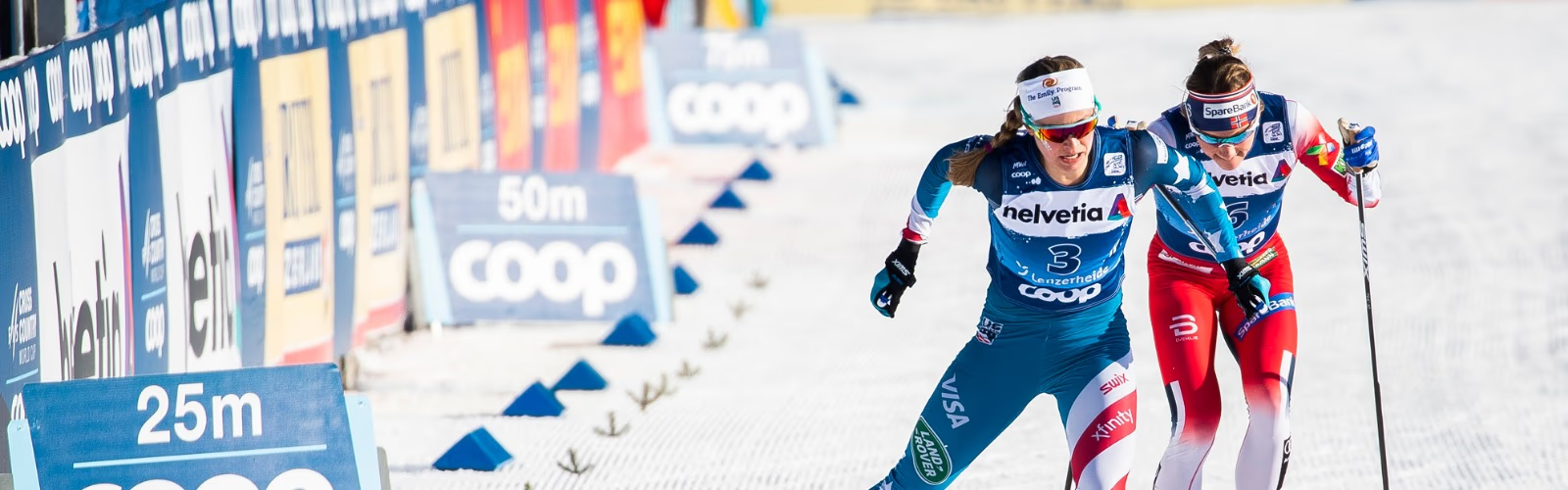
Any technique permitted, including skating (V-skate, marathon skate) and classic movements; No set tracks on the course; athletes choose their own line within the groomed corridor; Overtaking: the athlete being overtaken must yield the preferred line when the faster athlete comes alongside
Why people argue about this
People often assume that Free Technique Rules in Cross-Country Skiing restrict skiers to classic skiing only, forgetting that they allow both skating and classic movements. This misunderstanding stems from a lack of clarity on what exactly "free technique" encompasses within these rules.
First half raced in classic technique; second half in free technique (ICR 323.1); Transition zone: athletes remove classic skis and boots, switch to skating equipment in a designated pit box. No time added; clock runs continuously.; Per ICR 343.12.5 (June 2026 edition), each competitor may have o...
Why people argue about this
People often assume that overtaking in the skiathlon format is just about who can go faster, but actually, it's more nuanced - you have to yield to the athlete being passed because of their technique used on flat and uphill sections where classic skiing is employed. This rule highlights how different techniques affect race dynamics in cross-country skiing.
Men and women (ICR 327.1.1–327.1.2): Relay teams consist of four competitors; the first two legs are raced in classical technique and the last two legs in free technique.; Exchange: a tap of the hand on any part of the next competitor’s body while both are in the relay exchange zone constitutes a...
Why people argue about this
People often assume that overtaking is strictly prohibited in relay races, leading to arguments about when skiers can safely pass others. However, the official rule actually allows overtaking as long as the passing skier returns to their original track after the maneuver, which some find unclear and thus open to interpretation and debate.
Teams of 2 athletes alternate legs (ICR 326.1); Sprint distance per leg: 1.0–1.8 km (free or classic technique per the event programme); Qualification round (Interval Start) followed by a final organized as a relay of 3–6 legs per athlete
Why people argue about this
People often assume that herringbone is allowed anywhere in Team Sprint as long as it's on a steep uphill section, but actually, the rule specifies it can only be used on those specific uphill parts without set tracks for free technique skiing elsewhere. This ambiguity leads to misunderstandings and arguments about where exactly herringbone is permitted.
Competitors in front have the right to choose their best line but shall not obstruct competitors coming from behind; competitors intending to pass shall do so without obstructing the competitor being passed (ICR 343.10.2); In sections with marked corridors, competitors should choose a corridor bu...
— Section 7
Why people argue about this
People often assume that overtaking in Cross-Country Skiing is strictly prohibited unless both skiers agree, which leads to misunderstandings about when it's allowed. The confusion arises because the official verdict actually states overtaking is permitted as long as the skier being passed yields and they both return to a track afterward, not that it’s always forbidden.
Interval start races: final ranking by elapsed time (finish time minus start time), recorded to 1/10th of a second (ICR 317.2); Mass start and pursuit races: final ranking by order of finish (first across the line wins); photo-finish for ties; Ties in interval start: if athletes have identical ti...
Why people argue about this
People often assume that in case of ties, it's just about who crosses the finish line first, forgetting that even in mass start races where everyone starts together, times are recorded at various intervals throughout the course. The confusion arises because they overlook the importance of those interval times and how they're used to break ties, instead focusing solely on the overall race order.
Qualification round: competitors advance based on time (timed to 1/100th second, or 1/1000th for Level 0 competitions to break lucky-loser ties per ICR 317.2); Quarterfinals: heats of 6 athletes; top 2 per heat advance automatically, plus “lucky losers” (fastest non-qualifying times) (ICR 325.4.2...
Why people argue about this
People often assume that all competitors' times are equally crucial throughout the Sprint Event Results, forgetting that qualification round scores determine a top 30 based on time down to 1/100th of a second, while quarterfinals and beyond use finish order for ranking, leading to confusion about what truly matters in each stage.
FIS points calculated for each race: F = (Tx / T0 - 1) × FIS Factor where Tx is the athlete’s time and T0 is the winner’s time; Lower FIS points = better ranking; Athletes’ best results over a rolling period determine their FIS points list ranking (ICR 341.2, Rules and Guidelines of the FIS Points)
Why people argue about this
People often assume that in Cross-Country Skiing sprint events, ties are broken by fastest times in qualification rounds, which is incorrect. Actually, FIS Points System awards points based on finish order in the sprint event itself, not in qualification rounds where ties might occur.
World Cup points: 100-80-60-50-45-40-36-32-29-26-24-22-20-18-16-15-14-13-12-11 (1st through 20th), then 10-9-8-7-6-5-4-3-2-1 (21st through 30th); Overall World Cup, Distance World Cup, and Sprint World Cup standings maintained separately; Tour de Ski awards bonus seconds and a separate overall cl...
Why people argue about this
People often assume that mass and pursuit events in World Cup Scoring are scored based on finish time, just like interval start races. But actually, these events are judged by order of finish alone, which can lead to confusion since athletes might not realize their actual times aren't used for ranking until they see the results.
Sanctions for technique-rule violations can be given by a unanimous decision of two Jury members, including the TD, without requiring video evidence (ICR 352.1.3); The Jury decision chart (ICR 352.1.1.1) weighs the specific circumstances, any gain or advantage, and impact on other competitors to ...
Why people argue about this
People often assume that a yellow card is just a warning in Cross-Country Skiing, forgetting its actual role as an official penalty signaling a second offense of technique violations before leading to disqualification if committed again. They overlook how crucial each instance of infractions must be addressed individually and cumulatively towards this outcome.
Failure to yield when being overtaken, or otherwise obstructing another competitor, is subject to sanction under the ICR 352 decision chart, ranging from a written reprimand up to disqualification; Contact causing a fall: penalty applied to the responsible athlete; review by jury; In sprint heats...
Why people argue about this
People often assume that if they accidentally bump into another skier while skiing in a straight line, it won't result in penalties. However, the rule clearly states that any form of obstruction or interference, whether intentional or accidental, can lead to time penalties or disqualification, and deliberate blocking is even harsher with relegation or disqualification from the race.
Fluorocarbon wax detection: A competitor whose skis are found positive for fluorinated wax at controls before the start is not permitted to start; a positive control after the competition results in DSQ and equipment confiscation (ICR 351.4); Pole length exceeding limits: equipment must be replac...
Why people argue about this
People often assume that fluorocarbon wax is just a normal part of cross-country skiing equipment, so they argue it shouldn't be a big deal if detected. Actually, the rule makers are very strict about substances used in skis to give an unfair advantage because fluorocarbon can significantly increase glide and speed on snow, which could tip the competition's outcome unfairly.
Per ICR 315.9, if the temperature is below -20 °C (-4 °F), measured at the coldest point of the course, a competition will be postponed or cancelled by the Jury; With difficult weather conditions (strong wind, high air humidity, heavy snowfall, or high temperature), the Jury may, in consultation ...
Why people argue about this
People often assume that if it's below -20°C at some point during the race, the entire event is cancelled. However, the official criteria state only that if the coldest part of the course reaches or exceeds -20°C and/or the wind chill hits -25°C, the competition gets called off. So they're looking for the lowest temperature, not just any cold spot.
Directional arrows and course markings mandatory at every junction and turning point; forks and intersections must be marked and unused parts of the course fenced (ICR 311.4.3); Safety netting or padding on dangerous downhill curves and at bridge abutments; Emergency access routes for snowmobiles...
Why people argue about this
People often assume that directional arrows are only for navigation and forget they're crucial for safety at junctions, leading to misunderstandings about their necessity. Meanwhile, others argue that safety netting is unnecessary because the sport's downhill nature inherently mitigates risks, thus questioning why it should be mandated.
Medical team with ambulance stationed at the stadium area; first aid and medical services must be fully operational during all official training times (ICR 302.3.8); Mobile medical personnel on snowmobiles positioned along the course; Nearest hospital identified in competition plan; helicopter ev...
Why people argue about this
People often assume that the temperature threshold for cancelling a race is based solely on ambient air temperature, forgetting about wind chill entirely. The confusion arises because the official rule specifies both temperature AND wind chill conditions must meet or exceed those thresholds to warrant cancellation. It's easy to overlook wind chill when thinking about cold weather impacts.
Per new ICR 351.3 (June 2026 edition), a competitor who does not wear the competition bib, or who wears it with any part covered, is not permitted to start; no part of the bib may be covered.; Athletes are responsible for knowing the course and respecting course markings; Athletes who abandon the...
Why people argue about this
People often assume that just because they're skiing in a cross-country race, their equipment is automatically checked by officials before each run. But actually, the "8.4 Athlete Responsibility" rule means athletes are solely responsible for ensuring their gear and conditions are safe for racing, which can lead to misunderstandings about who's checking what on race day.
Classic skis: Minimum length = competitor’s height minus 20 cm. Maximum width 48 mm (1.89 in). Feature a “wax pocket” or “kick zone” under the foot for grip wax or mechanical grip patterns (fish scales, skin inserts). Relatively soft flex to engage the kick zone underfoot.; Skating skis: Minimum ...
— Article 343.10
Why people argue about this
People often assume that the minimum length for classic skis is simply their competitor's height minus 20 cm, without considering variations in foot size or leg length which can affect grip on snow differently. The confusion arises because they overlook the importance of a wax pocket or kick zone specifically designed to enhance grip and control, not just the overall length.
FIS-homologated courses must provide a balanced test of uphill, flat, and downhill ability. Under ICR 311.1.2, the course profile should include approximately one-third uphills (gradient between 9%...
Why people argue about this
People often assume that the 1:3 split for uphill, flat, and downhill terrain means an exact 1/3 of each section in every race, but actually, FIS is emphasizing a balanced profile across the entire course length to ensure athletes are tested equally in all areas, not just within individual sections.
Olympic: maximum 4 athletes per nation per individual event (based on FIS points ranking and continental quotas); World Cup: nation quotas based on FIS Nations Cup standings; top nations may enter 8–10 athletes; Athletes must hold a valid FIS license and meet minimum FIS points thresholds for entry
Why people argue about this
People often assume that athletes from a nation automatically get quota spots just because their country has high FIS points ranking, forgetting about continental quotas which can significantly impact who gets those coveted slots. The complexity lies in understanding how both rankings and continent-specific limits work together to determine the number of athletes allowed per nation.
Skating movements strictly prohibited on flat and uphill terrain; both skis must remain in the set tracks; Herringbone (V-step without glide) permitted on steep uphills only; Snowplow permitted for downhill braking
— Section 7
Why people argue about this
People often assume that all techniques are allowed in classic skiing based on the FIS rules, which leads to misunderstandings since classic has strict technical requirements like parallel turns and a specific stride length. They overlook the fact that free technique is entirely at skiers' discretion, unlike classic where precise methods are mandated for fair play.
Interval start races: final ranking by elapsed time (finish time minus start time), recorded to 1/10th of a second (ICR 317.2); Mass start and pursuit races: final ranking by order of finish (first across the line wins); photo-finish for ties; Ties in interval start: if athletes have identical ti...
Why people argue about this
People often assume that in qualification rounds for sprint events, they're ranked based on their final race time instead of how quickly they finish each leg. But actually, it's the total time across all legs in those preliminary stages what counts to determine who advances to finals.
Sanctions for technique-rule violations can be given by a unanimous decision of two Jury members, including the TD, without requiring video evidence (ICR 352.1.3); The Jury decision chart (ICR 352.1.1.1) weighs the specific circumstances, any gain or advantage, and impact on other competitors to ...
Why people argue about this
People often assume that technique violations are just minor infractions easily fixed by a coach during a break, leading them to overlook how three such penalties can result in disqualification, which they mistakenly believe is reserved for major offenses like hitting an official or falling off their skis mid-race.
Per ICR 315.9, if the temperature is below -20 °C (-4 °F), measured at the coldest point of the course, a competition will be postponed or cancelled by the Jury; With difficult weather conditions (strong wind, high air humidity, heavy snowfall, or high temperature), the Jury may, in consultation ...
Why people argue about this
People often assume that the temperature threshold for cancelling competitions is too high, thinking it should be lower to protect athletes from extreme cold, but in fact, the FIS has set a conservative standard considering the equipment and physical demands of cross-country skiing in such harsh conditions could lead to hypothermia or other serious health issues.