


🏛️Official — FIAS
Loading OpenSourceSports…
KO from clean strike = total victory; TKO via referee stoppage (cannot intelligently defend) = total victory
Why people argue about this
People often assume that a Technical Knockout (TKO) happens only when an opponent is unconscious on the mat, forgetting that it can also occur if a fighter cannot intelligently defend themselves due to strikes landing with significant force to their head or body, even if they're still standing and moving around.
5 minutes (single period); OT period: 2 minutes if score tied
Why people argue about this
People often assume that since each period is 5 minutes long, there's no overtime in Combat Sambo FIAS, which leads to misunderstandings about how ties are resolved. Actually, the additional 2-minute sudden death OT only kicks in if a match ends as a tie after two full periods, not for every single tie during the game.
Closed-fist punches (to head + body); Kicks (to head, body, legs); Knee strikes (to head + body)
Why people argue about this
People often assume that closed-fist punches are only allowed to the head in Combat Sambo's striking rules, forgetting about body strikes altogether. This misunderstanding stems from a lack of clarity on how far-reaching these body hits can be—specifically, including torso and limb strikes as well.
1 point: Knock-down (clean strike forcing opponent to ground); 1 point: Small throw (side landing); 2 points: Throw to knees
Why people argue about this
People often assume that a side landing throw is worth only half a point when it's clearly stated as 1 full point in Combat Sambo scoring rules, leading to misunderstandings and arguments about how points are awarded for throws versus strikes.
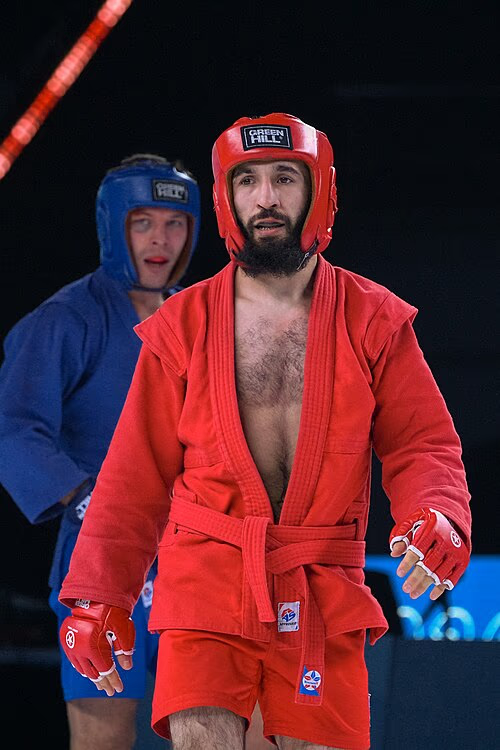
Sambo jacket + shorts (red or blue per competitor) — same as Sport Sambo; Sambovki (sambo wrestling shoes) — mandatory; Open-face protective helmet — mandatory in Combat Sambo (chin guard, padded crown, open visor)
Why people argue about this
People often assume that since Combat Sambo uses a protective helmet, it must be mandatory for all headgear in every match. But actually, the key fact is that only an open-face protective helmet with specific features (chin guard, padded crown, and an open visor) is required by this rule, not all types of helmets.
FIAS-spec mat: 11m × 11m total, 9m central circle (same as Sport Sambo); Padded safety zone; Multiple parallel mats at major championships
Why people argue about this
People often assume that the padded safety zone is only for major championships, forgetting it's a mandatory feature of all Combat Sambo mats, including those used in smaller tournaments. They overlook how crucial this area is for player safety and why its consistent presence across different events underscores its importance in ensuring fair play.
Two competitors per match; Weight classes (Adult Male, kg): -58, -64, -71, -79, -88, -98, +98; Combat Sambo introduced women's divisions in 2017
Why people argue about this
People often assume that Combat Sambo's introduction of women's divisions in 2017 was a response to global trends towards gender equality in combat sports, but actually, it aligns with the sport's evolution and recognition of its growing popularity among female athletes, which led to the inclusion of age categories like Junior, Senior, and Veteran.
5 minutes (single period); OT period: 2 minutes if score tied; Closed-fist punches (to head + body)
Why people argue about this
People often assume that throwing an opponent's knee doesn't automatically score 4 points; they mistakenly believe it requires a certain sequence of moves or conditions that aren't explicitly stated in the official rules. The confusion arises because the rule text is somewhat ambiguous, leaving room for interpretation about what exactly constitutes a valid throw to knees.
Decision priority: KO/TKO/submission > technical superiority > points > last-scoring competitor; Tournament: single-elimination + repechage; Gold/Silver/two Bronze per weight + gender
Why people argue about this
People often assume that in Combat Sambo tournaments, points are given more importance than knockout victories, which leads to arguments about scoring decisions. However, the official verdict clarifies that KO/TKO/submission scores significantly higher and can lead directly to gold/silver/two bronze medals, causing confusion when they think it's all about technical superiority or points alone.
Illegal strikes: head-stomps, back-of-head, spine, eye-poke, throat — caution → DQ; Strikes to grounded opponent's head: generally restricted (specific rule varies by edition); Passivity: warning → caution → opponent advantage
Why people argue about this
People often assume that a caution is just a warning in Combat Sambo, forgetting its serious nature as it precedes disqualification (DQ), leading them to argue about how severe they believe such a minor infraction should be. The confusion arises because this rule combines the severity of a penalty with the immediate threat of ending the match right after issuing a caution.
Combat Sambo has substantially higher injury risk than Sport Sambo due to permitted strikes. Mandatory equipment (helmet, gloves, mouthguard, shin guards, groin protector) is non-negotiable.
Why people argue about this
People often assume that since Combat Sambo allows strikes, it must be safer if you just use more protective gear. But the real issue is that allowed strikes in Combat Sambo increase risk regardless of equipment, leading to misunderstandings about what makes a match safe.
Joint locks legal (arms, legs); Chokes legal in Combat Sambo (unlike Sport Sambo); Submission = total victory
Why people argue about this
People often assume that only joint locks are considered legal submissions in Combat Sambo, forgetting that chokes are also valid under FIAS rules. This misunderstanding leads to arguments because it overlooks the full scope of what constitutes a submission win, including both types of holds.